


Tim Boland

My first career job out of college was running a large campus arboretum nursery at Michigan State University.

I will readily admit that fall is my favorite season of the year. The fact that I work at the Polly Hill Arboretum (a tree museum!) makes it possible for me to see the collective fall color of over 1,300 different trees and shrubs.

Picture this: dense, twiggy colonies of dark, gnarled branches buried in sand along the barrier dunes of Lambert’s Cove Beach. What is this tough plant that thrives in such a challenging environment? The answer is obvious each May when these same branches erupt with beautiful white flowers. It’s our native beach plum (Prunus maritima). This exceptional spring display lasts a few weeks then something even better follows. Over the following months plump, tasty fruits ripen, often creating a bountiful crop for harvest by the end of the summer.

My Vineyard hikes take me to many beautiful sites. I enjoy seeing the diversity of landscapes, many influenced by their agricultural past. A frequent plant I encounter in abandoned farm fields is northern bayberry (Myrica pensylvanica, now Morella pensylvanica). Quick to reclaim open pastureland, the shrubs have the unique ability to fix their own atmospheric nitrogen through specialized structures called root nodules. The nodules contain the nitrogen-fixing bacteria Frankia. This mutually beneficial symbiotic relationship allows bayberry to grow in soils with low fertility.
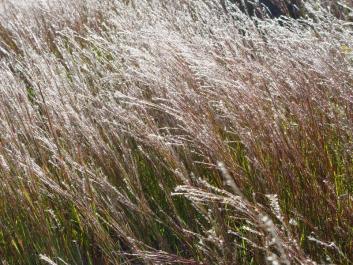
Plants in the grass family (Poaceae) dominate the planet by the breadth of their global coverage. They play a critical role in preventing erosion, in addition to providing forage and habitat for many animal species. The majority of the most important agricultural crops in the world are grasses, including wheat, corn, rye, oats and sugarcane.
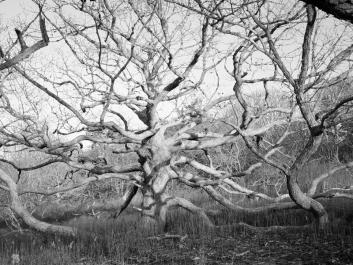
I noticed the oaks right away. My first visit to the Vineyard was in spring 2002 when the abundant oak trees were raining down yellow pollen. Later, after moving to the Island while my daughter was playing at the West Tisbury School playground, I wandered off into the woods to look at the trees. I was gleeful to discover five oak species, including Quercus alba, the white oak. A young mother asked why I was so excited. After I explained my love affair with oaks, and my new position at the arboretum, she gave me some input: “I hate oaks; they’re everywhere.