


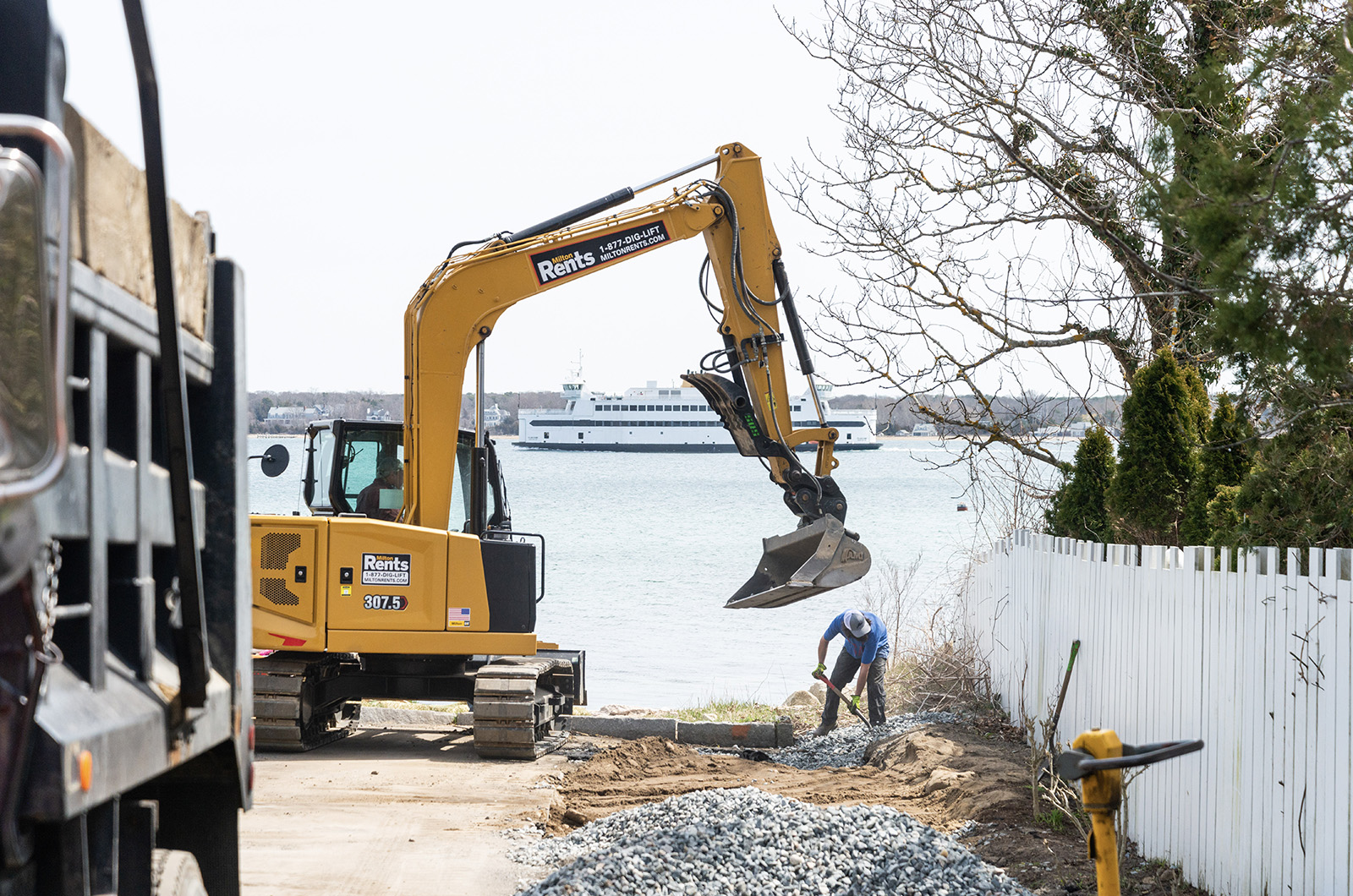
A stormwater infrastructure project being installed beneath Grove avenue in Vineyard Haven could be a blueprint for projects across the Island and a critical tool for local stormwater planning.
In Vineyard Haven, where Grove avenue meets Harbor View Road, engineer John Nader has been running interference for the University of New Hampshire’s Stormwater Center.
Dressed in a bright orange vest, ponytail tucked into his hard hat, Mr. Nader keeps passersby back from the worksite, where a yellow excavator sits against the backdrop of a Vineyard Haven harbor vista.
“I’ve probably had 20 people come by, walking their dogs, and ask me ‘Oh, are you finally fixing the drainage here?’” Mr. Nader said.
Indeed, that is the goal of a new stormwater infrastructure project installed beneath the avenue, a collaboration between the Martha’s Vineyard Commission, UNH and the U.S. Environmental Protection Agency. If successful, it could be a blueprint for projects across the Island, a critical tool for local stormwater planning.
“We’re trying to make sure that when we experience the uncertainty of climate change, we’re not letting drainage, which is relatively easy to predict, further complicate it,” said James Houle, director of the UNH stormwater center.
Mr. Houle got involved in Vineyard stormwater back in 2018, he said, following a push from MVC executive director Adam Turner to get EPA funding allocated to the Island.
“It was largely due to Adam and his influence that we’re here,” Mr. Houle said.
Since then, the team has worked closely with MVC water resource planner Sheri Caseau.
“They are the best in New England,” Ms. Caseau said of the stormwater center.
Their help, she continued, is much appreciated, a welcome dose of expertise to go towards innovation in Island drainage.
As Mr. Houle explained, stormwater problems are largely man-made.
“I like the roads to be nice and paved, everybody likes that,” he said, “but that has consequences for the water cycle.”
In the parlance of a stormwater planner, an asphalt road fits in the category of an impermeable surface, an area of ground unable to absorb water. In a town like Tisbury, where clay-rich soils already impede absorption, that deferment of water can become problematic.
“On-Island, when it rains, the relatively small infrastructure that exists with respect to stormwater gets inundated pretty quickly,” Mr. Houle said. In a location like Grove avenue, where a dead-end road terminates at a beach, surface-level stormwater can contribute to erosion.
The goal of the new project is to make those surfaces a bit more permeable. Through a new system of grates, underground culverts and hole-speckled cisterns, water will filter into surrounding gravel before dispersing back into the soil. It is a return to the natural water-cycle process, Mr. Houle said.
“Nature is the perfect engineer, because it’s seen all the conditions…so we’d like to learn from nature and settle on what works best.”
Filtering that water back into the soil can also improve water quality and reduce nitrogen pollution, a major draw for similar planed systems that could be installed around Island ponds.
“There are these kinds of end-of-the-road areas all around Lagoon Pond, and we want to continue this work,” Mr. Houle said.
The group is also studying ways to integrate bio-reactive elements (like the permeable reactive barrier also on the Lagoon) into their systems. And the team has begun to grapple with the chronic flooding at Five Corners.
“It was one of the first things we looked at when we got here,” Mr. Houle said, describing how the extensive paved area, runoff coming in from State Road and tidal pressure on drainage pipes converge to create “a hydrological traffic jam below an actual traffic jam.”
Although Mr. Houle said the Five Corners process is hindered somewhat by “a lot of cooks in the kitchen,” he feels the completion of this project on Grove avenue will put a new wind in their sails. From local dogwalkers to community leaders, he said, folks in town are getting interested.
“To me, it represents the movement from planning to implementation. And when you start to implement, people engage with the process, because they see things happening.”
Comments
Why has this been a priority
Lynne Fraker Vineyard HavenWhy has this been a priority over drainage into the Lagoon or Tashmoo? Why is erosion and drainage into Vineyard Sound a priority over drainage into our damaged Ponds? Who influences what projects get funding priority? A targeted project for Tashmoo will be many years before benefits are seen, and nothing for the more severely damaged Lagoon.
I would like to see Mr. House
Patsy McCOrnack VHI would like to see Mr. House visit Delano Rd. Where there is a definite prob;‘em where the road makes a turn toward the right and up hill. There are 3 converging run offs there and the drains cannot handle it. This results in a river running through my property and, in the past, digging a hole about 4 feet deep and 6 feet long until it comes out as a geyser on the opposite side of Villa Dr. Several years ago a small girl fell in the whole, but, thanksfully was not injured. THis has been a problem for over 20 years. Last year the town filled in and concreted the hole in the driveway, but this is not a solution to the problem. Would love to hear from Mr. House about this situation i regards to his program. Thanks!
Thanks for the comment Lynne.
James Houle University of New HampshireThanks for the comment Lynne. You have an understandable perspective, one that is shared by many. The truth is this is a start and we want to begin with success. There are few obstacles at the end of Grove Ave that complicate a successful stormwater installation. Now that we have a major installation under our belt we can focus on more pressing areas such as lagoon pond and Lake Tashmoo. We can point to these successful examples and move on from there. If we only had time and funding for one or two installation that would be more of an issue. But we will be around for at least 3 more years and already have our sites on new installations in those areas. I am happy we captured your enthusiasm and passion for the impaired areas of the island! We will need your support as we tackle harder and more complicated installations.
Why has this been a priority
Mac Schilcher TisburyWhy has this been a priority over drainage in the Lagoon or Tashmoo?
Not sure why anyone would
Leakage TisburyNot sure why anyone would complain about anything getting done. Tisbury didn't set this as a priority, it's low lying fruit while other projects take more work. So why not start somewhere. I applaud the work getting done. Who influences these projects ? Many are applied for and some get grant money thrown at them so why not do them. The area the article talks about take a lot of street drainage from the entire area west of Main Street. I applaud and can't find fault with this project. BTW. I live in Tisbury.
What about the 1.6 mile road
MacAleer Schilcher TisburyWhat about the 1.6 mile road that dumps into Tashmoo? That's a threatened watershed with a TMDL. What about the Lagoon? Low lying fruit would be the bottom of Skiff Ave. It's free money, so why not an EPA funded, administrated by Tisbury Waterways Inc president throw another project in West Chop. Same as Owen Little Way next to the Yacht Club. Neither of these projects are in EITHER threatened watershed.
Add new comment