

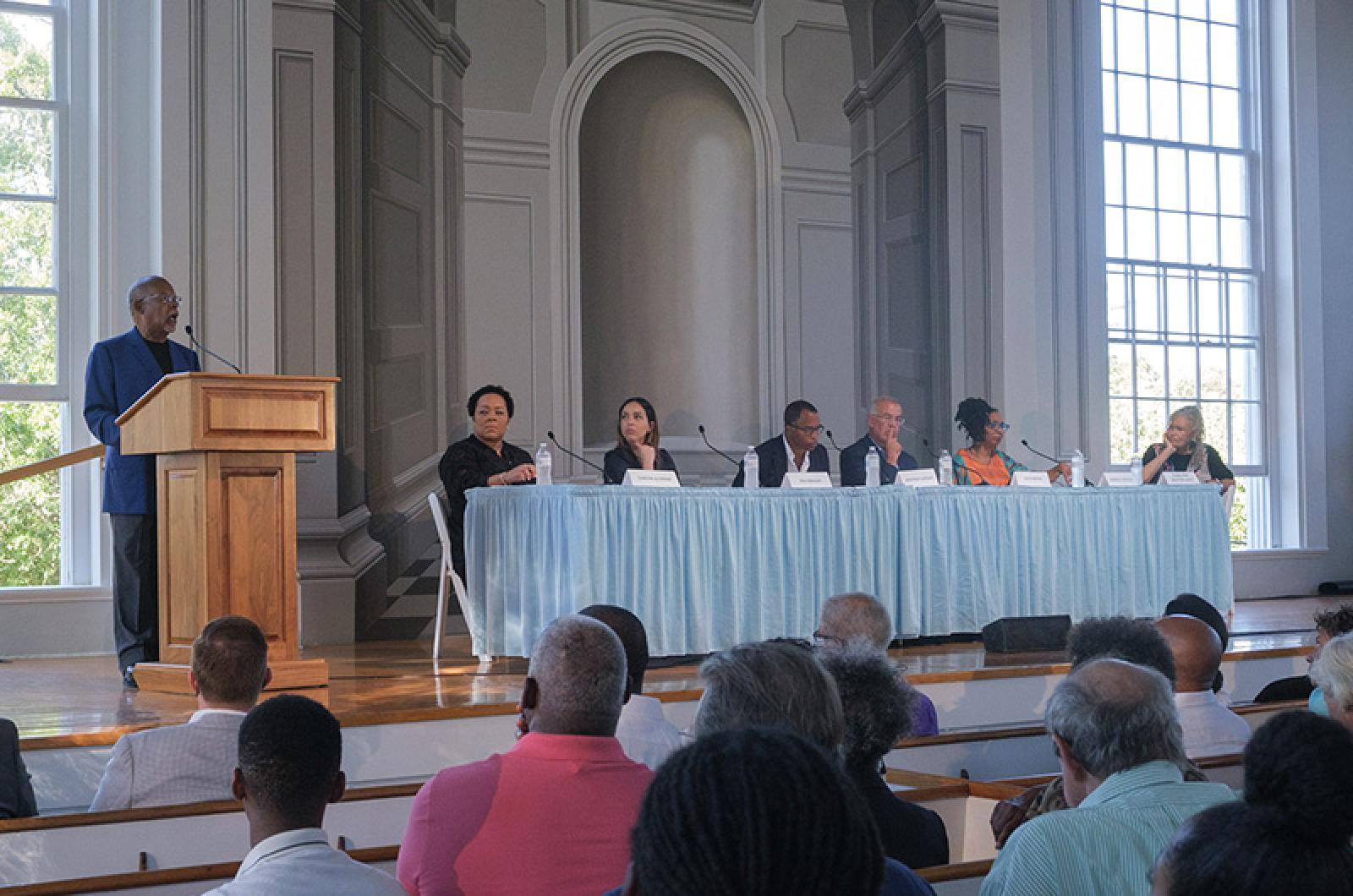

The 2022 Hutchins Forum brought a discussion of race and the American culture wars to the Old Whaling Church on August 18.
“It’s a boiling time in America, and not just because of climate change.”
So Henry Louis Gates, Jr., introduced the 2022 Hutchins Forum, a discussion of race and the American culture wars at the Old Whaling Church on August 18. An extension of Harvard’s Hutchins Center for African and African American Research, the forum brought together academics, journalists, and professors to discuss the cultural tensions present in public discourse and the media.
The discussion was moderated by Charlayne Hunter-Gault, a journalist and civil rights activist who was, in 1961, one of the first two Black students to attend the University of Georgia. In order to address the discussion’s diffuse topic, she asked each participant to define the culture war on their own terms.
Kimberlé Crenshaw speaks at the Hutchins forum.
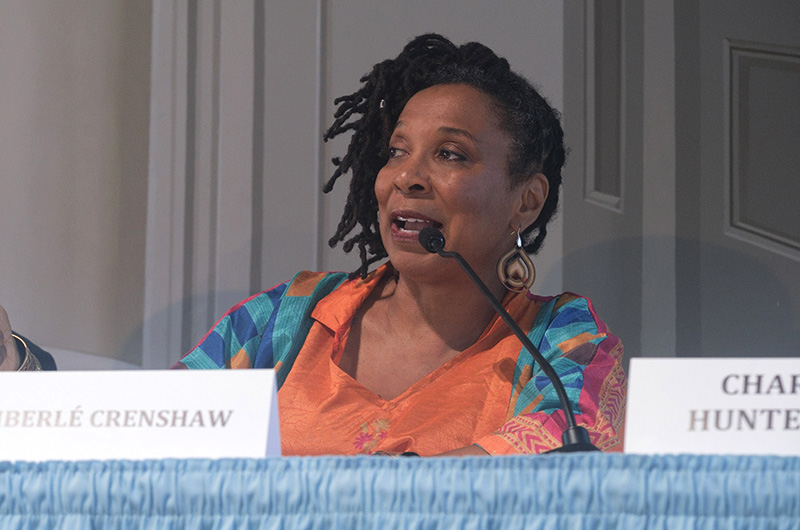
Kimberlé Crenshaw speaks at the Hutchins forum.
Kimberlé Crenshaw, a pioneering professor of critical race theory at Columbia and the University of California, Los Angeles, criticized the use of the term “culture war” for what she described as an attack on democracy and equality.
“I am not at all persuaded that what we’re in is a culture war… I think we’re in a democratic war,” she said. The she described the phrase as “part of the right-wing framing to push back against the modest civil rights gains we’ve made.”
Jonathan Capeheart, an opinion journalist at the Washington Post and MSNBC, echoed Ms. Crenshaw. He questioned the use of the expression “the culture wars” in right-wing news outlets as a reaction to progressive gains and protests.
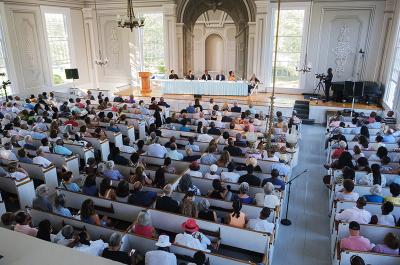
Pews were filled at the Old Whaling Church.
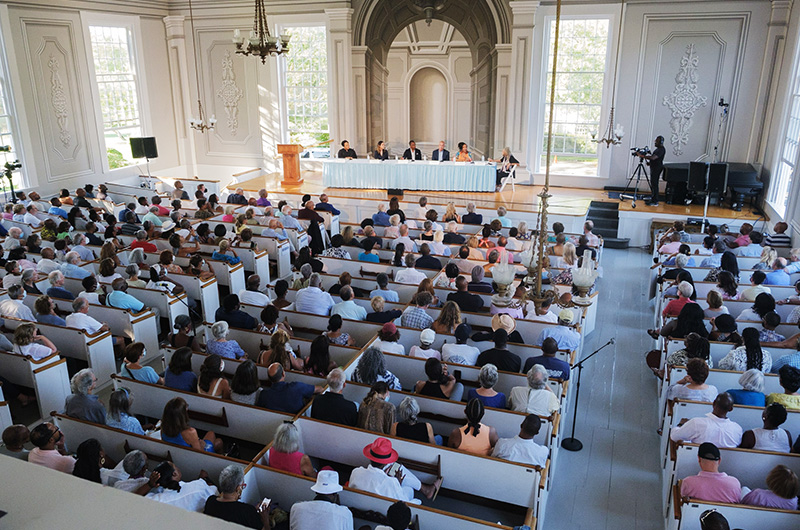
Pews were filled at the Old Whaling Church.
“When people talk about these culture wars, who is the victim?” Mr. Capeheart wondered.
Journalist Yamiche Alcindor had an answer to Mr. Capeheart’s question: Ms. Hunter-Gault. Ms. Alcindor recalled the vitriol and harassment Ms. Hunter-Gault was subjected to as one of the first Black students at the University of Georgia.
“It is absolutely a war, it is absolutely so violent,” Ms. Alcindor said, noting that the victims just aren’t the right-wing pundits who tend to describe the struggle as a culture war, she suggested.
Much of the discussion hinged on the increase in banned books and critical race theory gag laws in conservative states.
Ana Cabellos, a reporter at the Miami Herald who has covered Florida Governor Ron DeSantis’s “woke” law, discussed the difficulties of writing about legislation that seems tailored to address a nonexistent threat—so-called “woke” education.
“What is the problem on the ground that we’re trying to address?” Ms. Cabellos wondered.
New York Times opinion columnist David Brooks traced the origin of this legislation back to the conspiratorial threats and fearmongering promoted by right-wing news outlets.
“It’s about the perpetuation of outrage generated by the conflict machines,” Mr. Brooks said.
“Tucker Carlson feels comfortable talking about replacement theory on national television,” he added later, with a note of bewilderment.
Mr. Brooks said that it’s essential in the present day to look across the aisle and try to understand the world as other people do. But there’s a limit, he said, to this kind of bipartisan outreach: “Some people just need to be beaten,” he said.
Mr. Gates, whose own books have been the target of certain laws, condemned conservative politicians’ attempts to undermine free speech.
“Censorship is to discourse as lynching is to justice,” Mr. Gates said.
He also quoted Salman Rushdie, the British-American novelist who was recently attacked in upstate New York over his controversial 1988 novel The Satanic Verses: “What is freedom of expression? Without the freedom to offend, it ceases to exist.”
Comments
Mr. Gates is 100% correct
Islander MVMr. Gates is 100% correct when he describes censorship to discourse like lynching to justice, although if he were white and made this statement with the reference to lynching, as he did, it’s unlikely he would not be reprimanded for the racial comparison. He and others on the left need to remember there the chilling of free speech on campus and by left is also a significant problem — I’m not talking about allowing hate speech, but simply criticism of, say, critical race theory, on a meaningful, discursive level. When America can have those conversations that include thoughtful debates with all points of view, minus the very extremes, as Mr. Brooks points out (“some people just need to be beaten at the polls”) then we will have reached the detente to which Mr. Gates suggests is possible.
I’m sorry but the language
John Aldeborgh KatamaI’m sorry but the language and negative emotions here are never going to bring people together, just the opposite it promotes division. Finding common ground and a common purpose are how you bring people together and this isn’t even trying to do that, again just the opposite. It’s not constructive. I spent a 44 year career working in several global high tech companies (both domestic and foreign) with people of all races and genders, what they all had in common was that they were all run as meritocracies where all people were respected for nothing more than what they brought to the table. The only intolerance that was allowed to exist was an intolerance for office politics. We weren’t worried about anything other than excellence in all we did (as that was the key to survival) and serving our stakeholders (customers, employees, shareholders, suppliers and the local community). It may sound simple but when that’s your focus (excellence) this other self-serving political noise falls away to insignificance.
Add new comment