



<p>Matthew Desmond’s book, Evicted: Poverty and Profit in the American City, illustrates how eviction is not only a condition but a cause of poverty. Mr. Desmond spoke in Chilmark Sunday evening.</p>
When Arlene and her two young boys were evicted from their home in Milwaukee a few years ago, they found themselves in a cycle of poverty and eviction that affects millions across the country.
Their story is one of several in Matthew Desmond’s new book, Evicted: Poverty and Profit in the American City, which illustrates how eviction is not only a condition but a cause of poverty.
“Housing is a fundamental human need,” said Mr. Desmond, an associate professor of sociology at Harvard and winner of a prestigious MacArthur “Genius” grant to help him explore poverty and eviction on a global scale. “Without a stable shelter, everything else falls apart.”
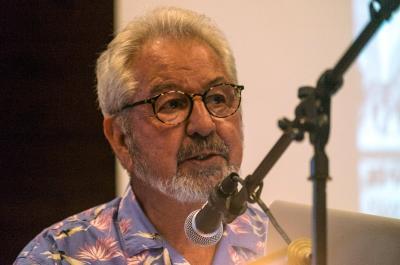
Bob Vila said Mr. Desmond’s new book “has been pivotal in changing the understanding of extreme poverty and economic exploitation.”

Bob Vila said Mr. Desmond’s new book “has been pivotal in changing the understanding of extreme poverty and economic exploitation.”
Mr. Desmond spoke to a crowd of around 100 people at the Chilmark Community Center on Sunday evening as part of the Martha’s Vineyard Author Series. He described his time living in poor neighborhoods in Milwaukee and getting to know families whose lives had been upended by evictions. The result was a new understanding of how poverty and evictions are linked in American cities, and how the country might move forward.
Longtime Islander Bob Vila, formerly the host of This Old House and Bob Vila’s Home Again, offered an introduction, recalling his own journey in the world of housing, and a growing awareness in the 1980s of the problem of homelessness in the United States.
“Here we are, 30 years later, looking at a situation that continues to be very aggravating,” Mr. Vila said, adding that Mr. Desmond’s new book “has been pivotal in changing the understanding of extreme poverty and economic exploitation.”
The story of Arlene’s eviction is both tragic and common. It begins when her son throws a snowball at a passing car, and the irate driver kicks in the door of her house. A short time later — just a few days before Christmas — the family is evicted. They bounce from place to place in the city, shut out by dozens of landlords based on their recent eviction.
“America is weird,” Mr. Desmond said, framing the problem. “There is no other advanced democracy that has the level of poverty that we do, and the kind of poverty that we do. And that’s always bugged me.”
When Arlene finally signed a new lease for a run-down duplex in a poor neighborhood, her $550 monthly rent amounted to 80 per cent of her welfare check, leaving no money for books and toys for her kids.
“Arlene is not alone,” Mr. Desmond said, citing data that rents have soared in the country while lower incomes have been flat or falling. One in four poor families spends 70 per cent of its income on rent and utilities, he said, compared to the 30 per cent widely acknowledged as affordable. Two-thirds of the poorest families who pay rent have no housing assistance, with people in some cities waiting decades to come up for review.
About 40 people are evicted every day in Milwaukee, a rate that Mr. Desmond said was commonplace in the poorest neighborhoods in American cities. Half of all evictions in Milwaukee were done out of court — highlighting the importance of on-the-ground work by Mr. Desmond and others to evaluate the problem.
African Americans, and mothers in particular, are evicted at a much higher rate.
“This is like the women’s version of incarceration,” Mr. Desmond said. “Many poor African American men are being locked up. Many poor African American women are being locked out.”
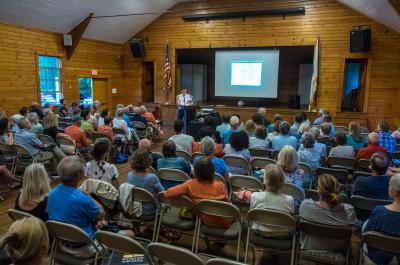
Mr. Desmond outlined a broad initiative for addressing poverty and homelessness through a universal voucher system.
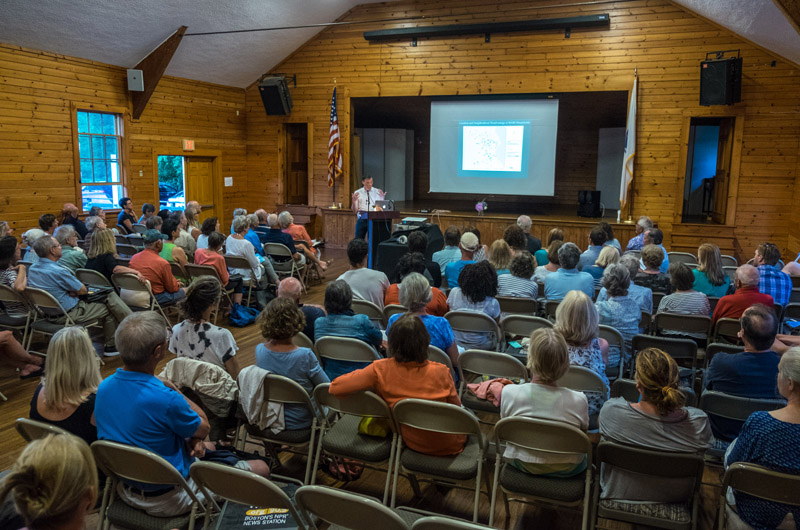
Mr. Desmond outlined a broad initiative for addressing poverty and homelessness through a universal voucher system.
In many cases, evictions lead to more severe poverty, with consequences that keep the cycle going. Between seventh and eighth grade, for example, Arlene’s oldest son attended five different schools and struggled socially. One day he kicked his teacher in the shin. When word reached the landlord, the family was evicted again.
“[Kids] can prolong the time you are homeless after your eviction, and they sometimes are the reason for your eviction,” Mr. Desmond said. Looking back on the study, he added: “It wasn’t race, it wasn’t gender, it wasn’t how much you owed a landlord” that often got people evicted. “It was kids.”
He recalled how the relentless ordeal affected Arlene, who sometimes found her body trembling and said she felt like her soul was messed up. But he also noted her resilience, and her desire to see her kids succeed. “We’ll be remembering stuff like this and be laughing at it,” he said, quoting Arlene directly. He paused for a long moment while the room remained silent.
“The home is the center of life,” he continued. “In languages spoken all over the world, the word for home encompasses not just shelter, but warmth and family, safety, the womb. Eviction causes loss. Families not only lose their home, but often their school, their neighborhood, their possessions, furniture, clothes, books.”
He saw promise in the use of housing vouchers to help people maintain affordable rents, but also noted that the vast majority of people never get them. He also noted “huge strides” in addressing poverty in the United States in the last 100 years, but pointed to a long road ahead and the need for big solutions.
“We can’t go small on this issue,” he said. “We are bleeding out. We can’t settle for bandaid fixes.”
In closing, he outlined a broad initiative for addressing poverty and homelessness in the country through a universal voucher system. At about $22 billion, it was a pricy solution, he said, but one he felt was well within reach. He noted that tax benefits to homeowners in the United States exceeded $171 billion in 2008 — more than the budgets of several federal departments combined — with most of that money supporting people with six-figure salaries.
“Let’s just be honest about that,” he said, “and stop repeating this line that this rich, rich country can’t afford to do more. If poverty persists in America, it’s not for lack of resources. Maybe we lack something else.”
“This degree of inequality, this cold denial of basic needs, this blunting of human capacity, this isn’t us,” he said.
The Martha’s Vineyard Author Series continues Thursday with a conversation with author Richard Russo at the Chilmark Community Center. For tickets and information, visit mvbookfestival.com.
Comments
He's got it exactly right
BS OBHe's got it exactly right when he says "If poverty persists in America, it’s not for lack of resources. Maybe we lack something else." There is a pervasive lack of understanding that you are responsible for your own condition. Find a way to make it work, that's what Americans did for generations until the welfare state enslaved so many.
You're painting with a very
Rob Burnside Kingston, PAYou're painting with a very broad brush, and it doesn't sound like you're spending 70% of your income on housing, or anything close Try to imagine yourself in that position and tell us, please, how you would make it work. Pious platitudes may make good reading, but they're awfully hard on the digestive tract.
75% of the Island's housing
Vineyarder Martha's Vineyard, Massachusetts75% of the Island's housing stock sits vacant for 75% of the year while homeless families live on friends' couches, in campgrounds or in their cars in the state forest. To me the blame rests upon the seasonal residents from Greenwich, Larchmont, Ridgewood and Chevy Chase who have the "help" open up their houses for two weeks each Summer and shutter them for the other fifty. How about town ordinances which require them to make their homes "affordable housing" when they are not there. My wife, my two children and I were forced to move twice by wealthy "seasonal residents" who used their homes for two weeks each Summer.
Dr. Desmond listed many
Sarah Kuh ChilmarkDr. Desmond listed many causes for the rental housing crisis during his presentation, which are detailed in his book as well: Lack of affordable rentals; fixed low incomes for families (usually single moms and their children); and perhaps most heartbreaking, the downward spiral for tenants branded with previous evictions who then have increasing trouble getting another rental. Then, in turn, the type of housing available is of poorer and poorer quality in increasingly dangerous neighborhoods: Remember, these are moms with children, who just want their kids to be safe. With most of their income going to rent, there is hardly anything left for food, clothing and other basic necessities. We see this here on the Vineyard, where there are fewer and fewer year-round rental units PERIOD, much less affordable units. This is a tragic result of income inequality and basic lack of support and opportunity for poor people, who end up trapped in a vicious cycle of poverty, homelessness and hopelessness. We can and must do better, there are solutions, if there is the will -- and the basic human decency to guarantee the right to safe and affordable shelter to all Americans. Fortunately, we can be part of the solution by joining Dr. Desmond's movement at justshelter.org Let's do it! And YAY for the new affordable housing project that was just approved in Vineyard Haven -- one unit, and one family, at a time -- we can get there.
Thank you for this profound
Kelly Nelson New Bedford, Ma.Thank you for this profound comment! You are absolutely correct by saying "there are moms out there who simply want to keep their kids safe". In fact you are correct with each individual statement and coming from one who has been evicted in the past, thank you for that link so i can stand up and join in Mr Desmomds fight for others who have been in my shoes or walked the mile like I have.
Add new comment