

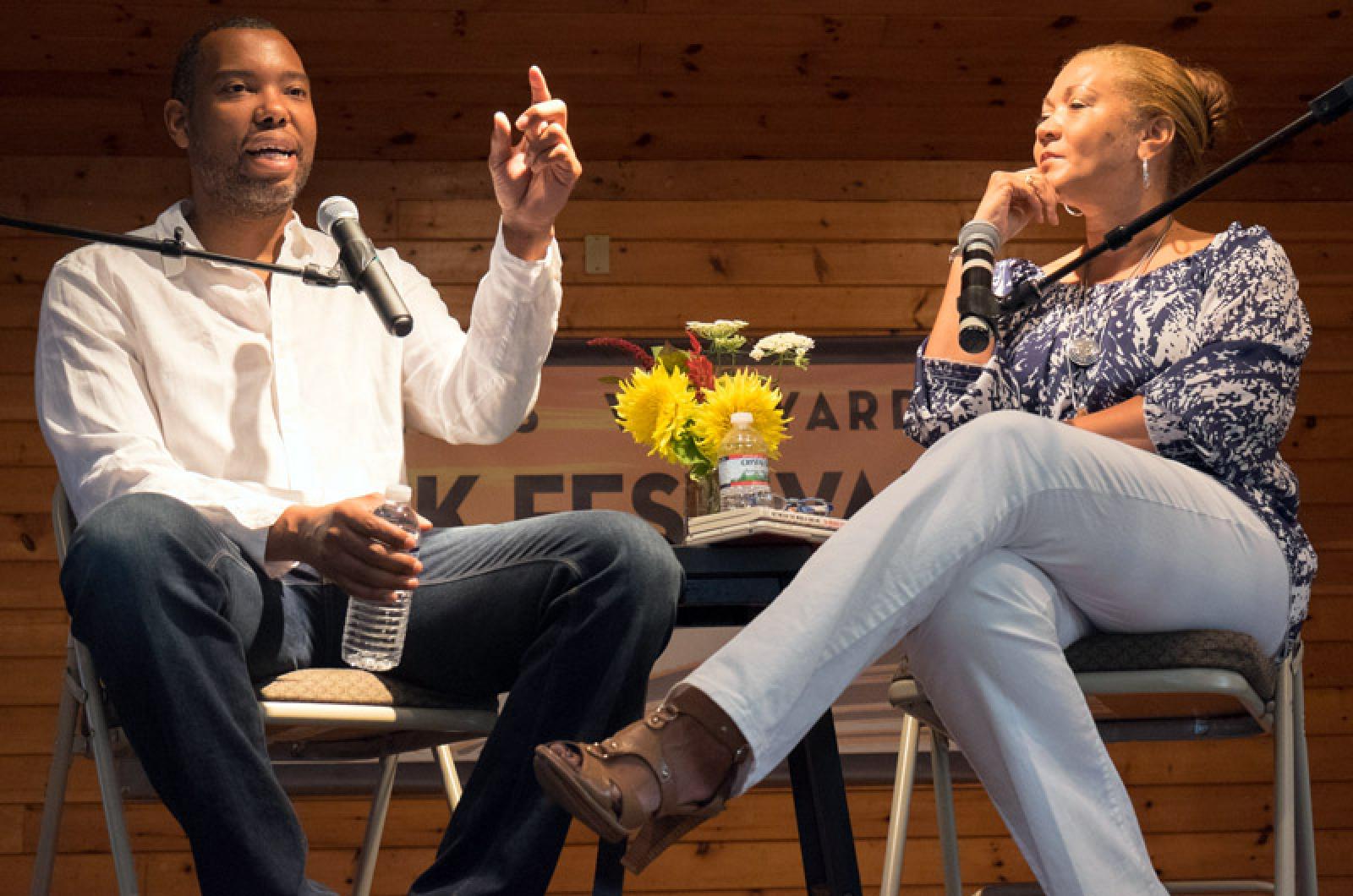
<p>Hundreds of people filled the Chilmark Community Center on Friday to hear award-winning journalists Ta-Nehisi Coates and Michele Norris discuss Mr. Coates’s new book and the idea of a post-racial America.</p>
Hundreds of people filled the Chilmark Community Center on Friday to hear award-winning journalists Ta-Nehisi Coates and Michele Norris discuss Mr. Coates’s new book and the idea of a post-racial America.
Sponsored by the Gazette, the sold-out discussion kicked off the sixth annual Martha’s Vineyard Book Festival, with talks and interviews with authors throughout the weekend. Mr. Coates’s new book, Between the World and Me, was released in July and quickly rose to the top of the New York Times bestseller list for nonfiction.
Ms. Norris, an NPR correspondent and founder of the Race Card Project — a national initiative to foster a discussion about race in America — served on the board of this year’s book festival.
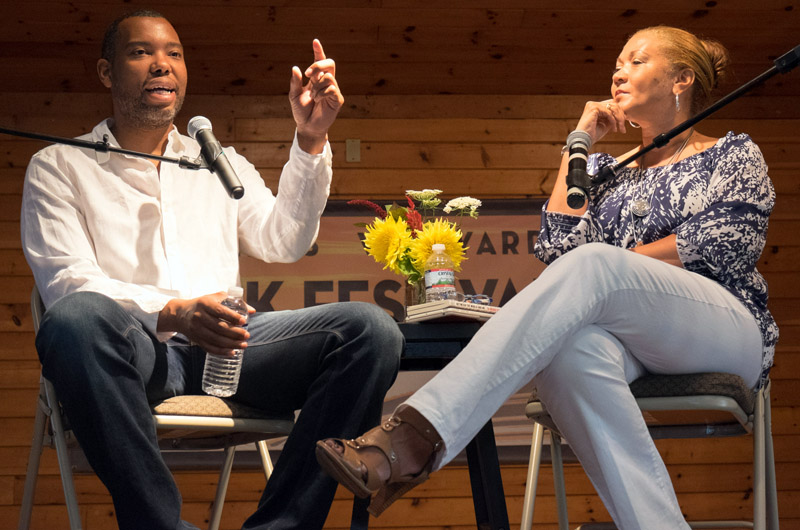
As a warm summer breeze blew through the doorways of the community center where bouquets with sunflowers decorated the stage, the two writers spoke openly about Mr. Coates’s new book, the concept of race, and the centuries of black oppression that underlie American culture.
Between the World and Me takes the form of a letter to Mr. Coates’s 15-year-old son, Samori, in the spirit of James Baldwin’s 1963 classic The Fire Next Time. It also pays tribute to Richard Wright, Sonia Sanchez and other African-American writers whom Mr. Coates credits as inspirations.

An appreciative audience took in every word.
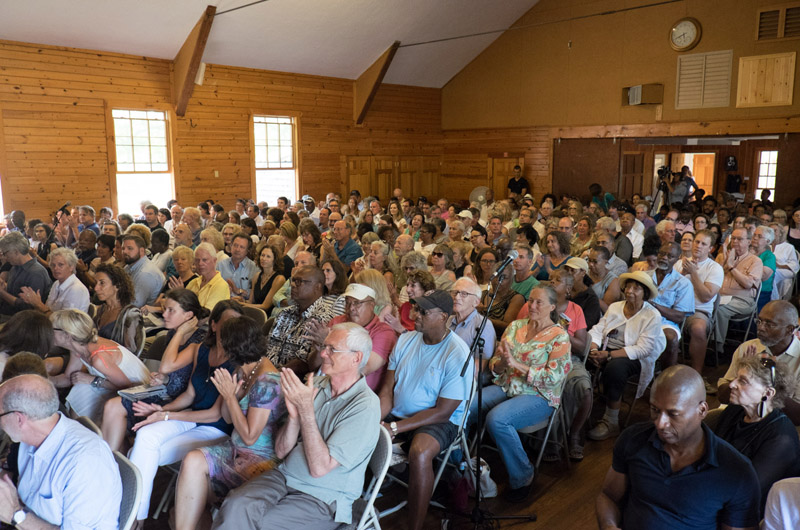
An appreciative audience took in every word.
Mr. Coates and Mr. Baldwin both address the politics of their time in stark, unapologetic terms. “It’s out of respect for the reader.” Mr. Coates said. “You give it as raw as you can.”
The American dream would not be possible, he argues in the book, without the centuries of black oppression that continues today.
He agreed with Ms. Norris that the book points an accusatory finger at white America. But he also argued, as Mr. Baldwin did, that the idea of a white race is “totally built on the idea of power.” Black identity, on the other hand, “has an ethnic and cultural component,” he said. “We are not the photonegative.”
Between the World and Me distills some of the feelings in the African-American community, in the wake of several high-profile killings of young black people in recent years. The dominant theme of the book is fear, which Mr. Coates said results from centuries of black oppression.
Noting the daily reports of violence toward African Americans, Ms. Norris wondered if this could be a moment for truth and reconciliation, akin to the efforts following the end of apartheid in South Africa. But Mr. Coates didn’t think so.
“There is nothing new about what is happening,” he said. “But it’s new that people are seeing it.”
He added that the current moment is somewhat distorted by the idea that police are the problem. “The police are just an expression of policy,” he said. He explained that in areas of high drug use, such as in Baltimore, you can be arrested simply for making eye contact with a police officer and running away.
“We could think about the [drug problem] from a public health perspective,” he said. “But we send in the hammers. And then when we send in the hammers we wonder why people get hammered.”
“You can literally go through almost every one of these cases and you can find the policy behind it.”
Ms. Norris wondered if the violence is itself borne of fear. Turning to the audience, she asked how many people had ever locked their car doors or clutched their belongings when seeing a black person. Almost no one raised their hand, although she said it happens all the time, even on the Vineyard.
Mr. Coates did not believe that the election of the nation’s first black president was enough to uproot centuries of oppression. Many people embrace the idea of a “post-racial America,” given the pain and violence surrounding issues of race, he said. “They do want to get past it, even if they are not equipped to do what needs to be done yet. It’s the dream: You press a button in a booth, you walk out, poof. It’s over.”
Author Tony Horwitz, who was also featured in the book festival, noted that people have a need to feel uplifted by stories of their past. He asked if the narrative of a benign United States history could be overthrown “without making our history such a bummer that no one even wants to read it.”
How to uproot that narrative while maintaining a civil society “is a really deep question,” Mr. Coates said, and the risk of being a “bummer” was something he thought about when writing the book. “How do you not retreat into despair?” he said.
He questioned the usefulness of thinking about what might be possible, since many activists never witness the full impact of their work. But he felt a sense of duty to his ancestors who struggled under slavery with no end in sight. “It would be the height of sin” to simply declare victory, he said.
“It has been rewarding to explore, it’s been rewarding to know, it’s been rewarding to struggle.”
Comments
After seeing the recent
CLNS Vineyard HavenAfter seeing the recent interview on Charlie Rose, I purchased Between the World and Me and read it last week. I was riveted by this book - overwhelmed by Coates' ability to seamlessly transition from memoir, to history, to political science, to instruction, to philosophy, to journalism. In terms of style, I've never read anything like it. I am an avid reader, and in my opinion, Coates is an extraordinary literary talent. I would use the word "poetic" to describe his command of language. I suppose his training as a journalist has taught him how to economically use words loaded with meaning and to transition between dispassionate reporting and touching narrative. Each standalone sentence is deliberate and precise - some land like punches, others like whispered intimacies. The paragraphs have their own lyricism, and I stopped many times to reread them (sometimes because they were so profound, other times because they were so well-crafted.) I draw attention to Coates' linguistic precision (which would be reason enough to read anything he writes) because it evidences the tremendous care he has put into this book: 1) he recognizes the gravitas of the subject matter, so he is almost monastic in his dedication to the truth, using neither obfuscation or hyperbole to advance any arguments he presents 2) he structures the book as both a loving letter from a father to son, as well as an elegy for a friend. By proxy, the book is an elegy to all the young African -American men and women whose lives have been extinguished needlessly, shamelessly, and carelessly as the result of callous, brutal, institutional racism. Coates speculates whether those precious lives have been lost as the result of hate, fear or indifference. He also questions whether understanding the cause gets us any closer to accepting the horror of that reality. Hats off to the organizers of the Martha's Vineyard Book Festival for bringing such an exciting author to our island. Well done.
thoughtful? yes. baldwin? no.
jeffrey mcnary edgartownthoughtful? yes. baldwin? no. and it's unfair to coates and to the readers to continually make that comparison.
solid af-am writers are legion, and it's unfortunate that one at a time, one is singled out as, "the one"...the flavor of the month. drag.
Add new comment