


Suzan Bellincampi
Star flower, star power.
If you find yourself seeing stars in the middle of the day, in bright sunlight, it may not necessarily be due to a bump on the head. It may simply be Mother Nature making magic.
Chokeberry had a stranglehold on James Hardin’s affection.
In 1973, James W. Hardin wrote an article called The Enigmatic Chokeberries. While I was unable to find this treatise on his beloved plant, I can relate to his fondness for a lanky shrub that is currently blooming in woodlands Islandwide.
Europe has given us many great food and drink specialties — prosecco and spumoni from Italy, triple cream brie and wine from France, sangria from Spain and Guinness (need I say more?) from Ireland.
There is at least one culinary gift from Europe that we can do without. Botanists, butterfly lovers, and plant people of all types abhor this overseas present, the invasive plant, garlic mustard. And some folks have come up with very creative ways to eradicate it.
Keep off the grass.
Good advice for the grass that is the only type of turf that I would ever advocate for. I am no lover of lawns; wildflowers and weeds are more valuable for the wild things in our neighborhood.
The grass of which I speak never needs trimming. In fact, the attempt to mowit would be something tosee. While it grows rapidly in the spring, it should never be cut atall. No matter, as no one has yet built an aquatic lawnmower.
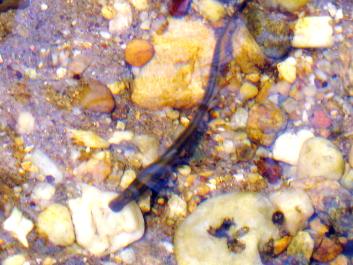
Eric Brown of Edgartown has a secret.
Like many fishermen, when it comes to his favorite angling spot, Eric does not fish and tell. But, he did call last week to share a fish tale.
The star of the story is an unusual animal: an American brook lamprey, which, to be accurate, is not a true fish. True fish, taxonomically-speaking, have jaws, while lampreys are jawless. Lampreys also do not have bones, scales or paired fins.
Naturalist Nicholas Culpepper made a valid observation when he noted that “God and nature made nothing in vain.”
He was speaking of honeysuckles, one of the first plants to leaf out in early spring, when he identified one of its detriments. Culpepper’s unfortunate observation was that “the chewing of a leaf is more likely to cause a sore mouth and throat than cure it.”