

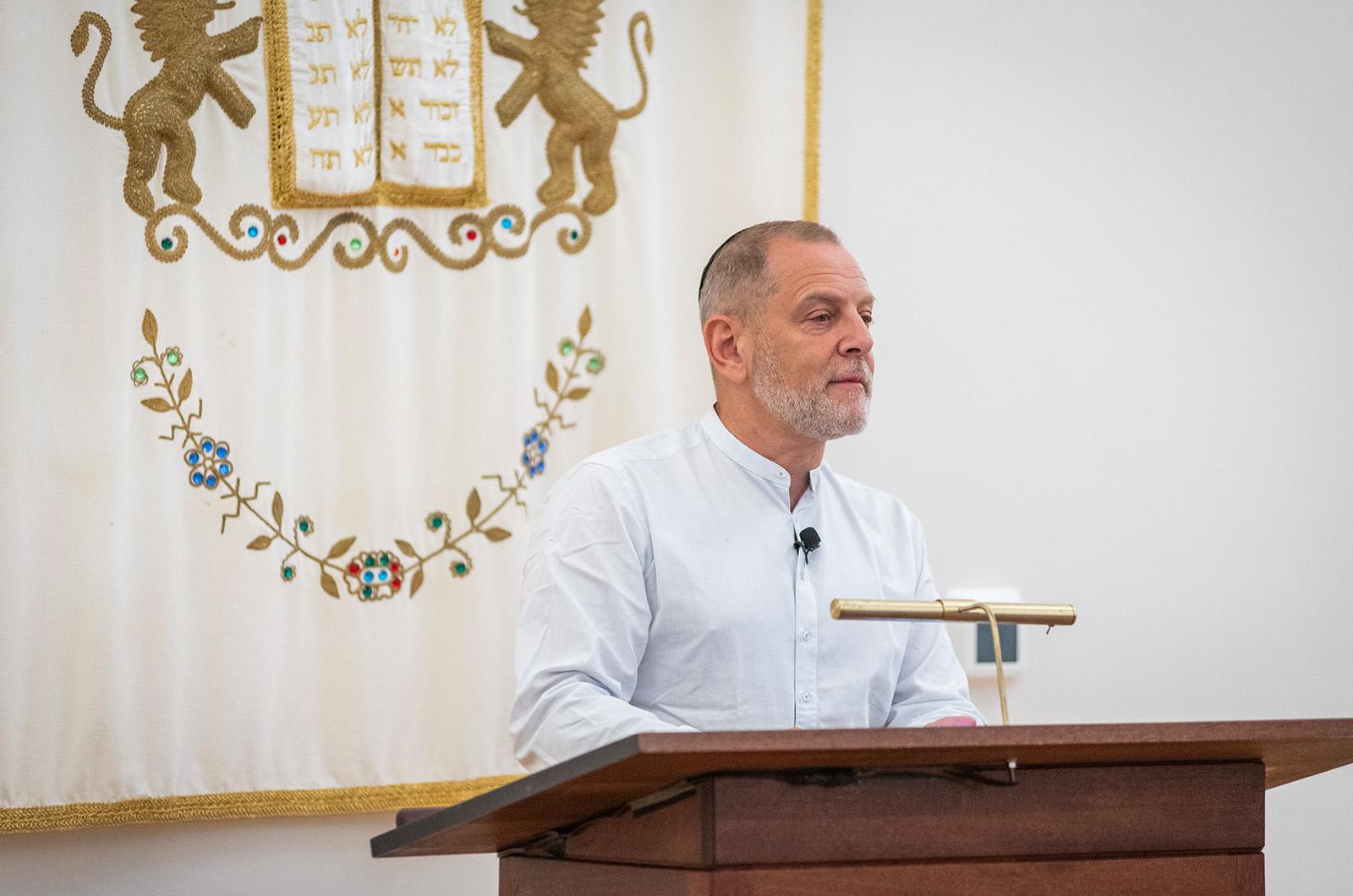
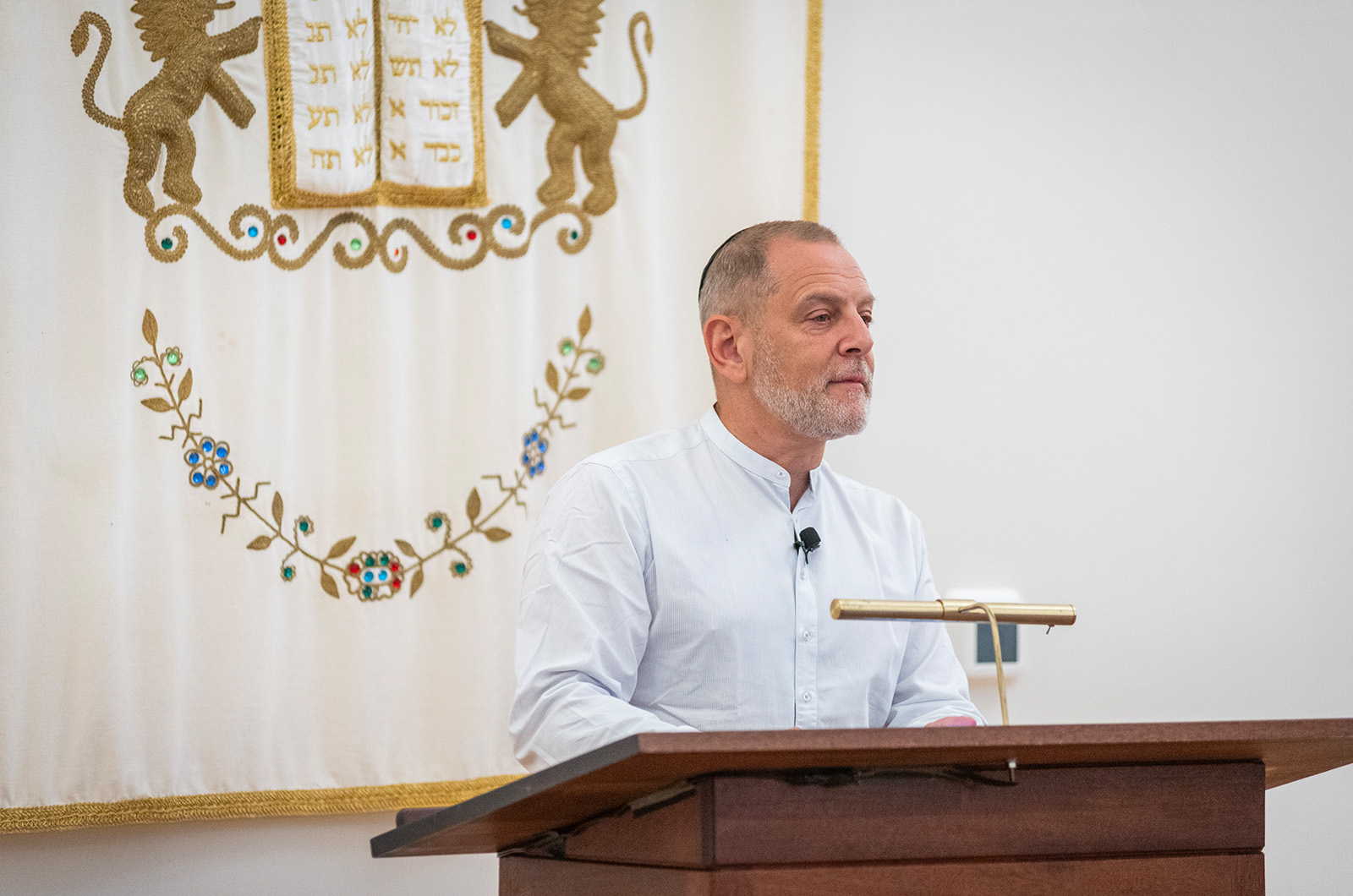
Rabbi Lau-Lavie’s talk a few weeks ago as part of the Summer Speaker Series at the Martha's Vineyard Hebrew Center was entitled “Radical inclusion, a moral response to divine divisive extremes."
At 13 years old, Rabbi Amichai Lau-Lavie uttered his own death sentence.
He was at his bar mitzvah, dressed in a “horrendous beige polyester suit,” he said, and reading aloud his Torah portion in front of his traditional Orthodox family and community. The portion includes the teaching: “If a man has sex with another man as with a woman, then it’s an abomination, and they both should be killed,” he said.
Rabbi Lau-Lavie is a 39th generation rabbi, the first in his line to be openly queer.
Rabbi Lau-Lavie was the featured speaker two weeks ago as part of the Hebrew Center’s Summer Speaker series. He was also the rabbi in-residence that week, leading Friday night and Saturday morning services.
“I had to stand there at my bar mitzvah and say these words that were basically my death sentence,” he told the audience. “I remember thinking at age 13, what do I do with this text? Can I rewrite it?”
Rabbi Lau-Lavie’s talk, entitled “Radical inclusion, a moral response to divine divisive extremes,” reflected on ways to address conflict and division in the Jewish community. Growing up, that conflict was largely grappling with his identity as a gay man raised in a traditional Jewish setting.
Now, it means approaching the Israeli-Palestinian conflict in a Jewish community that is deeply divided over the subject, he said.
“We’re in the middle of a moment, a long moment, a difficult moment,” he said. “How do we handle differences when they’re so deep?”
Rabbi Lau-Lavie also talked about a new documentary about his life and journey entitled Sabbath Queen, directed by Sandi Simcha DuBowski. The film follows Rabbi Lau-Lavie as he co-founds the progressive Lab/Shul congregation in New York City, discovers his drag alter-ego Hadassah Gross and becomes a rabbi in the conservative tradition. He then breaks that tradition by marrying two individuals of different faiths — Jewish and not.
“So many of us choose love over tribal ties, and it doesn’t mean we say no to Judaism,” he said during the talk. “It just means we say yes to humanity in a new way that’s tricky, perhaps, to our tribal ways.”
In the film, Rabbi Lau-Lavie explores his philosophy of “both/and,” an alternative to “either/or.”
“Both/and” is a common phrase in queer and trans discourse, used to emphasize principles of inclusion and acceptance. For Rabbi Lau-Lavie, it means he can love the Torah he grew up with, the same one that contains his death sentence, and know that he had to “talk back to it.”
He applied the same principle to the conflict between Israel and Palestine, urging audience members to find a “messy middle.” That means acknowledging differences, discovering commonalities and holding conflicting narratives together at the same time.
He recalled being at Columbia University during protests for both Gaza and Israel, a place of “concrete either/or,” he said.
“Being in the middle saying, ‘I stand with the Jewish people’s right to live and survive, and with the Palestinians right to live. I stand with Israel and with Gaza.’ That space was not sanctioned, that space was not safe,” he said.
Where he did find the “messy middle” was at Shabbat tables, sit down conversations and “heart circles where we could listen to each other and forge a path of both,” he said. “I know that exists.”
Over the next two years, Mr. DuBowski and Rabbi Lau-Lavie said they plan to tour college campuses to screen the film and continue discussions between divided Jewish communities.
Rabbi Caryn Broitman told the Gazette that she deeply appreciated Rabbi Lau-Lavie’s teachings and his philosophy of “both/and.” She pointed out two signs hanging on the outside of the Hebrew Center. “Bring Them Home,” one says, referring to the Israeli hostages taken by Hamas on Oct. 7, 2023. The other says “We Grieve the Loss of Every Child.”
Rabbi Lau-Lavie also noted the signs, speaking after the film screening.
“As I just walked outside this beautiful synagogue, I noticed the signs that you have in front,” he said. “You are holding the families of the hostages, and you are holding every child’s grief, right? You’re walking that talk of both/and.”
“Many Israelis right now, and many American Jews and people in the world are not there,” Rabbi Lau-Lavie said during his talk. “The hurt is very damaging and the fear is real and the trauma is fresh. But can we get there? Yes, we must.”
Add new comment