

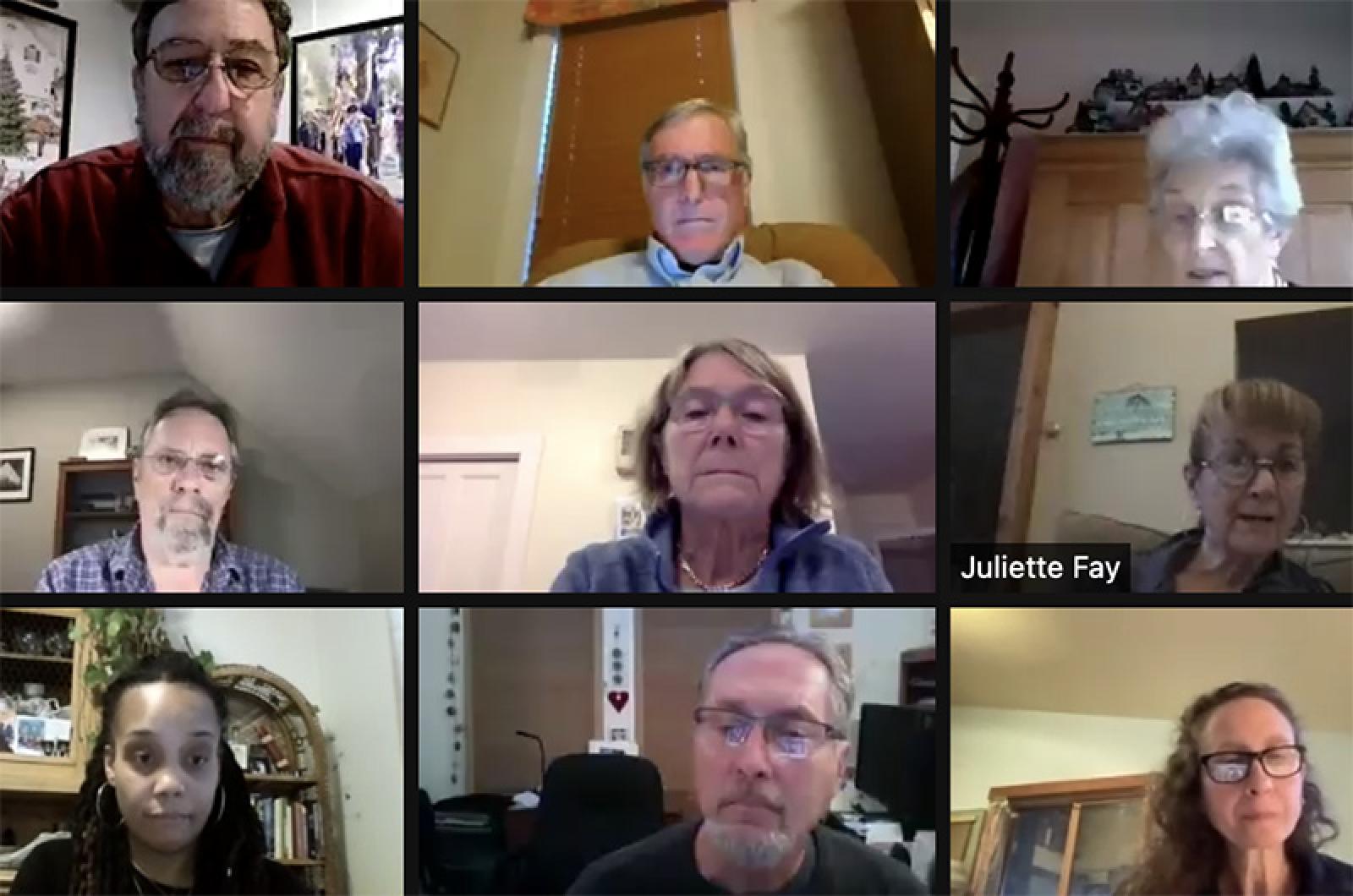
A revised version of a draft article to create an Island housing bank came before the Edgartown select board Monday, but the board delayed a vote again.
A revised version of a draft article to create an Island housing bank came before the Edgartown select board Monday, but the board delayed a vote again on placing the article on the annual town meeting warrant, amid ongoing debate about the details.
“We all know how important it is. There’s no question about it. It’s going to fly, everybody wants it. So it’s just a matter of getting it right,” selectman Michael Donaroma told members of the coalition to create a housing bank who attended the online meeting. “You guys are going to be handling millions of dollars and people are going to want to know every little detail. And so we’re trying to be cautious.”
The coalition is asking all six towns to put the draft article on their annual town meetings warrants in the spring. Modeled after the land bank, the proposal calls for creating a housing bank fund using a two per cent transfer fee on some real estate transactions. An elected housing bank commission would control the funds in concert with appointed town advisory boards.
Chilmark, Aquinnah and Tisbury have already agreed to put the draft article on their warrants, but Edgartown, Oak Bluffs and West Tisbury have said they want more fine tuning of the densely-worded article. Coalition members have been meeting with Edgartown town counsel Ron Rappaport, after he wrote an opinion on the draft last month.
Some changes have been made, and a new draft is now circulating.
On Monday, Edgartown selectmen had more questions, including about the electoral process for passage of the housing bank, provisions for member towns to withdraw from the bank, the role of the town advisory boards and the question of stipends for elected housing bank commissioners.
In the revised draft, a provision has been added requiring passage of on both the town meeting floor and in the ballot box.
Member towns could withdraw from the housing bank after 10 years through a majority town ballot vote. The 10-year period allows time to see what the housing bank looks like operating at full capacity, since it will take a few years to get it up and running, coalition coordinator Laura Silber said.
But selectman Arthur Smadbeck said towns should be able to opt out whenever they want.
“To restrict them to 10 years is quite onerous . . . no one is going to go in one year and then out the next anyway, practically speaking,” Mr. Smadbeck said. “I think it’s a good sales point for people, [to say] ‘look if you don’t like it, you can opt out of it.’”
The question of stipends for commission members remains a sticking point.
Commissioners would be paid stipends with approval by every member town in order “to align with local diversity, equity and inclusion goals,” according to the draft article. A modest stipend would allow a broader range of people to serve as commissioners because they could use the money to cover expenses incurred from participation, like child care, coalition member John Abrams said.
Mr. Smadbeck pushed back at the stipend idea.
Public money should be going to affordable housing and not elected commissioners, he said, noting that other regional commissioners such as land bank, Martha’s Vineyard and Dukes County commissioners are not paid.
“I don’t think, one, it’s necessary, and, two, it’s right,” Mr. Smadbeck said. “[Commissioners] have a fiduciary responsibility to make sure that these funds are handled appropriately.”
Others who attended the meeting backed the idea of stipends.
“We have an issue on this Island when it comes to representation and the people that need to be represented when it comes to affordable housing do not have the luxury and the time because we’re working,” said Kat Monterosso. “We need to remove any minor barrier, if that is $50 for a babysitter so that somebody who actually lives this can have their voice heard, we need to do that no questions asked.”
The select board asked the coalition to continue to work with Mr. Rappaport to iron out more details, and will take up the draft article at their next meeting, Jan. 3.
The Oak Bluffs select board was due to discuss the new draft at a meeting Tuesday.
Comments
I’ll give Art Smadbeck a call
Dean Rosenthal EdgartownI’ll give Art Smadbeck a call, he’s wrong in this one and his logic is part of what calcifies generational change. People have mortgages, children, committed jobs, they are raising families and pricing for them island. This he does nor know firsthand at this time, in this era, where costs are astronomically different then when he may have dealt with these issues. Should he come across this comment, Art, I feel this one is our off touch with the reality of Martha’s Vineyard
I agree with Mr. Smadbeck
Prudy Burt West TisburyI agree with Mr. Smadbeck about the stipend, and have told my two select board members the same. I grew up in West Tisbury and have lived here all my life- nearly 60 years. I have volunteered to serve on boards in my town over the last 30+ years, many of those spent moving seasonally- caretaking in the winters and spending summers in a small shed with an out house and an outdoor shower, all while making considerably less than $30K a year.
I strongly disagree that bus fare and child care expenses will prevent anyone from serving this worthy effort.
Everyone needs to find a way to participate in this community however, whenever, and wherever they can.
Thank you Prudy . for putting
gina Menemsha / NYCThank you Prudy . for putting the "stipend idea" in proper perspective .. It would set a dangerous precedent IMO.
Taxing retirement nest eggs
Mark EdgartownTaxing retirement nest eggs is wrong, why should islanders have to pay another tax. And yes I understand the proposed structure, it is a tax and it will reduce proceeds to the seller regardless of whether buyer or seller funds the tax.
The island is a community,
Tom Ellis EdgartownThe island is a community, not a "retirement nest egg".
Many islanders have invested
Mark EdgartownMany islanders have invested in and maintained their homes to fund retirement, I don’t support redistributing their hard work.
I live in Chilmark. We have 0
William Cumming CHILMARKI live in Chilmark. We have 0.0 affordable housing as tracked by the state. Why are Edgartown and O.B. Tax payers going to pay my share of affordable housing when my town does next to nothing and these towns are spending millions already. It is an embarrassment. Chilmark has the second lowest tax rate in the state, of the highest property values. Shameful, economic exclusionary zoning based on our towns zoning bylaw's hurts everyone.
Thank you O.B. and Edgartown for footing the bill but we should be paying our own way and you should not be taxing your residents once your town get to the magic 10% of required affordable housing. If you want to keep spending after that good on you, but it should be the respective towns choice period….
Strong agree!
Islander Martha's VIneyardStrong agree!
not only do it think the 2%
mike Marthas vineyardnot only do it think the 2% land bank fee is excessive, but another 2% on top of that? if this is on the ballot, I urge everyone to vote NO
Regarding stipends, with all
Kimberly Angell West TisburyRegarding stipends, with all due respect to those who have without them, anyone who has been a single parent understands the cost of childcare coverage and that having to pay out of pocket in addition to the time commitment necessary to properly serve on a town committee ( or as a commissioner in this case) could be a deal breaker. We need to diversify, be more inclusive and attract the younger generation to serve on these committees. I believe everyone deserves a reasonable stipend to cover costs.
This is a really good point.
Molly MartoneThis is a really good point.
Paying a stipend to someone
DownislanderPaying a stipend to someone to serve on a town committee is a bad idea.
It creates a new interest group whose demands must constantly be renegotiated.
A very poor precedent.
Possibly a voucher for babysitting could be issued by the town, to be redeemed by the babysitter at Town Hall.
The 2% land bank tax (fee) is
Lorraine EdgartownThe 2% land bank tax (fee) is excessive; another 2% tax (fee) is excessive. No stipends, where there is money, there is influence. Community service is a good thing. Volunteering is a good thing. We do not owe anyone affordable anything; and, yes, I have grands buying starter houses in several different states, they are facing the same thing, but they are choosing where to spend their money and saving for buying a place to live. It has not happened overnight, they have had to give up things and make choices in order to invest in a property. The island is no different from other desirable locations where people have flocked and property values have risen, and prices have also risen. Life happens. Markets determine value. Happy New Year to all. May we live in peace and harmony in the New Year of 2022.
2 points:
M.Toms Edgartown2 points:
1) stipend - I am against it as I believe if one decides to “run for election”, they are making the decision to “volunteer” their time, effort and perspective in bettering the community, not for influence or money which is often the case. If a stipend is enacted, the definition of “reasonable” needs to be very clearly defined and the amount tied to a very strict formula that cannot be changed by the Board during a midnight meeting, but rather adjusted by a vote of the Town impacted.
2) 2% fee - it should be split evenly between buyer and seller (1% each), not like the Lnd Bank which puts the burden solely on the buyer. Although some will take exception, the price of MV real estate for a home has increase where > $1mil is more the norm than not, and an additional $40k in a tax is excessive for 1 party to bear the brunt.
The Land Bank had done a fantastic job in successfully preserving open space for all island residents and visitors over the many years since it’s inception. However, instead of creating a whole new process with the “housing bank”, wouldn’t it be nice for the Land bank to alter its current mission and charter to include the potential opportunity of support this affordable housing initiative as well? There will be pushback that this cannot be done legally due to its structure, but if where there is a will, there is a way which I am sure could happen with the right intention and effort. Happy Blessed New Year to all.
Stipends are a problem. How
Ken Edg.Stipends are a problem. How high should the stipend be? Everyone will have input on that. Mr. Smadbeck has a good argument there.
It would seem to me by adding
David Hidden CoveIt would seem to me by adding a distinct and separate “housing bank” might serve to a misalignment in a broader effort to coordinate the open land preservation and housing needs on the island. Perhaps ONE “ MV Land & Housing Bank” which is managed and governed by 1 Board and management group. Such might save administrative overhead costs , no added Board stipends, and a seamless strategic plan to align land preservation with affordable housing. Two separate / disparate entities seem like there might be too many cooks in the kitchen. By expanding the current MV Land Bank to include housing ( i.e. a ‘MV Land & Housing Bank’) the administrative savings might also allow the aggregate “fee” to be reduced from the proposed 4% to perhaps 3%. It’s the administrative overhead costs which get many nonprofits in trouble ( I have 45 years experience in the nonprofit sector).
100% the best solution. Joint
William Cumming CHILMARK100% the best solution. Joint efforts in conservation and community housing is a win win and is becoming the model in the US. We can complete more conservation and community housing together. All that needs to be done is to add in section 6. after... conservation "and community housing" to the MVLB Chapter 736 of the Acts of 1985. All the towns controls are there. I would increase from 2% to 3%, the MVLB fee for a period of 20 years, then it reverts to 2%. The entire structure and organization is there already.
Add new comment