
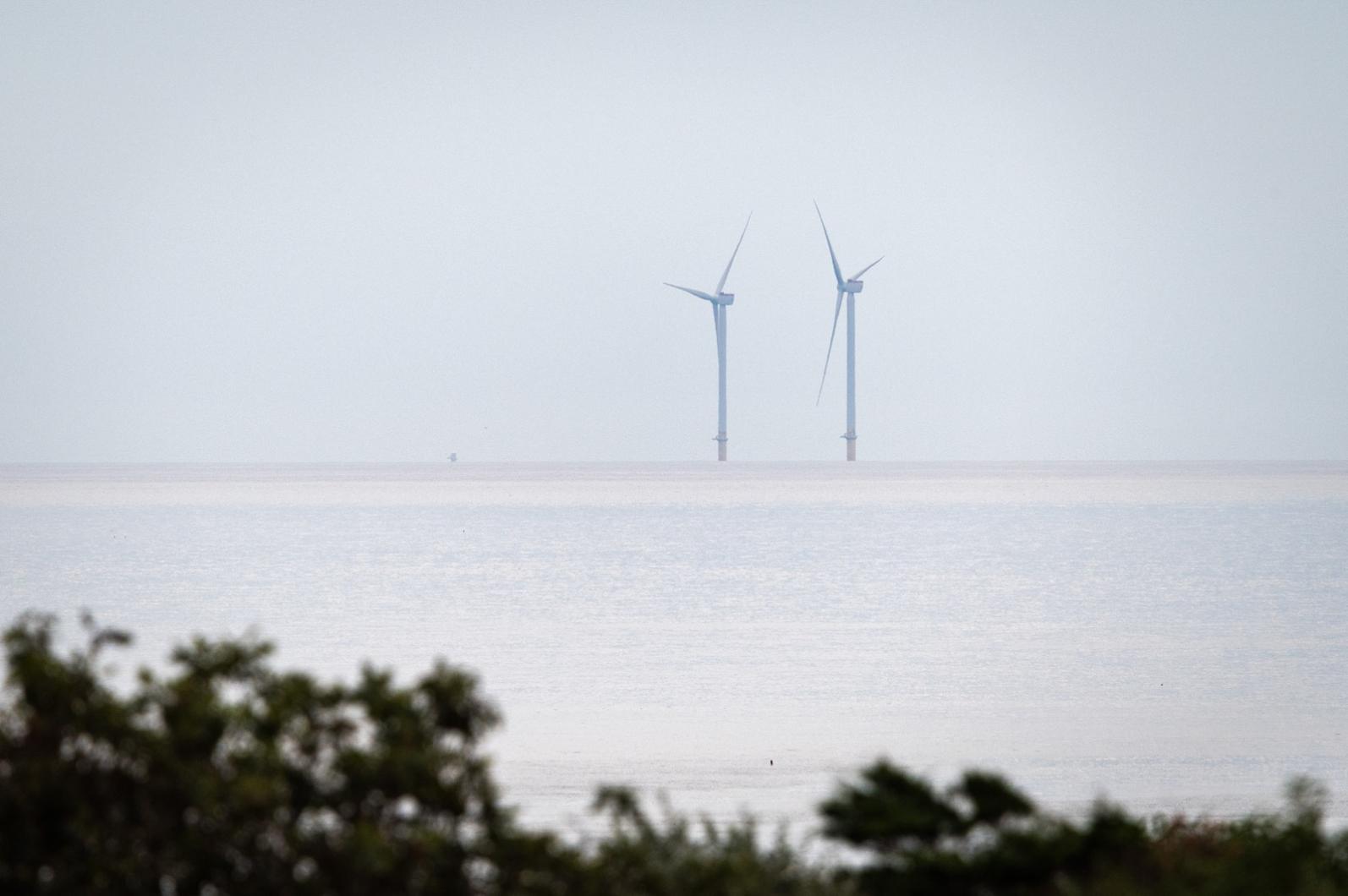
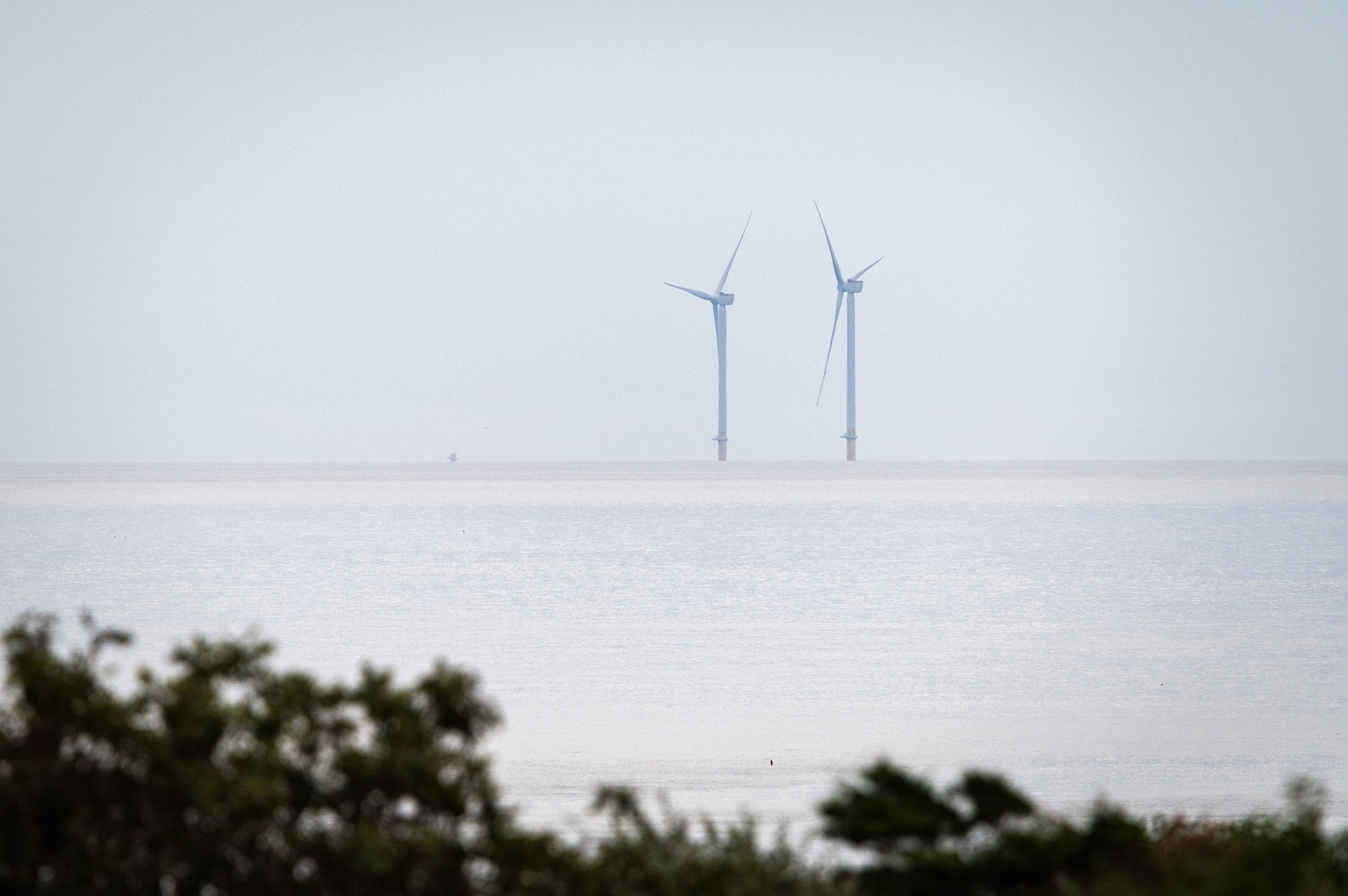
In court filings last week, Revolution Wind, the 65-turbine wind farm located 12 miles off the coast of Aquinnah, said the Department of Interior’s decision to halt leases for reported national security concerns was against the law.
The offshore wind farm closest to Vineyard shores is pushing back against the Trump administration’s decision to halt the renewable energy leases, saying the national security concerns raised by the federal government are bogus.
In court filings last week, Revolution Wind, the 65-turbine wind farm located 12 miles off the coast of Aquinnah, said the Department of Interior’s decision to halt leases for reported national security concerns was against the law, threatening billions of dollars of investment.
“[The stop work order] is wholly conclusory, internally inconsistent, and overbroad,” lawyers wrote in a new complaint filed in a Washington, D.C. federal court on Jan. 1. “The [order] ignores that [the] Interior has stated plainly that the Project does not interfere with national security.”
The company said the project was engaged in years-long consultation with the U.S. Department of Defense, the same department that now has raised security concerns rooted in the potential for turbines to create radar interference.
Revolution Wind argued that the Department of Defense and the Air Force had executed a formal agreement that outlined mitigation measures needed for the project to proceed.
The Trump administration has been hostile to the still nascent offshore wind energy industry since President Donald Trump’s first day in office. Revolution Wind has drawn particular scrutiny.
In August, the Bureau of Ocean Energy Management (BOEM) in August halted construction on Revolution Wind. That was one of the first times BOEM had cited national security concerns as a reason to consider if an already approved project should move forward.
The order was initially overturned as a temporary reprieve by a federal judge, and the new complaint was filed as a supplement when the Trump administration again halted activities for 90 days through a new order in December.
The December order was the most ambitious move against offshore wind energy, which is predominantly rooted in an area of water off the Vineyard coast. It stopped all projects already under construction, including Vineyard Wind, which had already started generating power.
Revolution Wind said about 87 per cent of construction was completed and the farm expected to start producing power this month. If the second order were to remain in force, the company claimed it would cost the project $1.4 million a day.
The attorneys have asked that the court find that the order breaks several different federal laws and grant an injunction.
The federal government has not yet responded in court to the new complaint.
Orsted said it is also considering legal recourse for its Sunrise Wind project, which is about 16 miles south of the Vineyard.
A Virginia farm and a New York project have also filed lawsuits.
Vineyard Wind, which was allowed to continue generating some power during the federal government security review, has not taken legal action as of Monday, though it has emerged successful in other cases.
Comments
Good! That decision was
Carol formerly ChilmarkGood! That decision was arbitrary and capricious - in the extreme. Lower electricity prices come from increased supply, relative to demand - and the cheapest ways to generate electricity are solar and wind, which require no or almost no staff (unlike fossil fuel plants) and do not consume fuel (unlike fossil fuel plants). I hope the courts follow the law and strike down the Trump Admin's unlawful order.
Solar is good. Wind farm
Jackie stinks VHSolar is good. Wind farm doesn't make sense in this area. There may be lack of knowledge and you should do some research. Take care.
Where does wind make sense
Albert GosnoldWhere does wind make sense
Where this enough to generate ROI?
Where you can not see it?
On-shore wind is very cheap,
James EdgartownOn-shore wind is very cheap, but off-shore wind is not. The price per kilowatt hour that Vineyard wind has quoted are considerably higher than the electricity prices that we pay now -- practically double.
This project should have
Jackie stinks vhThis project should have never been allowed in the first place. These wind turbines do not belong in that area to begin with. The people need to stand up. Love him or hate him, hes doing the right thing in this situation. Thank you Mr president. Come in!!!
If everyone who blindly
Roddy Seasonal VisitorIf everyone who blindly opposes our President could force themselves to submit to just a moment of honest reflection, employ even the tiniest sliver of common sense, and try a little harder to expand their thinking beyond the confines of hatred and their friends’ political groupthink echo chamber, they might actually realize that, in spite of his sometimes abrasive delivery style, he is right about almost everything.
Everyone is entitled to their
Big ones EdgartownEveryone is entitled to their own opinion.But why do you think it is an unlawful order?
These windmills will not make your electricity bill lower. You can use new Jersey as an example.
Please share your information
Tim Johnson TisburyPlease share your information of the examples in New Jersey of offshore wind -- whick has not actually been built yet -- has affected their electric bills.
They canceled the project due
Big Ones edgartownThey canceled the project due to excessive wind causeing damage, problems with scheduled maintenance and lack of being able to maintain them. grid management , ice buildup, wildlife protection, with some turbines running the risk of catastrophic failure at a high expense. They chose a different path for a cheaper alternative. In other words due to common sense The ocean is the worst place for them and if anything, they belong on land. Again (Common Sense).
What turbines in New Jersey?
David West TisburyWhat turbines in New Jersey? There have been no projects producing electricity in new Jersey to actually raise or lower electricity prices. You’re believing a false narrative. Look it up for yourself.
Thank you Donald!
Richard EdgartownThank you Donald!
Radar fog from the turbines
Cmd Lewis Ret. MenemshaRadar fog from the turbines is a national security risk, especially on the approaches to the Eastern seaboard.
Labeling opposition to
Murray HarveyLabeling opposition to offshore wind as “misinformation” oversimplifies a far more serious set of concerns. The questions being raised are institutional, not ideological. These projects were approved under specific assumptions about scale, density, radar mitigation, maritime safety, and long-term operability. Re-examining whether those assumptions were sufficient is not denialism — it is due diligence.
Regulatory approval does not confer immunity from reassessment. Offshore wind permanently alters offshore operating environments, and its impacts are cumulative, not static. Radar performance, vessel traffic patterns, emergency response access, and system resilience evolve as projects expand. Treating earlier approvals as final ignores how complex systems behave in real-world conditions.
Developers emphasize sunk costs and regulatory consistency. But sunk cost is not a public-interest standard. When new reviews suggest prior mitigation may have underestimated risk, pausing construction is not obstruction — it is correction. Large, permanent infrastructure deserves continuous scrutiny, especially when national security and coastal operations are implicated.
Disagreement with offshore wind is not opposition to clean energy. It is a call for higher standards before locking in decisions that will shape offshore waters for decades.
For an Island community that depends on safe navigation, working waters, and reliable emergency response, offshore decisions are not abstract policy exercises. They shape the daily operating environment for fishermen, ferry traffic, search-and-rescue crews, and coastal monitoring — long after headlines fade and court cases close.
What are the risks.
Albert GosnoldWhat are the risks.
The risks are not a single
Murray HarveyThe risks are not a single issue, but an accumulation of operational uncertainties. They include radar performance and mitigation effectiveness at scale; increased vessel traffic density in heavily used Island waters; navigation and emergency-response complexity around fixed turbine fields; long-term maintenance access during winter conditions; and grid reliability when generation is intermittent but geographically concentrated.
There is also risk in process. When projects move from modeling to real-world operation, assumptions about spacing, cumulative effects, and mitigation need validation. For an Island that relies on ferry corridors, commercial fishing grounds, and rapid search-and-rescue access, those assumptions matter in daily, practical ways. Reassessment isn’t an accusation of failure — it’s a recognition that permanent offshore infrastructure demands a higher standard of proof before decisions are locked in.
The monstrous structures are
Metacom AquinnahThe monstrous structures are a crime against nature and our whale brethren. Monuments to corruption and disharmony with Mother Earth and Father Sky.
How about the hundreds of
Harry Schwartz EdgartownHow about the hundreds of power poles and power lines that snake around the island? What about the tremendous ships that take miles to stop their forward motion? What effect do they have on nature? How about the billions of tons those ships burn to get where they're going?
"Offshore wind permanently
Harry Schwartz Edgartown"Offshore wind permanently alters offshore operating environments". That is an assumption.
Firstly, the long term environmental and defense effect of the wind farms was exactly what was examined when approval was given to these wind farms. Secondly, the the biggest complaint isn't the environmental effect it's the view that has changed and people's perspective of that change. Thirdly, our population is growing. How do we meet the growing need for electricity and not build expensive and polluting carbon burning plants, especially in poorer areas.? Lastly, the only thing that has changed is that we have a person in the Oval Office who personally doesn't like to look at them. He believes in ruling by fiat and the rule of law be damned.
Saying offshore wind
Murray HarveySaying offshore wind permanently alters offshore operating environments is not an assumption; it is a description of fixed infrastructure placed in navigable waters for decades. Turbine foundations, cable corridors, exclusion zones, and maintenance activity change how those areas are used and managed over time. Acknowledging permanence does not imply harm — it recognizes scale and longevity.
It is true that environmental and defense considerations were examined during initial approvals. The question raised here is whether those analyses, based largely on modeling and projections, remain sufficient once projects reach real-world scale and cumulative density. Approval is not the same as perpetual finality, particularly for infrastructure that cannot be easily reversed.
Visual impact and energy demand are separate issues. Even if some opposition is aesthetic, that does not invalidate operational, navigational, or resilience questions — especially for an Island community dependent on ferries, fishing, and emergency response.
Meeting growing electricity demand is essential. The issue is not whether new generation is needed, but whether any single solution should be insulated from reassessment once it becomes permanent. That standard applies to all major infrastructure, regardless of technology.
Off Shore Wind Turbines aren
Harry Schwartz EdgartownOff Shore Wind Turbines aren't a new thing. They've been in use for decades in Europe. Saying that now is the time reassessment needs to be done is a heavy handed way of trying to create an environment of constant litigation. All because this man in the white house doesn't like looking at them. I for one don't like golf courses (they pollute the ground water and they're a huge use of available land that could be put to better use. But that doesn't mean I have a right to block them.
In the early 1980's I decided
Kevin Brennan Oak BluffsIn the early 1980's I decided to volunteer as a firefighter in PA and was required to attend training. An early course was entitled something like "How To Properly Respond To Incidents At A Nuclear Power Plant". We received a wallet-sized card we were to show law enforcement so they would allow us to enter a nuclear facility. At the time, farmers in the vicinity of Three Mile Island were still dealing with animals born "not quite right" and hundreds of acres of abandoned farms in the area. TMI was closed but another Nuclear plant nearby was still running.
In September 2024, Constellation Energy announced plans to restart the Three Mile Island nuclear plant to sell the power to Microsoft, demonstrating the immense power needs of the tech sector as they build data centers to support artificial intelligence.[155] Constellation expects the Unit 1 reactor at Three Mile Island to come back online in 2028, subject to approval by the Nuclear Regulatory Commission. Constellation also plans to apply to extend the plant’s operations to at least 2054.
Recently I read about a blade that fell from a turbine into the ocean. I smiled. History does repeat itself. Can we bring nuclear plants back to this area? I think I still have that magical card which would allow me to respond to the plant should there be a disaster..........
In response to Harry Schwartz
Murray HarveyIn response to Harry Schwartz:
Harry, no one is saying offshore wind is new, or that Europe hasn’t been living with it for years. The point being raised is about scale and setting, not novelty. Vineyard Sound isn’t the North Sea, and it isn’t an open industrial zone. It’s a confined, heavily used corridor that ferries, fishermen, and emergency responders rely on every day.
Calling reassessment “constant litigation” skips a step. Reassessment is routine for long-lived infrastructure. Bridges, harbors, airports, dredging projects — all get revisited as real-world use replaces modeling. That’s not obstruction; it’s how risk is managed over time.
In fact, European projects are often cited because they have been adjusted after construction. Navigation corridors, turbine spacing, cable burial practices, and fisheries access have all been modified once actual impacts became clear. That doesn’t mean the projects failed. It means assumptions were tested against reality.
Approval doesn’t mean permanent immunity from review, especially for infrastructure meant to sit in navigable waters for decades. Early approvals relied heavily on projections about vessel traffic, radar interference, and emergency response. It’s reasonable to ask whether those projections still hold as projects scale up.
This isn’t about aesthetics or politics. Golf courses can be re-zoned or shut down. Fixed offshore infrastructure can’t. When something is effectively permanent, occasional reassessment isn’t radical — it’s responsible. Hi.
Wind turbines can
Island Air Force Veteran Martha's Vineyard, MassachusettsWind turbines can significantly affect the Air Force's Bourne PAVE PAWS radar's detection capabilities by creating "clutter," obscuring real targets, generating false alarms, and reducing sensitivity. First, there is radar clutter. The rotating blades and steel towers reflect radar signals, creating false echoes that look like moving objects (clutter). Second, there is target obscuring. This clutter can hide actual threats like missiles or satellites from the radar's view, making them harder to detect. Third, there is the reduced sensitivity. Systems may need to increase detection thresholds to filter out false signals, which lowers their ability to spot genuine threats, notes the Department of Energy.
The Cape Wind project proposal faced significant Air Force objections due to potential interference with PAVE PAWS, a crucial missile warning and space surveillance radar. While the Air Force initially concluded some turbines wouldn't affect the radar, later studies and the Pentagon acknowledged significant impacts, particularly if turbines are within the radar's line of sight.
The issue remains a balance between renewable energy development and national security, with ongoing studies and evolving policies to address impacts on military radar, notes Congressman Chris Smith and the Air Force JAG Corps.
I want to thank the Island
Murray HarveyI want to thank the Island Air Force veteran for laying this out so clearly. His explanation reflects concerns long documented by the Department of Defense and the Air Force regarding radar clutter, target masking, and reduced detection sensitivity caused by large wind turbines. These are not theoretical risks. The Air Force raised formal objections during the Cape Wind proposal specifically because of potential interference with the Bourne PAVE PAWS radar — a critical missile warning and space surveillance system. Later Pentagon reviews confirmed that turbines placed within radar line of sight could significantly degrade performance, even after earlier, more optimistic assessments.
I only wish offshore wind detractors who claim these projects pose no threat to national security would acknowledge this record. The evidence shows otherwise. National security concerns tied to radar interference are real, documented, and unresolved. Renewable energy goals are important, but dismissing legitimate defense impacts does not make them disappear — it simply ignores history and facts that have already been tested in this region.
Add new comment