

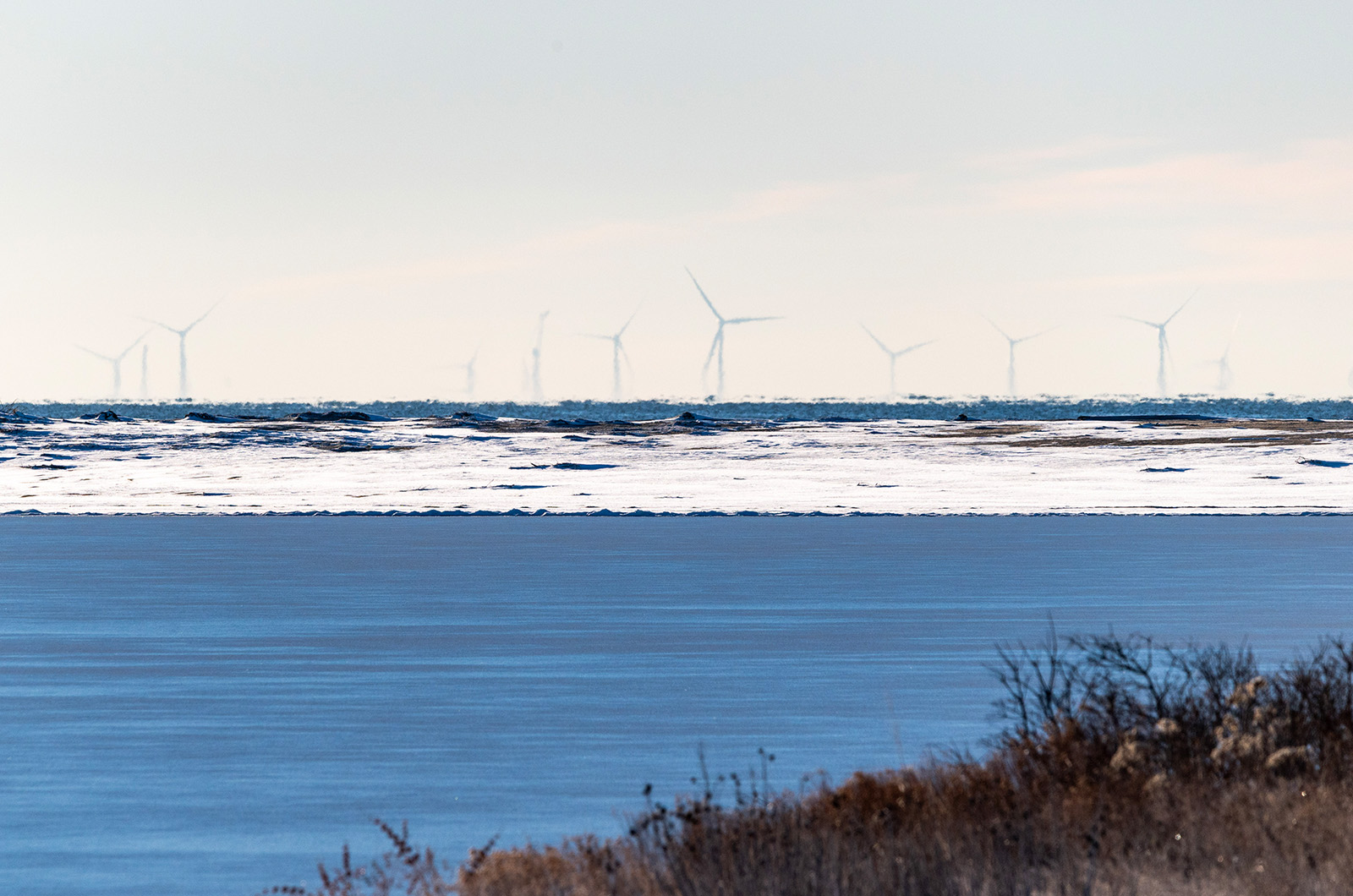
In a letter to the offshore wind farm last week, the Bureau of Ocean Energy Management said Vineyard Wind "may continue any activities from those wind turbines that are necessary for the current level of power generation."
Vineyard Wind, the 62-turbine project south of the Island, can continue generating power despite the Trump administration’s order last week that halted offshore wind energy construction.
The Department of the Interior last Monday announced that it was pausing the leases for five large-scale offshore wind farms due to national security concerns. Though it was included in the order, Vineyard Wind was singled out by the government as being allowed to resume generating some electricity.
In a Dec. 22 letter to Vineyard Wind, the Bureau of Ocean Energy Management (BOEM) said that during the 90-day suspension period, Vineyard Wind may “perform any activities that are necessary to respond to emergency situations and/or to prevent impacts to health, safety, and the environment over the next 90 days and during any subsequent extensions.”
“In addition, given that this project is partially generating power, you may continue any activities from those wind turbines that are necessary for the current level of power generation,” wrote BOEM’s acting director Matthew Giacona.
Vineyard Wind was hoping to finish construction by the end of the year and started producing some power in January. As of July, 17 turbines were sending power to the grid and now, according to the state, the project is capable of producing 572 megawatts of its 800-megawatt capacity.
Vineyard Wind did not respond to a request for comment this week about how many turbines were up and running. The Department of the Interior also did not respond to questions about the reasoning behind allowing Vineyard Wind to operate in the face of the concerns around national security and a spokesperson deferred to the BOEM letter.
Offshore wind has been in the crosshairs of the Trump administration since the President’s first day in office. The Department of Interior’s order, the latest swipe at the industry, halted any activities at the offshore leases for the next 90 days as the department considers the alleged national security threats. The department said the concerns were based on classified information shared by the Department of Defense and involved the potential for radar interference from the tall turbine towers.
The legitimacy of the concerns was called into question by leaders in Massachusetts and the other states that have a stake in offshore wind energy.
On Christmas Eve, Gov. Maura Healey, along with the governors of Rhode Island, Connecticut and New York, sent a letter to Department of Interior Secretary Doug Burgum, urging him to lift the order.
“These projects have already been subject to extensive federal review, including an assessment that expressly addressed national security considerations,” they wrote.
Shutting these down would actually hurt more than help, the governors contended.
“With this irrational and erratic action, you are not solving a national security crisis; you are creating both a national security and economic disaster,” they wrote. “By obstructing domestic power generation, you are inviting grid failure, surrendering the industries of the future, and threatening the economy and national security.”
ISO New England, the nonprofit tasked with overseeing the region’s electrical grid, has also raised concerns about the government’s decision. ISO said Vineyard Wind has been supplying hundreds of megawatts of power, and halting these projects would make energy production less reliable moving forward.
“These projects are particularly important to system reliability in the winter when offshore wind output is highest and other forms of fuel supply are constrained,” the organization wrote in a statement. “While ISO-NE forecasts enough generation capacity is available for the current season, canceling or delaying these projects will increase costs and risks to the reliability in our region.”
Revolution Wind, one of the five projects affected, has said it is considering legal recourse, but, as of Monday, none of the farms off the Vineyard had filed lawsuits in Massachusetts.
Dominion Energy Virginia, a project 27 miles off Virginia Beach that had its lease paused, has sued in federal court, laying the potential groundwork for other suits. In its filings, the company argues that it worked extensively with the government over security concerns in the lead up to its approval.
The order has no rational basis and violates the Outer Continental Shelf Lands Act, as well as other laws, the project backers argued in a 47-page complaint filed on Dec. 23.
“BOEM’s arbitrary and illegal order is fundamentally inconsistent with this legal framework and BOEM’s carefully considered prior actions,” the company wrote. “Our Nation is governed by laws, and a stable legal and regulatory environment is essential to allow regulated public utilities like [Dominion], as well as other businesses, contractors, suppliers, and workers, to invest and support our Nation’s energy needs and associated jobs.”
While the court case plays out, members of the Trump administration have said that offshore wind is a scam, and that they’d rather see more oil projects come to the fore.
“One natural gas pipeline supplies as much as these 5 projects combined,” Interior Secretary Burgum wrote on social media. “[President Donald Trump] is bringing common sense back to energy policy & putting security first.”
Comments
If Vineyard Wind poses a
Murray HarveyIf Vineyard Wind poses a genuine national security threat, I feel allowing it to continue generating hundreds of megawatts of power makes no sense. National security risks don’t conveniently pause at the construction phase and disappear once electricity is flowing to the grid.
Isn’t the more plausible explanation the one Massachusetts officials and ISO New England have already raised: these projects were reviewed, modeled, and approved under existing federal processes that explicitly addressed radar and defense concerns? Nothing material has changed since then — except politics.
What this episode highlights is not a newly discovered security flaw, but a breakdown in regulatory consistency. Selectively freezing some activities while permitting others undermines confidence in federal oversight and injects uncertainty into long-term infrastructure planning.
Energy systems don’t operate on press releases or talking points. They operate on reliability, predictability, and rule-based decision-making. Pausing projects midstream while acknowledging their importance to winter grid stability does the opposite.
If there is classified evidence that fundamentally alters the risk assessment, it should be addressed transparently through established channels. Absent that, this looks less like safeguarding national security and more like policy by disruption — with real economic and reliability consequences for the region.
It doesn't pose a genuine
Ada Queetie Vineyard HavenIt doesn't pose a genuine national security threat, if that helps.
Vineyard Wind is allowed to
Tim Johnson TisburyVineyard Wind is allowed to continue operation because it's operation does not present any issue or danger to radar. That was determined to be a non issue years ago by the Department of Defense. The Trump administration had it's prior court loss because it did not have an ending timeline. Now it will be fought out in the courts on its merits. And the courts will side With the Wind Farm operators. Trump is driving up the costs of electricity with these stunts.
Tim — I think we’re actually
Murray HarveyTim — I think we’re actually describing the same facts but drawing very different conclusions.
If the Department of Defense determined years ago that turbine operation poses no radar risk (which I agree it did), then the current posture still doesn’t make sense. You can’t simultaneously say “there is no operational danger” and justify an executive pause on construction activities as a national security safeguard. Security risks don’t turn on and off based on project phase.
That’s why I’m less focused on how the courts may ultimately rule and more concerned about the precedent being set now. Selective freezes without new evidence undermine regulatory credibility and inject uncertainty into infrastructure planning that depends on stable, rule-based approvals. Even if the wind operators win — as you expect — the damage is already done in the form of higher financing costs, delayed capacity, and grid instability risk.
So yes, I agree the DoD settled the radar question long ago. Where I differ is in viewing this as merely a legal hiccup. It’s a policy signal — and a costly one — that energy decisions can be reversed midstream without new facts, only new politics.
The Trump Administration is
Enough Already OAK BLUFFSThe Trump Administration is correct offshore wind is a scam. A scam that has bilked billions of taxpayer dollars which we'll never get back. Anyone who supports this, shame on you.
Enough Already has a point.
Lorraine EdgartownEnough Already has a point. Track the carbon footprint offset of the manufacture and transport and erecting of ONE wind turbine. What is needed for the manufacture, the placement, the servicing, the disassembly, the entire cost of the life of the turbine is rarely taken into account.
Please contrast and compare
Tim Johnson TisburyPlease contrast and compare the same carbon footprint of every other electrical generation source. For some reason you are focusing singularly of one generation type. Please share your information on the carbon footprint of mountaian top mining and the daily environmental costs to filter, crush, size, wash, transport, store, rehandle, and ultimately burn coal to make steam to operate a turbine in a power plant. And include the disposal costs and efforts to dispose of the toxic fly ash that results from burning coal. Then do oil
Based on a 2021/2024 article
Sakiko Isomichi ChilmarkBased on a 2021/2024 article by the Department of Energy, from manufacturing to decommissioning, the carbon footprint of natural gas appears to be 40 times more than that of wind energy. https://www.energy.gov/eere/wind/articles/how-wind-can-help-us-breathe-…
Lorraine,
Murray HarveyLorraine,
I don’t think you and Tim are actually disagreeing on the substance — but you are talking past each other.
You’re right that energy sources should be evaluated on a full life-cycle basis: manufacturing, transport, installation, maintenance, and end-of-life. That’s not a fringe concern; it’s exactly how serious energy comparisons are done.
Tim is right that life-cycle accounting must be applied consistently across all generation types. Where his response falls short is implying that these comparisons don’t already exist or that raising them somehow singles out wind unfairly. They do exist, and they’re routine.
When those same analyses are applied across the board, wind still ranks among the lowest-carbon options per unit of electricity produced. The reason is simple: wind’s environmental costs are largely front-loaded and finite, while fossil fuels carry ongoing emissions and upstream impacts for as long as they operate.
So the issue isn’t whether wind turbines have a footprint — it’s whether that footprint is lower than the realistic alternatives serving our grid. On that comparison, the data are already clear.
Reliability is intermittent
Vallorie A Oliver NantucketReliability is intermittent as a renewable resource, it is not going to support anything most tof the time. Pricing of energy is going to get higher, not lower as our esteemed state leaders keeps lying about, knowing full well it is not possible given the costs to build these type of power plants. See ISO New England for daily prices. Sweden just cancelled its offshore wind for security risks as well. Our leaders must have been financially supported by the offshore wind industry so they continue to support it in spite of its obvious shortcomings.
If we remember the original reason for these projects was to save the planet and reduce carbon emmissions....none of which is remotely true. It is a scam but someone is making money so they continue.
Amen. And thankfully, more
Sara Piazza EdgartownAmen. And thankfully, more and more people are waking up to this reality. It's been a green new money grab from the beginning.
Preliminary evidence that the
Mark VHPreliminary evidence that the Departments of Interior and Defense are already beginning to recognize that they are actions are on shaky legal ground.
Executive orders are only
Robbie OBExecutive orders are only valid when a Democrat president issues them. Never mind the 75 million people that voted for this dueling elected president that won all swing states, electoral college and the popular vote.. One unelected judge’s opinion is all that counts… and they cry no kings?!? I don’t want to hear about democracy…
Obviously this is a red
D New Bedford MAObviously this is a red herring. There aren't national security concerns as such. But it's a useful red herring if it stops offshorewind. OSW is ridiculous. The operating costs are simply astronomical. I believe VW's PPA is struck at $9.00/MWh, which is not a terribly high number. That increases the risk of VW coming up short on a debt covenant, etc., which would be highly bad and put the business under immense pressure. If VW gets into financial trouble, all that gear will become so much pollution. That being said, I am sure that BOEM required that they supply a decommissioning bond, so maybe I'm worrying too much.
Our kids will complain when
Danny East ChopOur kids will complain when they pay big $$$ to have these all taken down. Which will be required per service life in ~20years.
Some wind turbines have been
Albert GosnoldSome wind turbines have been in service for 45 years.
Plymouth Nuclear was in operation for 45Years.
Until it was shut down for safety concerns.
7 years ago.
We are still paying for the still incomplete shutdown.
Your grandchildren will be paying for the storage of of the radio actice components and spent fuel rods.
Add new comment