

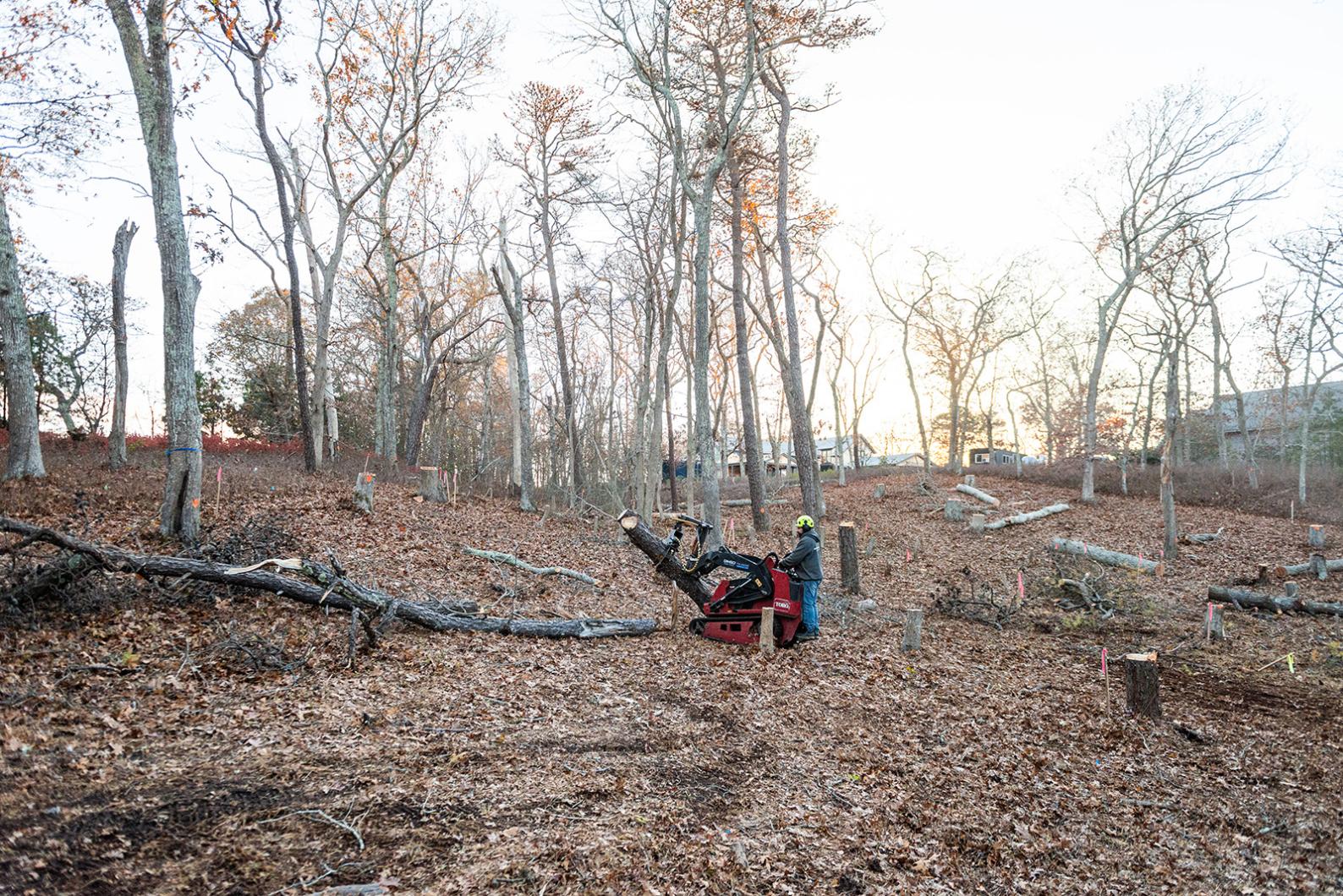

The homes of West Chop have been listening to a chorus of chainsaws this fall as the march of the devastating southern pine beetle progresses into residential areas.
The homes of West Chop have been listening to a chorus of chainsaws this fall as the march of the devastating southern pine beetle progresses into residential areas.
The beetles, which have decimated pitch and white pine trees in areas such as the West Chop Woods, have now become a big issue for homeowners. Dozens in the Vineyard Haven neighborhood in recent months have had to chop down hundreds of trees, as well as deal with the massive amount of waste, to prevent further damage to their properties.
“It’s really a shock,” said Wyatt Hamilton, an owner of a tree service company who has been inundated with work in the area. “The whole landscape is going to change.”
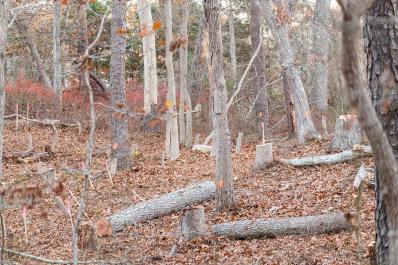
Homeowners worry the sick trees will start to fall on their homes and power lines.

Homeowners worry the sick trees will start to fall on their homes and power lines.
The southern pine beetle is a species native to the South that has migrated to the Island in recent years as the climate has grown warmer. Hundreds of thousands of the beetles, which are no bigger than a grain of rice, fly from tree to tree, drilling through the bark, cutting off its water supply and leaving them brittle and dead.
Managers of the forest have been on the forefront of the issue, preemptively chopping down trees and burning the dead ones in an attempt to slow the beetle’s spread. But now homeowners with little experience in battling such pests are finding themselves in the crossfire.
Batya Diamond, a homeowner in the Tashmoo Wood neighborhood, recently spent $7,500 to remove 45 trees from her yard.
“We were concerned about these trees falling on our house or our cars or ourselves,” Ms. Diamond said. “It felt like this was the only way to control the spread of the beetle and the destruction.”
The telltale sign that a tree is infected is the clumps of sap oozing from crevices in a pine tree’s bark. Mr. Hamilton will flag them to be removed when their crowns are still green. When he returns a few weeks later, all the needles are orange and strewn on the ground.
With many of the old pines in her yard now gone, the view from Ms. Diamond’s home is sparse. Some of the remaining trees had limbs that fell off leaving only the tops a stark orange.
“I’m looking out my window now and it just feels like a bit of a threat,” Ms. Diamond said. “Those tops of the trees can come down anytime.”
Mr. Hamilton’s Up-Island Tree and Landscape and other crews are on the front lines. In a two-week period, his team has cut down 1,200 infested pines for homeowners in the Mink Meadows neighborhood.
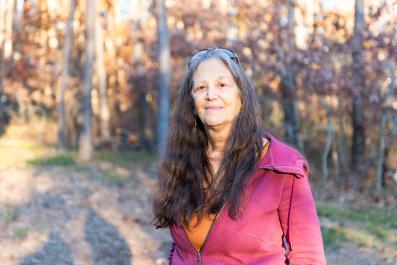
Batya Diamond had 45 trees removed from her yard.
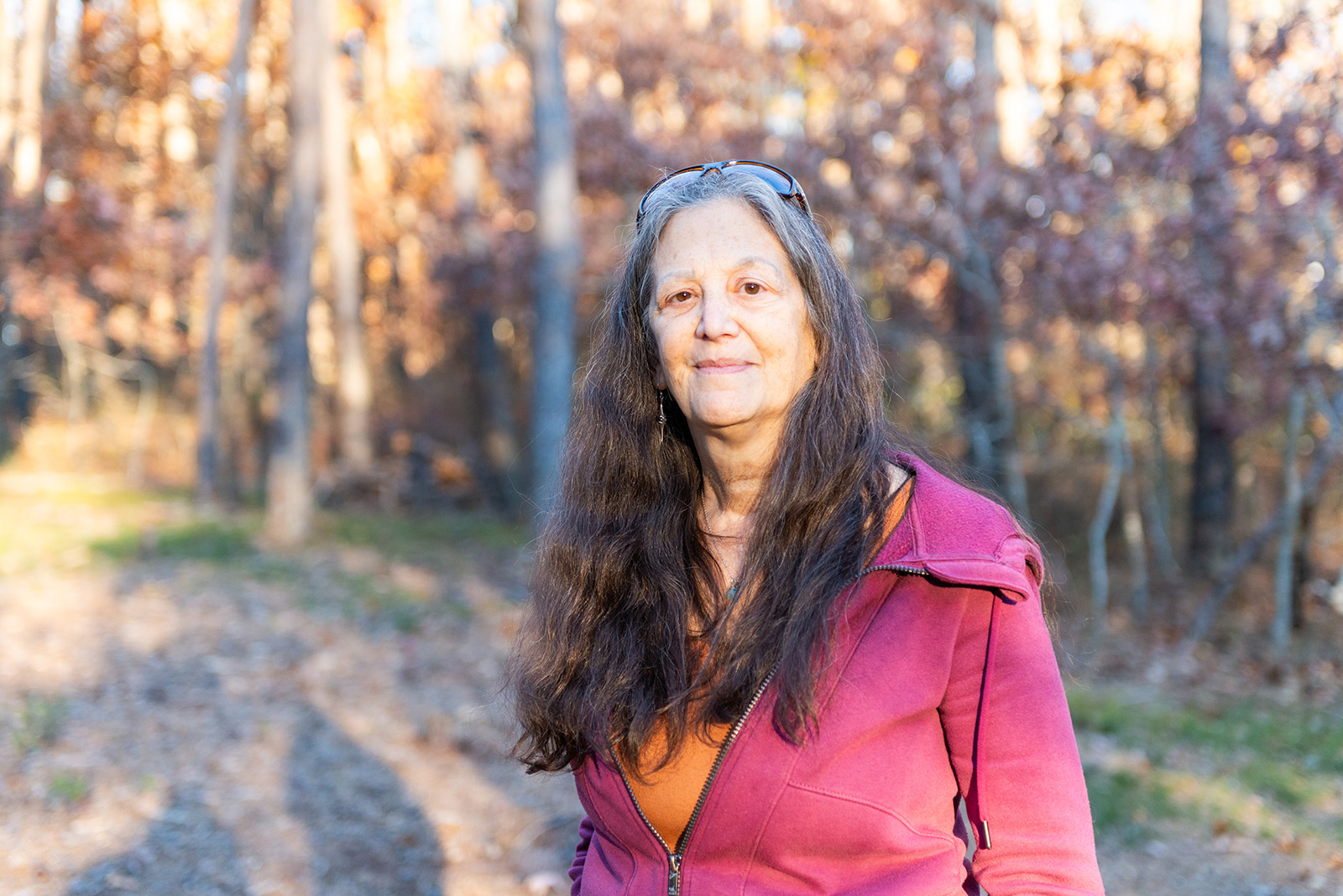
Batya Diamond had 45 trees removed from her yard.
“As we get going on these jobs, the next homeowner down the road comes out of the house and said ‘Hey, while you’re here can you do our house?’” Mr. Hamilton said.
West Chop has been hit particularly hard by the pine beetles, which have also made inroads in the state forest and the other down-Island towns.
As the cold weather sets in for the winter, the southern pine beetle will grow dormant. That makes now an ideal time to cut trees, said Adam Moore, the director of Sheriff’s Meadow Foundation, which has been dealing with the beetles on its conservation properties for years.
“The only thing you could really do that might have an impact on mature pitch pines on your property that you may wish to save is to thin out the pine forest ahead of the beetles getting there,” Mr. Moore said.
Bob Gilchrist, the president of Tashmoo Wood property owners association, said the association is still estimating how many trees it will need to cut down across its 107 acres, but that the number will surpass 2,000.
“Cutting them in a remote area is one thing,” Mr. Gilchrist said. “Cutting them when they’re near buildings or roads, or where they’re near our pool or tennis court is another thing.”
The push out of the forests and into neighborhoods has also raised concerns for Island towns and the Vineyard electric supplier.
Eversource has been tracking the progress of the southern pine beetle since it first appeared on Island in 2023. Chris Gonzalez, the manager of vegetation management, said Eversource is asking property owners for permission to cut down infested trees posing a risk to power lines.
“The majority of the trees we’re seeing are located on private property, but anything that is located on public property, we will eventually approach Tisbury, the town government tree warden or whoever else needs to be involved, to let them know what our plans are and get permission to cut those trees down,” Mr. Gonzalez said.
Kirk Metell, the director of Tisbury’s public works department, said he is already drafting a warrant article for this spring’s annual town meeting asking voters for $100,000 to trim and remove trees hanging nearby or above public roadways and walkways.
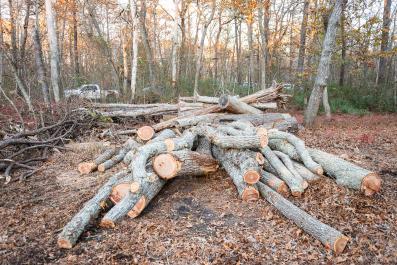
Figuring out what to do with all the dead wood has been a challenge.

Figuring out what to do with all the dead wood has been a challenge.
A growing problem for the electric utility, forest managers and homeowners is what to do with all of the cut down trees. Mr. Gonzalez said places on-Island are full and mainland facilities won’t accept the material because they worry about spreading the beetle infestation.
“One big concern with the amount of trees that are dying on the Vineyard is that there’s going to be so much wood waste…” he said. “We’re already running into issues with there [being] limited places where we can move logs and wood chips.”
Mr. Moore echoed the issue. He said shipping wood chips off-Island is expensive and the chips themselves aren’t worth much money.
“This is a big issue and as we deal with an outbreak over the next couple of years, that’s going to be something that we’ll have to figure out,” he said.
Mr. Moore has been advising homeowners who live near Sheriff’s Meadow properties that have been infested, such as the West Chop Woods. In April, Sheriff’s Meadow cut down 2,000 trees across 35 acres of the Philips Preserve in Tisbury. It was the first time the state permitted an organization to use an air curtain burner, a portable firebox used to incinerate tree debris.
“We got rid of that fire hazard, and in that sense, it was successful,” Mr. Moore said. “But I don’t think I would take that approach again, just because it was so expensive.”
The air curtain burner has been returned to its owner off-Island. Mr. Moore said Sheriff’s Meadow is now mulching the treetops.
“They’ll become a part of the soil,” he said. “Instead of burning it, setting that carbon into the air, we’re mulching it and putting that carbon into the soil and it’ll break down naturally.”
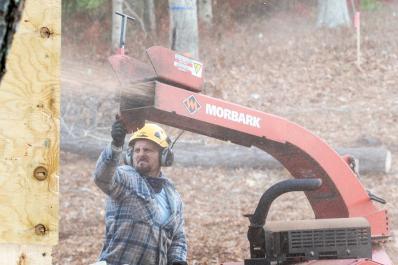
Work crews have been busy in West Chop.

Work crews have been busy in West Chop.
Ms. Diamond said the arborist she hired chipped the trees and offered to take them away for an added cost, but she declined. The arborist instead put them in a pile to the side of her driveway.
“If you drive along Sandpiper [Lane], you’ll see where the chips were mostly left on people’s property,” she said. “I think that’s part of the cost measures… if we can put the wood chips on the property that just makes [more] sense than having to pay to take them somewhere.”
Ms. Diamond said witnessing the damage felt like a chilling wake-up call.
“There’s definitely an emotional component…” Ms. Diamond said. “[We’re] just really witnessing first hand destruction and because of climate change.”
Comments
Do the piles of chips pose a
Lindsay Allison ChappyDo the piles of chips pose a fire danger themselves? Don’t they heat up when they rot? And aren’t those chips harboring the beetles, and potentially, spreading them?
Such a major change to the landscape but, remember, all those pitch pines are new since the 20’s when the island was open plains and grassland!
The pictures in the article
MikeD WTThe pictures in the article are mostly oak not pine
The first thing I noticed.
Bob D. ChappyThe first thing I noticed.
The trees still standing are
Jane Norton ChilmarkThe trees still standing are mostly oak, but the stumps are clearly pine - the bark is dark brown and ridged.
A couple of issues here, 1,
A Patriots View Off IsleA couple of issues here, 1, MOST ALL of the pic's you posted are of White Oak, NOT White or Pitch Pine!.
2, leaving Log,Chip,PILES or even spreading Dense Layers of Chips UNTREATED Can Often attract Carpenter Ants, Termites, to colonize over larger areas than would Naturally Occur.They are also FIRE FUEL should there be a fire it WILL INCREASE the INTENSITY/HEAT Factor which is what greatly feeds FIRESTORMS as seen in Ca, esp in open Flat Terrain w Constant Prevaing SW Winds Combined with the Drying Summer Heat in the Cape n Isle's areas.
3,If the expected tree waste is to be of great volume other methods, processes,exist to kill off the pests & should be utilized to create reusable product,ie Stove,Campfire,Fuel,Animal Bedding,Dewatering etc-Ground Cover on Busy,Muddy,Wet Paths,Drives,& Dust Supression, Erosion Control esp Busy Summer Area's.
4,Pest Spraying of decorative/ landscape/ Shade trees,esp near homes is also a cost effective defence as it takes So Long,$o Much to replace them ie Worth Trying, & value$ can drop for Tree Bare Properties. LOGICAL/PROPER Out of the box Thinking has I've noticed,is pretty uncommon in this area of Ma.& just doing what we've been doing is the More PUSHED ACCEPTABLE NORM
This is happening all over
Charlie Callahan So Boston/EdgartownThis is happening all over Plymouth county also
Add new comment