

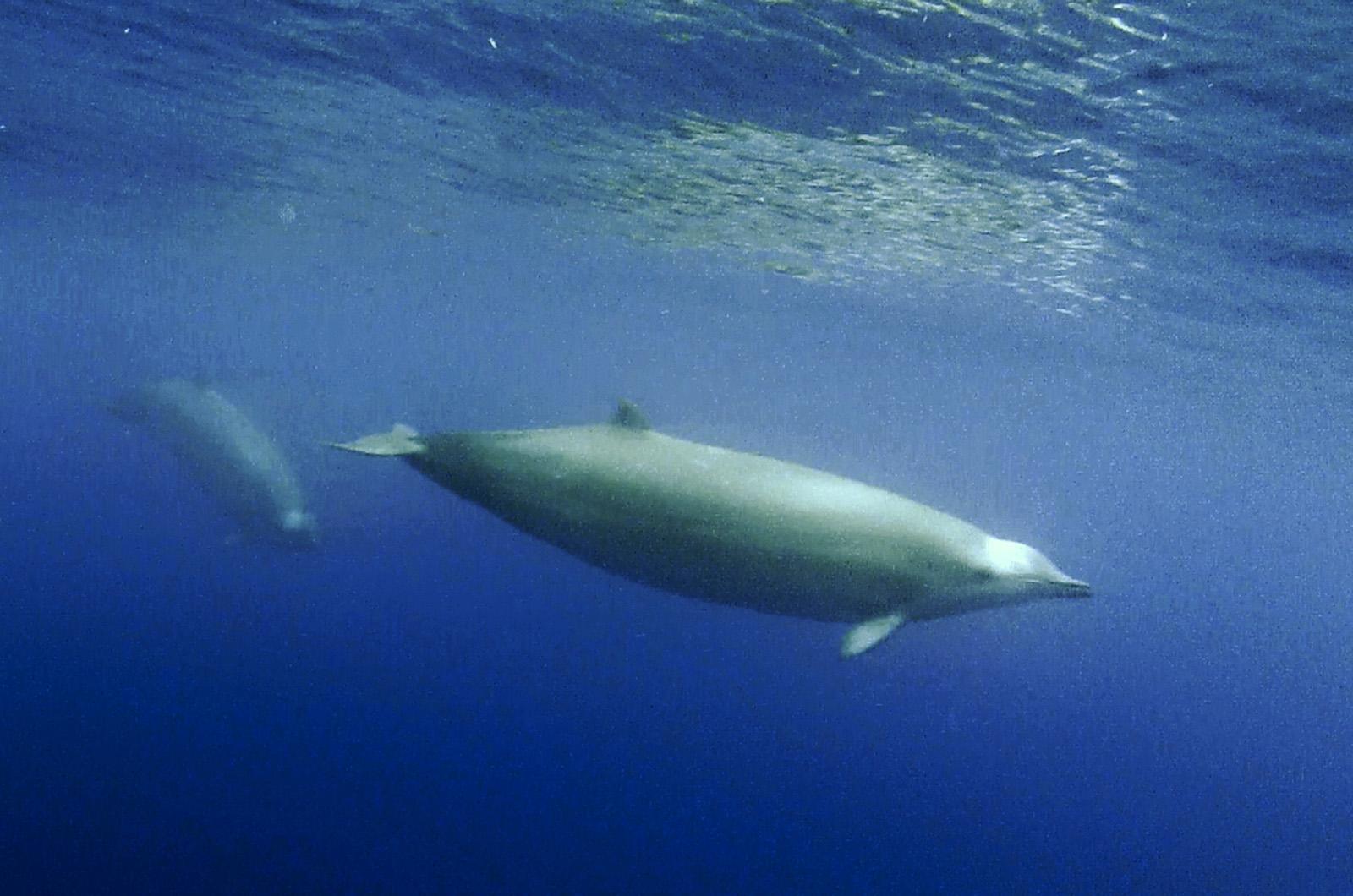
It was almost too good to be true.
It was almost too good to be true.
During a mid-October aerial marine survey, New England Aquarium scientists documented a bounty of beasts in the Northeast Canyons and Sea Mounts National Monument. The monument is a protected marine area located about 130 miles off the coast and encompasses 3.1 million acres of open ocean and its habitats. For reference, in its entirety, the monument is about the size of Connecticut and larger than Yellowstone National Park.
This special space was the first fully protected Marine Nation Monument in the Atlantic and was designated by Presidential Proclamation in 2016. This is the type of presidential decree I can get behind (thanks Obama), though the protections were weakened in the following administration (harumph), then restored by the one after.
More than 700 marine animals were observed in that survey, including more than 400 common dolphins and seven fin whales. The most unique sighting, however, was a rare and elusive True’s beaked whale.
True’s beaked whales are truly a mystery of the deep and have been described as the “least known animal in the world.”
Limited sightings of this whale make it a “data deficient” species. Both the International Union for Conservation of Nature (IUCN) and the National Oceanic and Atmospheric Administration (NOAA) suggest that population size or trends cannot be accurately determined.
Meloplodon mirus, the scientific nomenclature for this whale, translates into a description of the species as “armed with a tooth in the middle of its jaw that is wonderful or amazing.” Those teeth can be seen most clearly on the male whale, as its denticles are visible on the lower jaw even when the animal’s mouth is closed. The female’s teeth are smaller and are embedded in its gums so can’t be easily observed in the same way.
The whale’s common name was given by the man who first documented this species in the scientific literature. Frederick W. True was an American biologist and the first head curator of biology at the United States National Museum. The US National Museum was the precursor to the Smithsonian Institution.
True, born in 1858, started his career at the museum as an “expert special agent” on fisheries. He moved on to specialize in invertebrates, but his poor eyesight precluded the necessary use of microscopes. Committed to science and reinventing himself, True refocused on mammals and eventually began to concentrate on Cetaceans, the scientific order of whales, dolphins, and porpoises. In addition to his branding of this whale, this marine biologist also named True’s vole and True’s shrew mole.
It was a stranded whale that led to True’s discovery, when the first described specimen came up on a beach in North Carolina in 1912. These whales are small, with lengths of up to 17 feet and weights of 2,000 or so pounds. True’s whales are believed to give birth to one calf at a time, though it is not known where or when they breed.
Adding to the confusion is the difficulty in differentiating between the at least four different species in the genus of beaked whales. All are deep divers with members of this genus staying submerged for long periods of time. In 2020, a Cuvier’s Beaked whale broke the record for longest dive of a marine mammal when it stayed underwater (and not breathing) for just under four hours.
The photos taken of the True’s beaked whale may be the closest most of us will ever come to seeing this spectacular species. It almost sounds too good to be true, but the scientists that saw the species first-hand are true believers.
Suzan Bellincampi is director of the Felix Neck Wildlife Sanctuary in Edgartown, and author of Martha’s Vineyard: A Field Guide to Island Nature and The Nature of Martha’s Vineyard.
Comments
Very interesting! I'm just
John M.Very interesting! I'm just wondering: what differentiates a beaked whale from a dolphin? They look very similar. Thanks.
Add new comment