

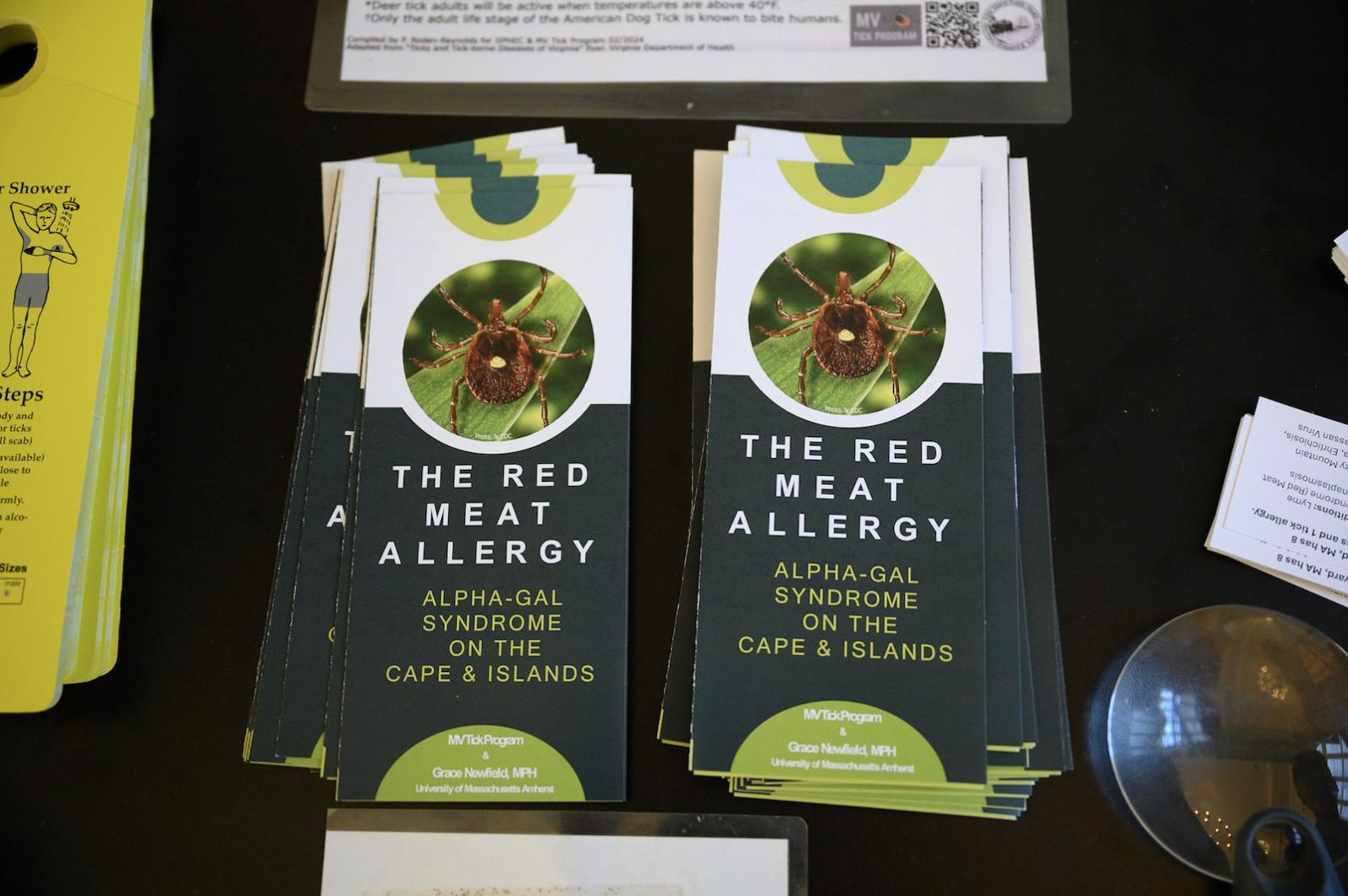
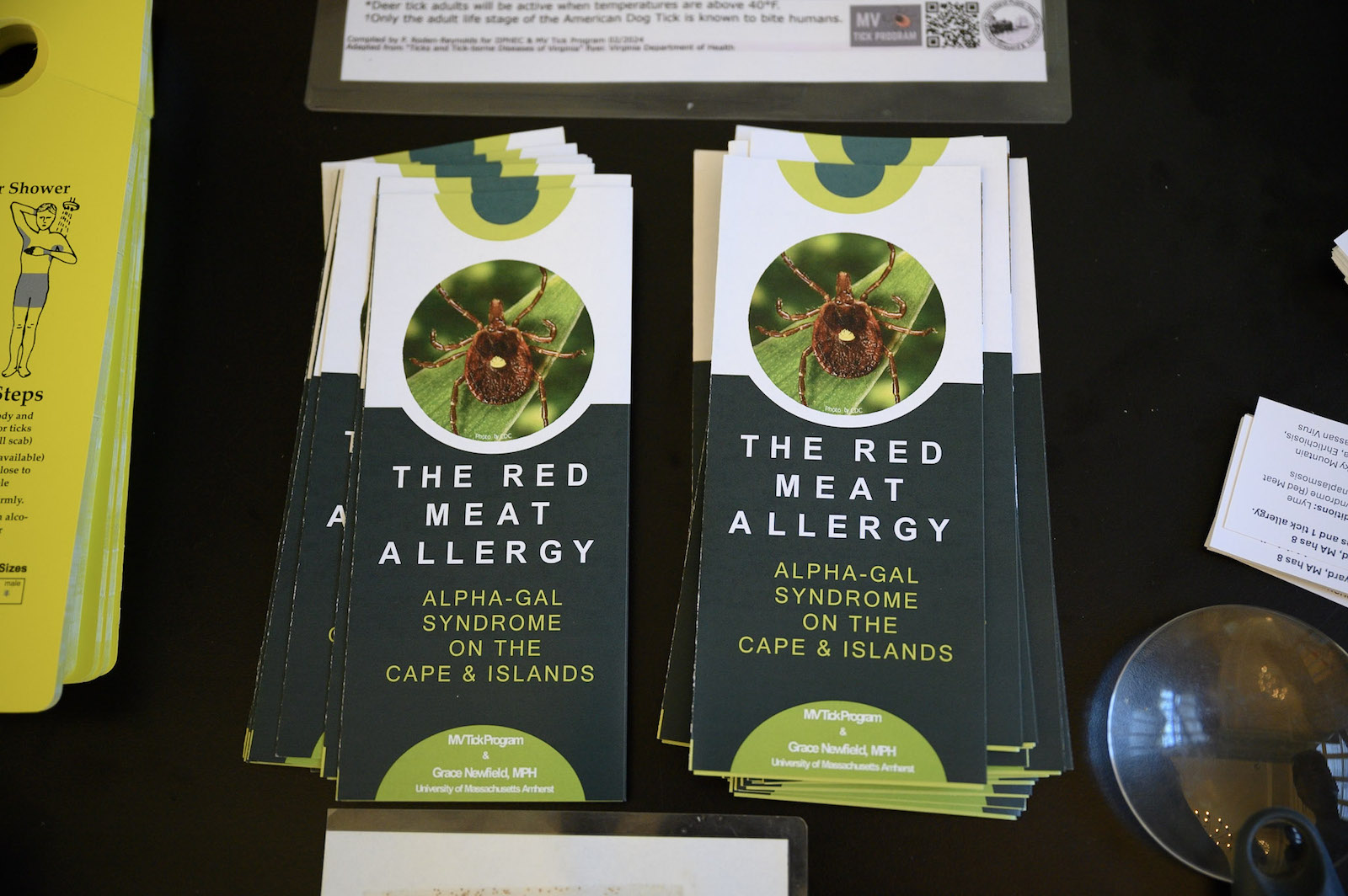
Researchers say that a New Jersey man’s death on the mainland last year is the first confirmed fatality caused by a tick-borne syndrome that has had a rapid rise on Martha’s Vineyard.
The death of a New Jersey man attributed to alpha-gal syndrome has put a national spotlight on the tick-borne illness that has had a rapid rise on Martha’s Vineyard.
Scientists with the University of Virginia published a study last week that found the 47-year-old man went into anaphylactic shock on the mainland in the summer of 2024 after eating a hamburger. Samples of his blood tested by the university pointed to alpha-gal syndrome as the culprit, marking the United States first reported fatal case of alpha-gal after consuming red meat.
The news spread to the Vineyard, which has become a poster child for the illness, bringing sadness and calls to redouble education efforts here and throughout the country.
“It’s an epidemic right now,” said Dr. Edward Caldwell, a recently retired ear, nose and throat specialist who has spoken on several Vineyard tick forum panels. “Now that there’s increasing awareness about alpha-gal sensitivity, you’ll probably have other fatalities reported.”
Alpha-gal syndrome has emerged as one of the major health priorities on the Island as cases have gone from single digits in 2020 to more than 500 positive tests at Martha’s Vineyard Hospital in 2024.
The syndrome can be caused by the bite of a lone star tick, which have made a home for themselves on the Island, and can make people allergic to red meat, dairy and other mammalian products.
Vineyarders infected with the illness have had to swear off beef, cheese and milk. Others have even had to give up certain pills that contain gelatin, as well as hand creams that use lamb’s milk.
In the case of the New Jersey man studied by the University of Virginia, he had eaten a steak dinner and several hours later had severe abdominal pain, diarrhea and vomiting, according to a study published by the university.
The man recovered from the incident, but the family couldn’t make sense of the health issue at the time.
About two weeks later, the man, whose name was being withheld, had a hamburger at a barbecue. About four hours after eating the burger, he collapsed, went into shock and later died.
The man’s family told researchers he had about a dozen chigger bites around his ankle that summer, according to the university. Many Vineyard residents two summers ago reported similar bites, and in both instances, tick experts believed the bites were actually from lone star tick larvae.
In the wake of the man’s death, the university tested the man’s blood and found he was sensitised to alpha-gal.
Lea Hamner, a Chilmark-based epidemiologist who has worked with the MV Tick Program, said this terrible incident illustrates why alpha-gal syndrome is often referred to as the “midnight allergy.”
“People can eat a perfectly normal dinner, feel fine for hours, go to sleep, and then wake up in the middle of the night or early morning with unexpected symptoms — sometimes with gastrointestinal symptoms like abdominal pain, nausea, or vomiting, sometimes with skin symptoms like hives or flushed hands and feet, sometimes with shortness of breath or dizziness, sometimes an impending sense of doom,” she said. “Because of the delayed reaction — two to eight hours after eating the trigger food — alpha-gal syndrome can go undiagnosed.”
Many people who work with ticks on the Island were sad to learn of the man’s death, especially considering increased education about alpha-gal could have made a difference in the case.
“It made it clear that education and awareness is crucial,” said Patrick Roden-Reynolds, a tick biologist with the MV Tick Program. “As soon as you get off the ferry on the mainland, alpha-gal awareness is nonexistent.”
Several people involved in fighting tick-borne diseases on the Vineyard hoped that this tragic incident would raise the profile of alpha-gal at the national level, perhaps bringing more attention and funding to the allergy.
There are estimates of 450,000 people nationwide who have alpha-gal, pegging it as one of the most common food allergies.
For Aubrey Stimola Ryan, a physician’s assistant at Martha’s Vineyard Hospital who has been dedicated to talking to Islanders about tick-borne diseases, what was distressing about this man’s case was how textbook it was for people who have encountered alpha-gal.
“When you look at the actual journal article, his symptoms are classic,” Ms. Ryan said.
But the hallmarks of alpha-gal that make it easier to see in hindsight are often what make it difficult to diagnose for patients and doctors unfamiliar with the disease. The symptoms are generic, delayed, and, once they’ve gone away, often forgotten about.
But now that the allergy has proven lethal in the U.S., Ms. Ryan wanted more doctors and patients to have this on their radar moving forward.
“It’s something we need to bear in mind waking in the middle of the night,” she said.
There has been ongoing work around alpha-gal on the Vineyard and its visibility has pushed several restaurants to highlight which items are alpha-gal friendly.
The Island also has an alpha-gal support group, and the death was much talked about at a recent meeting, according to Mr. Roden-Reynolds. He said he’s heard from people who were able to recognize their symptoms after learning about the allergy, giving him hope that education can work.
Island health care providers agreed that more needs to be done, both here and across the country, to prevent further deaths.
“It qualifies as an exponential epidemic that’s occurring,” said Dr. Caldwell, who has alpha-gal himself. “The Island needs to get on top of their skis about it.”
Ms. Hamner said getting the word out about alpha-gal to the public and policymakers is crucial because people have often not heard of the allergy until they are diagnosed with it. Health care providers in other parts of the country are also not as familiar with the delayed allergic reaction.
“That’s why the Martha’s Vineyard Tick Program has been so focused on outreach and awareness,” she said. “Our Island health care providers have been on the frontlines of our allergy epidemic, but I constantly hear from patients about the lack of awareness when they go get medical care off-Island.”
Awareness and bite prevention is key as science learns more about the allergy.
“It’s changing how we are interacting with the Island,” Dr. Caldwell said. “Unfortunately, it makes it more difficult. You have to be more aware.”
Comments
I get on average 6-7 bites a
Tom Engley West tisburyI get on average 6-7 bites a year I have one now. I have a lot of dogs in my life and I live in the woods. Cats too.
Maybe we should all eat as if we had alpha gal.
Epi-pens need to be more
Tick magnet AquinnahEpi-pens need to be more accessible. Most people get their first reaction having no idea what’s happening, and many times it’s late at night after dinner. It takes too long to be prescribed a pen and it’s very expensive. They should be available over the counter and free, or at least discounted, to Vineyard residents. They should be in every home medical kit. People are going to start dropping like flies out here bc there’s not enough access.
I'm surprised the red meat
tom BostonI'm surprised the red meat and pork industry is not all over this. They should be donating millions for research and development of a vaccine. This is spreading all over the country and is unlikely to stop. They stand to lose millions of customer.
Create the problem . Offer a
Art bell Vineyard HavenCreate the problem . Offer a solution. Lab gown meat.
Or Plant Based
Betsy Burmeister West TisburyOr Plant Based
I was diagnosed about 2 years
Ralph Friedman Vineyard HavenI was diagnosed about 2 years ago with Alpha-gal. I have strictly followed a safe diet avoiding all meats, all dairy products, and changed certain medications that come in gelatin capsules to tablet form. This has resulted in my numbers going down. Unfortunately, the number is not yet low enough to safely try even a piece of parmesan cheese. It would be helpful if Vineyard restaurants expanded their menus for Alpha-gal friendly foods and also train their wait staff and the cooks who prepare the food. This is available in many restaurants off island. One restaurant gave the table a grid listing various allergies and the food items they prepare. Following the grid, it was easy to pick out what was safe to eat. The most helpful tool we have found to assist buying products is the App FIG. The FIG app on your phone allows you to select the allergy/allergies to screen. Open the app in a store, and use the camera on the product's barcode. FIG will inform you if it's safe or not.
What is the deer population
Lorraine EdgartownWhat is the deer population of the Vineyard per acre? What is the deer population number per acre that is safe?
One comment to all eat like
Jesse Vineyard HavenOne comment to all eat like we had alpha gal, another for lab grown meat. Society truly losing a grip on itself. Buy food from farms, not from laboratories.
Jesse, obviously this is not
LiisaJesse, obviously this is not a helpful comment when red meat (even from farms) is the problem. Also, don't knock it tol you try it!
Let us be proactive with this
Lorraine EdgartownLet us be proactive with this problem. We have had tick issues and illness for decades; we have highly visible and important people on the island, including, but not limited to, a former president. Let us get something global going on here.....a center of learning and research? There seems to be funds for everything except this problem. Is this a class issue? The McMansion people do not do their own garden and yard work, so who is getting hurt? I find this apathy in the face of illness and now fatalities to be unconscionable.
Spray the state forest with
Charlie Callahan So Boston/EdgartownSpray the state forest with permethrin
Before going in woods etc, I
Carol suitor FalmouthBefore going in woods etc, I spray Sawyers on my clothing. Dog gets sprayed with wondercide. I am out a lot. So far lucky. Totally agree about epi pen availability post.
Add new comment