

A bill before the state legislature that has drawn Islander support makes a new attempt to secure a fee on high-end real estate sales in order to turn the tide on the region’s housing crisis.
A bill before the state legislature that has drawn Islander support makes a new attempt to secure a fee on high-end real estate sales in order to turn the tide on the region’s housing crisis.
About a dozen residents Wednesday threw their weight behind the bill filed by the Island’s state Sen. Julian Cyr earlier this year. If passed, it would allow seasonal communities in the state to assess a 1-2 per cent fee on most real estate transactions over $1 million, with the money going towards housing initiatives.
The Vineyard, Nantucket and several other communities in the state have been pushing for a housing transfer fee for years, but it has continued to meet resistance at the State House, partially from the real estate lobby in Greater Boston.
Last year, Gov. Maura Healey included a transfer fee in a large housing bill that was similar to the Vineyard’s parallel housing bank push, but both failed to make it through the legislature. Seeing that resistance, Senator Cyr, a Democrat from the Outer Cape, said he crafted the new bill to be only applicable to resort communities where there is desperate need.
The hope is that the more tailored version would draw less pushback on Beacon Hill, finally giving the Vineyard and seasonal communities a much needed funding source to deal with lack of year-round housing.
“It’s one more strategy for how we can secure a revenue source to stem the housing crisis that confronts Martha’s Vineyard and the whole region,” Senator Cyr said in an interview.
Kuehns Way, a 20-unit affordable housing complex in Vineyard Haven, was completed in 2022.
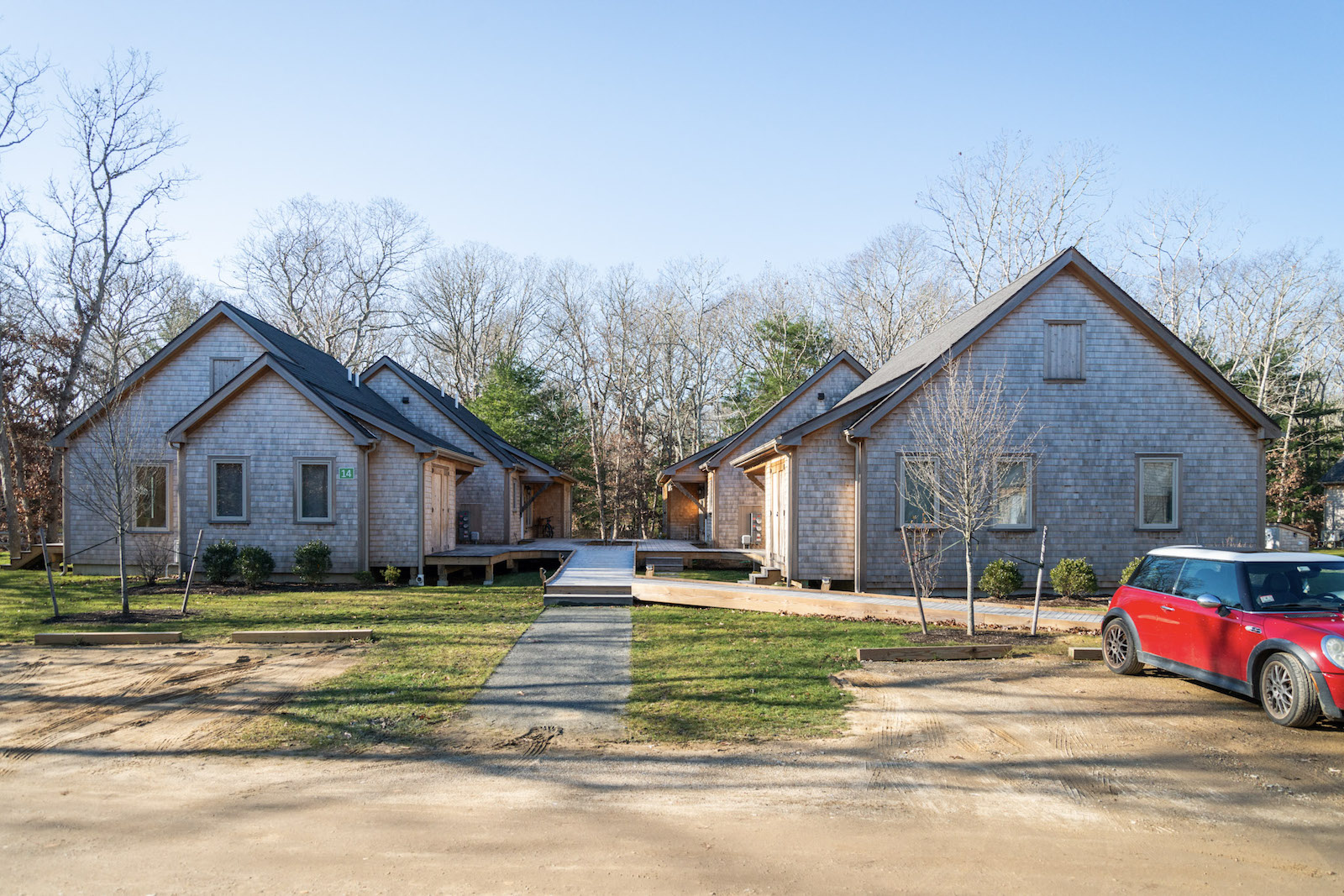
Kuehns Way, a 20-unit affordable housing complex in Vineyard Haven, was completed in 2022.
During Wednesday’s hearing with the legislature’s joint committee on housing, Islanders painted a bleak picture for middle class and low income residents on the Vineyard, saying they are increasingly being pushed out of housing opportunities, leaving few people to take service, medical and public safety jobs.
Though the state has given towns more options to combat the housing crisis through the Affordable Homes Act last year, the lack of funding to implement those strategies has hampered the Vineyard.
“This bill would give us a sustained revenue stream to preserve existing homes, convert short-term rentals to year-round use and build affordable housing where appropriate, while protecting our fragile environment and sole source aquifer,” said Philippe Jordi, the CEO of Island Housing Trust, a prominent nonprofit housing developer on the Island.
“Please give us the ability to help ourselves,” he said.
During the hearing, some stark numbers were laid before the legislators. The median home price on the Island has reached $1.5 million, a 120 per cent increase over the last decade. At the same time, 40 per cent of Island households are putting more than half of their income toward housing, and one in five members of the year-round population is going to the Island food pantry each year.
Residents talked about deeply-rooted families moving off-Island because they couldn’t find a place to live, and essential services having unfilled jobs because no prospective applicants could afford the Island’s housing costs.
Noli Taylor, the co-executive director of Island Grown Initiative, a nonprofit that runs the Vineyard’s food pantry, said Islanders from all walks of life are asking for help.
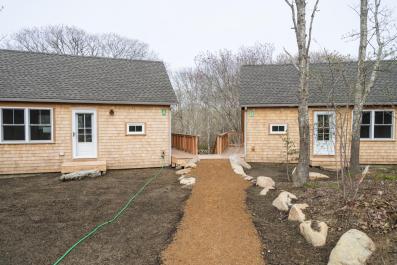
Construction was completed last year for affordable housing units at Carl Widdis Way in Aquinnah.
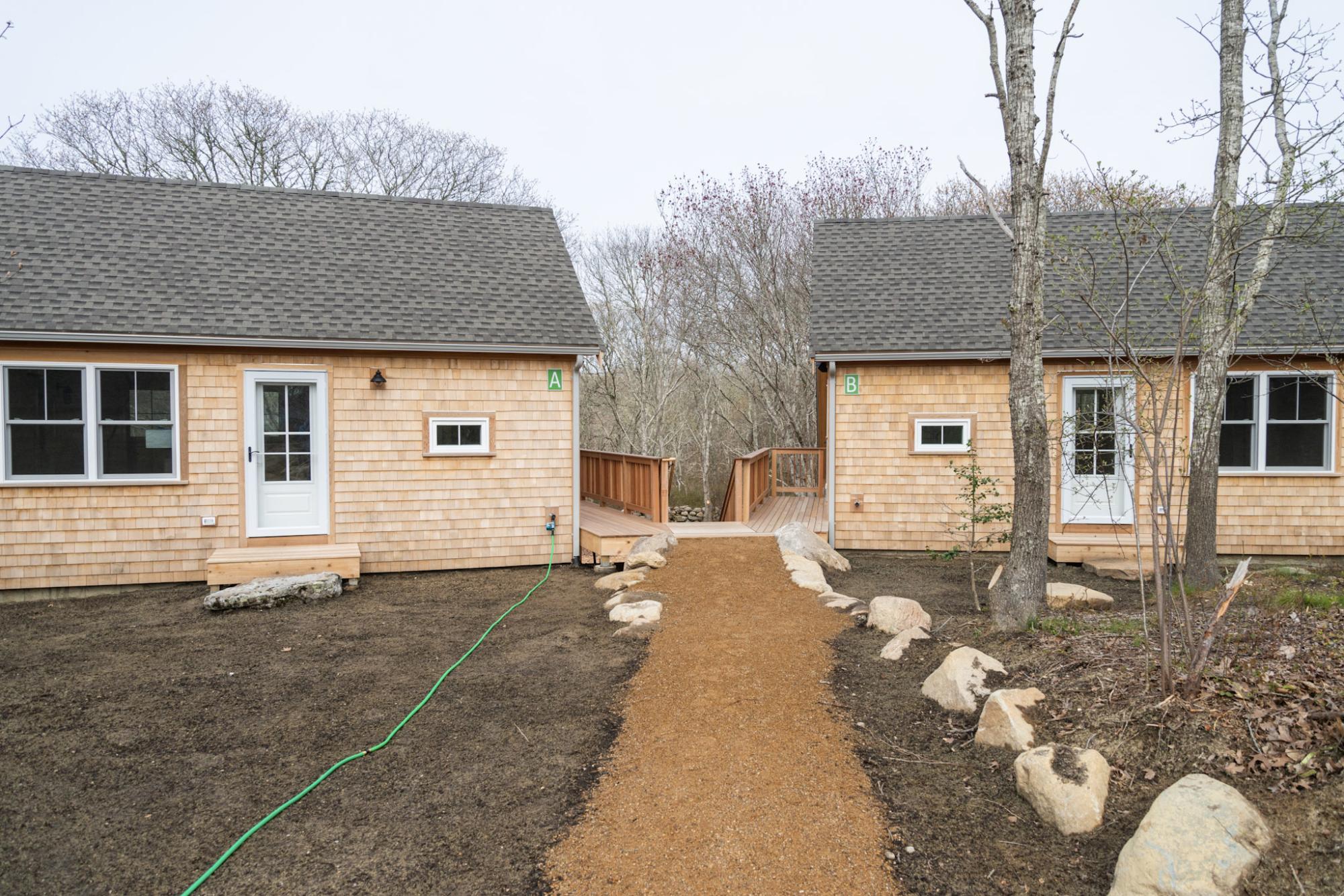
Construction was completed last year for affordable housing units at Carl Widdis Way in Aquinnah.
“Thousands of our neighbors are having to choose between putting food on the table or a roof over their heads, and that is an impossible choice to have to make,” she said.
Nowhere was the workforce issue more urgent than in Aquinnah, where the police force is down to a single officer who is set to retire next year. Chief Randhi Belain pleaded with the committee to pass the bill.
“This would tremendously help us to be able to tell an applicant that you potentially could be able to afford housing here, whereas right now it’s unfeasible,” he said.
Dukes County Sheriff Robert Ogden made similar calls for action, as did Elsie Taveras, a doctor and the chief community health and equity officer with Massachusetts General Brigham, which owns Martha’s Vineyard Hospital and Nantucket Cottage Hospital.
“Our 2025 community health needs assessments show severe housing shortages on both Islands,” Dr. Taveras said. “Even those who are housed often live in overcrowded, unsafe or unpermitted conditions, some without running water or cooking facilities. Nine-month leases are common, forcing residents to leave so landlords can rent at incredibly high summer rates that we all have heard about.”
Under the bill, towns would have to vote to adopt the transfer fee, which would be paid for by the buyer when closing on a home. The rate could be between .5 per cent and 2 per cent and would be only applicable to the portion of a sale price above the exemption threshold – another key difference from the past attempts to pass the bill.
For instance, if the transfer fee was set at 1 per cent of a $1 million exemption, a home sold at $1.5 million would be $500,000 above the threshold and result in a $5,000 fee for housing.
The housing fee funds could be used for affordable or attainable housing, which would allow towns to reach the “missing middle” income earners on the Vineyard who don’t qualify for affordable housing, but don’t make enough to buy their own places on the Island.
Towns could set a higher real estate price threshold and there would be several other exemptions for homebuyers, including for first-time homebuyers who plan to live at the property.
Supporters said there is precedent for transfer fees on the Vineyard; the Martha’s Vineyard Land Bank is currently one of only a handful of similar organizations that is supported by fees assessed on property sales.
Laura Silber, the Martha’s Vineyard Commission’s housing planner, said the bill could be useful for the Island, and mirrored similar efforts in other resort communities across the country, such as Aspen and the Hamptons.
“We have seen very successful examples in high-priced resort communities where the luxury transfer fee effectively harnesses the problem to help fund the solution,” she said.
There is still hesitancy from some realtors about the new proposal. Betsy Hanson, the CEO of the Cape Cod and Islands Association of Realtors, said in an interview that her organization is against the bill.
The association is opposed to transfer fees in general, saying past studies have shown that they can affect home prices and can fail to raise enough to deal with the problem.
“You’re looking at a lot of fees that are baked into the sales transaction,” Ms. Hanson said, before asking towns to consider other measures first.
Not all realtors were in agreement, though.
Jim Feiner, a Chilmark realtor, told lawmakers at Wednesday’s hearing that he and other Vineyard real estate professionals were firmly behind a transfer fee, saying it was needed to prevent the hollowing out of the community.
“Martha’s Vineyard is eroding, and I’m not talking about the beaches and the shoreline, but the community and the people,” he said. “We’ve been watching our friends and our workforce and our vital workers depart slowly but steadily, and now faster.”
Other critics felt that the focus should be on driving down the costs for residents, not adding fees.
“Senator Cyr should redirect his focus on driving down costs for all residents, not take from Peter to pay Paul,” said Paul Craney, the executive director of the Massachusetts Fiscal Alliance, a vocal statewide conservative group. “Raising taxes does not make something more affordable.”
Senator Cyr has also put forward another bill that would give seasonal communities a host of other options to make housing easier for residents. The bill would give municipalities the right of first refusal on foreclosure properties to use them for housing, the ability to set higher tax rates for homes that sit vacant for most of the year, and the opportunity to raise the meals tax from .75 per cent to 1.5 per cent, with the extra money to go toward year-round housing.
The bill also could allow the conversion of hotels and motels into year-round housing, as well as zoning changes that would allow small-scale, year-round housing by right. It also would allow towns the ability to require large developers to either include a small percentage of year-round units in new projects or pay a per-unit fee toward a municipal year-round housing fund.
Much of the second bill is aimed at expanding the seasonal communities designation that was passed by the legislature last year, and acknowledges that places such as the Cape and Islands and the Berkshires have different circumstances that other parts of the commonwealth.
It also seeks to clean up any technical issues that came from the bill that was passed last year, Senator Cyr said.
While the senator said many of the tools in the second bill are great and he wanted to see towns use them, he emphasized the need for the transfer fee above all else so there is sustainable funding for housing.
“Without a stable and robust revenue source, it will be difficult [to realize] the scope and scale of what [the seasonal communities designation] was intended to do,” Mr. Cyr said.
Comments
One million isn't 'high end'
seasonal edgOne million isn't 'high end' here. Its a starter home if you're lucky enough to find one habitable. There IS a simple solution but nobody here wants to discuss it. A 'manufactured home' community where you can easily put 8-10 'single wide' homes per acre. Take the old landfill on Meshacket road, put in water, sewer and pave the roads.Rent the pads cheap. Homeowners own their manufactured home.. Problem solved.
I agree that $1 million is
Christine SengeI agree that $1 million is not high-end here. I’m all for the proposal, but believe the rate needs to start at $2 million.
First, you are exactly
John Aldeborgh KatamaFirst, you are exactly correct, $1M is a starter home at best on island.
Second, allocating what is essentially public land for low cost housing development is a very sensible and practical move. Followed by investment in the infrastructure to allow modular or prefab homes would reduce costs dramatically.
It’s essentially impossible to build (construction only) on island for under $500 a square foot, which by mainland standards is ridiculously high.
Time to stop the 3% Land Bank
Anne EdgartownTime to stop the 3% Land Bank tax and move to 1-3% Affordable Housing tax. There are plenty of hikes on the Cape and Islands. No one is actually hiking because of Lyme disease and Alpha Gal. It has served it's purpose and it is time to retire that tax.
I agree 100%. Enough money
Janice EdgartownI agree 100%. Enough money to the Landbank and enough land under conservation restrictions. Islanders desperately need affordable housing.
there is no housing crisis...
michael edgartownthere is no housing crisis....not everyone can live here... stop the drama
This is a cynical perspective
Mike Vineyard HavenThis is a cynical perspective. Service industry workers need places to live. This is part of the cost of the privilege you have in living in a resort community.
Hi speed ferry is a good
tom BostonHi speed ferry is a good solution. Our year round population has grown too far, too fast. To "solve" the housing crisis you will destroy the character of the island (and that is unquestionably under way). Another issue that is rarely talked about regarding housing is MV is a seasonal economy. It's very difficult for many residents to make enough to be able to afford a house even if it was subsidized. Insurance, taxes, utilities and maintenance have skyrocketed.And why wasn't the hefty STR taxes 100% applied to affordable housing?
You are correct - there is no
Anonymous WTYou are correct - there is no housing crisis for rich people!
Don't tax thee, don't tax
Lorraine EdgartownDon't tax thee, don't tax thee, tax that man behind the tree. Fees are taxes.
Whoops, forgot to proofread
Lorraine EdgartownWhoops, forgot to proofread in my enthusiasm. Don't tax ME......don't tax thee, etc and so on and so forth...
I am an island property owner
Rose Boston and KatamaI am an island property owner and I support this measure. We (all of us, everyone, me and you) need to do more - far more - to alleviate the lack of affordable housing. Those who have the privilege of ownership should be willing to make a contribution to those who are struggling with housing. It’s simply the right thing to do.
This is the last thing the
Bob EdgartownThis is the last thing the island needs is another tax on selling a home. In fact the island is building more low income housing all the time and at some point the island will have enough of all homes but the tax will still be there. And then they will build even more homes we can not support and will have ruined the island.
It’s simple. Put municipal
Easy fixIt’s simple. Put municipal housing on the tax rate. Create housing for teachers, police, fire, assessor etc and fund it through the tax roll. Everyone else is an employee of a for-profit business that should be the responsibility of the business owner. If you profit from the sale of a hamburger, you should be using some of those profits to support the person that makes it. Four vacations, a boat and a plane shouldn’t be at the expense of the property owner. Enough already.
End the land bank.
michael chilmarkEnd the land bank.
Assign those $$$ to housing.
I'm with Michael. The Land
Chris KatamaI'm with Michael. The Land Bank has taken in enormous sums of money as Island real estate prices have skyrocketed. They are over-funded and serve to compete with the open market for valuable land. We need halve the fees for the land bank and replace that half with an affordable housing tax. Both should have expiration dates so they can be periodically renewed and reset to the right level, or they should have a graduated scale that moves inverse to the market. Here's a novel idea, when the towns and the state slapped a combined 10% tax on short-term rentals, with ZERO investment on their part and ZERO accountability to where those tax dollars go, it was a brazen money grab. How about using the short-term rental tax to fund affordable housing? Massachusetts real estate taxes are the highest in the nation BEFORE you add in the Land Bank taxes. Enough incremental taxes!
I agree with Chris. Halve the
Payer of Taxes NJI agree with Chris. Halve the land bank and make use of the STR tax for affordable housing. Expirations on all taxes is also a great idea.
Totally agree michael, I have
Islander61 OBTotally agree michael, I have been saying that since the beginning of this debate. However, the issue that contributes to our problem is that when the land bank buys property it takes that property off the books and now that decreases availability of land for housing, thus increasing the cost of property due to lack of supply. Land is finite, we aren't making any more.
Secondly, I also agree with the Seasonal, Christine, and John above, $1M is way too low of a trigger. That needs to be raised. Suggestion to anyone who may have influence: Alternate years of land bank and housing bank, use those funds to create housing, do not add another tax (it is not a fee).
We cannot and clearly will
Wake Up EDGWe cannot and clearly will not "build" or "tax" or "non-profit donate" our way out of this. Major problems need multiple staged solutions, not a single approach. New and creative ideas out here get crushed under the weight of the sole solution mentality. The concept of "if we tax it, it will be solved" is insane. The STR tax alone puts millions into the coffers of our municipalities, and yet, simply used to balance out budgets. The two major challenges I hear about the ADU / AHA law is that 1) How do families estate plan with the new added structure and 2) If you can't add more septic capacity / or tie into sewer - you're out of luck. Massachusetts had roughly 850 ADU applications and about 500 were approved. Think about it. The AHA was incredible for building consensus, but in practice, it's failing to demonstrate scale and impact. I'm sorry, but a tax on sales is only realistic if the committees doling out the funds actually know how to build, what to build and where to...
Simple solution , stop the
Tim Greer TisburySimple solution , stop the theft against property owners and eliminate property taxes .
Property taxes are unfair, especially to lower income families. What will happen to property taxes when hyperinflation comes and $1 million dollar fixer uppers become $10 million ?
Do the Towns really think they can get away with raising the property taxes to astronomical amounts after the collapsing dollar gets reset ? Think Venezuela, Argentina or Germany after WW1. The Island Towns need plans in place for dealing with hyperinflation and there is no way funding Town budgets through inflated property taxes is going to work when homeowners have lost their bank deposits and stock market portfolios. There’s a very real financial crisis coming and we are worried about more affordable housing ? This issue is as old as time and simple fixes are not going to resolve the housing shortage, especially now when hyperinflation is around the corner .
We need to do far better electing Town officials and get fair minded business savvy people to run our Town budgets . The Island Towns urgently need to get plans in place for bank closures and the loss of tax revenue due to hyperinflation and the collapse of the dollar.
How will schools, police,
Albert GosnoldHow will schools, police, fire, and public infrastructure be funded?
A local income tax?
Sales tax?
We the people elect our leaders, would you want it any other way?
Many of us are already gone -
Chief Wiggum off islandMany of us are already gone - to a better life - as unthinkable as it once was.
A mansion tax has proven a
John Aldeborgh KatamaA mansion tax has proven a disaster in California, crushing the high end real estate market, so the anticipated tax revenues never materialized, the realtors suffer alone with real estate investors, essentially there are no winners. It’s not possible to tax our way to better living standards or prosperity.
Stop whining about real
Charlie Callahan So Boston/EdgartownStop whining about real estate taxes,taxes on the Vineyard are pretty cheap
Nearly the lowest in the
Albert GosnoldNearly the lowest in the State.
We have fabulous park's and beaches.
What you and Charlie
tom BostonWhat you and Charlie consistently ignore in the tax calculation is the extremely high valuations of MV properties vs the vast majority of the state. Yes maybe the tax rate per $1000 may be on the low side but multiplied by an unusually high valuation turns into a pretty hefty tax burden. For example, a house in Chilmark might be valued at $2.5m. That exact same house is likely $1m off island (in most towns). So the low rate multipled by a high valuation equates to a higher tax bill (certainly not low). Then you have the service component. I believe the majority of homes on the island are owned by folks who use them seasonally. They use very little of the services so in reality their taxes are very high. . It's disingenuous to say proper taxes on the island are low.
How many homes on MV are
Pearl WTHow many homes on MV are short term rentals? Is there a place to find this information? It would be interesting to know how many single family homes are being used for this purpose.
Develop a two percent minimum
Bill Oak BluffsDevelop a two percent minimum fee for anything that has a rental agreement. This would be for homes, rooms, cars, bikes, mopeds, jet skis, tents, tools, moorings, anything that is rented. These funds could go directly back to the towns to fund police, fire and ambulance services in whatever way it is needed. I would assume housing and seasonal workforce would be a good use. This puts some financial responsibility on the folks that increase the strain on those services.
That fee ( tax) already
Enough Already Oak BluffsThat fee ( tax) already exists for rental homes and the towns take in somewhere around 10 million a year which they have chosen to put towards the bottom line. Elections have consequences!
I don't understand this
Enough Already Oak BluffsI don't understand this concept that everybody has a right to live here and we need to raise taxes to make that happen. Housing has been expensive and hard to attain on the island for decades, it's nothing new. STR's are not the problem, in fact, they may be the solution. They create the jobs that enable young people, if they are willing to work hard, to start businesses and thrive on the island. Affordable housing developments create few local jobs yet increase the population raising taxes for all of us with increased school population , more emergency services, road maintenance , hospital upgrades , etc. I could support this new tax if it were for properties over $2 million and the money was spent to subsidize high speed ferries for commuters. That's how the real world works!
We cant even fix the traffic
Ken Edg.We cant even fix the traffic problem at the triangle during summer. Dont build anymore until you can.
Young people can buy a house
James EdgartownYoung people can buy a house on the island if they put in the effort. I did it in my 30's with no inheritance and on a blue collar salary. All of my peers told me it would be impossible. The narrative on the Vineyard is a victims narrative. They want hand-outs. I'm not making the claim that it is easy, simply that it is possible. If you don't feel like putting forth the effort, move somewhere else. Otherwise stop claiming the sky is falling. Housing crisis!? Can you hear how weak that sounds? And how insulting to those who have made the effort to be homeowners without government assistance.
James you are absolutely
Enough Already Oak BluffsJames you are absolutely right. I did the Vineyard shuffle for 13 years, then found a place I rented for 7 years and then after my wife and i worked two or three jobs each year round we bought a place 10 years ago. Wages are very high here but you must work at least two jobs to afford a house. Unfortunately young people today aren't going to deny themselves the trip to the Bahamas or the new car or the latest Iphone in order to save for a house. They certainly wouldn't consider buying a lowly "starter home", gasp!
I bought land in 1980, built
me too MVI bought land in 1980, built in 1983 when interest rates were 18 percent fixed. I had 3 jobs and rented a room to a friend for the income to help pay the mortgage. It can be done. In the summer bartenders routinely make $1000 per night in unreported tips. SO making close to a 100k for the summer is a nice gig, especially when you can do construction in the winter. They make more money than I do and do not deserve a subsidy. I have heard this same stuff forever.
I commend the commentor who
Charlie Callahan So Boston/EdgartownI commend the commentor who said he had 3 jobs in the 80 and was able to build a house . Now u can have 3 jobs and barely afford an apartment here.I retired 40 years ago and bought a small place in Edgartown for $30,000,I cant believe what its worth compared to what I paid,I was lucky. Now kids don't have a chance when a little place like mine is worth over $1,000,000. I would gladly pay higher taxes if it would help those that need a hand up.I have a 3 decker in southie that is in need of repair and the taxes are triple what I pay here. Raise the taxes and lets help young people get a start.Make provisions for eligibility like not renting anything out that they got help getting and they can't sell for ten years and whatever else that would make sure no one gets help if they are planning on renting the place out.
Are you comparing Edgartown
tom BostonAre you comparing Edgartown to a section in the City of Boston? Edgartown is essentially pert of rural America and is heavily subsidized by considerable tourist dollars. Soth Boston is part of a major metropolitan with vast, expensive services. There's zero comparison between the two. I wouldn't compare Lake Placid, NY to Manhattan either.
Affordable housing enables
Tired of Transfer Fees West TisburyAffordable housing enables employers to pay wages below what workers need to exist on island. If we all want services on the island we as users should pay service costs that reflect the true cost of providing those services.
Add new comment