


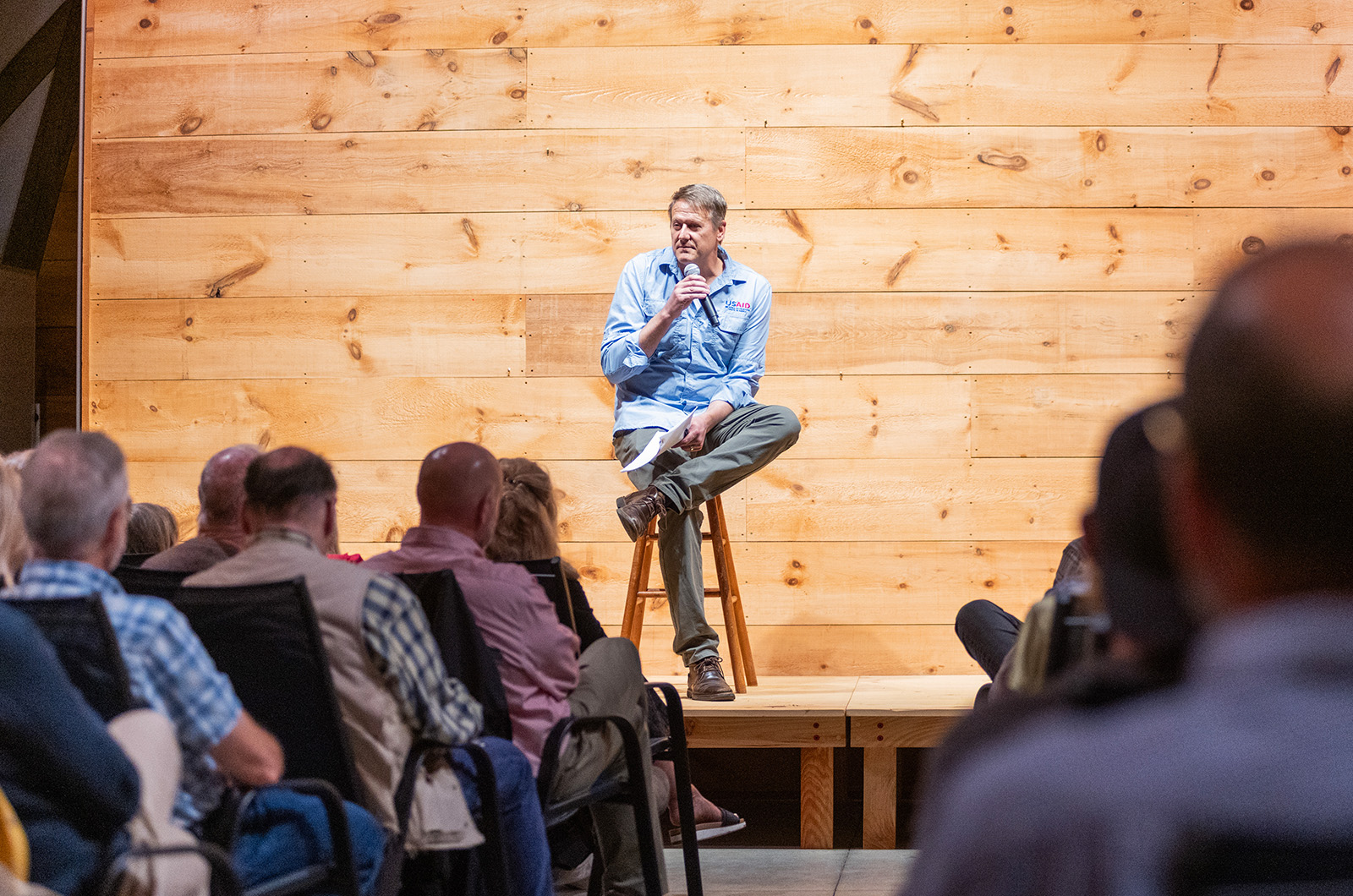
Nathaniel Scott took the stage at Stillpoint Thursday to talk about his 16-year career with the US Agency for International Development (USAID), and the agency's ongoing collapse.
When Nathaniel Scott took the stage at Stillpoint Thursday to discuss his 16-year career with the US Agency for International Development (USAID), he was wearing a blue button-down shirt with the USAID logo embroidered on the pocket. It’s the style of shirt he used to wear to identify himself when doing field work for the foreign aid organization.
“I used to hate wearing them,” he said. “These are the dorkiest shirts I’ve ever seen in my life. But now, it hits different.”
Mr. Scott lost his job at USAID after the Trump Administration abruptly cut the majority of the organization’s funding and staff earlier this year. His Stillpoint talk, An Evening with Nathaniel Scott, detailed his career at USAID and the agency’s ongoing collapse.
USAID is the main American government agency that provides humanitarian and developmental assistance overseas. Founded during the Cold War, it was the world’s largest foreign aid organization until this year.
Mr. Scott grew up on the Vineyard and he first started traveling abroad when a fellow Islander urged him to “get out of his zipcode.” He visited Australia, backpacked through South America and taught in the Marshall Islands for Harvard-run organization WorldTeach. The experiences made him curious about international aid and led to his first job with USAID.
Mr. Scott's 16-year career was abruptly cut short due to the Trump adminstration's new policies.
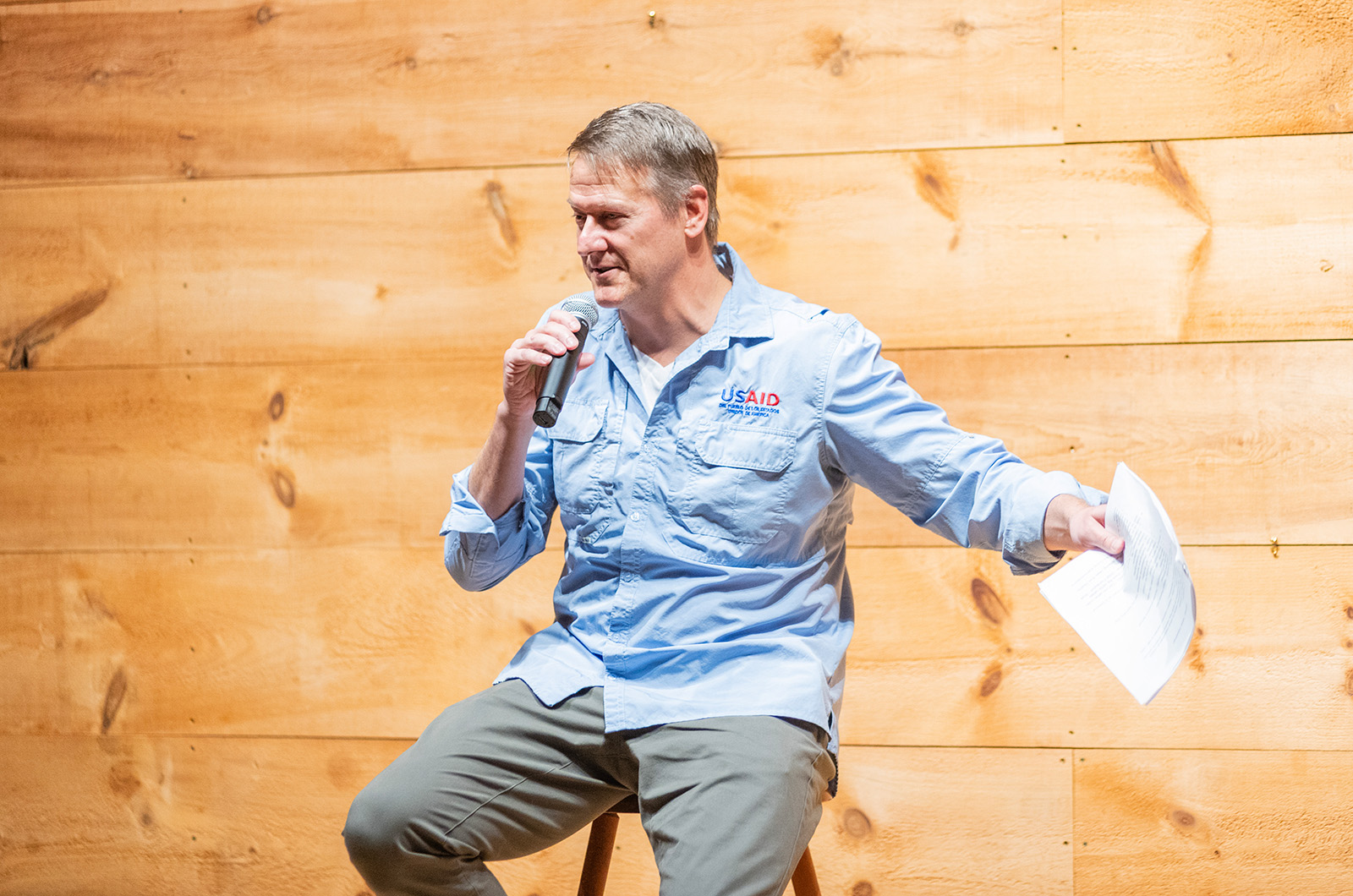
Mr. Scott's 16-year career was abruptly cut short due to the Trump adminstration's new policies.
“I want to do this for the rest of my life, but I kind of want to get paid for it,” he said, recalling his early inspiration.
He started his career in Uganda as a contracting officer, overseeing USAID’s contracts with the local partners that carry out aid missions on the ground. After that, he moved to Haiti to work on earthquake recovery, where he and his team tackled large-scale systemic and infrastructural changes to the country’s healthcare system.
In Colombia, Mr. Scott ran the largest technical office in Latin America. He worked with his team to functionally implement the 2016 Colombian peace agreement, negotiated by the Colombian government and the Revolutionary Armed Forces of Colombia, to end decades of violence in the region. His team also worked to counter the narcotics trade. After realizing that farmers with land titles were far less likely to grow coca, which is farmed to produce cocaine, his team helped build a system to get land titles to as many farmers as possible.
Mr. Scott used these examples to underscore USAID’s focus on systemic change. Fixing broken systems instead of only treating their symptoms, he said, leads to longer-term impacts.
“These are some of the systemic changes that we were after,” he said. “I think one of the things folks don’t realize when they criticize aid is just how complex the problems are that we’re trying to take on.”
When President Trump was reelected in 2024, Mr. Scott said he and his colleagues were reasonably confident they could work productively with the administration. But when Trump allies began publicly condemning USAID and similar agencies, he started to have concerns.
“There were signs of trouble from the beginning,” he said. “And then, on January 20th, it all kind of began.”
On January 20, President Trump signed an executive order placing a 90-day freeze on all US foreign aid, followed four days later by a stop-work order for all ongoing US-funded projects. While the administration issued temporary waivers for the continuation of “life-saving” projects, Mr. Scott noted a lack of clarity on what constituted “life-saving” work.
Elon Musk, who headed the Department of Government Efficiency (DOGE) at the time, tweeted about his and President Trump’s shared desire to “shut down” USAID. Mr. Musk also labeled USAID a “criminal organization” that “needs to die.”
“Elon Musk is the world’s richest man and owns the world’s megaphone,” Mr. Scott said, referring to Mr. Musk’s ownership of X, formerly known as Twitter. “[DOGE] propagated all this false information on Twitter, and they called themselves the most transparent agency there ever was.”
The administration fired several top USAID officials and took the organization’s website offline. Mr. Scott asked the audience to pull out their phones and search “USAID.gov,” which now yields only a “notification of administrative leave.”
The next several months saw the Trump administration systematically dismantle USAID, placing the majority of global personnel on leave and requiring those stationed abroad to return to the US. Prior to Trump’s second term, USAID employed over 10,000 people globally. As it stands, just 15 legally required employees remain at the agency.
In May, the Trump Administration announced plans to legally abolish USAID as part of the 2026 budget, which is set to cut foreign aid by 86 per cent overall.
Mr. Scott claimed the way the Trump Administration dismantled USAID without first going through the legislature was unconstitutional.
“It’s not really legal, what happened,” he said. “Congress has still not voted to abolish USAID.”
Mr. Scott noted that Americans’ general unfamiliarity with what USAID does has been reinforced by the spread of misinformation. He said that while polls find Americans believe a quarter of the national budget funds foreign aid, the actual figure is less than one per cent.
He also said that the administration’s decision to stop aid immediately, as opposed to slowly weaning communities off American aid over time, has deadly consequences. The freeze meant people reliant on aid lost access to life-saving resources, such food and medicine, overnight.
“We don’t know how many people have died yet, maybe 300,000,” he said, referring to research from Boston University professor Brooke Nichols. “That’s [more than] the population of this Island in the summertime.”
Mr. Scott cited a peer-reviewed study published in The Lancet estimating that federal aid cuts impacting USAID could lead to more than 14 million deaths around the world by 2030.
While USAID is not yet fully defunct, Mr. Scott warned that things need to change in Washington if US foreign aid — and democracy as a whole — are to rebound. For him, the key is for the Democratic Party to develop a cohesive vision and to develop leaders and policies to rally around.
“We’re at a real tipping point. I think the Democrats need to find their voice,” he said. “They need to focus on just a couple things that resonate with people.”
Mr. Scott urged audience members to fight for their taxpayer dollars to go to causes they care about.
“You guys should feel proud about what [USAID] did accomplish with this money,” he told the audience. “It was money well spent. It was your money, and you should feel more than a little angry about what happened.”
Comments
Great article about a great
Julian F Wise West TisburyGreat article about a great Vineyarder. Kudos to Stillpoint for offering events like this.
Add new comment