

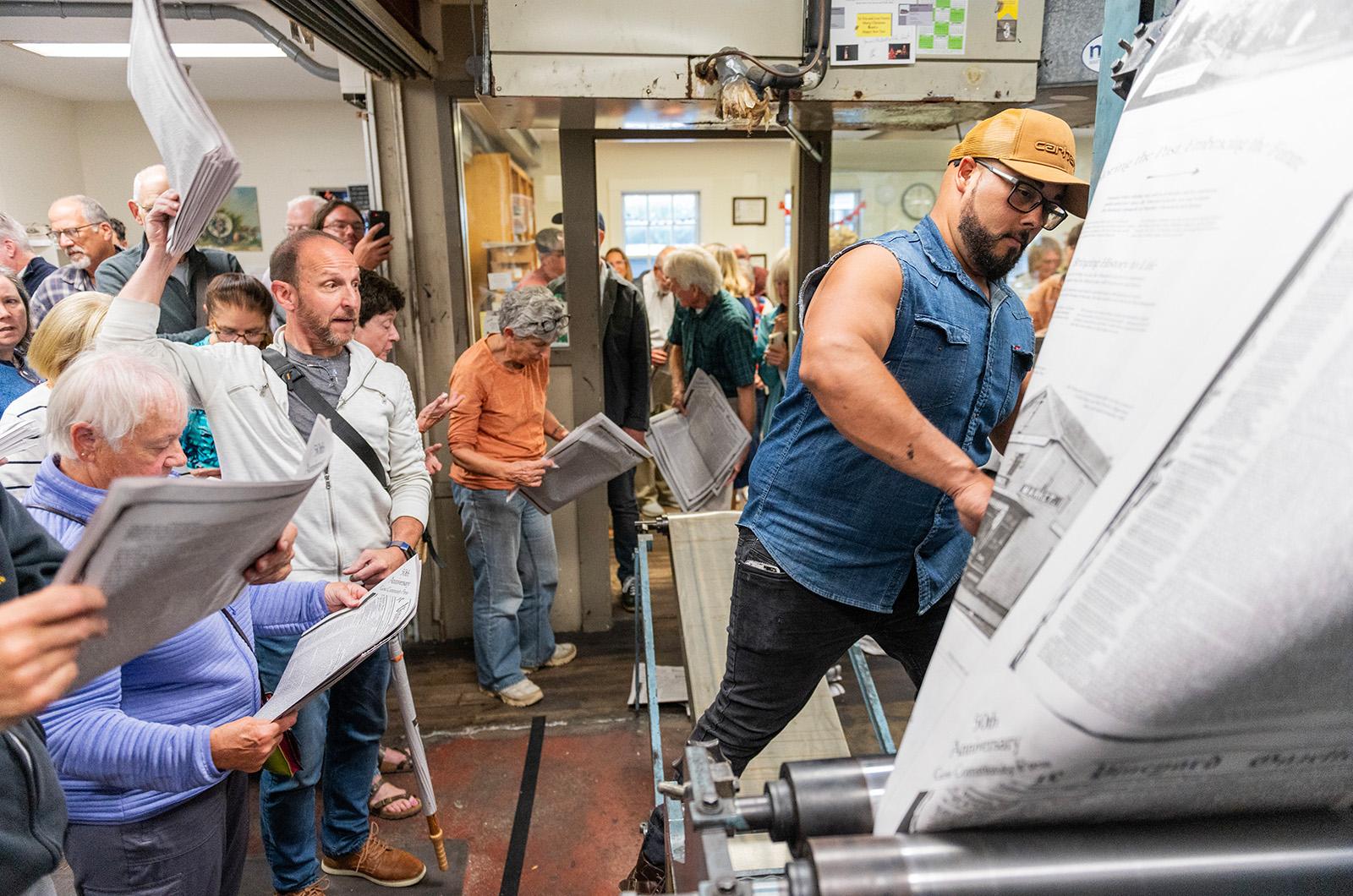

The Vineyard Gazette celebrated the 50th birthday of its Goss Community Press on Tuesday by welcoming community members to the newspaper’s office to learn about the history of the press and see the workhorse in action.
The Vineyard Gazette celebrated the 50th birthday of its Goss Community Press on Tuesday by welcoming community members to the newspaper’s office to learn about the history of the press and see the workhorse in action.
The event was led by operations manager Jim Pfeiffer, head pressman Musica Moreau and Gazette librarian Hilary Wallcox.
Since 1846 when the Gazette was founded, it has always been printed in Edgartown. It carries on that history each week, using the Goss Community Press to produce its broadsheet editions, one of the few remaining papers in the country large enough to cover the entire surface of a coffee table.
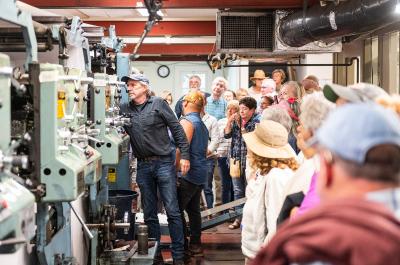
Jim Pfeiffer gets things going.

Jim Pfeiffer gets things going.
“The graphic design [and] printing — the actual physical labor that goes into making sure that every paper gets printed and distributed is huge...” said Ms. Wallcox. “It’s something that we can really claim as a distinctive feature of our paper and of our staff.”
Mr. Pfeiffer began working for the Gazette in 2023. Prior to that, he had spent many decades running a print shop in Rhode Island. He found his way to the Gazette after reading an advertisement in the paper that posed the question: “Bored in retirement?”
“He was bored in retirement and now he almost lives here,” Gazette editor Bill Eville said to the audience, when introducing the speakers.
Mr. Moreau joined the press staff 14 years ago, when he was still a teenager, and took over as head pressman when Jeremy Smith retired in 2023.
Talk began on Davis Lane entrance.
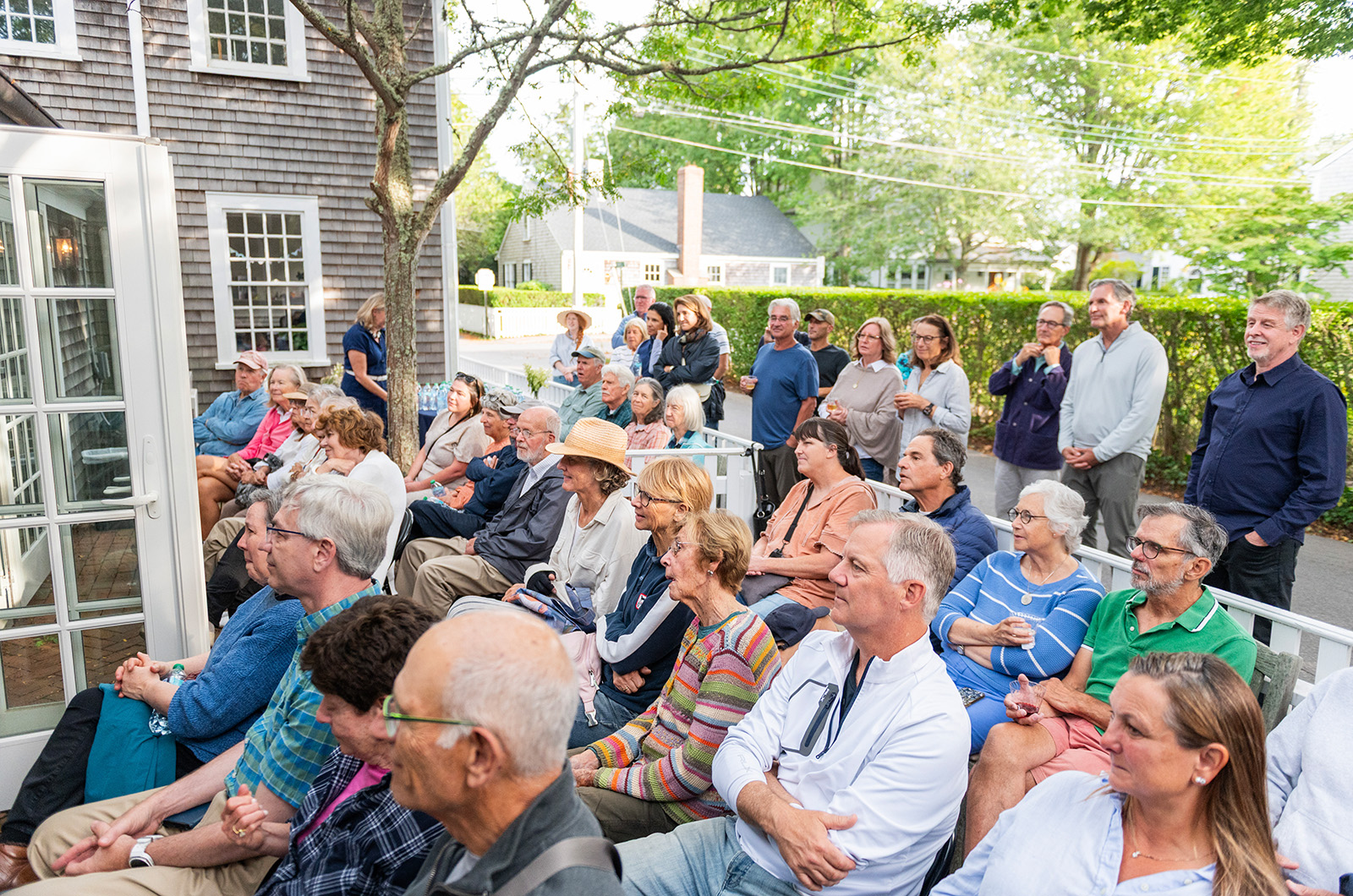
Talk began on Davis Lane entrance.
The two men are the brains and brawn behind keeping the 50-year old machine running on Thursday evenings when the Gazette goes to press.
At Tuesday’s event, attendees learned about the long history of printing the Gazette. The first issue came out on May 14, 1846, printed on an 1830 Seth Adams press, which remains in the loggia of the Gazette building
Wooden blocks from a 1929 Duplex Press, which stamped photographs onto the pages, were also on display, and its iron wheel is embedded in the loggia floor.
But the star of the night was the Goss Press.
“In the 70s, when the Restons were the publishers, they got our birthday boy or gal,” Mr. Pfeiffer said, gesturing toward the press.
The Goss Press was acquired out of necessity, Mr. Pfeiffer explained. In the 1970s, pressmakers transitioned away from manufacturing letterpress machines, which used raised ink surfaces to press text onto paper. There was no one left to replace parts and repair the Duplex Press.
The Gazette purchased the Goss Press in January of 1975 for $65,535 (which would be about $401,363 today). It’s an offset machine, meaning it transfers images from an aluminum plate to a rubber blanket and then on to paper.
The press wasn’t delivered until April of that year. During the interim the Gazette had to be created in Arlington and the printed copies were then ferried back to the Vineyard.
When the press finally arrived in April, the Edgartown police and Norton and Easterbrooks Boatyard helped with the move.
In the April 25, 1975 edition of the paper, the Gazette issued an apology to neighbor Barbara Nevin: “One of our forbearing neighbors deserves an apology and a thank you for putting up with the inconvenience moving day caused her.”
The first official run for the new Goss Press took place on May 9, 1975. The lead story heralded Tisbury’s unanimous decision to become a historic district, and text on either side of the front page masthead said: “Today Our New Press Rolls... Our Change Is Complete”.
The new press could print 14,000 papers per hour, a huge leap from the Duplex letterpress capacity of 2,500 papers per hour.
Mr. Pfeiffer took the audience through some of the intricacies of the current printing process.
“It’s based on the whole notion that oil and water don’t mix,” he said, summing up how the images, both light and dark, are transferred from an aluminum plate to paper. “Typically you wet down the plate first with a thin film of water, it’s applied with rollers, and then you ink it up with some ink rollers.”
At Tuesday’s event, Mr. Pfeiffer and Mr. Moreau printed commemorative issues for guests, featuring the front page from the first issue of the Gazette, and photographs of longtime editor Henry Beetle Hough laying out waxed galleys of stories by hand.
As the pages ran, Mr. Pfeiffer inspected the pages, checking the visuals and looking out for any splotches of ink.
Mr. Moreau stood at the press, checking for changes in tension and humidity as the paper made its journey through the press.
“It all has to be perfect or it’s absolutely shot,” Mr. Moreau said.
As if on queue, the paper ripped and the process had to be shut down, fixed and started again, giving the audience an insider’s look as to what might be happening on any Thursday night. One week this summer, the pressman were still hard at work Friday morning, having labored all through the night to solve a mysterious malfunction.
“They are amazing... keeping this 50 year-old machine running each week,” Mr. Eville said. “It’s really a weekly miracle to see what they do.”
Comments
Thanks so much for the
Pat Tyra EdgartownThanks so much for the opportunity to attend, see, and learn. As an Edgartown student in the mid to late 50's I had the opportunity to visit and witness how the old press worked. Welcome to the new era. Again thanks.
Add new comment