


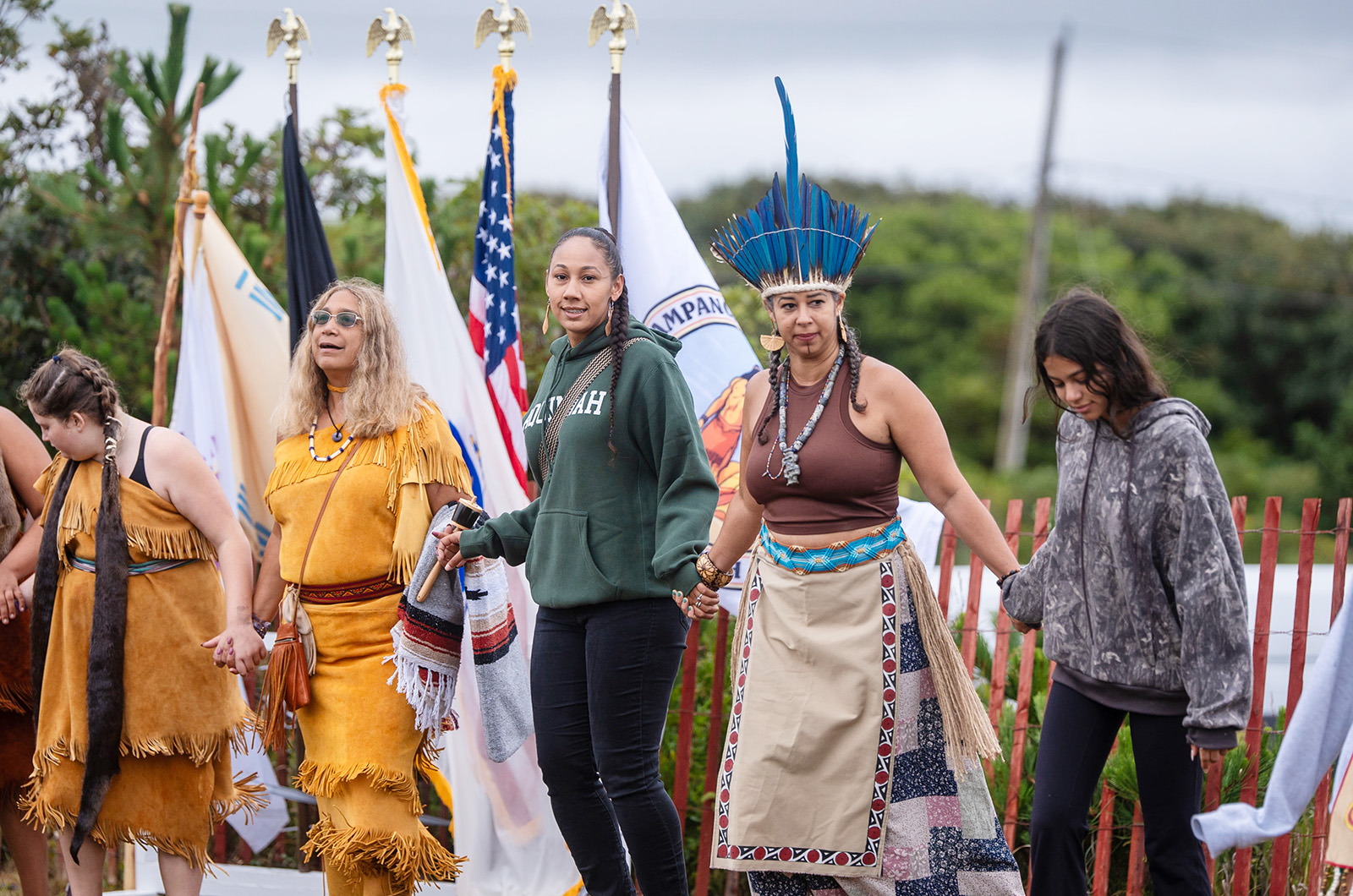
The Wampanoag Tribe of Gay Head (Aquinnah) held its 19th annual powwow over the weekend, bringing together generations of tribal families to celebrate their culture and honor the land.
The air smelled of sage at the Aquinnah Cliffs over the weekend as the Wampanoag Tribe of Gay Head (Aquinnah) held its 19th annual powwow, bringing together generations of tribal families to celebrate their culture and honor the land.
The tribe’s largest event of the year kicked-off on Saturday with a ceremonious fire sending offerings to the Creator and ancestors. Sundays wet weather did not dampen the festivities as families from the Mashpee, Narragansett and Nipmuc tribes continued to reunite and catch up while dancing together atop the cliffs.
“Welcome to our homelands here in Aquinnah...” said Cheryl Andrews-Maltais, the chairwoman of the Aquinnah tribe. “Hopefully you take more away than seeing us dance, but come to see who we are as people.”
During the Grand Entry, tribal members paraded behind the Aquinnah tribe’s flag, along with flags of visiting tribal nations, the American flag and another flag honoring veterans.
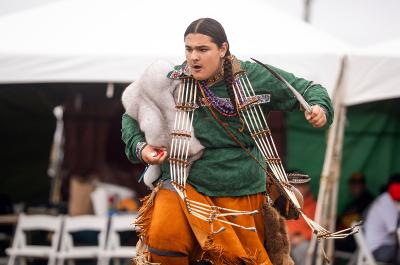
Bangii-Kai Bellecourt is a docent at the Aquinnah Cultural Center.

Bangii-Kai Bellecourt is a docent at the Aquinnah Cultural Center.
Medicine man Jason Baird was on hand to help tribal members smudge themselves with sage that was burning in a large seashell. He also led a prayer in the Wômpanaâk language, which has been revived in recent years through the reclamation project.
Many tribal members wore regalia crafted out of deer leather with pieces of quahog shell and colorful ribbons stitched throughout. Others wore silver chimes which jingled as they pounded their feet into the soil.
“[Dancing] is a connection, not only to the people who came before me, but also the land itself,” said Bangii-Kai Bellecourt, a docent at the Aquinnah Cultural Center. “In our belief, our bodies aren’t different from the land.”
Mr. Bellecourt, who is also an after-school program aid for the Aquinnah tribe, wore leather pants and a dark green shirt with ribbons flowing from the cloth. Fur from a skinned arctic blue fox was draped over his right shoulder, bone bead hair ties stretched from his braids to his waist and red, white and blue venetian chevron beads adorned his neck.
“A lot of really unfair land trades happened through [chevron beads],” Mr. Bellecourt said, explaining the historic legacy of his regalia.

The dances told stories.
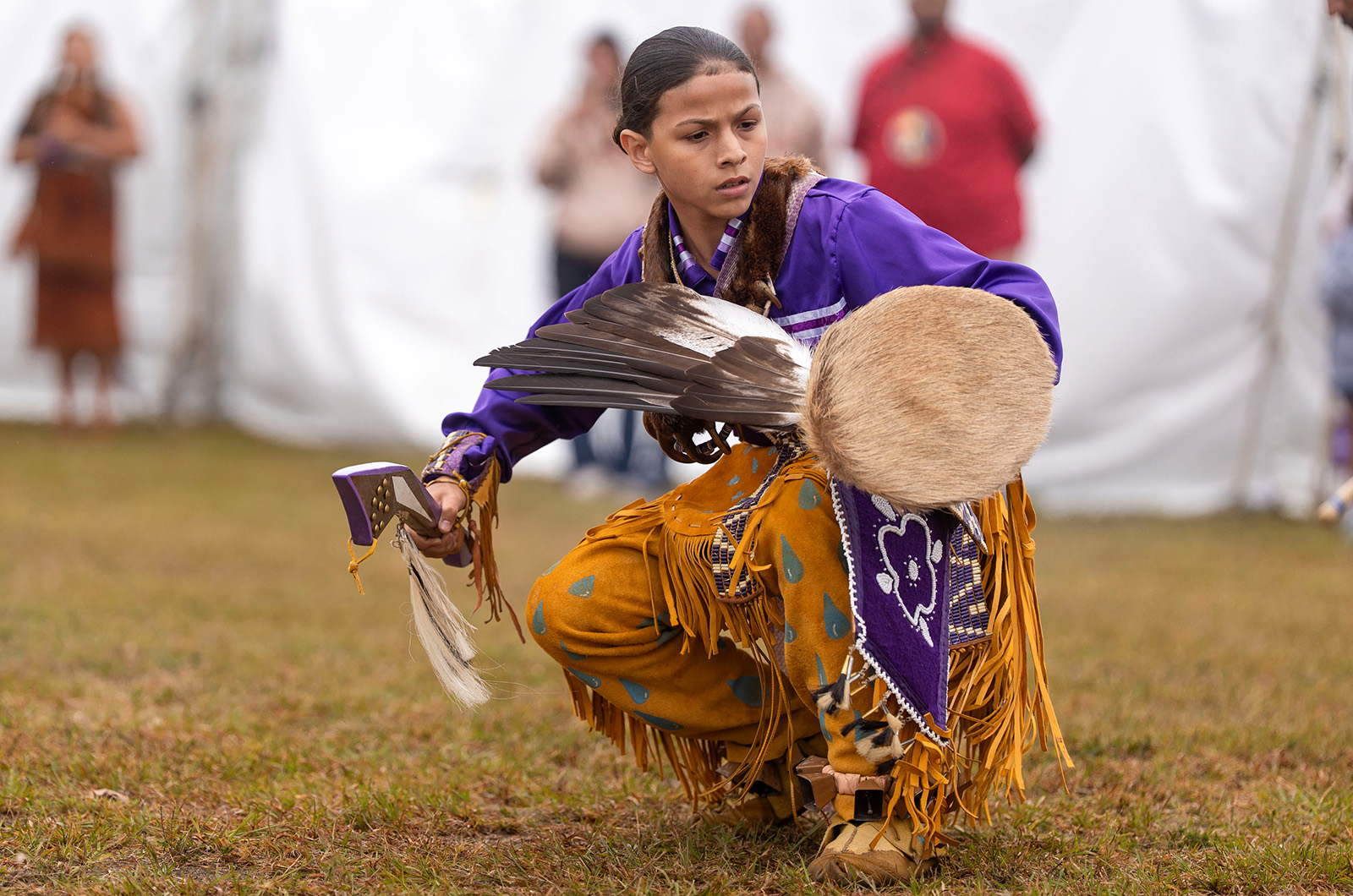
The dances told stories.
Many Native artisans sold beaded earrings, necklaces and merchandise.
Sonia Little, who goes by Wampum Moon, sold her quahog shell jewelry and earrings made from sea glass. Ms. Little is from the Mashpee Wampanoag Tribe and has visited the Island for the Aquinnah Powwow most years.
Ms. Little said she first started cutting quahog eight years ago and her initial piece was a gift she made for a benefactor who donated money to help pay for her to go to nursing school. She found the art stimulating and said it is a cultural connection to her ancestors.
“If you look into history, when the settlers came and they took our land, they started making these humongous wampum tariffs that we would have to pay in order to get our land back,” Ms. Little said. “[It was] an impossible amount of wampum to come up with. So now I’m glad that I make them as much as I want [without] those limitations.”
The annual powwow is a time for tribal members to share their art and practice cultural traditions, but it is also an opportunity for outreach.
Jen Randolph, executive director of Kinship Heals — a nonprofit dedicated to providing domestic violence relief for tribal members — said powwow is a time for healing and a chance to share resources within the community. The organization distributes informational brochures and merchandise while engaging with tribal members about their programs.
“I think for the most part, what we do a lot of at powwow is we listen to what community members are saying about the things that they wish we would do, what’s going on in their lives [and] how people are doing,” Ms. Randolph said.
“Within the last couple days, we’ve talked with so many different organizations from other tribes, other nonprofits, other health providers, and [are] thinking about collaborations,” she added.

Music and drumming filled the air both days.
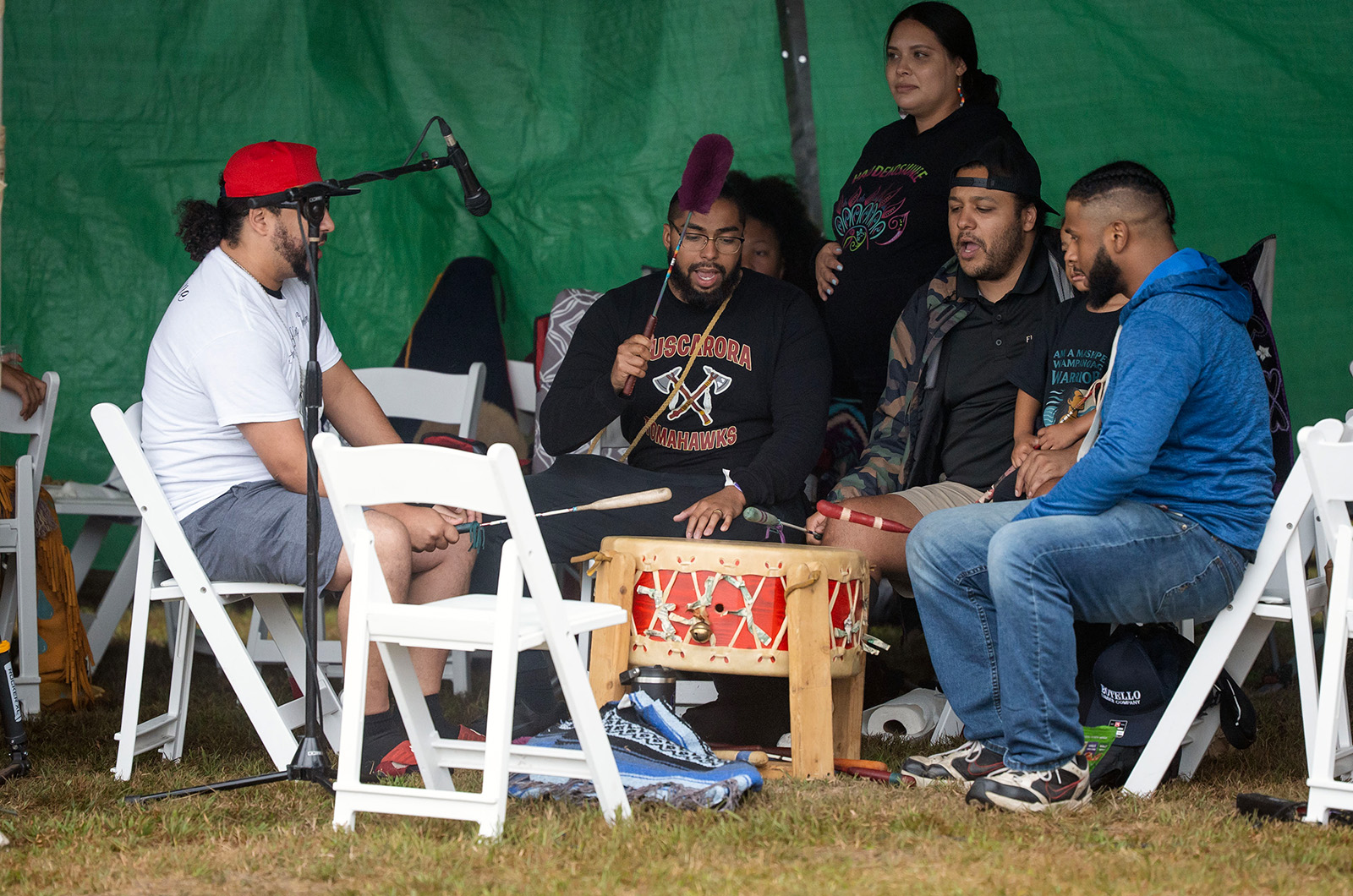
Music and drumming filled the air both days.
The Aquinnah Tribe’s Natural Resource Department was also present. The organization displayed baleen from a Minke whale that washed ashore on a Chilmark beach in May that participants could touch. The teeth were a milky white color and lined with hair-like bristles, used to strain food sources, such as krill and plankton, from seawater when the whales take in massive amounts of water during feeding.
A tooth from a sperm whale that washed-up on Cuttyhunk this year was also on display.
Guests enjoyed traditional Native food by Sly Fox Den, a Mashpee Wampanoag business that is opening a restaurant in Preston, Conn. They served smoked bluefish, salmon and mussels, venison, firecracker shrimp, Indian tacos (fry bread with chili on top) and three sisters rice, a traditional corn, bean and squash combination.
“All three take care of each other within the garden,” said co-owner Jade Galvin. “You plant the mounds of corn [and] always have the beans and squash on the bottom, because it always helps the corn thrive.”
A memorial dance for Waylon Sauer was held on Sunday, honoring the 17-year-old West Tisbury teenager who died in 2023 after a tragic car accident.
The memorial started with speeches from family members, followed by an Eastern War special, where tribal boys ages 12 to 17 danced in full regalia, competing for a cash prize, donated by the Madison-Sauer family.
A song written for Waylon was performed by The Black Brook Singers as both tribal members and non-tribal guests were invited to exchange hugs and handshakes while circling around the fire,
Emcee Justin Beatty, who is Ojibwe, Saponi and African American, kept the crowd engaged throughout the weekend, explaining the significance of dances and sharing jokes in between. He welcomed tribal members to reunite with each other and invited non-tribal members to celebrate alongside them.
“By coming here today, you get to see us and how we represent ourselves,” he said.
Comments
Spiritual healing good not
Ruth Deaner Lynchburg, VaSpiritual healing good not only for us, animals and for the land meaningful important for all people come together just wishing could had been there ✨️ ❤️
I am a 78 yr old Native, a
Patricia Numkena Phoenix AZI am a 78 yr old Native, a member of the Hopi Tribe from the village of Hotevilla. I would love to visit your tribe but I am unable to travel. Keep celebrating. We do.
I wish I could have been
Sylvia Garcia San AntonioI wish I could have been there. My grandmother was Lipan Apache, and I would love to learn more about our great people.
Respect the native culture
David c. Lopez BlackfootRespect the native culture EXSPECLIE the pow wows great music and great dancers Respects to all of you,
Add new comment