


The possibility of low-income families to make a life here has all but vanished, and, in recent years, even Islanders who make six figures have few options.
Darren Mancha has worked on Martha’s Vineyard for nearly 25 years and has always dreamed of owning a home here.
A 38-year-old drywaller who rents a garage apartment in Edgartown, Mr. Mancha makes a good salary and has steady work, but he is among a number of Islanders who are now being cast as the “missing middle,” a growing segment of residents who earn too much to be eligible for affordable housing, but not nearly enough to afford a home on the Island.
The housing crisis on the Vineyard grows worse every year. The possibility of low-income families to make a life here has all but vanished, and, in recent years, even Islanders who make six figures have few options. This missing middle cohort extends to all facets of life on the Vineyard, from teachers to small business owners, from construction workers and all manner of trades, to town officials.
Police departments, fearing a future where $100,000 starting salaries may not be enough to keep officers on Island, are considering adding bunkrooms to their departments, teachers often have to move off-Island for the summer to save money, and people like Mr. Mancha are wondering if they will ever find stability here.

Despite a good salary, Darren Mancha's unsure he'll ever be able to own on Martha's Vineyard.
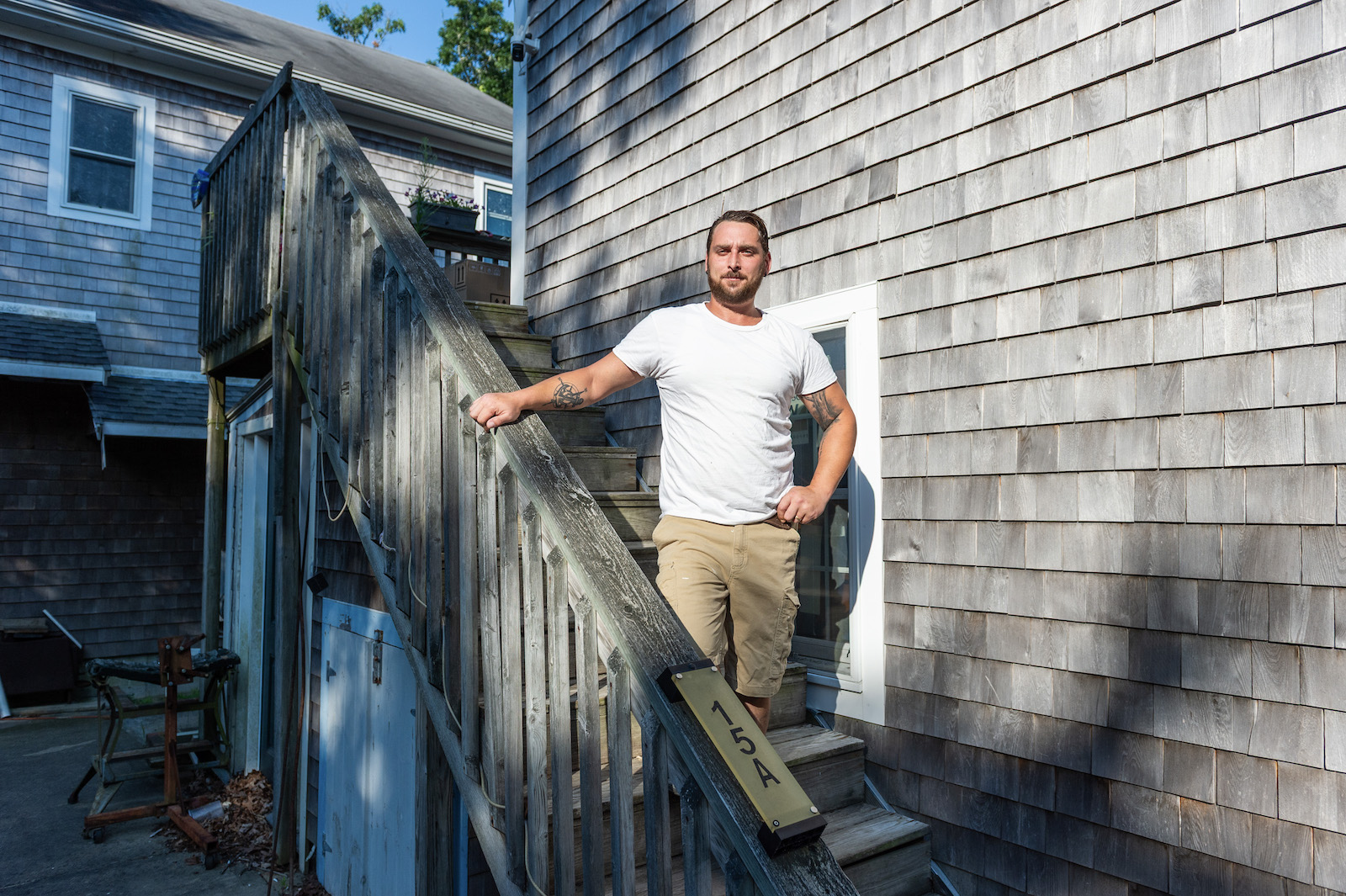
Despite a good salary, Darren Mancha's unsure he'll ever be able to own on Martha's Vineyard.
“I feel a sense of hopelessness,” said Mr. Mancha. “If I lived off-Island, I would probably be able to find something affordable. On the Island, it’s damn near impossible.”
On the Vineyard, people in the missing middle have incomes that are too high for traditional affordable housing projects, but don’t come close to heights needed to afford a home on the Island, where the median home sale price in 2024 reached a new peak of $1.6 million. The cohort has been drawing more attention from housing advocates and lawmakers in recent years as home prices continue to climb.
“There’s no question that the missing middle has expanded as the cost of housing has gone over $1.2 million,” said Victor Capoccia, the chair of the Tisbury affordable housing committee.
Recent figures in Island housing reports lay out the sizable gap between the cost of a home and what Islanders can afford, even for families bringing in more than $150,000 annually.
The Martha’s Vineyard Commission looked at the median cost of a home in each town and compared it to what a three-person household making about $168,000 — or 150 per cent of the area median income — could buy when spending no more than 30 per cent of their total income. The gap for the county was $610,500, ranging from $391,000 in Tisbury at the low-end, to $1.1 million in Aquinnah at the high-end.
This gaping hole has raised alarms.
“This shows that even middle-income households are being shut out of the private housing market, including workers who support critical infrastructure of community services and public safety,” a 2024 commission housing report concluded.
Addressing the missing middle has increasingly become a target for housing advocates, though much of the priority still remains on the lower incomes, which still make up a majority of the need, officials say.
“Neither have access and they both deserve it and both need help in a legitimate way,” Mr. Capoccia said.
Last year, Gov. Maura Healey’s Affordable Housing Act gave the Vineyard, Nantucket and potentially other seasonal communities the ability to develop housing for municipal employees, many of whom may not otherwise qualify for affordable housing. The new law also allowed towns to establish year-round housing trust funds that could be dedicated towards not only affordable housing, but to what’s now being referred to as “attainable housing.”

Town leaders fear that the gap could lead to even more people commuting from the mainland.

Town leaders fear that the gap could lead to even more people commuting from the mainland.
Here on the Vineyard, Island rental assistance programs have raised their earning caps to catch a broader range of residents in need. Oak Bluffs now allows assistance for people earning up to 120 per cent of the area median income, and the Dukes County Housing Authority this summer raised its cap to 100 per cent, up from 80 per cent.
Most of the Vineyard’s subsidized housing units, in line with the current need, are dedicated to people making below 80 per cent of the area median income. The state considers projects at 80 per cent or under as affordable housing, and higher percentages are categorized as community housing.
Island Housing Trust, the main developer of affordable housing on the Vineyard, said that of its 90 rentals and 76 ownership units, 70 per cent are dedicated to the lower incomes.
Philippe Jordi, the CEO of Island Housing Trust, said that funding at the state, local and federal level is often restricted to the lower income level, making it harder to pay for the community housing units.
“The cost of construction has increased so much that it’s really challenging to make those numbers work now,” Mr. Jordi said. “It’s really tough and it’s not getting any easier.”
There are several projects in the works on the Vineyard that are targeting the missing middle.
Green Villa, a 100-plus unit Oak Bluffs proposal from developer William Cumming, is aimed at serving earners between 80 and 150 per cent of the area median income.
Katama Meadows, a planned subdivision off Meeting House Way, is in the midst of a new design for a project that would designate lots for people making between 80 and 250 per cent of the area median income. The change came at the request of Edgartown housing officials, who wanted to see more efforts for people in the higher income brackets.
Both those proposals have received significant backlash for their size and locations, however. If approved, Green Villa would be one of the largest ever housing development on the Island, and Katama Meadows has drawn concern from conservationists who worry about its potential to harm the area’s water quality.
One project, though, has been praised by several town leaders as an innovative way to help the missing middle.
Walking Man Close, a private project put forward by attorney Rob McCarron, is developing nine community lots, one affordable duplex and five market-rate lots on the property of the late Edgartown selectman Jean Hathaway. The community lots are for people earning up to 220 per cent of the area median income.
Mr. McCarron said the idea for the development along Jernegan Pond in Edgartown has been percolating for more than a decade. As a real estate attorney, he has seen young people selling off their property and leaving the Island, and he specifically wanted to create something that could help people in the higher income brackets, such as carpenters, teachers, medical workers and emergency responders.
“I think it’s hugely important that we have a community that is stratified in socio-economics,” he said. “The whole spectrum.”
The people picked for the lots will have to build their own houses there, a strategy that was often used for Islanders of Mr. McCarron’s generation.
“We all got a start by buying something we could just barely afford and figuring out how to build a house,” he said.
Towns are considering ways to keep homes from going into the short-term rental market.

Towns are considering ways to keep homes from going into the short-term rental market.
While he could have done entirely market-rate homes, Mr. McCarron said that factoring in the potential public backlash and limitations that could have been imposed on a such a project, the earnings from the community-focused development are comparable.
The owners for the community lots have been picked and include two Edgartown town employees. Town administrator James Hagerty hoped it could spur more private developers to consider similar projects.
“I think that opened a lot of eyes for how successful the missing middle [projects] can be,” he said.
While private developers consider their options, towns are eyeing several ways to help keep missing middle residents and others in need of assistance on the Vineyard.
Starting this summer, Chilmark is embarking on a pilot program that offers cash incentives to homeowners who convert their properties into long-term rentals for year-round workers. The idea is to help cover the difference between what homeowners could make in the vacation rental market, said Peter Cook, the chair of the affordable housing committee.
“It’s a way of using [the] existing housing stock that hasn’t really been done before,” he said. “It’s a big step forward.”
Provincetown and Nantucket have implemented similar plans, which have also been used in western U.S. ski towns that deal with similar issues.
Purchasing year-round deed restrictions on homes is also gaining traction among housing advocates as a way to ensure properties don’t leave for the vacation rental market. Under this model, towns could purchase deed restrictions on homes — similar to how Massachusetts allows conservation restrictions — that would prohibit properties from being used for short-term rentals. Under the convenants, future owners or tenants would need to be year-round residents.
But each plan takes time, and many fear the community has already begun to be hollowed out, with some essential services at risk of being filled entirely by commuters from the mainland.
Oak Bluffs police Chief Jonathan Searle has long been voicing concerns about the next generation and he is already bracing for the potential of a force made up of off-Island officers.

Philippe Jordi with the Island Housing Trust.

Philippe Jordi with the Island Housing Trust.
Depending on their experience, Oak Bluffs officers can start with salaries close to if not above $100,000 a year, not counting overtime and payment for details. But Chief Searle has seen several officers have to leave the Island.
“[Officers] had no possibility of purchasing a home and what they were paying for a garage apartment or basement was equivalent to a mortgage,” Chief Searle said. “The fear moving forward is the prices have only increased since then.”
The town is considering what to do with its aging police station near the Steamship terminal, and Chief Searle said that potential new plans include bunks for commuting officers.
He worried that if the Island continues to have constant turnover in policing, the schools and the hospital, it could leave Islanders lacking much-needed services.
“Who is going to fill that void,” he said. “That’s what needs to be looked at.”
While the missing middle grows in priority, some say the Vineyard also needs to remain focused on helping the lower to moderate wage earners.
During a hearing for the Cat Hollow development, an Island Housing Trust project in Vineyard Haven that has an equal mix of affordable, community and year-round units with no income limits, several members of the Martha’s Vineyard Commission said they would vote in favor, but had reservations.
“I will vote yes, but I believe... it’s the very low income, the 65 per cent [annual median income] that we need,” commissioner Michael Kim said during the July deliberations.
David Vigneault, the executive director for the Dukes County Housing Authority, said he understands the push for missing middle, but in his experience he sees far more applications for the lower income rentals on the Island.
“I think that everybody is correct in discussing and planning for an actuality that is coming down the pike,” he said. “In this office’s experience to date, it is not the current reality that those folks are showing up in any great numbers for rentals....I think the narrative is slightly ahead of the actuality on the ground.”
For Islanders caught in the middle, though, help is needed now.
Amy Westburg, a teacher in the Island public school system, has lived in more than 20 rentals in Woods Hole and on the Vineyard over the past 20 years. She said she earns too much to qualify for most affordable housing, leaving her stuck in the Island shuffle.
Another teacher, who asked not to be named for fear of it hurting her future housing prospects, said she and her husband are shut out of affordable housing opportunities because their dual income puts them over the earnings level. But the couple has not been able to compete in the open housing market.

Oak Bluffs police Chief Jonathan Searle worries for the future of his department.

Oak Bluffs police Chief Jonathan Searle worries for the future of his department.
“With two incomes, we are overqualified for that, but entirely not in the realm of getting a house,” the teacher said.
So, every summer, the couple leaves their Vineyard winter rental to couch surf with family off-Island until the school year begins.
Mr. Mancha, the drywaller in Edgartown, said that while working on homes he will never be able to afford, he often thinks about whether he can afford to stay on the Vineyard long-term. He knows the housing market on Nantucket has reached even more extreme heights, and wonders if that’s what is in store for the Vineyard.
“I always joke, we are turning into Nantucket,” he said. “Is that what the Island wants?”
Editor's note: a previous version of this article incorrectly stated the type of units in the Cat Hollow project. It has been corrected.
Comments
It is important to reflect on
Frederick Rundlet TisburyIt is important to reflect on what the major factor that created the housing crisis. Since 2018 .... I have addressed this issue by numerous letters to the Editor of the Gazette and Times and also serving on the Short Term Task Force of Tisbury. The solution is to LIMIT SHORT TRRM RENTALS TO ISLAND RESIDENTS ONLY. As the Innkeeper of the "licensed" Look Inn, we are surrounded by STRs.... which are businesses, plain and simple. All of these STRs were here to fore "affordable housing units". Look Street is no longer a neighborhood, it is a business corridor. There is nothing left to save. Including our last year after 35 years of providing affordable lodging to our many guests. We are all pricing ourselves out of business and livelyhood. MVGA (Make the Vineyard Great Again) in the words of Ivan Cox.......
In response to mr Rundlet
Here we are yet again VHIn response to mr Rundlet letter regarding short-term rentals and the changing character of Look Street, I’d like to offer a broader view of what “protecting the neighborhood” truly means.
In your neighborhood there are signs posted on lawns that say “Protect Our Neighborhood.” But what exactly are we protecting? The right to run short-term rental businesses or the ability for working islanders to live and stay in those neighborhoods year-round?
It’s confusing to hear your passionate arguments against short-term rentals while simultaneously watching many in that same group actively oppose long-term workforce housing. The recent outcry against 97 Spring Street was referred to the Martha’s Vineyard Commission wasn’t over short-term rentals. That home was intended as long-term housing for people who actually work here, earn a paycheck from local businesses, and contribute meaningfully to the community. Yet the opposition was loud and persistent.
How do we square that?
You can’t say the neighborhood has been overrun by businesses and then oppose actual residents who want to live and work here. If Look Street is, in your words, now a business corridor due to STRs, why fight against homes that would house people permanently?
If we are serious about solving the housing crisis, we must be honest about what we’re truly protecting and who we’re keeping out. Supporting long-term housing for working islanders should be the bare minimum if we want real, lasting solutions. Otherwise, “protecting the neighborhood” starts to sound more like a slogan of exclusion than a path to progress
You realize short term
tom BostonYou realize short term rentals have been around for decades, correct? Many families want to rent houses and avoid hotels and B&Bs. The biggest culprit is the Island is and always has been a very expensive place for housing and the economy is mostly limited to a few months. Tough way to make a living. If you want to fine tune STR then go for it. But to think that is the solution is naive not to mention self-serving. Btw, if we went with your solution and the market saw an increase of housing stock come on the market, what would prevent islanders from snapping houses up and turning them into STRs?
Fast ferries with free
seasonal mvy and mainlandFast ferries with free parking will solve the problem of commuting workers. Many people want the big salaries of Manhattan but cannot afford to live there. Some endure a 2-4 hour roundtrip commute daily to make the big money and live in a cheaper area. Life is about choices. No one 'deserves' to live somewhere. When I bought my land here in 1980, the seller, a long time multi-generation native laughed all the way to the bank. Now his grandchildren expect a subsidy from me?
This is the answer!! ride
James Oak BluffsThis is the answer!! ride the ferry every morning and talk to the people. Stop with the mindset that everyone who works here wants to live here. Make the commute easy! FAST FERRIES
While that solves some of the
Michelle Katz Vineyard HavenWhile that solves some of the issue that mindset neglects the group of people that are the exact subject of this article in the first place. You really want your 1st responders to come over from another community? Teachers bringing up Island youth who have no idea the nuances of Island life? My job won't hire from off islanders BECAUSE I need to be available in an emergency. It's one thing for a retail worker to commute.. it's a whole other beast when you get into critical infrastructure. 5 houses are not solving anything. Cries for more commuters are not solving anything. We need ideas like incentive programs that reward property owners that offer year round rentals to island residents while avoiding raising taxes at large because that hasn't worked in decades. Island resources need to go to Island families not Barnstable hopefuls.
Amen.
tom BostonAmen.
The Vineyard is playing catch
Jim Feiner ChilmarkThe Vineyard is playing catch-up in a real estate scenario where the odds are stacked against us. Land is expensive, building is expensive, rentals are expensive and we continually try to create strategies on how we can help fix this community crisis. We have created tools that allow us to do new things in terms of development (ADUs), and find new ways to subsidize the ever-rising costs, but the runaway rental market keeps a lot of potential inventory unavailable for year-round people. Our subsidies have limits both in scope and size and building alone cannot fix this problem. Housing needs a year to year funding sources to give MV the necessary boost to make long term meaningful changes that will support all businesses and the island in general. We need a housing bank.
Jim, you may or may not be
tom BostonJim, you may or may not be right but when you say we need a housing bank, but aren't you ultimately saying more taxes and fees to fund it? The island already has high taxes and they have been increasing rapidly. We've added STR taxes which are so high they are pushing tourists away. We have a CPA tax. We have beach access fees. We have land bank fee when purchasing. There's been talk about introducing a seller's fee on a purchase. But none of this has made a dent in the housing crisis. We can't tax our way out of the problem. I would get corporations out of the STR business (maybe limit STR to one per owner?) but that will likely help only at the margins. The bottom line is MV is an island and very expensive. It simply can't house everybody who wants to live here. We all do not all "deserve" to live wherever we want. The year round population has grown too much IMO. It's not sustainable.
Hamptonization! I am next in
Born & Raised Vineyard HavenHamptonization! I am next in line to sail one way off island in search of more stable living.
We left the island for good
The Nelsons ex-OBWe left the island for good last fall. There really is a more affordable life off island. It's more relaxed, less stressful, and far more affordable. Good memories, but good riddance, too.
The Walking Man Close project
Island Resident; Born & Raised ChilmarkThe Walking Man Close project is a great thing, and will keep employees working for the town thankfully. Even then, it is going to be quite the expensive project for those people who were chosen, buying land and building a home is not a cheap thing to do.
Something needs to change on island or soon enough you will no longer have town employees, hospital workers or police officers, emts, etc....It is becoming more and more impossible to live here, raise kids and have a family etc. It's disappointing for those who grew up here and now can't afford to stay.
I’ve always wondered why the
John Aldeborgh KatamaI’ve always wondered why the towns haven’t used some of the large tracks of public land to enable low cost housing. Divide it into small lots (5000 sqft), restrict the size of the houses and encourage using modular or prefabricated structures, all of which would help keep building costs to a minimum and speed up the development. As it is the island construction industry is geared towards high end homes.
Covenants on architecture might also be a good way to protect the aesthetic of the island.
Land prices sales could be determined using a formula that encompasses both income and net worth.
If a combination of island, State and Federal politicians came together to solve what all agree is a conundrum maybe real practical solutions could happen. As it is all I see are disparate efforts that lack any real chance of success. It must start with a high level vision and an achievable strategy.
This idea has happened in the
Pat Brown tisburyThis idea has happened in the past: the youth lots, etc. One could question whether it's a fair use of town lands - to deed out to private individuals and the open market, at far less than market value. I think major zoning changes is a better and more fair strategy.
Changing zoning changes the
Pearl WTChanging zoning changes the island. What was the point of the zoning to begin with then? Enforce current zoning. STR are illegal. STR are commercial businesses in our residential neighborhoods squeezing out the human beings who once occupied these houses. Try as you might you'll never make 1+1= 3. And before we have to listen to the, "Renting homes in the Vineyard is as old as time" script: Year round owner occupied homes being rented a few weeks in the summer to bridge the expense gap while the owners literally camp in their backyard is not the same as what is going on here today.
Pearl, while that may be true
tom BostonPearl, while that may be true, plenty of second home owners have rented outright their homes for a few weeks during the season to help with expenses for decades. Remember, these second homeowners pay the majority of residential property taxes on the island and use far fewer of the services (and they have no voice in how their tax dollars are spent. You should be thanking them not denigrating them.
Right.
M kelfer ChilmarkRight.
Millions collected annually by the Land Bank to preserve…
Seems misdirected when so much housing (and land) is needed.
There’s gotta be an acceptable split between construction and conservation.
Land is indeed very expensive
Pat Brown TisburyLand is indeed very expensive and not much can be done about that. However, construction does not have to be so expensive and there are things that can be done to mitigate that.
A really great piece by the
Follow upA really great piece by the Gazette would be on the large number of amazing immigrants that have left their homes and lives behind to build a new future here so many have worked tirelessly and made sacrifices and many have bought homes on Martha’s Vineyard even at the current price points, wouldn’t it be amazing if there were a follow up article showing the other side of the coin
Another great follow-up would
Sara Piazza EdgartownAnother great follow-up would be a piece about the natives and our families who are hanging on for dear life, trying to hold onto ancestral homes, trying not to be forced out of our heritage and family history.
This is America. We already
Mike EdgartownThis is America. We already paid a 2 percent fee for our homes so that others can philanthropically decide which spaces to purchase. We paid for our homes and there is no legal basis to re-direct our hard earned tax dollars as subsidies for others to be immediately enriched with real estate that costs them nothing. Many of us worked on the mainland and saved and bought our homes up here. We should pay fair wages but should not subsidize real estate for nothing for folks.
The great housing crisis hoax
Pearl WTThe great housing crisis hoax. Let the rich who own all the short term housing keep telling you that isn't the issue, while they laugh all the way to the bank.
Add new comment