

Planting Seeds of Justice, Compassion and Love
An Interview with Rev. Dr. Otis Moss III
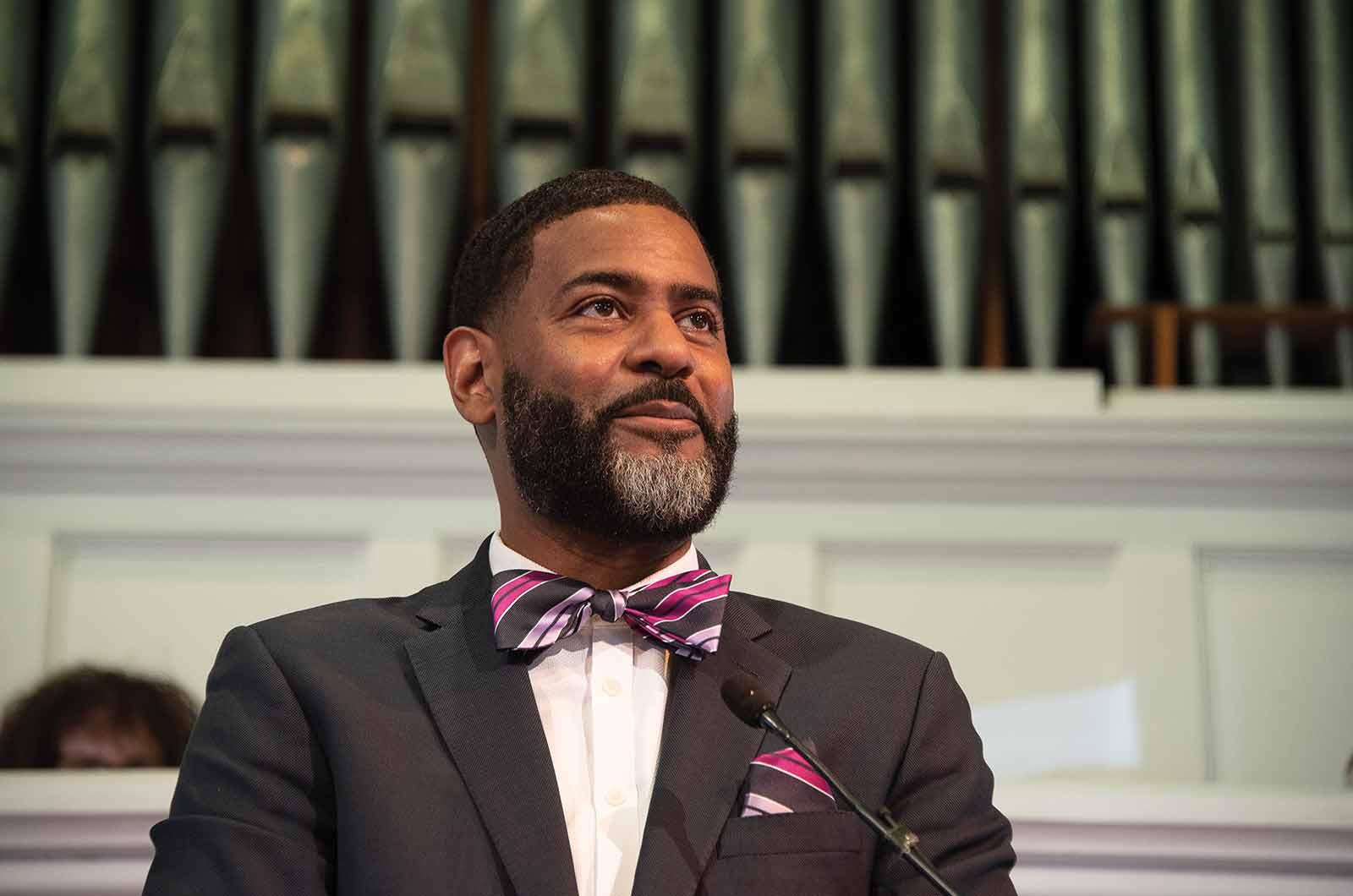
In his much-anticipated annual visit to Martha’s Vineyard, Rev. Dr. Otis Moss III will preach at Union Chapel in Oak Bluffs on Sunday, August 3 at 10 a.m. With his voice booming from the historic octagonal walls to a congregation that spills out into the park surrounding it —creating an outdoor sanctuary and an unmistakable Oak Bluffs happening — Otis’s sermon has become a cherished tradition for many summer visitors.
A third-generation minister and senior pastor of Chicago’s Trinity United Church of Christ, Otis is known for blending theology with justice, storytelling and the arts. A passionate cinephile and filmmaker, he’s the founder of Unashamed Media Group and the creator of sermonic films — visual expressions of the Gospel designed to reach new audiences. A lover of jazz, hip-hop and Black cultural history, he brings all of these influences to bear in the messages he shares — many of them shaped by more than a decade of preaching, connecting and recharging on the Vineyard.
I caught up with Otis over Zoom in July, just ahead of his visit. We talked about family, film, the Island, and the intersection of faith, service and resistance. His message is clear: faith should speak to every part of our lives — not only the personal, but the public and political as well.
Q: You come from a long line of faith and activism; both of your parents were leaders in the Southern Christian Leadership Conference — and your father was pastor for churches in Georgia and Ohio until his retirement in 2008. When did you personally feel the call to ministry?
A. It happened during my sophomore year at Morehouse College. I was recruited to play football and switched to track, and at the time, I was trying to discern between cinematography, political science, religion and philosophy.
One day as we were winding down practice, jogging in circles like we always did, I heard a voice — clear as day — ask, “When are you going to stop running in circles?” That moment stopped me. I went back to my dorm, called my girlfriend — who’s now my wife — and told her. She just said, “I knew.” And it turns out, so did a lot of the people closest to me.
Q: Those interests you had as a young person considering film, philosophy and politics seem to have found their way into your ministry, which extends beyond the pulpit to filmmaking.
A. I’ve always been deeply connected to the arts — to storytelling, writing and especially film. I’ve kept journals for years, written plays and sermons, and now I’m producing documentary and narrative films through our production company, Unashamed Media Group. It began in earnest during the pandemic. With churches shut down, I wanted to create something more than a static Zoom box. So I leaned into my background — studying cinematography at Morehouse — and started writing sermons as scripts, then building visual experiences around them. We called them “sermonic films” and those early pieces went viral. Then came Otis’ Dream, a short film about my grandfather’s struggle to vote during Jim Crow. It’s now used in schools and churches across the country, from Louisiana to North Carolina, to teach civics in 12 minutes.
We recently received a grant from the Lilly Endowment to produce seven new films over the next five years. These projects will continue to explore the intersection of faith, culture and justice.
Q: Do you see filmmaking and preaching as separate, or are they different expressions of the same calling?
A. The Gospel is the priority, but it goes hand in hand with stories we’re creating, which are rooted in faith, culture and social justice. It’s an extension of what we do every Sunday. It’s been a real privilege to write and curate the kinds of stories and experiences that will allow people to see the world in a different way.
Q: Let’s talk about Union Chapel in Oak Bluffs. What do you feel when you step into that pulpit each August?
A. There’s a sacredness — a sublime energy to Union Chapel. The unique creation of people coming together for the summer represents what the American project is supposed to be. People coming from all these different places and spaces ethnically and racially. It’s a beautiful thing. It’s gumbo in motion.
And it’s deeply intergenerational — you see grandparents and young children worshipping together. It’s not just biological families. People become family over these gatherings and have formed chosen families through this shared tradition. It’s beautiful.
Q: Do you remember your first time preaching at Union Chapel?
A. It was sometime around 2010. My son was about 10 or 11. I came the first year alone and knew right away that next time, the whole family would need to come. We’ve made it a tradition ever since.
Q: You preached alongside your father at Union Chapel in 2015. Can you share what that meant to you?
A. That was incredibly meaningful. In Chicago, my father and I started a tag-team sermon every Father’s Day. The joy of the experience is, of course, standing with my father. But the real joy is in the process of preparing the sermon — listening to his wisdom and stories and working through ideas — like a jazz session. It’s something I hold near and dear to my heart.
You know, [John] Coltrane said some of the best music happened in practice, not performance. It was the same with us — working out themes, tossing ideas back and forth. That’s what I treasure most.
Q: How did you find your own voice, especially growing up with the large presence of your father?
A. Like any artist, you start with imitation, then move to emulation — and eventually arrive at authenticity. I started out mimicking my father, Gardner Taylor, Carolyn Knight and others I admired.
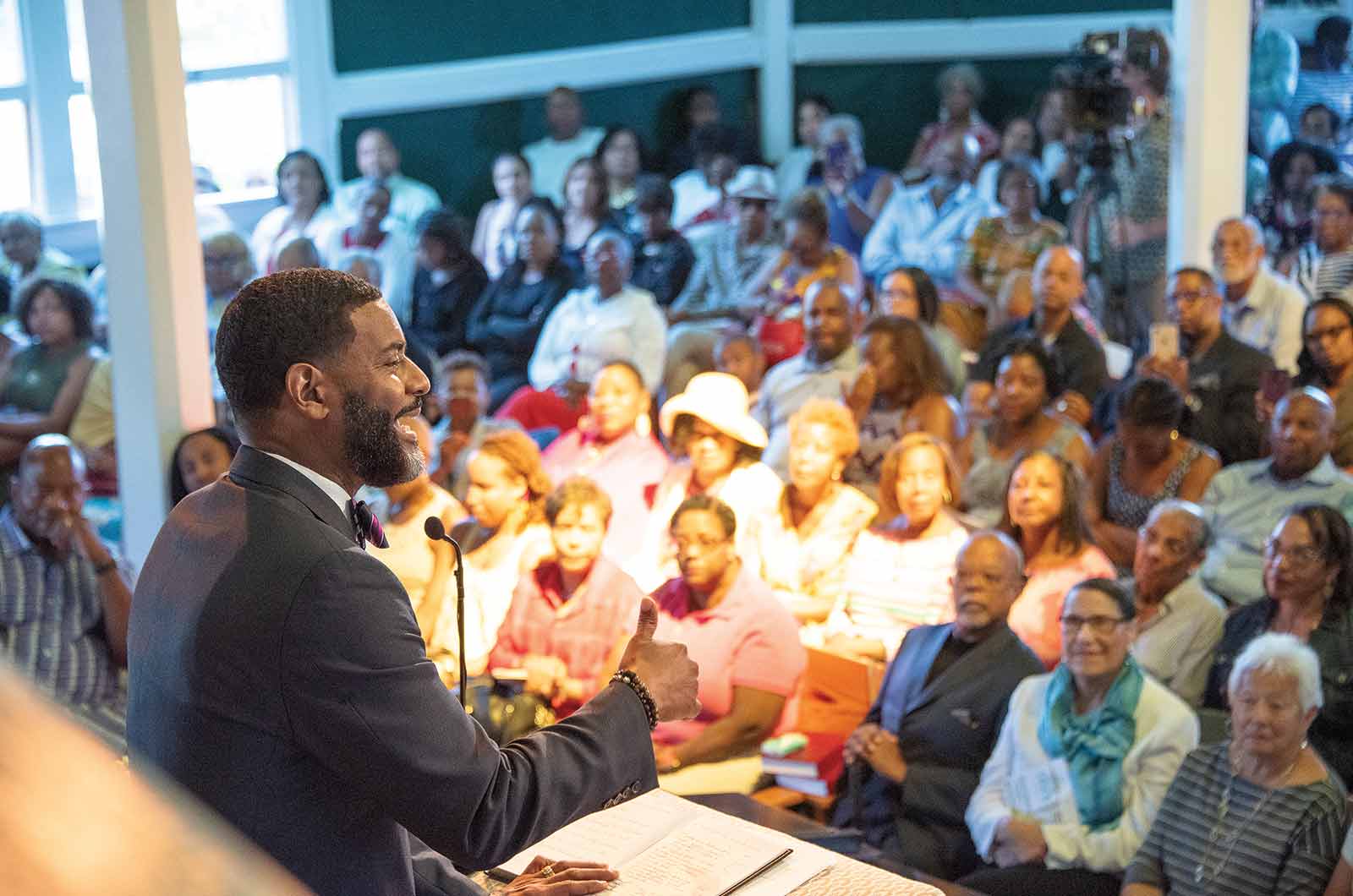
Then I became a youth minister, trying to reach young people, and that forced me to find a new rhythm. I drew from hip-hop, poetry, film — anything that communicated with power and clarity. All of that shaped how I preach now.
Q: Have you personally been involved in any of the national protests or recent expressions of resistance?
A. Yes, consistently. Resistance for us is part of the ministry. Over the past year and a half at Trinity, we began doing something we call “Five Minutes After the Benediction.” I’ll say, “Just give me five minutes,” and in that time, I’ll break something down — explain a policy, highlight an injustice or call attention to who’s really pulling the strings.
One week I talked about Project 2025. Another time, I called out what’s been branded “The Big Beautiful Bill.” I called it “The Big Betrayal of Human Decency.” That bill would strip 12 million people of healthcare and cut off support for young adults aging out of foster care.
I want our congregation to understand that policy reflects our moral compass. Budgets show what we value. If we’re people of faith, we must be engaged in the public square — not just personal piety.
We’ve also organized through the Black Church PAC [Political Action Committee] — bringing together ministers across the country to focus on policy, to support candidates and to mobilize for justice. We’re not just preaching resistance — we’re living it, every week.
Q: Will you do that at Union Chapel?
A. Probably not in that format. But those themes — justice, compassion, the public good — are always embedded in the message.
Q: Over these nearly 15 years visiting the Island, have you built lasting connections?
A. Definitely. I look forward to seeing one family in particular — a young brother and sister. Every year I give them a lapel pin of an historical figure. I tell them, “Ask your parents about this person.” It’s a little tradition now. One of the kids I watched grow up became an intern at our church in Chicago.
That kind of relationship — born on the Vineyard — is special.
Q: What’s on your summer reading list?
A. I just finished James by Percival Everett — phenomenal book. I’ve got another of Percival’s ready to go, Dr. No . I’m also reading S.A. Cosby — noir thrillers in the vein of Walter Mosley or Dashiell Hammett. I love a good noir — whether on the page or the screen.
Q: Will your family be joining you on the Island this year?
A. Absolutely. My son Elijah, who’s 24, has a student film premiering at the Martha’s Vineyard African-American Film Festival — Sadness of Men . He’s studying film at Loyola Marymount University in Los Angeles and he’ll be on the emerging filmmakers panel. My daughter Makayla is 21 and Monica, my wife, is perpetually 22.
Q: What’s the perfect Vineyard day for your family?
A. It has to be — without a doubt — breakfast cooked by my wife and mother-in-law. There’s a crew of young people who come not just for the pancakes, the eggs, the omelets; it’s so they can be in the presence of Monica and Mama Brown when they are hooking up breakfast. It’s a wonderful thing to witness.
Q: What would you say to someone who picks up this issue of The Vine but missed the opportunity to see you at Union Chapel? What message might they carry with them?
A. The Vineyard is a place of rest, yes — but also of recharging. The question is, what will you do with the recharge? Will you use that restored energy to sow good in your community? That’s all any of us can do — plant seeds of justice, compassion and love where we are.
Sissy Biggers is the Q&A columnist for The Vine and a regular contributor to Martha’s Vineyard Magazine. She lives in Oak Bluffs.
Comments
I can’t help but wonder, when
John Aldeborgh KatamaI can’t help but wonder, when you mix politics and religion at a minimum you instantly lose a large portion of the population. It doesn’t matter which side of the isle you’re on, the fundamental premise of this nation was separation of church and state. Values are the domain of the family any dependence on the government in a free society is a step in the wrong direction.
When we judge any government, it’s the outcome that matters, not the empty hyperbole that is the staple of career politicians. Similarly, when we judge people it should be as a meritocracy, which at its core is about character, discipline and accomplishment, not simply words.
Add new comment