

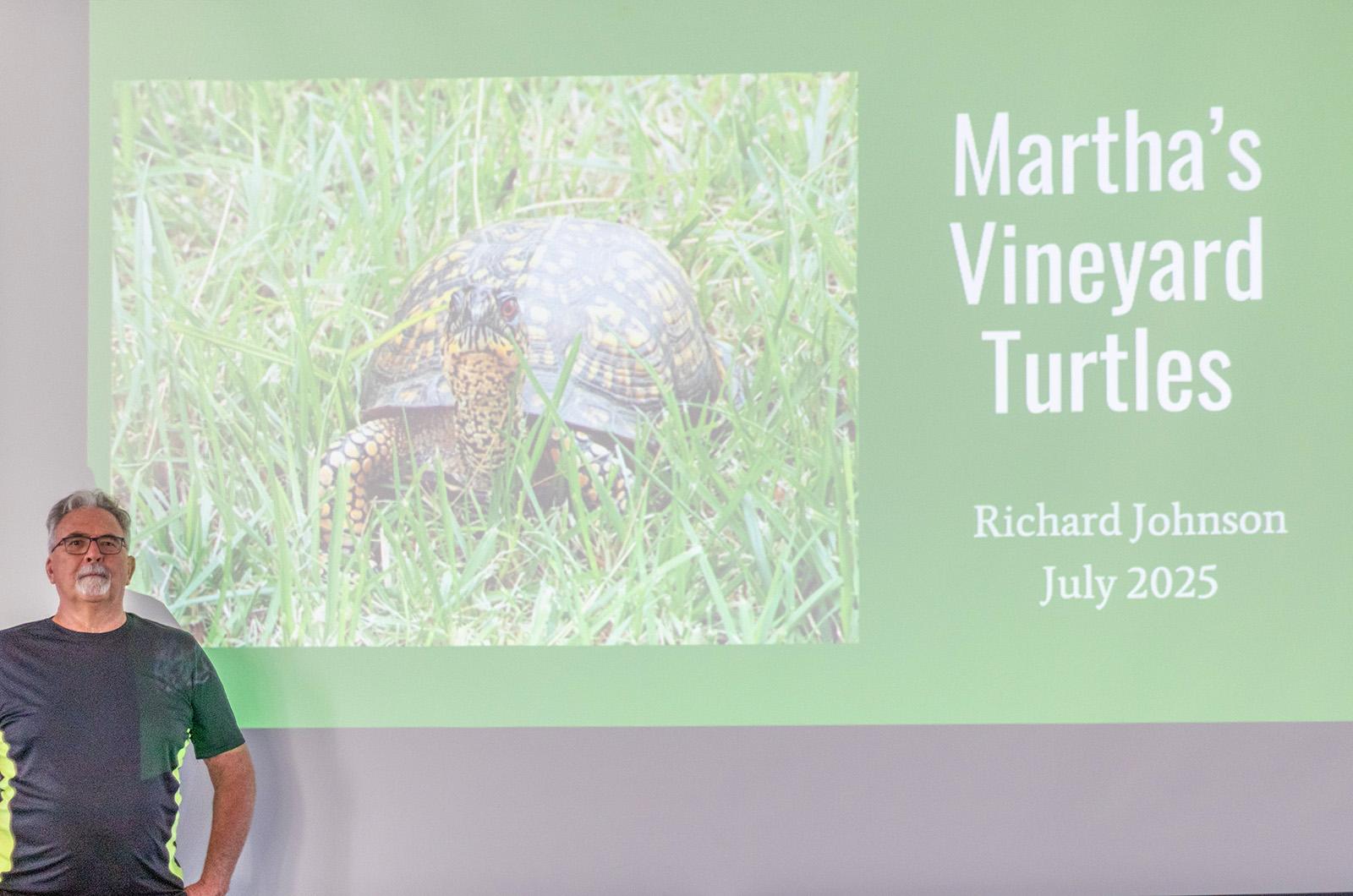
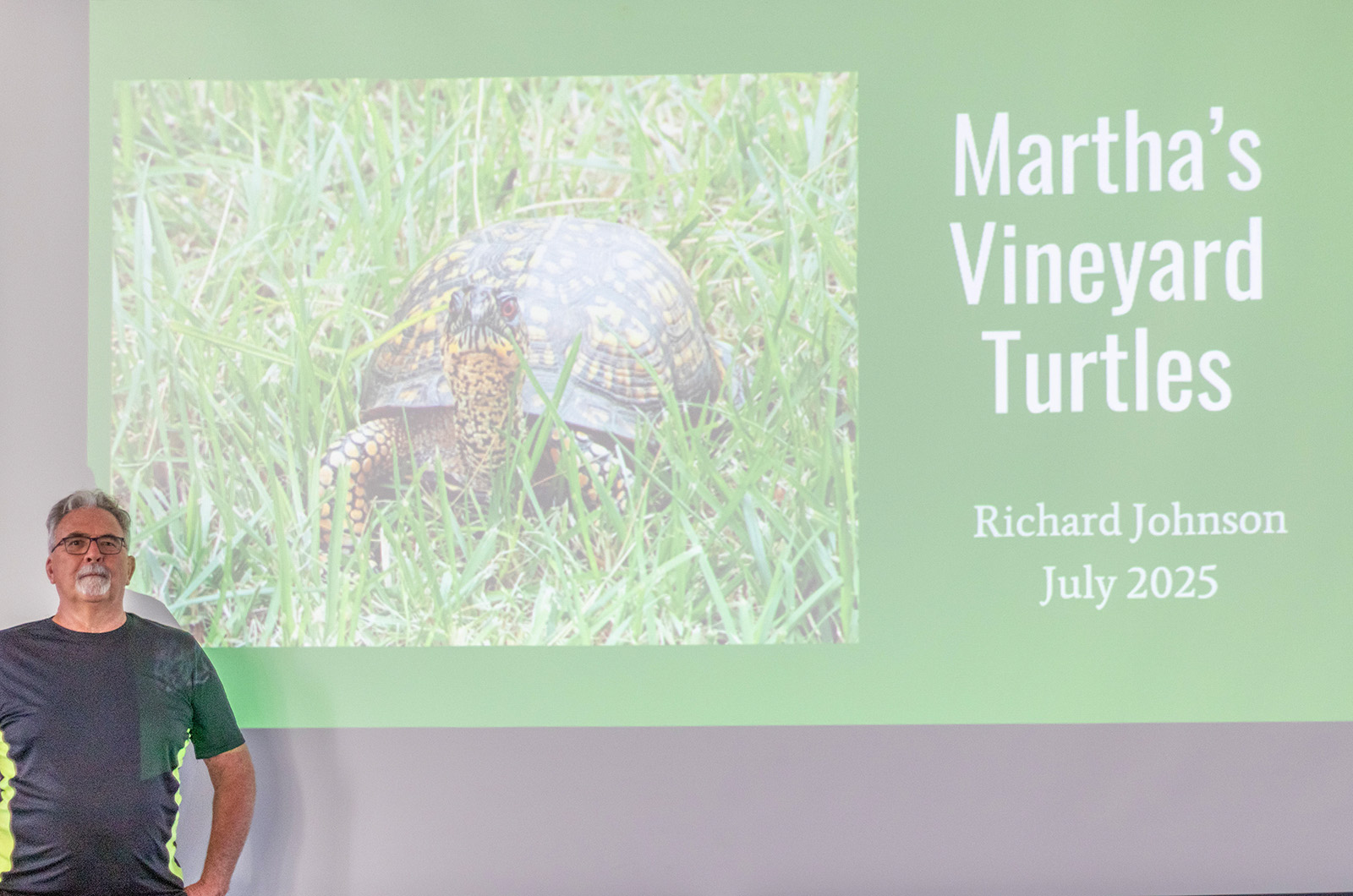
As the former head of the Martha’s Vineyard Tick Borne Illness Reduction Initiative, Richard Johnson spent years tracking, studying and worry about ticks and tick-borne illnesses. Now he is focused on turtles.
As the former head of the Martha’s Vineyard Tick Borne Illness Reduction Initiative, Richard Johnson spent years tracking, studying and worry about ticks and tick-borne illnesses.
Now he is focused on turtles.
“I was the tick guy for many years, and I did that because I felt like it needed to be done,” he said during a recent talk at the Katharine Cornell Theatre. “It was an important public health issue, but it was never a passion, whereas turtles are something different.... I love seeing the turtles. I love the fact that we’re doing something for them.”
Spotted turtle is easily recognizable.
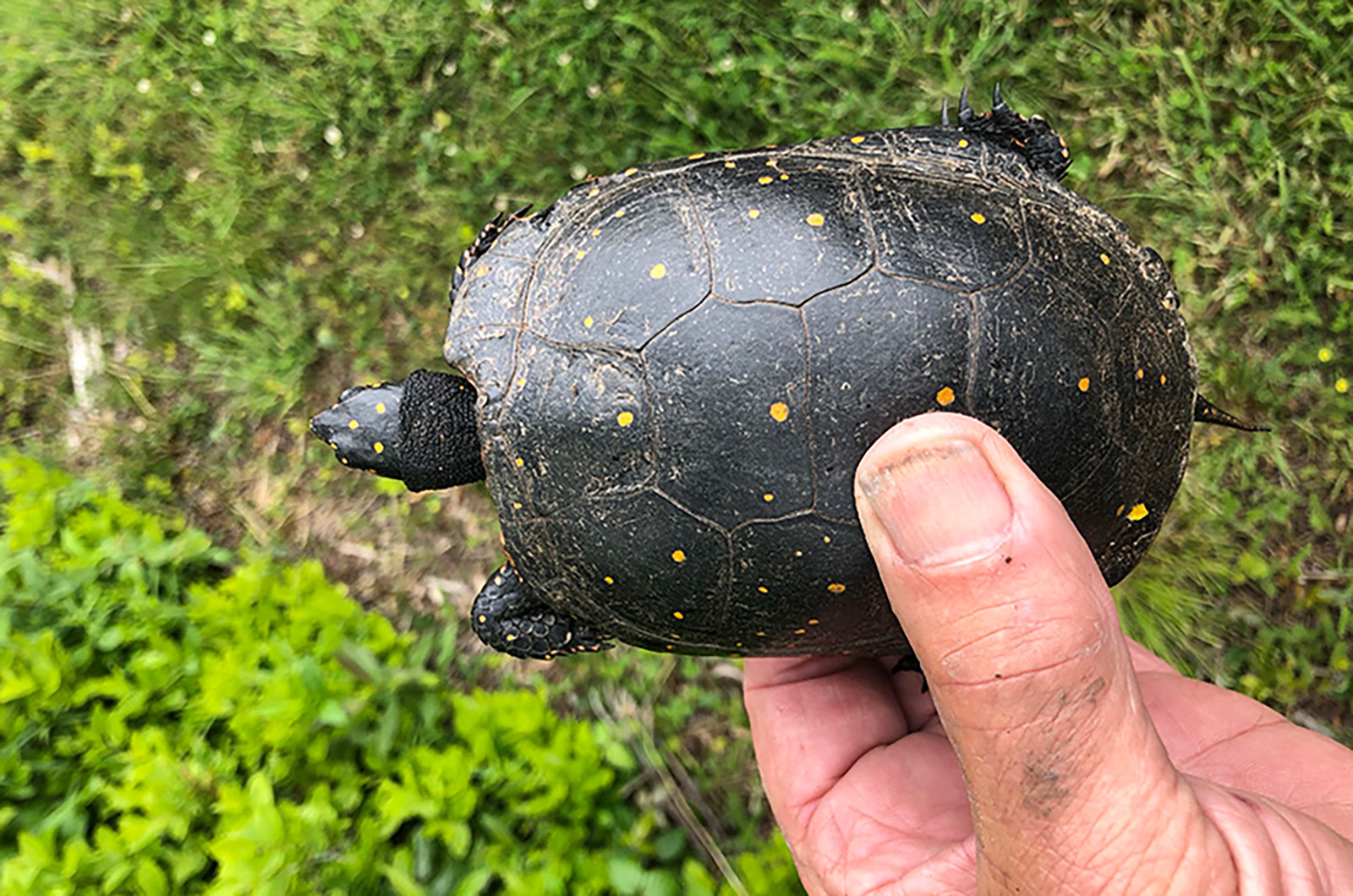
Spotted turtle is easily recognizable.
Recently, Mr. Johnson created the MV Turtles Project to assess the status of native turtles on the Island and gain a better understanding of the threats they face. The project is sponsored by BiodiversityWorks, a wildlife research organization led by Luanne Johnson and Liz Olson.
During his talk, Mr. Johnson educated the audience on the local turtle population, which includes three native species and one invasive species.
The three native species of pond turtles are the Eastern painted turtle, the spotted turtle and the common snapping turtle. Mr. Johnson’s project is mainly focused on the Eastern painted turtle and the threats that its population is facing.
He said the three biggest killers are predation, roadkill and habitat loss. He mentioned that skunks, raccoons and even bullfrogs all seek out turtle nests to eat the eggs.
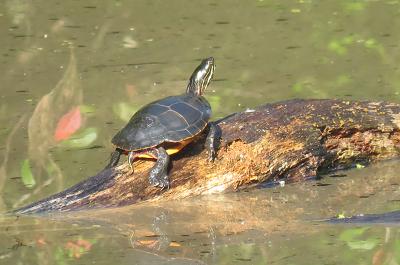
Turtles need to sun themselves to regulate their temperature.
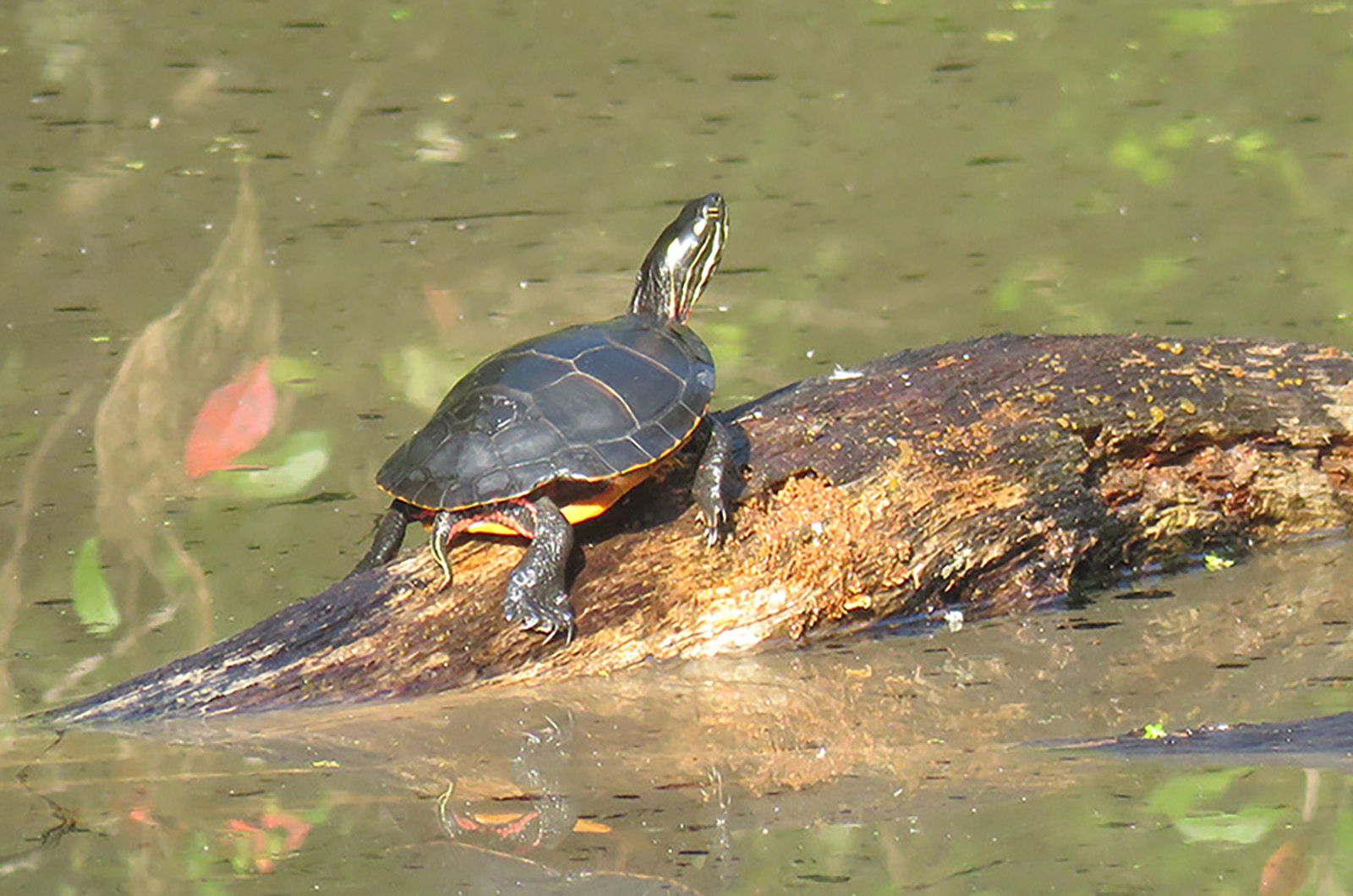
Turtles need to sun themselves to regulate their temperature.
But humans lead the way in destruction.
“The big problem is that we built roads, which a lot of times a turtle is in a pond here and wants to nest across the road to its traditional nesting area but now there’s a road” he said. “It’s a real issue on the Island.”
In the future, Mr. Johnson hopes to install small tunnels beneath roads where turtles congregate. In the meantime, he has been posting “Turtle Crossing” warning signs near ponds so drivers will be on the lookout.
Another threat to the painted turtle population is the invasive red-eared slider turtles, which Mr. Johnson said were likely introduced by a human who had one as a pet.
“I think they’re great turtles. I’d love to have one, but we’re watching them very closely because they could be a real problem,” he said.
The red-eared sliders grow up to 10 to 12 inches and take up space on rocks or logs in the ponds, where the smaller painted turtles usually bask in the sun. Turtles need time in the sun to regulate their body temperature, so without the space to do that, they are at risk.
A baby snapping turtle.
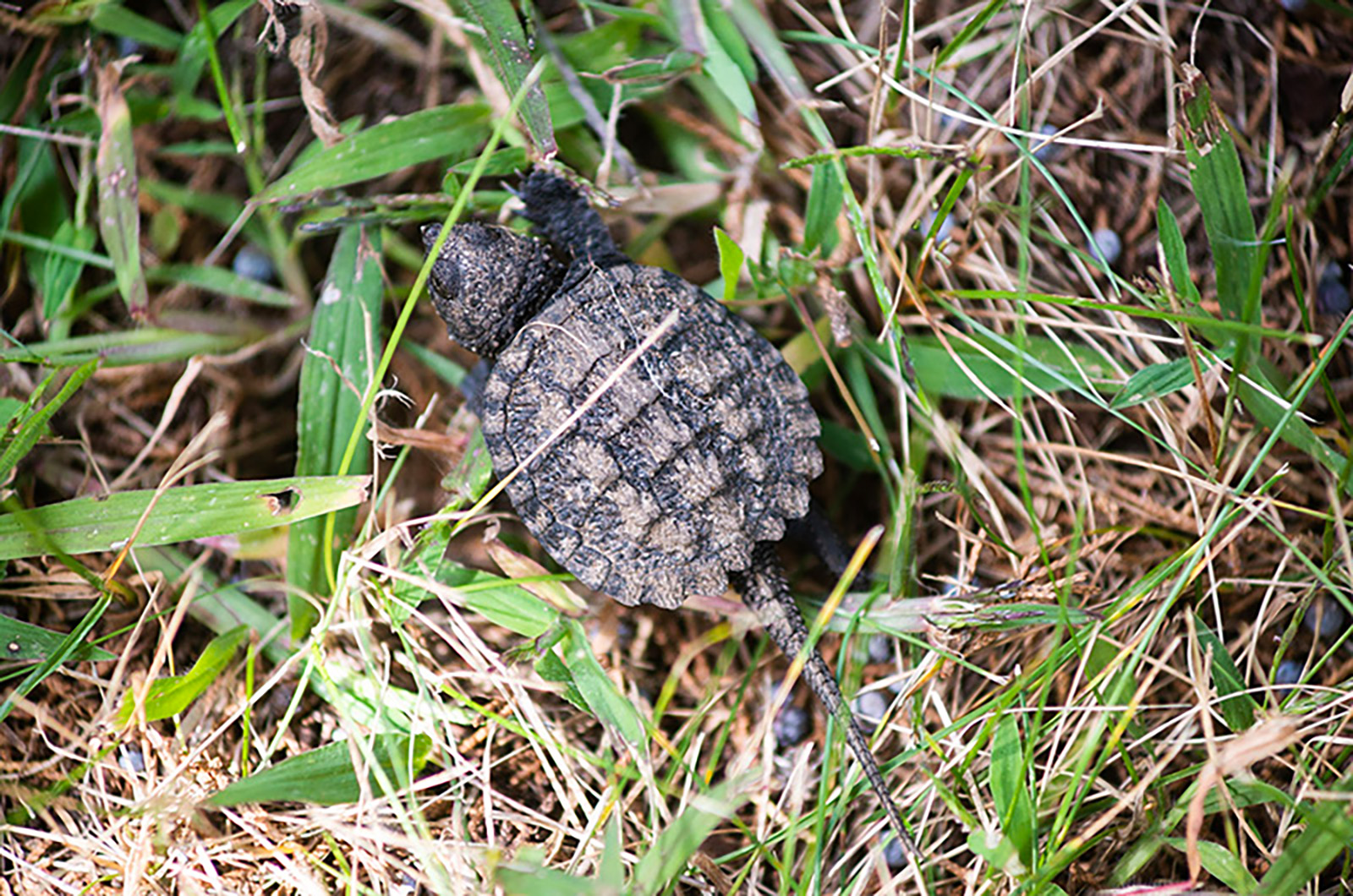
A baby snapping turtle.
With the help of Oscar Thompson, another turtle expert involved with BiodiversityWorks, Mr. Johnson is focusing on juvenile painted turtles, ages zero to four, which he feels will give him the best estimate of the size of the population here. However, juvenile painted turtles are often the most difficult to trap because they are hard to find, usually hidden in the ponds instead of lying out on the rocks in the sun.
Despite the difficulties, Mr. Johnson will not be deterred. After all, it’s a passion the biologist has wanted to pursue since he was a little boy.
“I used to make my mother go over to the frog pond, there were turtles there, and we would go and throw a piece of bread and wait until a turtle came and scoop them up,” he told the audience.
He emphasized the importance of support from the community in gathering data. He asked that anyone who sees a turtle, dead or alive, should email him a picture at [email protected] so that he can identify the species and location.
Comments
Bravo, Dick! Another turtle
Dana Nunes MVBravo, Dick! Another turtle lover here. This year the intersection in Menemsha just before the Home Port has seen quite a lot of turtle activity. Sadly, some of it fatal. Approaching the stop sign last week, we spied the largest painted turtle I’ve ever seen in the middle of the intersection, heading towards the HP. I snagged her out of the road, and carried her over to the edge of the pond in front of the Coast Guard station. There’s a corner that could use one of your signs.
Add new comment