

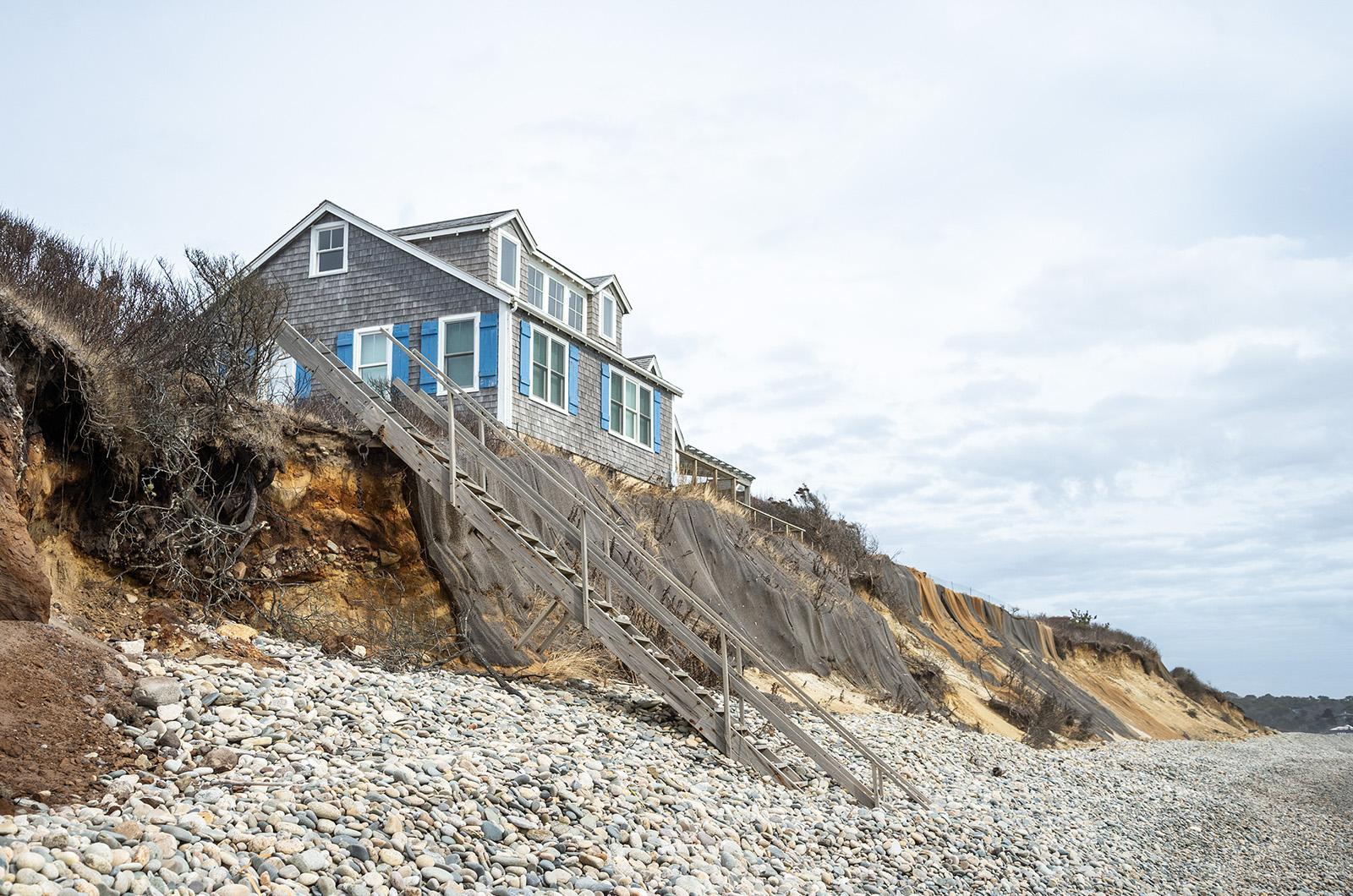
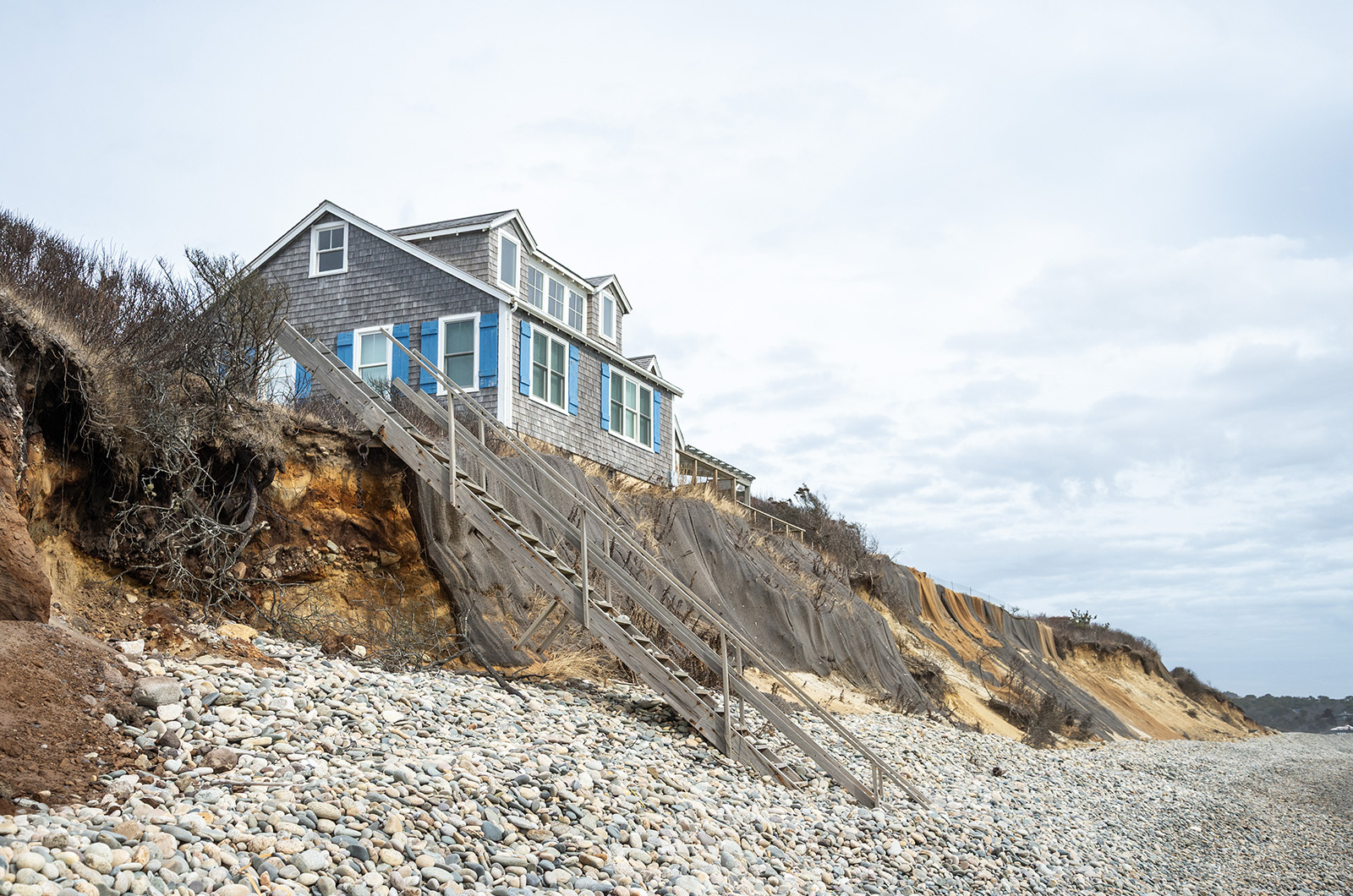
Three homeowners on Stonewall Beach have proposed an ambitious plan to move their houses inland while also bolstering the steep, deteriorating cliff.
A wave rolls in at Stonewall Beach in Chilmark, and the rocks under Paul Darrow’s house begin to rattle.
It’s been this way for years, each successive wave eating away at the base of the cliff. The appetite of the ocean has put the homes of Mr. Darrow and his neighbors in danger, with the former about a foot or two away from tipping over the edge.
In an attempt to save their homes, Mr. Darrow and his neighbors Larry Rockefeller, and Joel and Marcy Greenberg are presenting an ambitious plan to move the three houses inland while also bolstering the steep, deteriorating cliff.
It is one of the largest projects proposed to the Chilmark conservation commission in recent memory, spanning several hearings and hours of deliberation over the last four months.
The homeowners are asking to move their homes back.
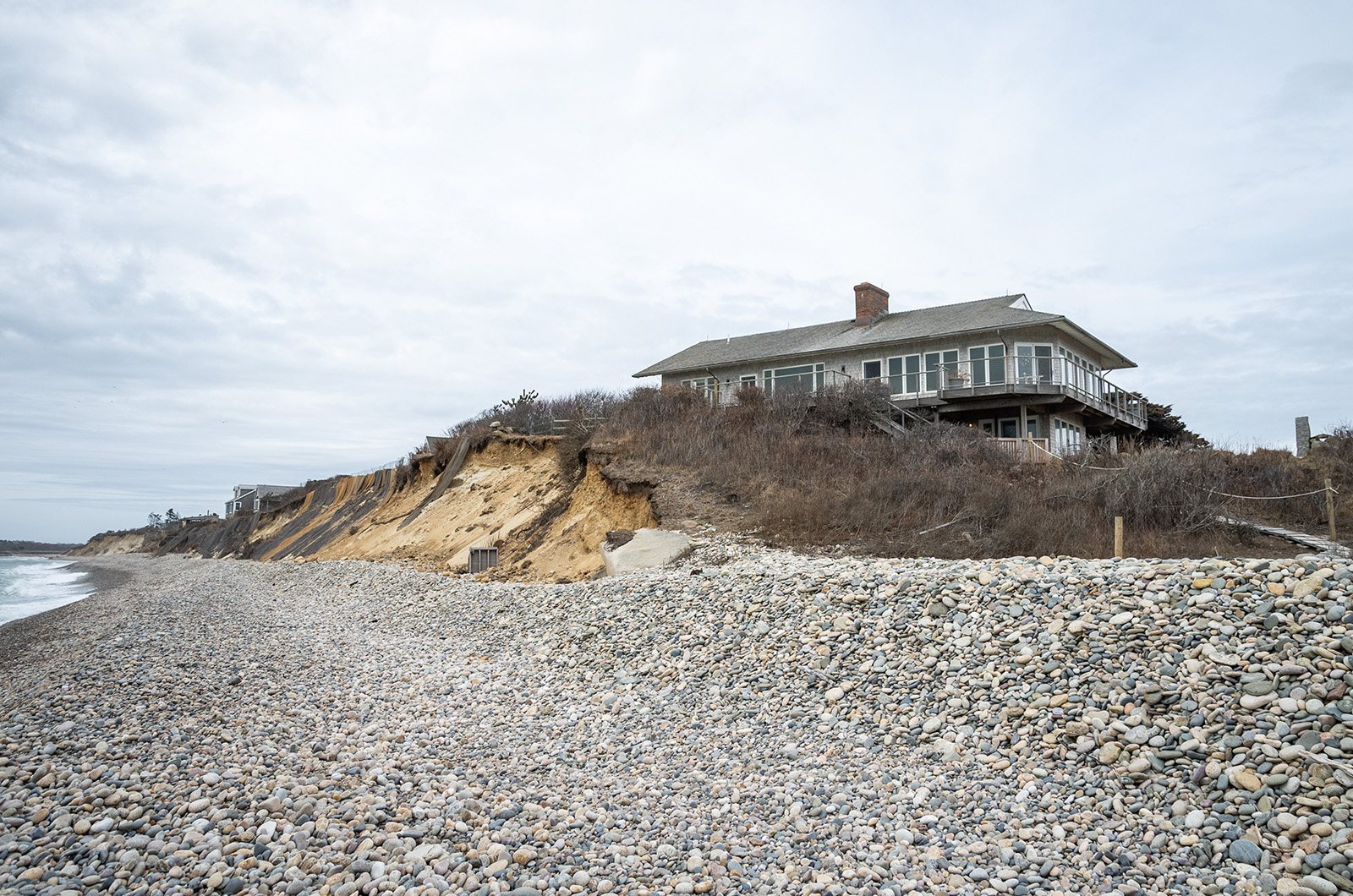
The homeowners are asking to move their homes back.
“This is the biggest such project we’ve had, at least in my tenure as chairman,” said commissioner Sarah Khedouri at a meeting last month. “We take it very seriously, especially whether it’s setting any kind of precedent for future managed retreat projects and shoreline protections.”
The trio of homeowners atop the cliff are presenting the plan both as a group and as individuals, making for a rare neighborhood approach. Each has a site-specific plan to move their homes, but they have banded together to offer up a proposal to shore up an approximately 400-foot stretch of the rocky beach.
Mr. Darrow’s three-bedroom ranch purchased in 2020 is the closest to the cliff, which has been eroding about two feet a year, according to experts. Mr. Rockefeller’s four-bedroom home is about 17 feet away, and the Greenbergs’ home is about seven feet away.
Given the complexity of the plan, commissioners have sent dozens of questions to the applicants, consulted several specialists and researched similar work done in other parts of the Island and the country.
Initially, the homeowner’s engineer George Sourati proposed digging a temporary trench at the toe of the dune in order to install 500-plus metal gabion baskets. The baskets are usually made of wire or metal and loaded with rocks to be used as a sturdy foundation.
On top of the baskets, the dune would be supplemented with log-shaped fiber rolls that would be tamped down with biodegradable blankets secured with steel cables. The dune would be replanted with beachgrass and other vegetation to give more support, and the baskets would be buried under rocks.
To continue to keep the ocean at bay, the area would require regular sacrifices of sand and rock.
The idea drew all sorts of questions and concerns from the town, especially on the gabion baskets. Some commissioners worried the baskets could either become dislodged — posing a threat to people around the beach — or that inserting them would do more harm than good.
In one meeting, Ms. Khedouri said evidence given to the commission indicated that the baskets could have been an “environmental disaster” on Stonewall — a south-facing beach that has its rocky shore hammered by waves day-in, day-out.
Last week, in apparent response to the concerns, the homeowners withdrew the baskets idea, instead opting for the natural fiber rolls that are often employed around the Island to stabilize the soil.
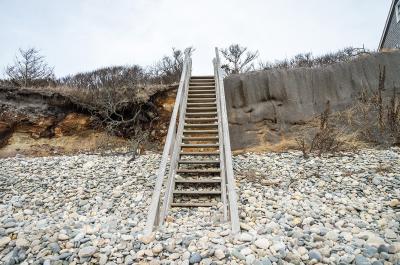
The beach has been eroding about two feet per year.
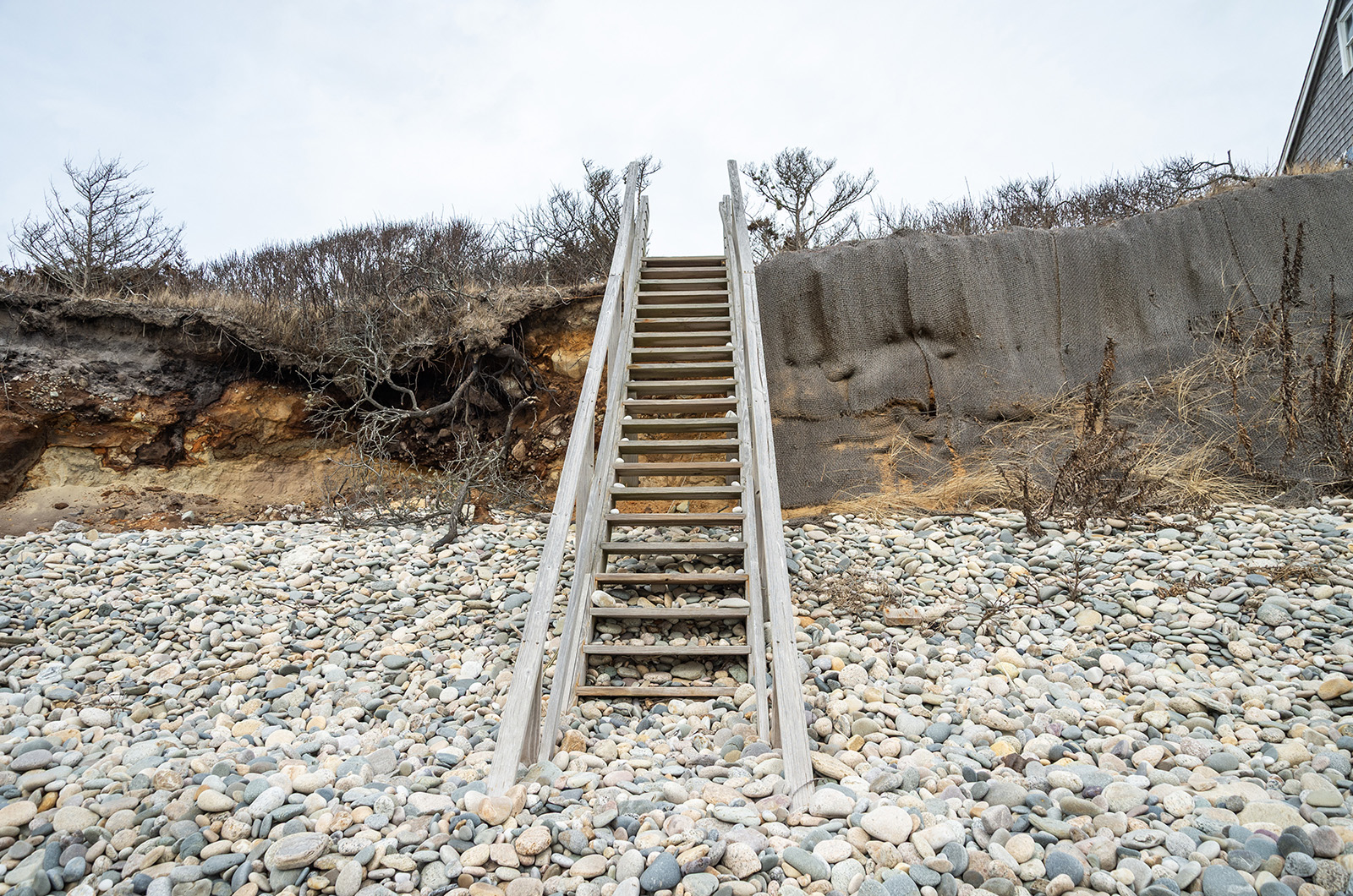
The beach has been eroding about two feet per year.
“The gabions have now been completely removed and we’re just looking at a fiber roll approach here, but one that goes sufficiently deep into the beach so that if that beach were to lower in a storm the bank would still be protected,” Seth Wilkinson, a restoration ecologist working for the homeowners, said at a meeting last week.
The homeowners new plan is to pull the current rocks on the beach out of the way, install the fiber rolls under the existing sand, and then put everything back in place.
This amount of disruption also caused alarm for some commission members, though Mr. Wilkinson said he didn’t expect the excavation to result in any future issues on the beach.
“[Beaches], they’re highly mobile,” he said. “They move all the time, so moving them with a machine and then putting it back to the exact same profile so that it can be protected would have no negative impact.”
The commission so far has largely focused on the beach nourishment plan, which remains up in the air. As debate about that continues, the applicants have pushed for the commission to make a decision soon on at least the home relocations, saying their homes are getting closer to the cliff.
“We can’t do this forever,” Mr. Darrow said. “My house is the most at risk of the threat. My house needs to have an immediate resolution so that we can protect the property. We just can’t continue this for years, because it will all become moot.”
A hearing is scheduled for next week, though the months of hearings seemed to be testing the patience of some of the applicants. While he appreciated the board’s thoroughness, that thoroughness was expensive as an applicant, Mr. Darrow said, and could be a de facto denial.
“This is a quasi-taking just by the delay itself,” he said at the March 6 meeting. “We need to deal with this, because what’s the alternative? The thing’s going to fall on the beach and you’re playing around with how good the plan is?”
The commission has lingering concerns though about the house moves, especially for Mr. Darrow’s property.
The Greenbergs have plenty of room to move their house back at 8 Greenhouse Lane, and Mr. Rockefeller’s home has not, at least initially, raised many questions. But Mr. Darrow’s house is on a much smaller lot hemmed in by a wetland.
Mr. Darrow is proposing to pick up his top floor, demolish the existing basement and foundation at the edge of the cliff, and move the home back about 22 feet. He hopes to build a new foundation into the cliff and place the upper floor of the existing house there.
The excavation on the cliff caused concern among commission members, and prompted some to ask about the potential to put the house on piers, like the home next door owned by Natalie Conroy.
“I’m hearing a lot of concerns about the excavation that’s required, both for removal of the existing house and for the creation of the new house, and concerns about the recontouring of the cliff,” Ms. Khedouri said. “All those concerns, I think, could be eliminated if you were to look at this approach instead.”
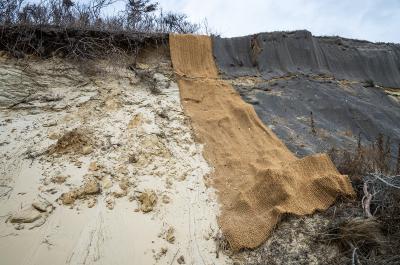
Waves and wind have taken their toll.
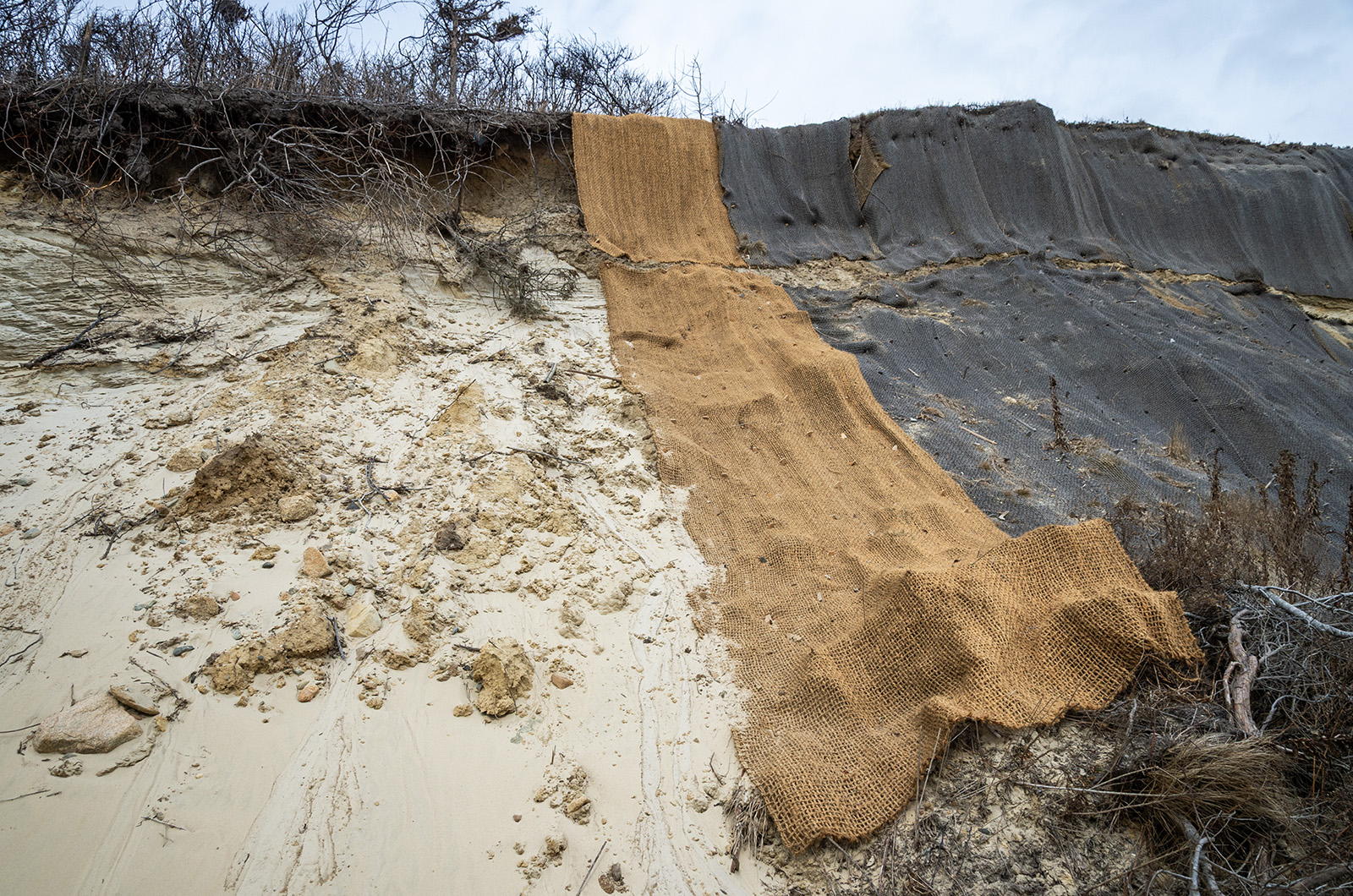
Waves and wind have taken their toll.
Piers would preclude a basement, forcing Mr. Darrow to think about the potential expansion of the house’s footprint.
“We have a 2,300 square foot house right now,” he said. “We’ve reduced that significantly, and we need a three-bedroom house. You can’t do that in 800 square feet and have any living space.”
The commission is set to meet again on March 20, with the goal of tackling the house moves decisions. As the commission deals with the logistics of the plan and considers the future of the rocky beach, the applicants’ attorney Gregor McGregor hoped the board would see the good in the proposed plan and take action.
“We feel this project is a model or at least a real good example for the ConCom and the various Town boards and officials who due to your locale will be dealing with coastal retreat for decades at the behest of landowners, facilities, agencies, utilities, and the Town itself,” he said.
Comments
Nice to have money! I wanted
Jenn MVNice to have money! I wanted to build a 6x8 shed to store a couple bikes and was denied.
Free men don’t ask permission
Joe MVFree men don’t ask permission
…they ask forgiveness.
Dana Nunes MV…they ask forgiveness.
That makes no sense. Appel it
frank Brunelle TisburyThat makes no sense. Appel it. Wow.
From the real estate listing
Jake Toomey ChilmarkFrom the real estate listing for Mr Darrow's property: "The property may be used as is for some time and then be converted into a private beach access ideal for surfers and beach goers alike."
It was well known what the outcome would be, just enjoy the beach access and forget having a house there. Why let the beaches and environment pay the price for a few more years of having a home there?
Soil tubes don’t work. They
Anne K EdgartownSoil tubes don’t work. They used them in Galveston Texas. I have photos of these ugly tubes after Hurricane Ike. Fat black earthworms after fake dunes washes away. They were slashed and removed. Did nothing against mother nature.
See Brasch House in Wellfleet
AlSee Brasch House in Wellfleet. That is our reality. To quote the old advertisenent, you can’t fool Mother Nature
I think whoever is
Charlie Callahan So Boston/EdgartownI think whoever is responsible for, or who gets the job should have to take out a huge bond in case the job goes down the tubes and the beach gets wrecked in the future because of what has been done. and the contractor has headed south
I don't think that preserving
Elizabeth Edgartown and Delray Beach, FLI don't think that preserving beach front for any private business or residence should come at the expense of the tax payer. Buyer beware! The ocean will have the last word!
Curious if any State or
Mark Acker VhCurious if any State or Federal funds will be used?
I don't think the towns by
Charlie Callahan So Boston/EdgartownI don't think the towns by law can use any public money for something like this. People know what happens when they are on the edge that is eroding
I don’t know whether to label
James EdgartownI don’t know whether to label this ignorance or hubris. Throwing some sand tubes down is not going to stop this island’s slow erosion into the sea. Like Cape Cod, Nantucket, and Long Island, the ocean will eventually make glacially formed MV disappear like a beach sandcastle. These homeowners are just at the tip of the erosive spear that will eventually (over a few eons) swallow every structure and piece of land here.
Historically, Owners of
Mary ChilmarkHistorically, Owners of properties in the different towns that are located on eroding parcels have moved their houses back quite a ways from the edge of the cliff, often sacrificing the current large water views in exchange for safety. If the parcel is too small then abutters were approached to sell off any excess land they could spare to solve the dilemma. If these two options weren't feasible then the Town’s involvement ended except to enforce the homeowners responsibility to keep the beach below safe from falling debris. Its always hard when facing this possible outcome but it is one of the harsh reality of buying & owning water front property in vulnerable areas. Mother Nature always has the last word.
What a bummer.
Mike SomewhereWhat a bummer.
A Dynamic stone/cobble revenant would do a better job than the temporary fix being proposed.
Similar to what was done nearby on Squibnocket Farms Road. Albeit both ends need maintenance.
The key will be the core. Jetty sized boulders will need to be used.
Here is an idea: instead of
James OBHere is an idea: instead of moving the house back off the cliff, move it 100 feet into the water!
Leave it alone!
Richard J. O'Neil Naples, FloridaLeave it alone!
Add new comment