

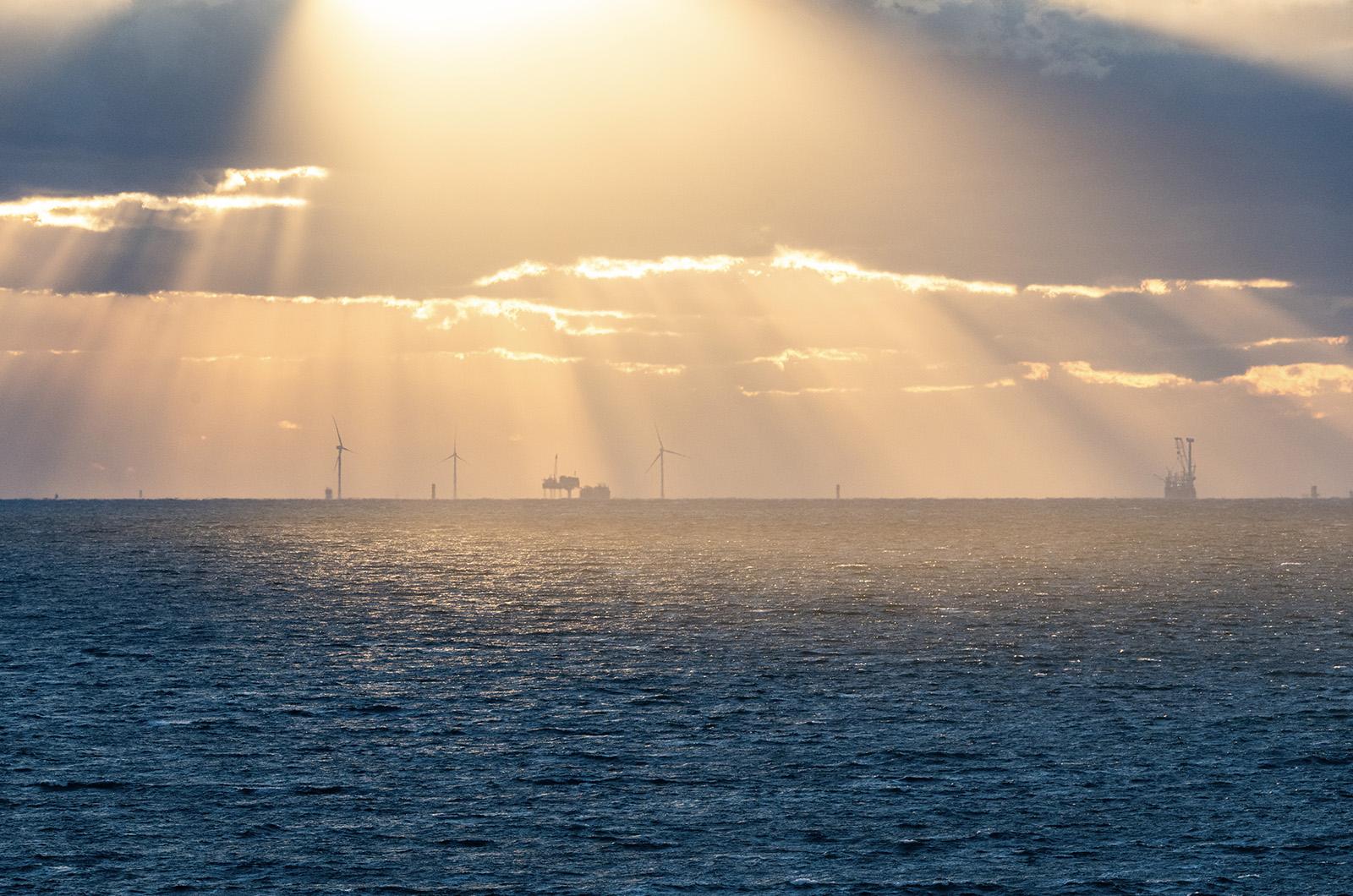
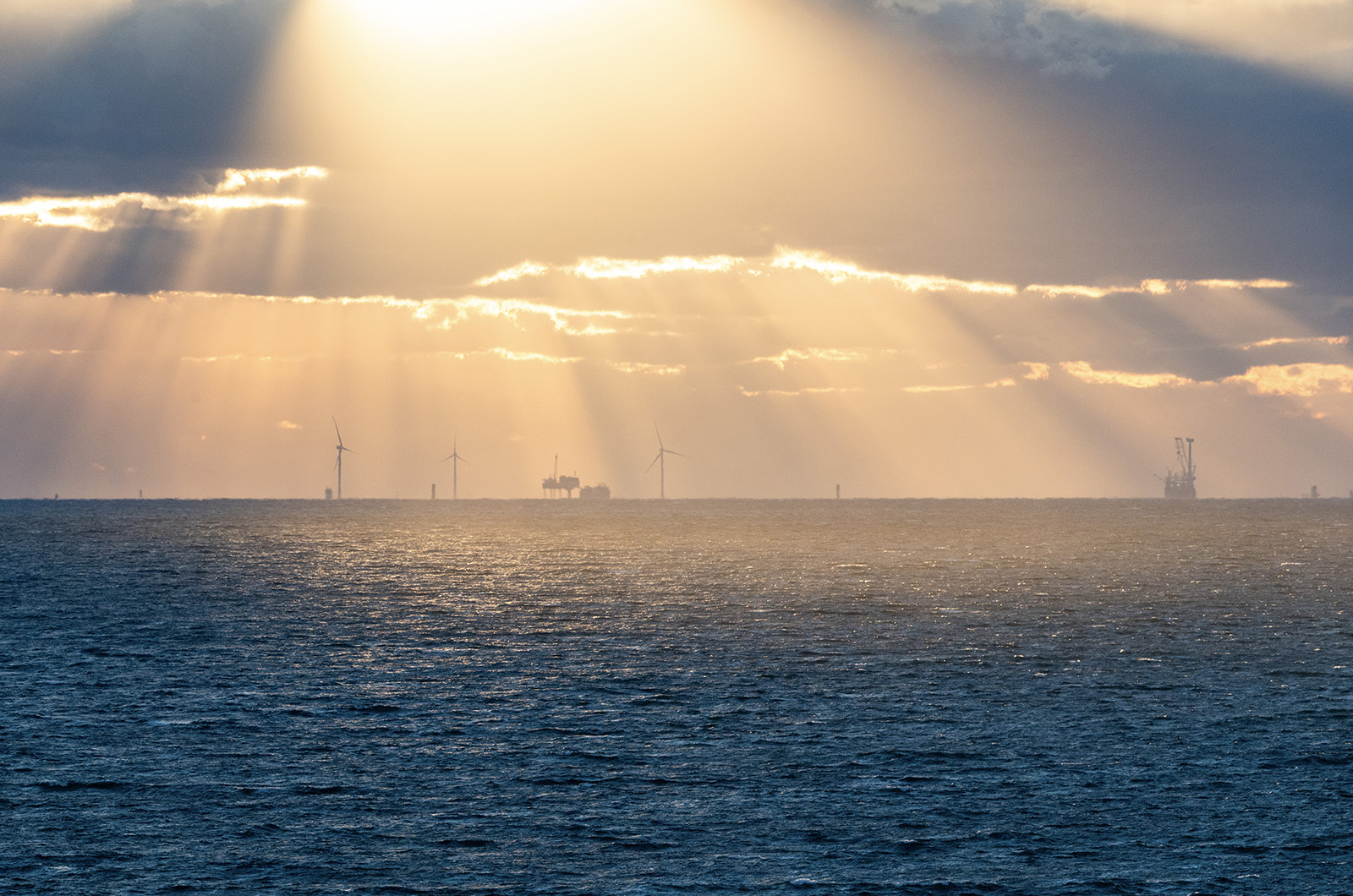
As regulators consider projects up and down the east coast, researchers at the Woods Hole Oceanographic Institution have been simulating the booming sound of pile driving turbine monopiles to see if it has an effect on a variety of species.
With hundreds of towering offshore wind turbines planned to be built in the waters south of Martha’s Vineyard, a team of local scientists is working to find out if the construction noise will hurt ocean life.
As regulators consider projects up and down the east coast, researchers at the Woods Hole Oceanographic Institution have been simulating the booming sound of pile driving turbine monopiles to see if it has an effect on a variety of species. So far, results have been mixed.
While there’s been research into how turbine construction impacts the endangered right whale, the ocean’s small ground critters have largely been left to fend for themselves, said Aran Mooney, an associate scientist at WHOI.
“This is a knowledge gap, and it could really impact the fisheries,” he said.
The research team has been replicating construction and observing its effects on lobsters, sea scallops, flounder, squid and black sea bass. Mr. Mooney’s work was contracted by the Bureau of Ocean Energy Management, the federal agency that oversees offshore wind energy.
In the past few years, the WHOI scientists have determined the impact the noise has on squid by playing an audio recording of pile driving as they were enclosed in a tank.
“The sound profiles are pretty much the same as what we see in offshore wind, actual construction.” Mr. Mooney said.
Once the sound played, the squid inked, jetted and changed into vibrant colors. Mr. Mooney said that while squid often have a flair for the dramatic, they seemed to habituate to the noise.
Sea scallops, a prized fishery in southeastern Massachusetts, had almost an opposite reaction, Mr. Mooney said. Every time the bivalves heard the pile driving sound, the scallops clammed up, closing their shells tight.
After some time, they would try to open their shells back up, but would immediately close again when the sound played.
“They’re breathing faster and harder, and it actually exhausts their main muscle, and then they are much more susceptible to predation,” Mr. Mooney said.
In recent months Mr. Mooney’s team have been focused on studying lobsters. In the fall, WHOI ran a daily experiment with 60 lobsters from Rhode Island. A construction company drove a one-foot diameter steel piling into the Woods Hole harbor seabed. Two of the lobsters at a time were placed in enclosures 10 and 60 meters away to see how they would react.
Mr. Mooney said the experiment represents a scaled down version of lobster habitat, recreating what the species would experience when the massive 30-foot-wide pile drivers used by offshore wind developers are employed. Ten meters represents what a lobster resting at 300 meters away from the pile driving would experience, and 60 meters represents a lobster one kilometer away from the offshore wind construction.
To gauge the lobsters’ reaction, the researchers equipped the crustaceans with health monitors, as well as tiny backpacks with sensors.
“We created these little Fitbits for them that measure their heart rate,” Mr. Mooney said.
The lobster data is still being analyzed and the team won’t have results for several months.
The team is also studying the effects on flounder, putting monitors on their gills and tracking each time the fish takes a breath. The scientists so far have noticed the flounder will stop swimming when they hear the pile driving noise.
While the scientists don’t know for certain, they hypothesize that the pile driving noise is stressing the fish and making them hold their breath, Mr. Mooney said.
Offshore wind developers are required to mitigate their effects on the ocean’s species, though this type of construction has never been done before in the northeast. For example, farms are restricted to when it can pile drive in order to protect right whales. They are also required to have observers looking and listening for protected species during construction.
Vineyard Wind, which is dealing with the fallout of its broken turbine blade, previously touted special technology used to keep the ocean quiet despite the loud hammering.
During the installation of its dozens of monopiles, Vineyard Wind has used what’s known as a bubble curtain, which creates a sound barrier of bubbles, as well as a noise-reducing hammer.
But even with these mitigation efforts, the WHOI scientists worry that sea creatures could be harmed, making the study crucial work.
“The bubble curtains are designed for basically the higher kind of frequency parts of the sound that mostly marine mammals detect,” Mr. Mooney said. “For the animals that detect low frequency sound – the fishes and the squid and scallops and lobster – the bubble curtains probably won’t be a very protective measure.”
Comments
Maybe they should conduct
Jen WTMaybe they should conduct these studies BEFORE building the turbines. And if the result show harm to sea life, hopefully we can require that the turbines be removed once and for all.
Jen Jen Jen,
Michael Frick Edgartown, MAJen Jen Jen,
That woukd make too much sense silly!
On a side note, I was told by a board member that over 50 Vineyard residents would be hired to work on the wind farm, but less than 10 ha e been hired. I was also told part of the agreement was that you would not be able to see the turbines from shore. We'll we all know how that worked out with the ugly towers clearly visible from South Beach, but we all digress!
Exactly. Ugh
Martha Klein EDGARTOWNExactly. Ugh
I don't need scientists to
kinda late mvI don't need scientists to tell me what is already out there with the dead whales washing up all over the east coast where the sonar was 'mapping' these areas
Having already issued leases
Quitsa ChilmarkHaving already issued leases and permits for hundreds and hundreds of wind turbines, the Bureau of Ocean Energy Management thought to fund some studies of the impact of the actions they have already taken? Add this to the list of gross flaws in the regulatory process that has allowed this environmental nightmare to proceed unchecked. What is BOEM planning to do with the results? Apologize for being in the pocket of the wind industry and tell us it is too late now to do anything?
But I thought there were no
Jason Gale West TisburyBut I thought there were no negative impacts from these projects? That's what many have been saying.
Mono pile driving noise has short term negative effects but the scope of these projects up and down the coast means that Mono pile driving will continue for years to come , so short term becomes long term.
Then we get to move on to mono pile turbidity (mixing of the water column) for 40 + miles down stream that kills zooplankton.The same zooplankton that the North American Right Whale depends on for food, as well as,other marine species.
Then we have the impact of EMFs emitted from the thousands of miles of cables that drive bottom dwellers away (URI-BOEM report).
Blade shedding dumping 40 lbs of micro plastics per blade per year into the ocean.
How about the open loop cooling systems that dump millions of gallons of chlorinated sea water back into the ocean at 95° daily from the substations, changing the environment around each one and also killing zooplankton through the intake process.
I applaud WHOI for finally admitting that OSW has negative effects on marine life , 2 years ago they weren't so forthcoming.
They will have to remove them
steveThey will have to remove them if they affect the Piping Plovers. I wonder if the developers got a waiver for the cost of taking them down when they reach their end of life built into the development budget or are they going to stick it to the energy users at that time. I believe that happened with the nuclear reactor in Plymouth.
Jason, I have been heart sick
Peter Fyler West TisburyJason, I have been heart sick about what is happening to our seas, and wonder if in the end, as I have taught my sons, "There are no friends where money is concerned", 'friends' being our sea creatures and their 'wild' habitat.
Your succinct list of conditions and the WHOI study just confirms what any logical thinker already knows, but what is next ... business as usual?
Pile drive next to people.
Jo EdgartownPile drive next to people. Monitor their environment at home while they’re working and sleeping and reproducing. Maybe there are no effects.
Dismantle and Disappear.
George F.Dismantle and Disappear.
The only acceptable
Johanna Hynes KatamaThe only acceptable mitigation is to take them all down.
Offshore oil production
Albert GosnoldOffshore oil production platforms?
Or just the stuff you can see?
Would you rather they were
Jay Lagemann ChilmarkWould you rather they were drilling for oil out there and we were looking at the oil rigs?
If you want a nice clean ocean, you don’t allow fishing either. Dragging nets over the bottom is not exactly good for marine life, and using water jets to dig up the sea scallops not very good for The seafloor either.
We all use electric power. It’s got to come from somewhere. And of course, we would prefer that it was in somebody else’s backyard. NIMBY is alive and well.
Jay ,
Jason Gale West TisburyJay ,
It doesn't seem your too familiar with fishing practices.
Sea scallops are caught using a larger version of a bay scallop dredge, and drag gear for fish barely tickles the bottom.
Fishing practices today are far less invasive than say 50 years ago and completely sustainable.
WHOI is telling us we have a problem here and it's only going to be magnified as these projects continue to grow in numbers and in size.
People need to stop deflecting by saying fishing is killing the ocean and OSW isn't.
The point isn't that offshore
Katie FalmouthThe point isn't that offshore wind doesn't have impacts, it's that everything we do has impacts and there are always tradeoffs. The fossil fuel industry is far more harmful to both humans and the environment than offshore wind, it's just that we don't have to see any of the direct impacts in coastal New England. I agree with the original poster that there is a ton of NIMBYism in this discussion. I get it, change is hard, but if we want to have cold beer, hot showers, and a growing population, the impacts have to fall somewhere. If we're lucky, when all of the construction is done and ecosystems have a chance to recover, the main impact will be on views on a clear day-- honestly a non-problem in the grand scheme of things. I would love to see some in-depth reporting on long-term environmental impact studies from Europe, where large-scale offshore wind has been in place for decades. That would tell us a lot more than preliminary results focusing on individual species. I also think you and many others don't understand the history of overfishing in the North Atlantic and the degree to which overharvesting has changed the ecosystem. To say that fishing practices today are sustainable ignores the fact that they are keeping populations at tiny percentages of what they were before colonization, and is as misinformed as it would be to claim that recent vessel strikes and entanglements are the reason the North Atlantic Right Whale will most likely go extinct. The damage was done a century ago, and we are all just trying our best to live well and repair what we can.
Many good comments here. I
Lorraine EdgartownMany good comments here. I have traveled the world and seen wind energy being harnessed. And other forms, tidal, solar, geothermal. Scotland is doing wonderful things, as are other countries, and we have some large windfarms in our interior. There have been problems with them, as to the companies handling the debris from broken systems, some have been littering the landscapes and it has taken strong actions for the companies to clean up the messes. Not pointing fingers here, just observing. I am totally against the offshore wind farms, this is a huge mistake. We, Canada, Mexico, our two neighboring countries, have vast areas that are uninhabited by humans, if we could get out of our own way and just collaborate and put these monstrous wind farms in uninhabited territory we would be ahead of the game. IMHO.
Don't forget your beautiful
Bob Oak BluffsDon't forget your beautiful big factory at five corners! What is actually in there? Are we ALLOWED to know now that it is already constructed? It seems we are not ALLOWED to comment about it. Will this even get printed?
Has anyone considered Global
Tim RIHas anyone considered Global Warming? Let’s blame the wind Turbines, that’s the easiest answer but not the correct one. It’s either harvesting Wind Power or Nuclear Power or we stop reproducing
It got printed.
Albert GosnoldIt got printed.
What comment have you made about the big beautiful factory at five corners that was not printed?
The only "factory" at Five Corners is the Black Dog Bakery and Gannon and Benjamin.
The Vineyard Wind facility is no where near Five Coroners.
Vineyard Wind manufacturers nothing.
They own, operate and maintain wind turbines.
Have you ever stopped by the Vineyard Wind facility to find out what they do there?
I have found them to be very open.
Do you have an open mind about wind?
Nothing can change your mind?
My biggest concern is large
Paul D. Adler ChilmarkMy biggest concern is large storms or hurricanes with a collapse of these turbines and our beaches littered with oil and fiberglass debris. And then the turbine developers declaring bankruptcy and we must clean it up. I am hearing they have no disaster funds.
I find it odd that a "green"
Carl Simonin Oak BluffsI find it odd that a "green" company like Vineyard Wind doesn't have solar panels on it's roof.
Will the Trump Administration
John MarionWill the Trump Administration restrict/limit or reverse any aspect of the massive harmful ill thought through initiative underway to construct hundreds of wind turbines in the seabed south of the Vineyard? Environmental impact studies and the impact on marine life have been largely ignored or not thoroughly investigated. An early sign of pending trouble was when the Biden Administration issued a "permit to harass" marine life and endangered whales specifically. Look into Green Oceans initiatives.
Add new comment