


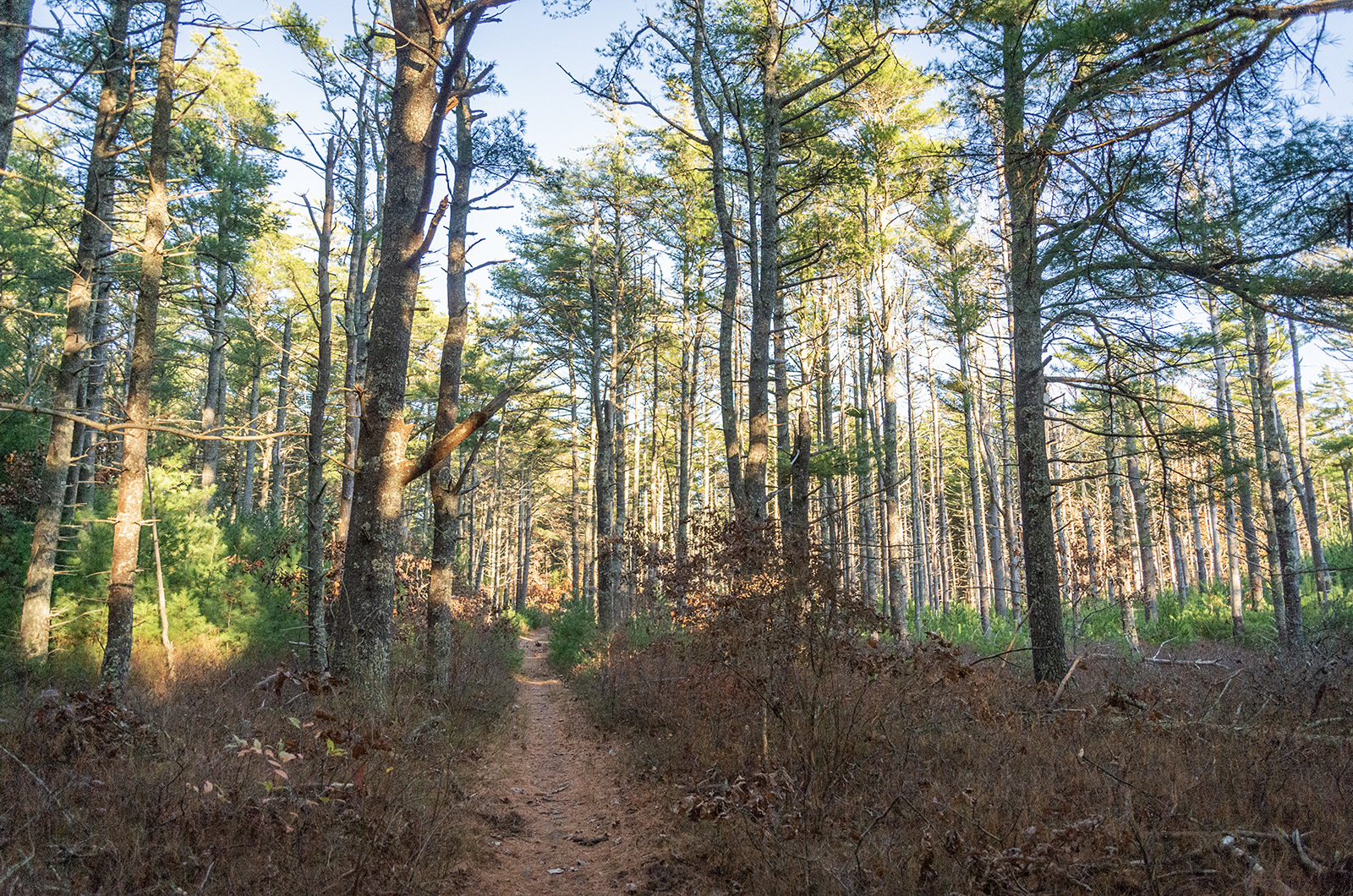
A proposal by the Department of Conservation and Recreation to remove an area of white pine trees from the state forest is facing pushback from local forestry experts.
A proposal by the Department of Conservation and Recreation (DCR) to remove an extensive area of white pine trees across 175 acres of Manuel F. Correllus State Forest is facing pushback from local forestry experts.
Last Friday, DCR management forester Paul Gregory led a tour through the forest to detail the plan, which he said will meet requirements set by the Natural Heritage and Endangered Species Program to mitigate the environmental disturbance that occurred when fire breaks in the forest were extended in 2001.
The initial stage would cover 79 acres in the southeast corner of the forest.
Ben Robinson, David Foster and Conor Laffey on walk last week.
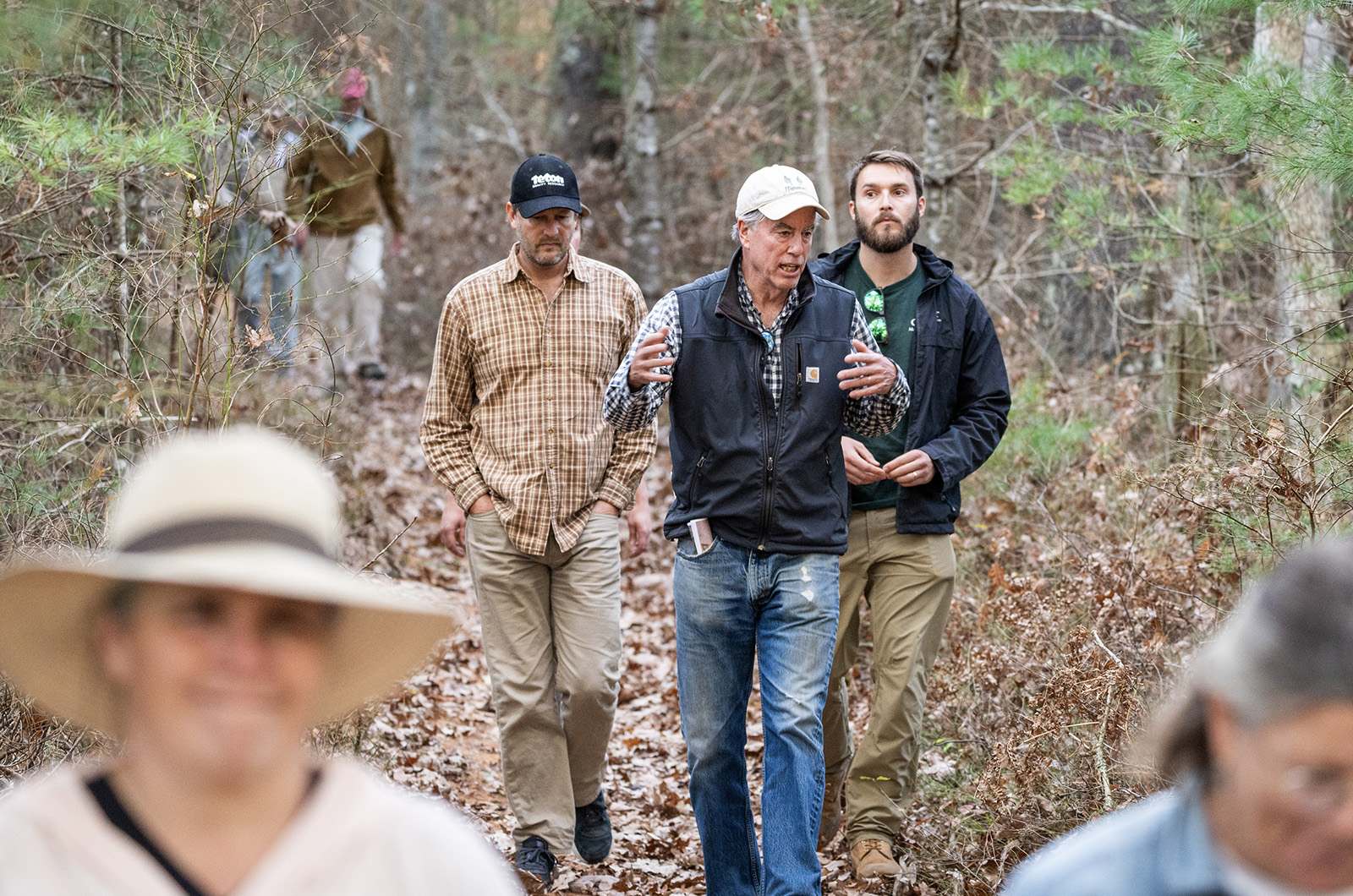
Ben Robinson, David Foster and Conor Laffey on walk last week.
Mr. Gregory said that removing the white pine population would enable native plants to thrive, and allow for the areas to be restored to either sandplain heathlands or pitch pine oak woodlands.
“We don’t want the white pine because they are getting in the way of providing the habitat needed for the rare species [in the forest],” Mr. Gregory said during the walk. “It overpowers the oak, overpowers the scrub oak. It’s not at its full potential for rare species habitat.”
He also cited the risk of wildfire as an objective for the project.
“If we maintain it, we can keep it at a lower risk,” Mr. Gregory said.
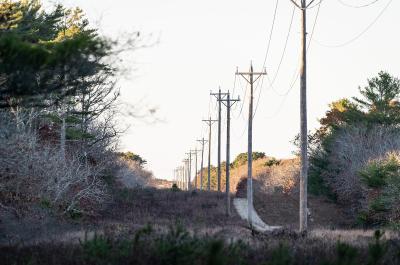
Fire roads line the forest.
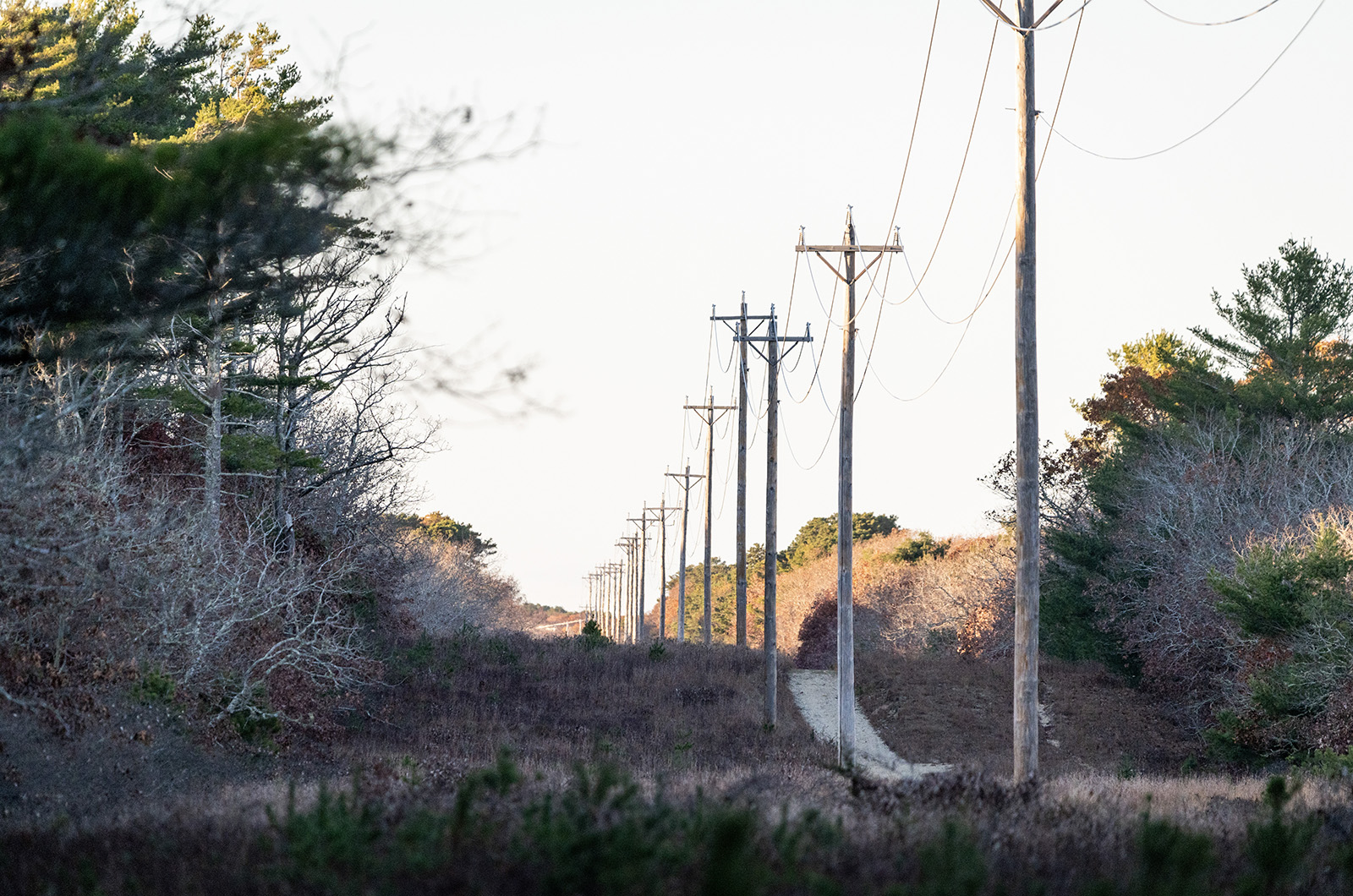
Fire roads line the forest.
Following the walk, local ecologist David Foster sent a letter to DCR outlining his issues with the plan, which he feels would be a “disaster.”
Mr. Foster is a member of the state’s Climate Forestry Committee and the Martha’s Vineyard Commission’s Manuel Correllus State Forest task force. He also served as the director of Harvard Forest and is a resident of West Tisbury.
“It’s hard to describe it as anything other than environmental disaster,” Mr. Foster told the Gazette. “That’s a big activity and my concern is that before DCR undertakes anything that scale, that they work on much simpler and in some ways much more pressing issues.”
Mr. Foster said he is in agreement that some white pines should be removed, but was taken aback by the size and scope of the proposed project. According to Mr. Foster, the history of the tree on the Island is complicated. The majority of the white pines in the state forest were planted between 1925 and 1941, over 400 acres of which were planted by the Civilian Conservation Corps.
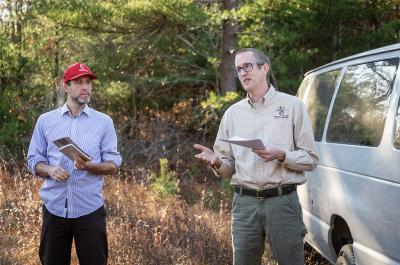
Dan Doyle and Paul Gregory.

Dan Doyle and Paul Gregory.
“White pine grows all across New England, and it grew on Martha’s Vineyard for thousands of years, but right at the time of European settlement it wasn’t growing here,” he said. “Because it was planted, it is considered not native, but the trees are doing remarkably well. It seems like if you want to support resilient forests and resilient landscapes, you want to let the things that are doing really well grow.”
He feels that the focus should not be on areas where the pines have already settled, but in places where they are beginning to encroach on the native oak forests.
“Those are getting established and they are going to grow up and change and degrade the native forest. The idea would be to go in and simply cut them down. That’s a very simple task that somebody with just a chainsaw would do,” Mr. Foster said.
He added that his recommendation for a more scaled-down approach, which he also made to DCR 25 years ago, would result in a smaller carbon impact. Less work with machines would emit less carbon, and because fewer trees would come down, the impact on the amount of carbon dioxide stored by the forest would not be as large.

White pine trees can overshadow smaller native plants.

White pine trees can overshadow smaller native plants.
In response to Mr. Foster’s arguments, Mr. Gregory told the Gazette: “We are following our obligations to Natural Heritage as stated.”
Mr. Gregory also said that DCR would review Mr. Foster’s letter but that changes to the project would depend on decisions made by senior staff.
In the meantime, although funding has not yet been secured for the initial removal, Mr. Gregory said that DCR is already looking to longer term management of the area, and that specific management plans would be decided based on what grows back after the initial white pines are cut down.
He added that mowing and prescribed fires would be used to ensure the white pines do not grow back in the area.
That part of the plan is another point of contention for Mr. Foster, who stated that the areas in question have thrived without that level of management in the past.
Mr. Foster acknowledged that wildfires are a concern but not enough of a reason to validate DCR’s proposal.
“I don’t want to ignore [fires], I don’t think we should use them as the major concern as a reason to destroy our forest,” he said. “I think we have to be very careful being over-reactive to fire.”
Comments
Perhaps there’s a compromise?
Margot Lane MenemshaPerhaps there’s a compromise? To me those trees have always seemed like a man made monocrop, and that what’s most resilient springs from biodiversity. Having more oaks seems like a no brainer, contributing to a more varied and fertile soil.
What a horrible idea . To cut
Nathan Vineyard HavenWhat a horrible idea . To cut down the healthiest and most beautiful part of the state forest is insane . Let's face it it's the only part of this preserved area that is a true forest . How do we go from total lack of management to cutting down these beautiful white pines ? You state in the article that it would help bring back the pitch pines but those are being attacked by the Southern Pine Beetle . Entire groves of mature pitch pines have been felled by the state because of the beetle and left in big heaps . This attracts the Black Turpentine beetle and those help finish off the remaining trees . Maybe the state could run some brush cutters through the fire lanes to control what is becoming a fire hazard . I say preserve this beautiful part of our island .
I agree,there is so much more
J. Consel West tisburyI agree,there is so much more that needs to be done like trimming the bike path edges that are so over grown,exposing walkers and bikers to ticks,poison oak,other tall grasses,weeds,are extended out into the paths. Brush cut the fire lanes to keep fire from spreading,and not setting fires in the spring to clear brush when this rare wild life is growing and animals and birds nesting. White Pine is cooling, creates a quiet atmosphere in the forest,santuare for wild life. Let nature be.
Nathan is correct on all
Don Ogden West TisburyNathan is correct on all counts though we should curtail any mechanized activity until after the drought. As for DCR, their forest management operation needs new blood. It wasn't until 3 or 4 years ago one could even find the word "climate" in any of their publications. Now they use terms like "climate resilience" as cover for business-as-usual: old-school forestry. David Foster, on the other hand, is a forest ecologist and while I don't agree on some of his positions on this issue he is spot on.
Healthiest? They are all dead
John Mort EdgartownHealthiest? They are all dead
due to the ban on plastic
Michael edgartowndue to the ban on plastic bags, we need to chop down a whole lot of trees, to make paper bags for our groceries......I just tossed about 65 bags that were cluttering up my house.....what a waste of trees
so they closed the newer bike
Jon edgartownso they closed the newer bike trails a few years ago and now they want to clear cut 32+ acres. this makes no sense
Something tells me this is
Johanna hSomething tells me this is all about clearing space for future housing developments. Tragic.
Perhaps a little less "Man's
abigail higgins west tisburyPerhaps a little less "Man's control over Nature" and a little more conservative eco-forestry?
what is cited as an invasive species needing the control of a massive clearcut may in some sense be valid. however, it is easy to foresee unintended consequences.
Why not remove white pines in smaller patches and observe what then happens?
as the commenter above noted, DCR, after years of inattention to the forest, has produced a clearcut plan on a breath-taking scale.this is boggling!
in my view, Hands Off The Forest until we know more.
I agree 100%! With waves of
Linnea FalmouthI agree 100%! With waves of disease and climate change stress, we need all the diversity of trees we can get. Eastern White Pine is not aggressive or new to our ecosystems. I am surprised that professional foresters would buy into the false binary of native vs non-native. Why not thin or patch cut if the goal is diversity? And as others have said, it seems like there are much more worthwhile projects in the Forest.
Please don't do this! The
Thomas S Hodgson West TisburyPlease don't do this! The proposed expenditure could do far more good elsewhere. One particularly good place for these funds would be to finish renovation/restoration of the State Forest Manager's house, and to put a manager (and presumably their family) in place on site.
Let's be clear- White Pine
Jean Cargill Oak BluffsLet's be clear- White Pine (Pinus strobus) is native to Massachusetts. We see so little old growth because the wood is highly valued. This was especially true during the Colonial Period when they were considered ideal for ship masts and the best White Pines in New England were marked on the trunk with the symbol of the King's Broad Arrow, signifying the trees were reserved for the King of England and the Royal Navy.
For me, White Pine is New England's most beautiful tree. I see no good reason for DCR to clear-cut beautiful trees and leave us with an ugly scarred landscape for decades to come.
Science based environmental
Earthdog RoanokeScience based environmental action is on the rise. Many so called environmentalist have little real knowledge in that area. Restore original native habitats. Start in your own yard if you really care. The suburbs are an endless AstroTurf like carpet of crewcut fescue, largely devoid of wildlife habitat. The denizens there love the tree and wildlife museums, so pretty! They can't see the forest for the trees.
Cut the trees and put up
Charlie Callahan So Boston/EdgartownCut the trees and put up affordable housing
Stop! Look! Listen! STOP
Sherrie S Cutler, A.I.A. Edgartown at Forest EdgeStop! Look! Listen! STOP:Hopefully, these alert and knowledgeable whistle-blowers can stop this uni-lateral, unstudied and massive removal of a tree type that is increasingly rare on MV ––the "ever" green tree that helps lift us through the winter. LOOK!: At the areas have already been already been stripped to produce "sandplain heathlands", but instead produce ugly scars and areas that require maintenance and mowing, LISTEN: Exactly what "native species" are expected to spring from this wasteland? We hear nothing of exactly what we should expect in return for our beautiful native white pine. (If it is truly fire prevention, it should begin with removal of huge branch piles in surrounding neighborhoods, instead, do we hear chainsaws for the sale of profitable lumber?)
LISTEN to Mr. Foster: If you want to support resilient forests and resilient landscapes, you want to let the things that are doing really well grow.”
I would suggest that
Marty Milner TallahasseeI would suggest that individual trees, and stand clusters, that appear heathy and tall with straight (borer free) trunks be identified. They could then be pruned and the resulting standing forest could eventually be harvested for lumber in the distant future. Judicious stewardship over time can preserve the quality diversity of the natural forest. Remember the pitch pine and lumber harvesting that was done about 45 years ago- willed on site with a portable mill. This could easily become a forest management technique that helped the forest and the community. A good read is "Forest Farming." It doesn't have to be all one thing and no human input.
Some stats are in order on
Pam Kelly Western MASome stats are in order on the decision to cut White Pine Forest on the Vinyard. !. Canopy Trees like White Pines, start sequestering carbon doixide (pulling CO 2 out of the atmosphere and storing it), when they get big / old enough, about 70 years. But they live 400 or so years! So multiply that modest C02 X 275 years, that is a lifetime amount for ONE tree....them multiply X for a whole forest!
HOWEVERY, ONLY forests with trees 70 years and older are going to have an impact toke humstoring enough carbon to help make a diffencg You only need to multiply. You cannot now plant a tree that will sequester carbon (at least significantly) before our "drop Dead deadline;;;
What a crazy idea! The white
richard Toole Oak BluffsWhat a crazy idea! The white pines are one of the most beautiful and healthiest trees on the Island. If needed, do a selective cut, utilizing the trees for lumber. Richard
I do not understand the
Lori Bradley New Bedford MAI do not understand the current hysteria over certain non-native species. White pines were planted here during the early years of European settlement. Why does that make them a target as a non-native species? They are doing well here. They offer shade, homes for animals, and offset climate change and erosion. Why cut them? What other successful species brought here by immigrants will be targeted for removal next? The white pines are accused of potentially increasing forest fire threat. The opposite is true. Forests with heavy acccumulated understory slow the spread of fire. Most fires we hear about lately are brush fires that move very quickly and burn hotter than forest fires. The DCR is not serving the community of Martha's Vineyard well with this logging plan.
What a tragedy it would be to
Johanna CharlestownWhat a tragedy it would be to destroy such an important part of the forest. I hope that the good people of Mv will pull together to stop this insanity.
White pines are indeed lovely
Bruce E. Nevin EdgartownWhite pines are indeed lovely trees, with medicinal uses.
Mr. Gregory says that changes to the project would depend on decisions made by senior staff and “We are following our obligations to Natural Heritage.” That punt of responsibility is an invitation to communicate directly to MassWildlife's Natural Heritage & Endangered Species Program (NHESP).
[email protected]
Regulatory Review Inquiries: (508) 389-6385
Main number: (508) 389-6360
The Wampanoag Tribe has at least an advisory interest here in respect to the pre-colonial landscape and oncoming climate change. Indigenous nations nationwide are petitioning for return of lands held under governmental stewardship, often successfully, and even some corporate holdings have been returned, as for example in northeastern California Pacific Gas and Electric has returned land to the Pit River people, with whom I work.
As Mr. Foster says, the white
B. Gravely BostonAs Mr. Foster says, the white pine was planted there but it is native to eastern North America. This is a bizarre approach to ecological balance. I agree that the oak forests could be protected but from further encroachment but let this forest live.
I'd guess there's more to DCR
johanna hI'd guess there's more to DCR"s proposal than meets the eye:
The White House has announced new actions to repurpose underutilized public lands for affordable housing. This includes:
The U.S. Forest Service planning to lease Forest Service land to build workforce housing
New rules to help developers secure underutilized federal lands for housing under the Title V program
Charles de Geofroy November
CHARLES A DEGEOFROY ChilmarkCharles de Geofroy November 15, 2024 At 9:08 am
I worked in the State Forest under Manny Correllus for twelve years, and the idea the State has to clear-cut the White Pines is foolish and short-sighted. They want to encourage native species, which is fine, but by clear-cutting, which is always a bad idea, and encouraging Pitch Pines, which, granted, are native trees that are dying in large numbers, you are making more of a fire hazard in the end. Pitch Pines will reseed in such numbers as to create a scrub, which will be a much worse fire hazard. Maybe the White Pines are not native, so thin them out instead of a clear cut. They are beautiful trees and are not being hit by the Southern Pine Beetle and dying on masse like the Pitch Pines. Chas de Geofroy
Everyone in the comments is
Antoine rockamora MvEveryone in the comments is all talk and no fight. "It's trees, the moths, oh no the homeless left things behind in and were removed by the state but wait we do not like this house going up and this one being demolished that's been abandoned for 30 years but it's 'historic'. Pick a lane
I think the real question is
Brendan debettencourt Oak bluffsI think the real question is what are the trees doing for us?
Add new comment