

In the first week of September, the hospital emergency room treated “approximately 20 cases of lesions that are consistent with tick larvae bites,” said Dr. Ellen McMahon, the hospital’s chief of medicine.
Benadryl, hydrocortisone cream, prescription-only permethrin cream — all are in high demand at Conroy’s Apothecary in West Tisbury, where owner and pharmacist Tamara Hersh says that a wave of late summer tick and mite bites have sent Islanders into her store itching for relief.
“It started in August and has just exploded,” Ms. Hersh said.
Island wildlife experts, doctors and pharmacists have all reported a spate of tick and mite bites in recent weeks.
This time of year, the Island’s lone star and deer tick larvae emerge by the thousands, tick biologist Patrick Roden-Reynolds said. At the same time, nymph and adult ticks are dying or going dormant, so their bites are rare.
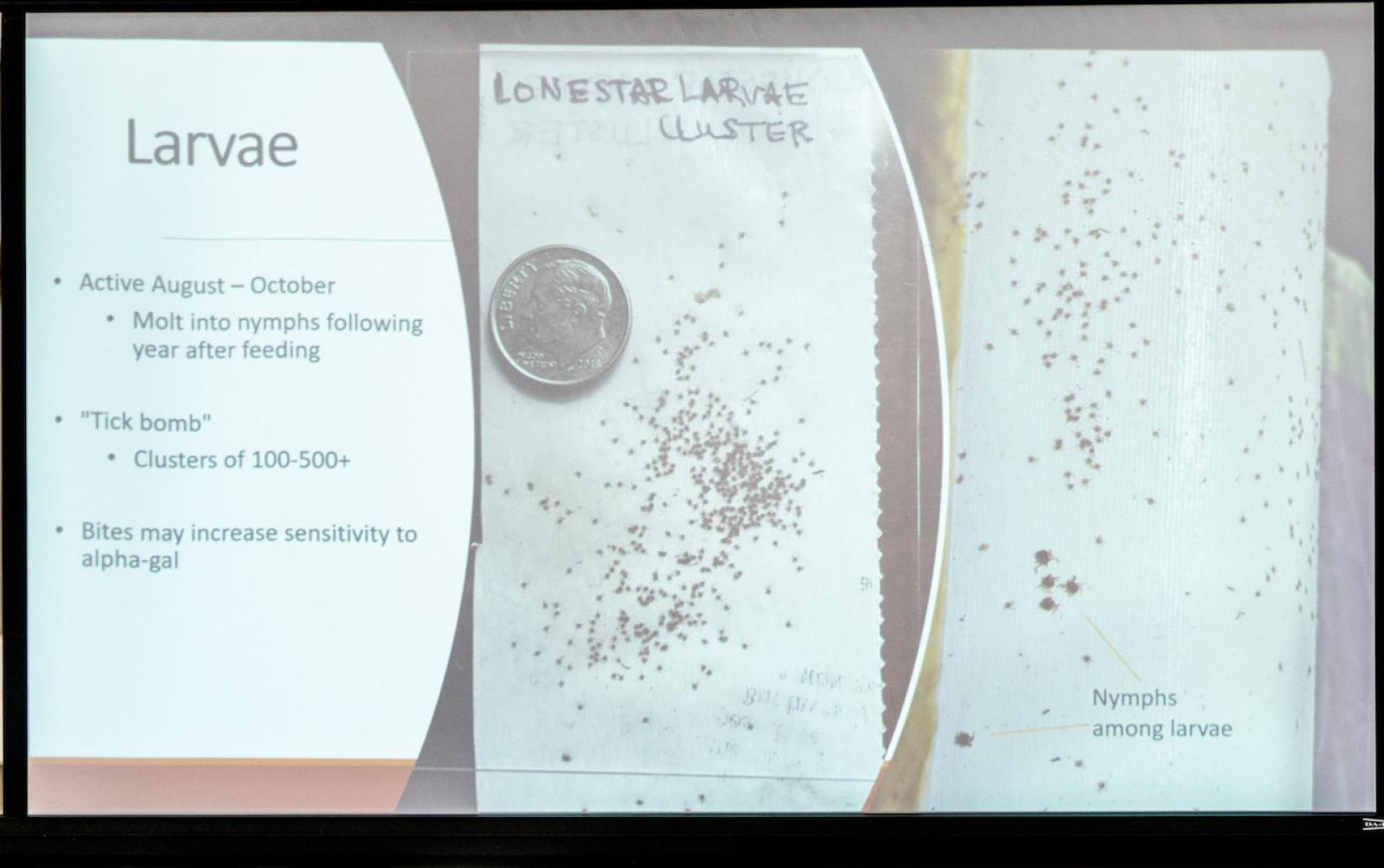
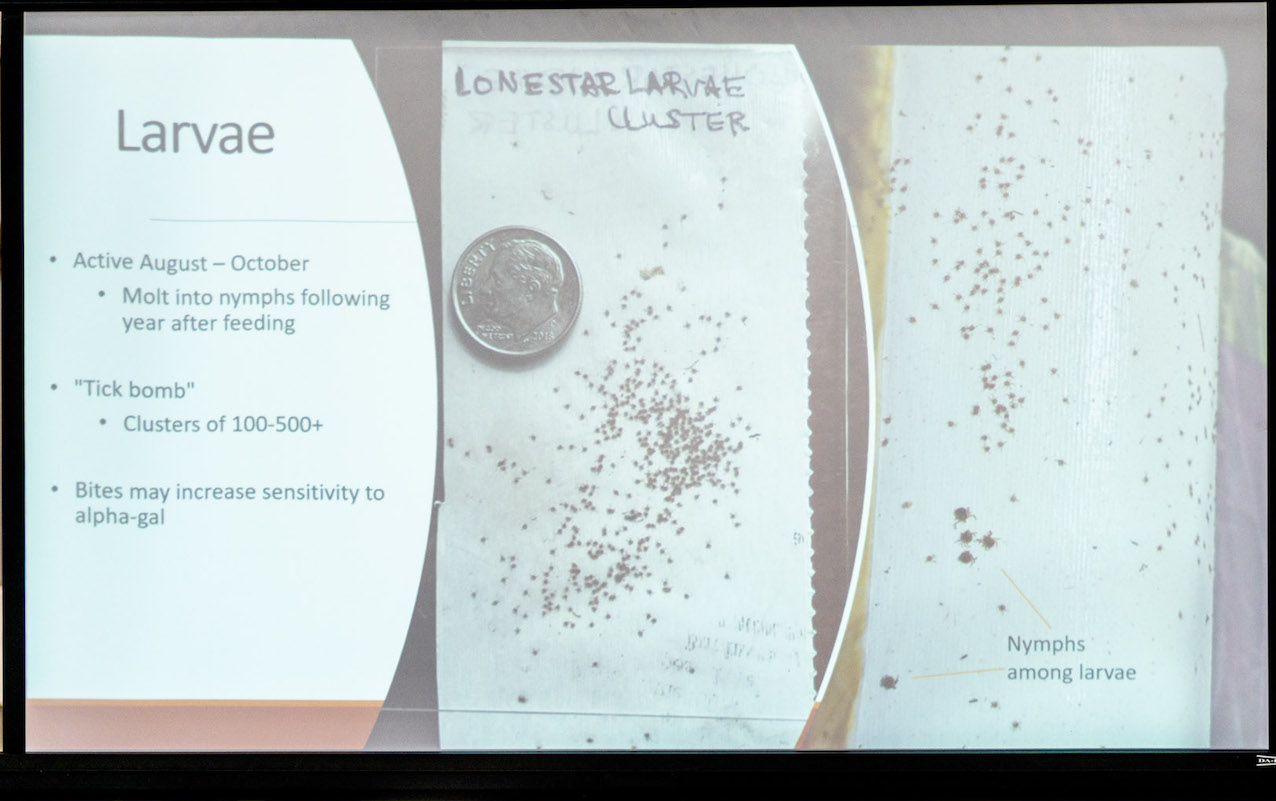
About the size of a speck of dirt, tick larvae can still cause extremely itchy bites, Mr. Roden-Reynolds said. Unlike adults or nymphs, tick larvae (especially lone star larvae) appear in clusters. Their bites often resemble a rash.
Earlier this summer, Patrick Roden-Reynolds spoke at a tick disease support group.
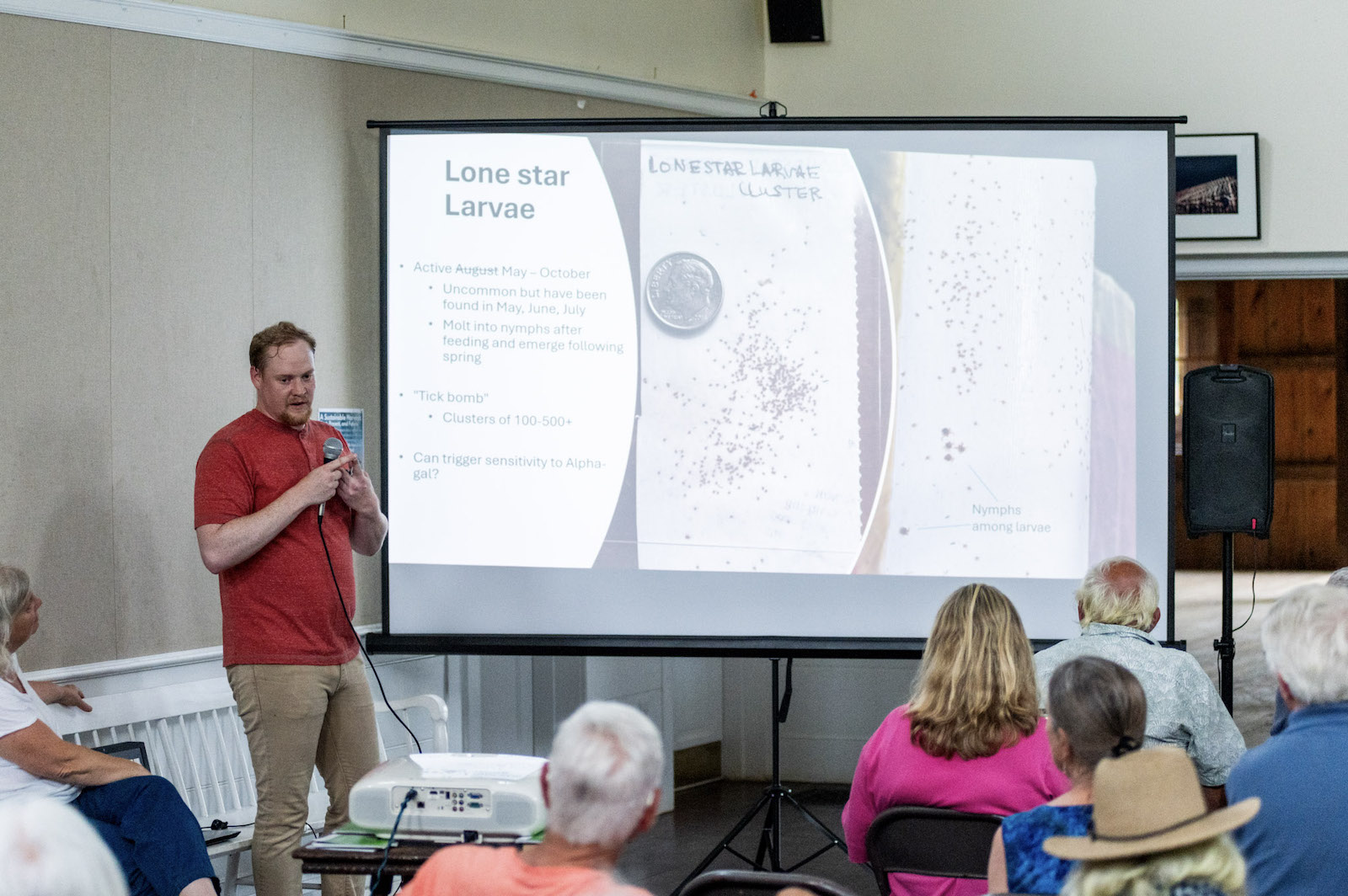
Earlier this summer, Patrick Roden-Reynolds spoke at a tick disease support group.
“I feel strongly that most people are suffering from larvae bites, tick larvae, whether it’s deer tick or lone star,” Mr. Roden-Reynolds said of the recent wave of bites. “It’s hard to like describe the actual bite, because other people will react differently.”
A handful of bites scattered across the ankles, leg and belly are indicative of deer tick larvae. Clusters of dozens of bites around the legs and ankles are likely due to the lone star ticks, which spend their larval stage in tight clusters that Mr. Roden-Reynolds calls “tick bombs.”
“You’ll literally just swipe up against something, and then you have hundreds of tick larvae on you at once.... It’s the number one way you kind of encounter lone star tick larvae is in these massive clusters,” Mr. Roden-Reynolds said.
In the first week of September, the hospital emergency room treated “approximately 20 cases of lesions that are consistent with tick larvae bites,” Dr. Ellen McMahon, the hospital’s chief of medicine, told the Gazette in a statement.
“These lesions are typically located on the legs, feet and ankles and are highly itchy. The bites are generally acquired in grassy areas, as the larvae ascend from the ground,” Dr. McMahon said.
Deer ticks, which carry Lyme disease and tularemia, are born sterile and their larval bites carry no risk of disease. However, both Dr. McMahon and Mr. Roden-Reynolds noted that bites from the lone star larvae can cause sensitization to alpha-gal syndrome, a tick-borne allergy to red meat. This is because lone star ticks, which carry the carbohydrate compound that triggers alpha-gal syndrome, are likely born with the compound in their saliva, Mr. Roden-Reynolds said.
As word of bites and rashes spread across social media, many Islanders suggested that their bites were caused by other biting arthropods, such as the oak mite or chigger, neither of which is known to be native to Martha’s Vineyard.
At the hospital, Dr. McMahon said they had “also encountered cases of oak mite irritation, though less frequently” than tick larvae bites.
“Oak mites are tiny arachnids (not insects) that are commonly found on oak trees and are difficult to see without magnification. These cases are usually linked to activities such as gardening or working with oak trees,” Dr. McMahon said.
Mr. Roden-Reynolds noted that oak mites drop from oak trees onto the necks, shoulders and backs of those underneath, and so their bite pattern differs from tick larvae, which concentrate around the legs and ankles.
Other Islanders reported being bitten by chiggers, another microscopic arthropod not native to the Vineyard.
Dr. Sam Telford of Tufts has studied the expansion of the chigger population northward into New England from its mid-Atlantic and southern range. In an email, Dr. Telford wrote that he had observed chiggers in New England and spoken with a small handful of Islanders who he believed had suffered from chigger bites.
Dr. Telford stressed that, regardless of any chigger bites that may be identified on the Island, the most likely culprit for the recent wave of bites is tick larvae.
Claire Seguin, chief nursing officer and vice president of operations at the hospital, said that Islanders should take precautions when spending time outdoors in the coming weeks.
“For oak mites, reducing exposure by avoiding oak trees or using insect repellents may help. For tick larvae, wearing long sleeves and pants in tick-infested areas and using tick repellents can reduce the risk of bites and associated diseases,” Ms. Seguin said.
Comments
Thank you for this. AGS can
AlissaThank you for this. AGS can be deadly and people need to become aware of what it is and what they can do to prevent it.
This is a very useful article
Elias Reichel, MD ChilmarkThis is a very useful article. It would be great if you could provide some images of what the bites/rash looks like. This will help people identify the problem.
I also would appreciate
Lisa R Herrick AquinnahI also would appreciate photos. I suffered from bites this month both around ankles AND on upper body and Permethrin was the only thing that helped. I guess there is no perfect Eden and our island has its ticks and mites.
I witnessed about 200 tiny
Inde West tisburyI witnessed about 200 tiny ticks start to climb up onto my ankle from my sandaled foot after a walk in Quansoo. I became aware of them because they were already biting and it hurt slightly. They are so tiny you could mistake them for a fleck of dirt or a tiny freckle, but if you look carefully you’ll see them moving. (You’ll need to wear your reading glasses to see them.) Two people helped me remove them with blue tape. Then I took a bath and scrubbed my legs. The next morning all three of us had bites, mine as high up as my armpits , but concentrated on the ankles and shins. The bites blistered and released a clear liquid that got crusty, by about 24 hours. On day five they now appear as tiny red sores with scabs. I have about 40 of them. They itched badly for the first two days. There were no ticks that I or my two friends ever found on our bodies or in our sheets after that first discovery on me. But do wash your sheets if you wake up with these itchy pussy bites. The bites look the same as oak bite mites, but having witnessed the buggers I assure you they are seed ticks.
Yes, photos of the bites
Tim ChilmarkYes, photos of the bites would be very helpful. Thanks
It’s official: The first
Bill Simpson VHIt’s official: The first documented case of a prospective visitor changing their vacation plans because of the lone star tick risk…
My son’s girlfriend stated that she did not want to come visit us on MV because of the Alpha Gal risk. I shared the gazette articles with them and her responses was “sorry, I don’t want to risk getting a life altering allergy to animal products just to come and visit your island.” So that being said, the ticks, the ferry and the other exorbitant costs are now the three strikes against visiting the island. But will anything be done? I highly doubt it.
Signs of things to come.
I live in upstate NY and
Jessica M. Buffalo, NYI live in upstate NY and pretty sure I encountered a tick bomb while gardening (didn’t see or feel anything until red itchy bumps started popping up on my legs and elsewhere). It’s a month later and some of the areas still itch! Long pants and sleeves for me from now on, even in my own yard.
I was troubled by a very
Judy Hogan TruroI was troubled by a very itchy rash at my ankles. Ointments helped to relieve the itch. It wasn’t until I listened to the weekly news cast on the radio station WCAI. I heard them discuss a rash around the ankles. It caught my attention.
My rash started the 1st week in September. We are now into the 1st of December. The rash has subsided, but it seems to still erupt tiny fluid type bumps that are very itchy. A good scratching and a antibacterial ointment sooths until another appears.
The information you have given confirms my belief, I stepped into a lone star tick bomb. Not on the island, but in Truro.
OK, so I was working on my
Scott shetler AquinnahOK, so I was working on my Muffler under my van up in Aquinnah and my legs are covered with Tenant tiny itchy little bites that must be these oak larva. I’d like to include a picture, but I don’t know if I can. These things really are no fun
Add new comment