


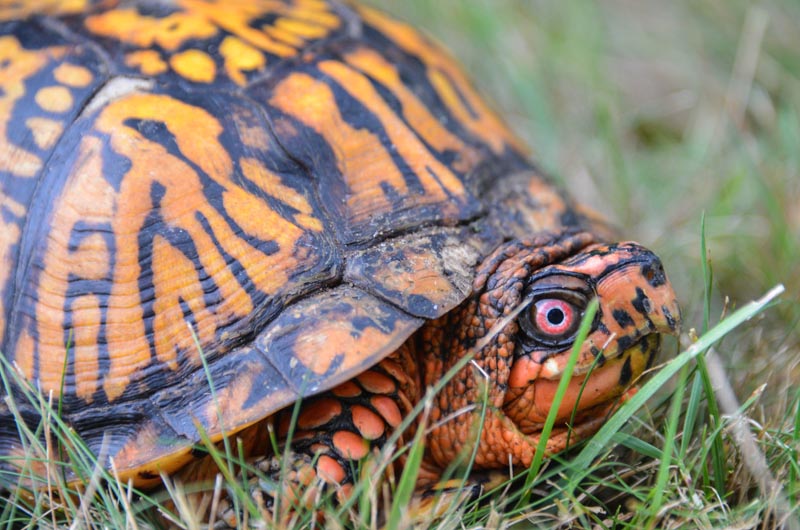
As a conservation biologist on the Island for the past 30 years, I have become increasingly concerned about the future of our common pond turtles.
As a conservation biologist on the Island for the past 30 years, I have become increasingly concerned about the future of our common pond turtles.
At the moment, both painted turtles and snapping turtles are common and frequently seen even by the casual observer. However, I worry that what we are seeing may give a false impression of the populations of both species.
My fear is that these are only older adult turtles and that due to nest depredation by raccoons and possibly skunks there may be limited recruitment of young turtles into the population. I am worried that when these older turtles die, there may not be enough young turtles to replace them and we will see a rapid reduction in their populations.
Personal observations and anecdotal reports suggest that in many turtle nests the eggs are being eaten before they hatch. In addition, there are several introduced predators, including raccoons and bull frogs, that may be eating young turtles before they are old enough to reproduce.
With advice and guidance from Liz Olsen of BiodiversityWorks, my goal is to use information provided by professional conservationists and citizen scientists to identify turtle nests and their hatching success. To assess interest in this project, this first year we are asking people to report sightings of turtles on dry land that may be searching for nest sites, as well as any observed nesting. The month of June, especially after a heavy rain, is the best time to watch for nesting painted and snapping turtles.
I want to stress that if you do see a turtle nesting, do not approach it or the finished nest, as this may make it easier for predators to locate the nest.
If there seems to be enough interest this year, next year we will provide more formal training for citizen scientists and focus on finding nests and recording the number that successfully hatch. Finally, if this information indicates that there is a problem, we will make a concerted effort to identify more nests and protect them from predators.
If you see a turtle on dry land or that appears to be nesting, please contact Richard Johnson at [email protected] or call me at 508 693-1893. If you can take a photo from a safe distance (15 to 20 feet) that would also be useful. Please feel free to call or email me if you have questions or would like more information.
Richard Johnson is a longtime Island biologist and former leader of the tick-borne illness prevention program for the Martha’s Vineyard Boards of Health.
Comments
Thanks for the invitation to
Rex Jarrell West TisThanks for the invitation to such a meaningful citizen science initiative, Mr. Johnson. We have heard about planet wide numbers of amphibians decreasing more rapidly than other sets of species over recent decades, and biological health in general may be more connected to turtle population health than we typically take time to recognize. Plus it’s fun to be outside and connected to the environment along with our social network.
Looking forward to keeping an eye out: with you to report in to as lead scientist.
I hope this opportunity will be well-received by the island public.
We spotted a box turtle in
Annie Oak bluffsWe spotted a box turtle in our back yard near the fire station in OB , we have a pond , no photo though .
Annie
richard Johnson VINEYARD HAVENAnnie
thanks for report, you are lucky. I have only seen a few box turtles in my 30+ years on the Island.
would you be willing to share your address? We are trying to map turtle sightings on the Island-If you could email me [email protected] I would love to have more info.
Thanks
If you see a turtle and want
richard Johnson VINEYARD HAVENIf you see a turtle and want to report it, you can use email in the article or use our online report form at this link:
https://docs.google.com/forms/d/e/1FAIpQLSd75MjLSEfPRxEXaMQDJMKToM7togJ…
Add new comment