


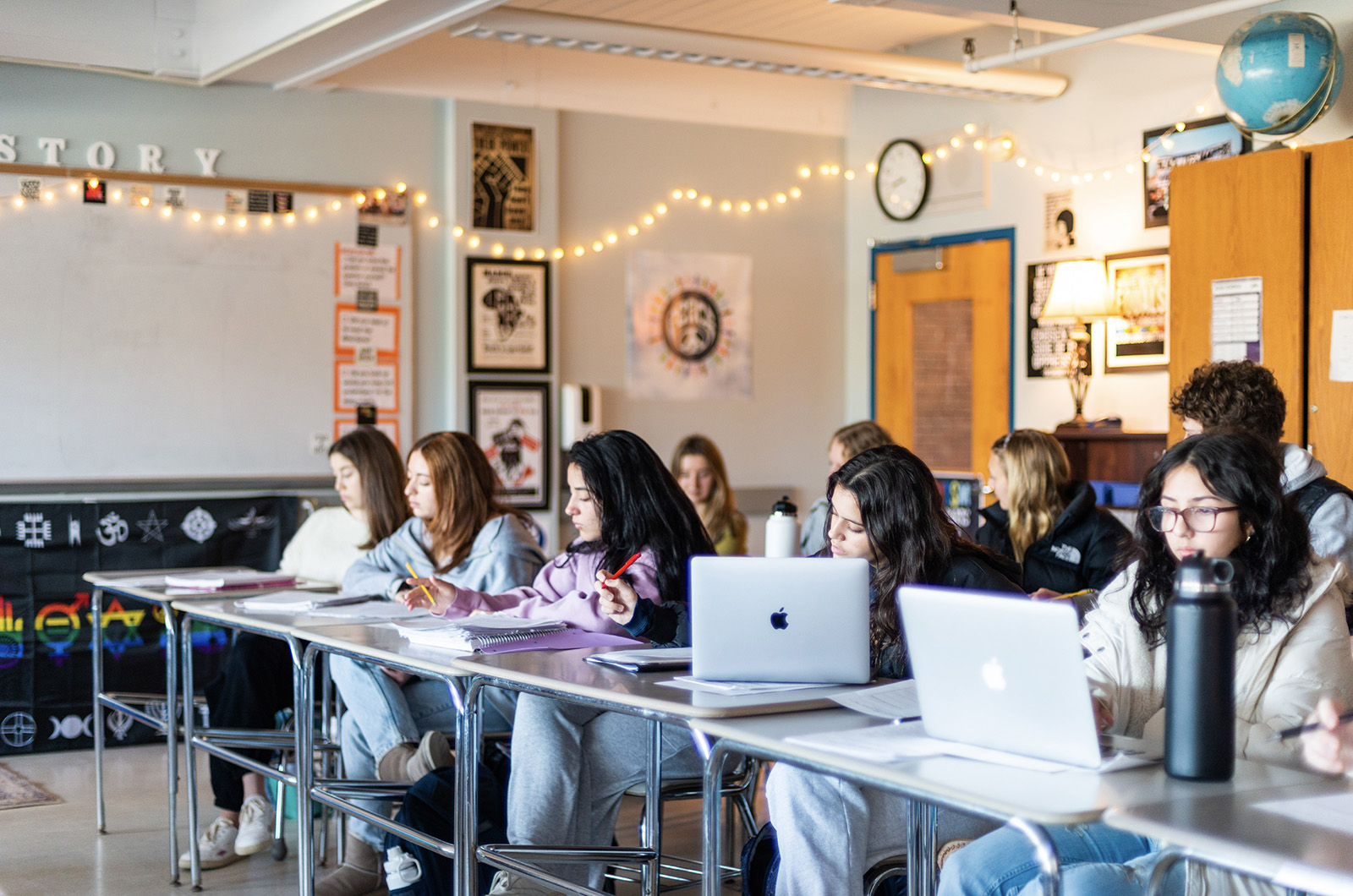
Starting in September, students at Martha’s Vineyard Regional High School will no longer be permitted to use their personal laptops and tablets, which school officials say are too easily misused for cheating, virtual truancy and evading the district’s internet controls.
Starting in September, students at Martha’s Vineyard Regional High School will no longer be permitted to use their personal laptops and tablets during the school day.
Instead, the school will equip all of its 700-plus students with identical Chromebooks, lightweight internet-based laptops that are already in use on the MVRHS campus and at schools across the country.
The regional high school makes Chromebooks available as students need them, but also has allowed students to bring their own devices such as computers to school, which officials say are too easily misused for cheating, virtual truancy and evading the district’s internet controls.
Educators should not have to make the choice between policing screens and delivering instruction, regional high school principal Sara Dingledy told the Gazette.
“It’s becoming a real hardship for teachers,” she said. “They shouldn’t have to circulate; they should be able to look up and visually see engagements.”
Rick Mello, the high school’s one-man information technology department, said that personal devices can bypass the school’s internet controls by using hotspots and virtual private networks to browse the web, text or email their friends, play games and watch movies — all activities the Chromebooks would prevent.
He likened the Chromebook switch to a change in textbooks that ensures everyone is working from the same book.
High school families were notified of the upcoming change in a letter, Ms. Dingledy said, and town school principals also will be informed on behalf of their graduating eighth-graders.
Mobile telephones are covered by a separate high school policy, which prohibits their use during classes, flex time and transit in hallways and while waiting in offices. But the phones still can be used as illicit hotspots, allowing personal devices to connect to the unfiltered internet, Mr. Mello said.
Mr. Mello and Ms. Dingledy presented a report on the upcoming change, which was unanimously recommended by a committee of high school staffers, to the regional high school committee on April 1.
The school already owns more than 500 Chromebooks, with about 300 in daily use, said Mr. Mello, adding that the technology budget has the funds to purchase enough for everyone.
No vote was required at the committee meeting, Ms. Dingledy said, because the switch is simply an update to the school handbook and not a separate policy.
“The handbook is the policy,” she told the Gazette.
A poll of regional high school teachers received 66 responses, all in favor of the personal device ban, Mr. Mello told the school committee.
Teachers also spoke at the school committee meeting, with math instructor Kris Chvatal calling the ban a “no-brainer” now that most standardized tests are administered online.
“It is impossible to guarantee the integrity of any test if we don’t go to full Chromebooks,” Mr. Chvatal said, noting that students with personal devices can send and receive screen shots of answers during exams.
English teacher Kate Hannigan said she minimizes screen time in her classes to encourage dialogue, but struggles to keep students from playing computer games while they are online during flex periods, when they are supposed to be studying individually.
“I can walk around and I can say ‘Hey, what are you doing?’ And they can ‘yes’ me to death, but the minute I walk away, there are just too many open [browser] tabs,” she said.
The new device policy will become official once the high school committee approves the updated school handbook, which Ms. Dingledy said would likely come before the committee in June or July.
Comments
Students do not need a
Abe Henderson OBStudents do not need a computer in school at all unless it’s for a computer programming class. Computer are tools for creating—writing papers, editing photographs, etc.—not for learning. Teaching and learning in a classroom should come from a teacher lecturing and students taking notes with pen and paper (which is proven to be more effective than typing notes). The academic obsession with computers in every class needs to end.
I’d be interested to
Michael Anthony Auburn. MAI’d be interested to understand how taking notes using pen and paper has been proven more effective than typing them. I assume the process of note-taking - listening to the teacher lecture and extracting key facts, thoughts and ideas — hasn’t changed. What about before the ball point pen was invented? Did a bottle of ink and a quill make a difference? When I attended the Tisbury School the desks had inkwells. Fortunately I never needed to use it although it was good for holding my bottle of milk from the MV Co-op Dairy at lunch.
I must be old, but why do
Down islanderI must be old, but why do students need any kind of computer in the classroom? What happened to taking notes in a notebook? Is there no place free from screen time anymore?
“ Norwegian researchers have
Marie“ Norwegian researchers have now found that handwriting is actually better for brain connectivity, meaning it could actually improve memory while studying”. Their findings are published in Frontiers in Psychology
Writing by hand results in better retention.
Computers are a distraction in school. And computers that are not “Lockdowned” can be used for cheating and just surfing the web. Ask a teacher
Did you write your comment on
Laurence EdgartownDid you write your comment on your cell phone, tablet, laptop, or PC?
On my cell phone, but that’s
AbeOn my cell phone, but that’s a process of creating, not learning from a teacher during a lecture and taking notes, for which no cell phone or computer is needed.
The biggest issue I see is
Chris Mara EdgarownThe biggest issue I see is that the students hate the Chromebooks. These laptops are so limited in their ability to perform simple tasks. They're fine in grammar school but in high school they're a hindrance. They might see a rush to transfer kids to the Charter School.....bad move.
Chris, I’m genuinely open to
Kate Hennigan EdgartownChris, I’m genuinely open to and interested in hearing specifically about the ways in which the Chromebooks might limit and hinder student learning.
Maybe they should teach kids
Charlie Callahan So Boston/EdgartownMaybe they should teach kids how to use a pen and pencil.
It will be fine. Of course
Inde West TisburyIt will be fine. Of course students will hate the chromebooks — they can’t do what they have gotten used to doing at school: watching Netflix, hanging out on TikTok and other social media, using math apps to do their quizzes, etc. Sure they will hate the Chromebook’s. Should that concern us? Let’s stop spoiling our kids. Thanks to the principal and supporting teachers for this no-brainer decision.
Having tests on computers can
Ken Edg.Having tests on computers can be a problem.
My son recently took a job as
Albert GosnoldMy son recently took a job as a windfarm service boat manager.
He was issued a double monitor desk top, laptop, tablet (dedicated to emergency procedures) and a cell phone.
The bridges are almost completely computerized. it has a server rack.
He is a high school grad.
He will not be hiring any "Pencil and Paper" people.
Add new comment