


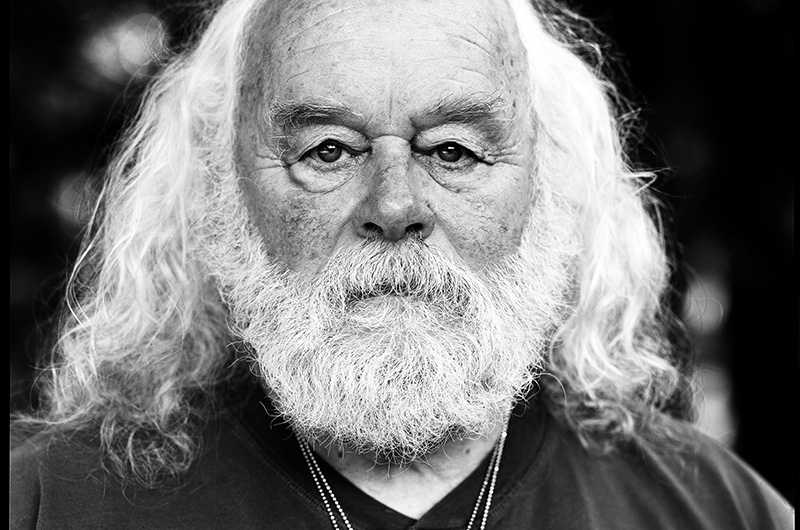
Steve Maxner’s new exhibit at the Martha’s Vineyard Museum combines stunningly beautiful assemblages of shell and sea wrack with his experience in the Vietnam War to create an explosion of emotion.
Steve Maxner’s new exhibit at the Martha’s Vineyard Museum combines stunningly beautiful assemblages of shell and sea wrack with his experience in the Vietnam War to create an explosion of emotion.
Titled But . . . Such is War, the work is constructed from crab carapaces, rope strands, fish egg pods, shells large and tiny, bird beaks, sea glass and rutted driftwood improbably shaped by wind, wave and sandblast. Judged purely as art, his sense of color, composition and design and the discipline of using everyday Island materials to create stunning forms that catch the light and appear to vibrate, is compelling.
Moving closer to each piece, the beauty is wrenched asunder by the card describing it, as if someone had thrown a hand grenade into the room.
The tiniest piece in the exhibit, titled Forgive me Johnny, is a beguilingly improbable swirl of wood that appears to bend in an invisible wind set off by an ivory eruption of barnacles. About this work, he writes: “My poor judgment led to the death of a 19-year-old American soldier. I will never forgive myself, nor should I . . .”
Where is God? is fashioned from a dark, wave-shaped piece of driftwood and a starkly white bird beak with tiny sharp teeth. It is accompanied by this: “While under attack I prayed for God to keep me safe. During B-52 strikes along the Ho Chi Minh trail, I prayed for the deaths of the soldiers coming to kill me. I am sure that these same ‘enemy’ soldiers prayed to God that their artillery shells would find their American targets and that American bombs would miss theirs . . . Where is God?”
Duck Pond is a delicate flurry of feathers and broken wings, a gull’s beak, weathered sea glass and a bird’s leg. “Some thought it great fun to toss grenades into the duck ponds that were common on the outskirts of most villages in the delta . . . what would our reaction be to a 19-year-old ‘foreigner’ throwing a grenade into our own beloved Mill Pond, killing the ducks, geese, and swans? Further, what state of mind would any of us have to be in to perpetrate such an act?” the artist writes.
There is also hope here. Molecules is fashioned from bleached clam shells — open mouths marching upward — attached to laminated driftwood, its layers exposed by weathering which suggest the layers Mr. Maxner passed through on his journey from the horrors of post-traumatic stress syndrome toward the light. “On my daily walks on the beach with my dog, Ollie, to collect ‘ingredients’ for my healing process work, I am always struck with the awesome beauty of the objects I find. They have become friends who help me remember that despite a darkened heart, I, just like these magnificent quahaug shells, have a place and a purpose, however small, in our own tiny world . . . ”
Mr. Maxner’s artistic path to recovery has been buttressed by his family. “When I began making my work I showed them to Joyce, my wife, who is an artist,” he said. “I thought a three-year-old could do this kind of work. She pointed out my use of textures, levels, and composition. She told me ‘you’re an artist, you are expressing yourself beautifully’ and it encouraged me to carry on.”
Daughter Mollye, on her own quest to understand her father’s PTSD, wrote an award-winning one act play, Occupied Territories, that embodies her experience growing up with her father. “I was not a good husband or father,” he confessed. “I was not emotionally present. I lived in a bunker in the basement . . . Mollye had the ability to take that suffering and transform it into something of beauty that others can benefit from. I feel that I am emulating that in my art. She is so encouraging. She is energizing and insightful.”
The exhibit speaks to us on many levels. Made of materials from Island beaches it evokes a deep sense of place all of us feel. Each piece tells of the struggle (and that of all victims of war) to heal and find peace. They celebrate a family that has provided support with empathy and love. And they remind us of the cost of useless yet enduring wars in foreign lands.
But . . . Such is War will be up at the Martha’s Vineyard Museum until Feb. 28.
Comments
I am so sorry for what you
Margaret Vero BeachI am so sorry for what you had to see, Mr. Maxner. Thank you for telling the story with your art. Where is God? He was there with you and all the soldiers, and still is and always will be. God bless your work with the VNCA, I read about it online. It is very needed. Faith, hope and peace
Lovely words Margee
SusanM of OB W HartfordLovely words Margee
A thoughtful, beautifully
Rob Burnside Kingston, PAA thoughtful, beautifully crafted review of an exhibit clearly worth a good, long visit. Lessons too late for the learning? Hardly so.
Oh my, such a beautifully
Gee Gee Barden Porter Ranch, CA, and Oak BluffsOh my, such a beautifully crafted report on what is clearly an exceptional and important exhibit. I hope that the exhibit may be shown more widely, perhaps as a permanent or semi-permanent installation somewhere on the Vineyard, as it has valuable lessons to be learned and beauty to behold, which a larger audience should have the opportunity to experience. I would love to be able to see it when I am there this summer.
Thank you, Steve Maxner and Sam Low. You are both wonderful and exceptional artists.
Excellent review of an
Steve Auerbach Oak BluffsExcellent review of an important exhibit at the MV Museum. Every Islander and visitors should see the display of Steve Maxner's work at the Museum before it closes, for it is truly both beautifully created art and an eloquent and revealing event highlighting one man's search for meaning. Don't miss it.
Add new comment