


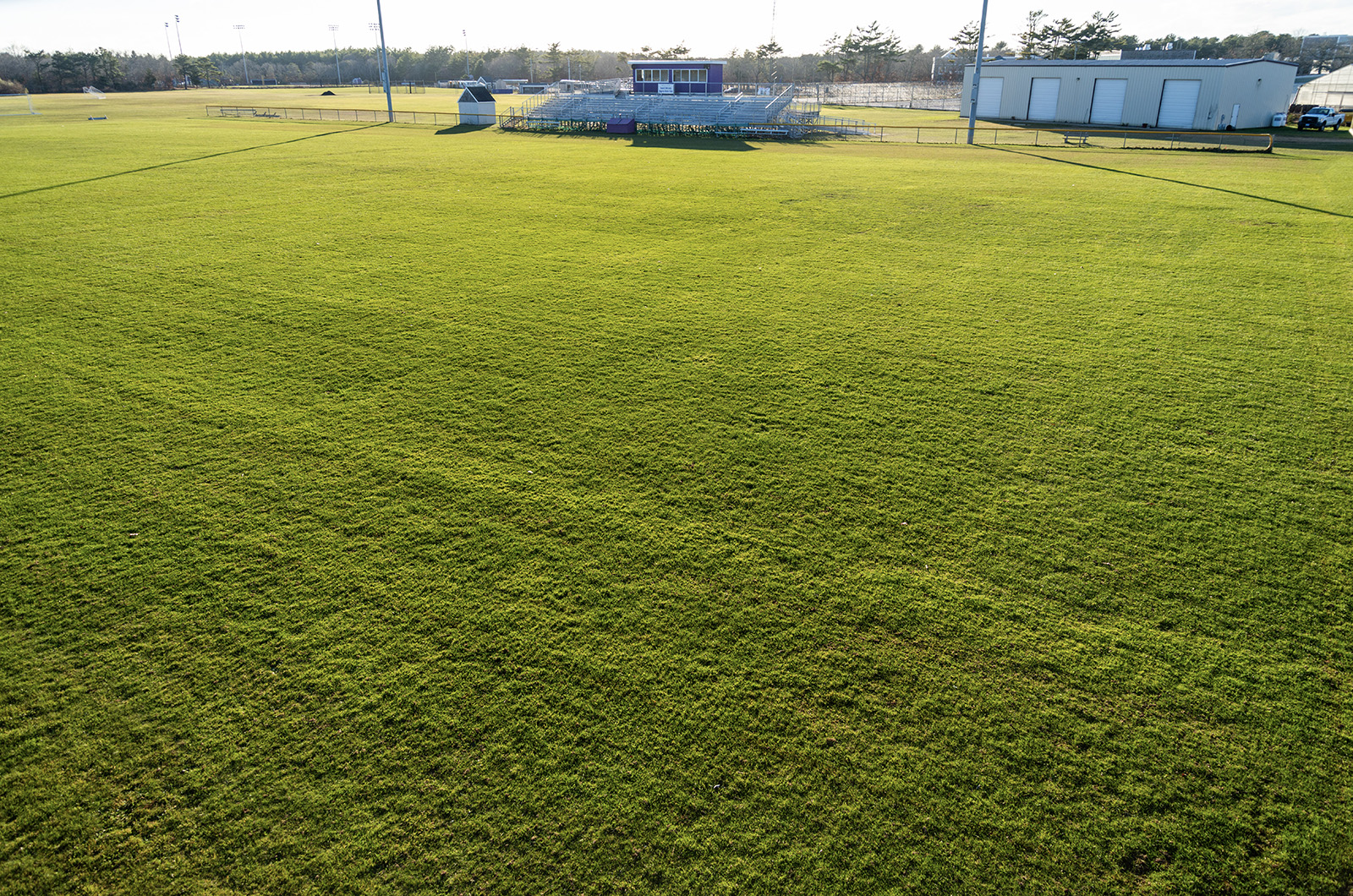
The Oak Bluffs board of health held off on making a decision about a moratorium that could stall plans for a new artificial turf field at the regional high school.
The Oak Bluffs board of health held off on making a decision about a moratorium that could stall plans for a new artificial turf field at the regional high school.
The board called a meeting Tuesday to discuss a potential three-year pause on the installation of some artificial sports playing surfaces, and just shy of 50 people were in attendance to debate “forever chemicals” and the pros and cons of turf fields.
But at the onset of the 75-minute meeting, board chair William White made it clear that no action was going to be made.
“We’re not going to take a vote today,” he said in his opening remarks.
The board has been weighing the moratorium going back to 2021, after the regional high school proposed overhauling its athletic facilities, including the controversial field and a new track. The moratorium is being considered out of concern for per- and polyfluoroalkyl substances, a group of chemicals commonly referred to as PFAS, and their potential to seep into the Island’s sole-source aquifer.
On Monday evening, the Edgartown board of health voted unanimously in favor of the possible moratorium by the Oak Bluffs board of health.
If approved, the current draft of the moratorium would stop the installation of any turf field in Oak Bluffs for up to three years. It could be rescinded earlier if safe alternatives were found.
Much of Tuesday’s meeting revolved around PFAS — the man-made chemicals that can be found in everything from plastics to upholstered furniture, waterproof fabrics to shampoos. Continuing research indicates they can lead to an increased risk of thyroid diseases, decreased fertility in women and increased cholesterol levels.
Past studies on the high school’s plans showed low levels of the chemicals, similar to what is found currently in the ground and at concentrations below risk standards. The board of health was concerned about adding a turf field with PFAS and wished to see a PFAS-free alternative.
“The worry of the board would be adding to that further by adding this field,” said Garrett Albiston, the Oak Bluffs health agent.
Chris Huntress, the athletic field designer the high school had previously engaged for the project, said the field’s PFAS levels were so low and installing the field would actually take PFAS out by removing the topsoil.
“When a synthetic turf field goes in place, that existing topsoil and organic layer would be removed, the PFAS within that topsoil and organic layer would also be removed,” said Mr. Huntress.
More than a dozen members of the community spoke, some in favor of a moratorium and others in favor of letting the artificial turf field project proceed so the students could have a better athletic facility.
Several high school committee members questioned how the moratorium would work. Moratoriums are usually implemented to handle emerging threats, allowing officials time to consider new potential regulations.
Kris O’Brien, the school committee member from Oak Bluffs, said that the field’s effects had been extensively scrutinized when it went through the Martha’s Vineyard Commission, including studies by independent consultants.
“You say that you want a study to understand the impacts that this field could have on the ground water, yet that was done by the MVC, by Tetra Tech, in February 2021, and again by Horsley Witten,” she said. “You have the data, so I’m confused what it is you’re searching for.”
Tuesday’s debate comes after the school emerged victorious in the legal battle over whether the Oak Bluffs planning board had the power to deny the project on the basis of water quality concerns. A state Land Court judge last week ruled in the school’s favor, saying it didn’t need the planning board’s approval.
The board of health did not give a timeline on the moratorium, but promised it would put the health of residents first.
“That’s the mandate,” Mr. White said. “And we’re going to stick to that.”
Comments
If my child were a student at
Shelley EdgartownIf my child were a student at MVRHS I would be outraged at the idea that anyone would even consider an artificial turf. Young peoples’ endocrine systems are vulnerable at this age. Are people not aware of the damage done on the island already from PFAS; that homes closed to the airport have had water filtration systems installed to filter out PFAS? The source of contamination was chemicals used by fire departments at the airport seeping into the ground water. Are they not aware that fire departments around the country are suing manufacturers of fire fighting equipment which are laden with PFAS and have resulted in high rates of cancers in firefighters? Yes and allegedly educated and wealthy community like Martha’s Vineyard is not aware of potential environmental damage done by these horrific forever chemicals than this country is doomed!
This just reeks of bad town
William Oak BluffsThis just reeks of bad town politics. The BOH could have placed a moratorium on synthetic surfaces years ago, but they didn’t. They allowed years to pass, studies to happen, the project to go through all the planning stages, and both parties to spend money on a legal battle. Only now that the judge nullifies the Planning Board decision does the BOH raise the idea of a moratorium again? Yesterday, they kicked the can down the road, basically paralyzing any progress. Regardless of what the BOH decides, this is an EPIC fail on the part of the BOH.
William I couldn’t agree more
Islander61 OBWilliam I couldn’t agree more. This whole debacle with the planning board acting well outside of their lane, especially when town counsel warned them against it. Now, 8 years into the project, the BOH is not going to follow any of the EXPERT testimony, independent testing and analysis that was thoroughly vetted by the MVC. My question is “who then are they listening to?” It seems to me that to jump in at this time, ask for letters is support for their plan by any and all people who oppose the field, and not ask one group who supports the field project for their input. This is all bad politics. The BOH says it’s not political but it absolutely is, or they wouldn’t be doing this moratorium if they followed the science that’s been done and not the politics.
While Ms. O’Brien is correct
Susan Desmarais Oak BluffsWhile Ms. O’Brien is correct in saying the project was scrutinized by the MVC it’s important to note that the science of those studies is at least 3-4 years old. Environmental science, particularly as it relates to forever chemicals like PFAS is constantly emerging, new data along with new toxicity guidelines are issued often. Therefore it can’t be a reliable source of current information.
Fair point, but I still have
William Oak BluffsFair point, but I still have not seen current evidence how this project will negatively impact the water supply. These surfaces have been vetted in hundreds of communities. I live next to a creek that is a watershed for a major river in the northeast. The local high school has 4 turf fields adjacent to this creek. What do the "Martha's Vineyard Experts" know that hundreds of other community experts do not?
Are you saying you have new
David Oak BluffsAre you saying you have new scientific information or just more emotion?
Most of the comments that
Patsy McCornack VHpMost of the comments that have been posted are concerned about the chemical output of the artificial turf. Isn’t anyone concerned about the athletes health and not incurring injuries from the artificial turf? As I have said before, the NFL has ruled that all turfs ought to be grass, not artificial!
Add new comment