

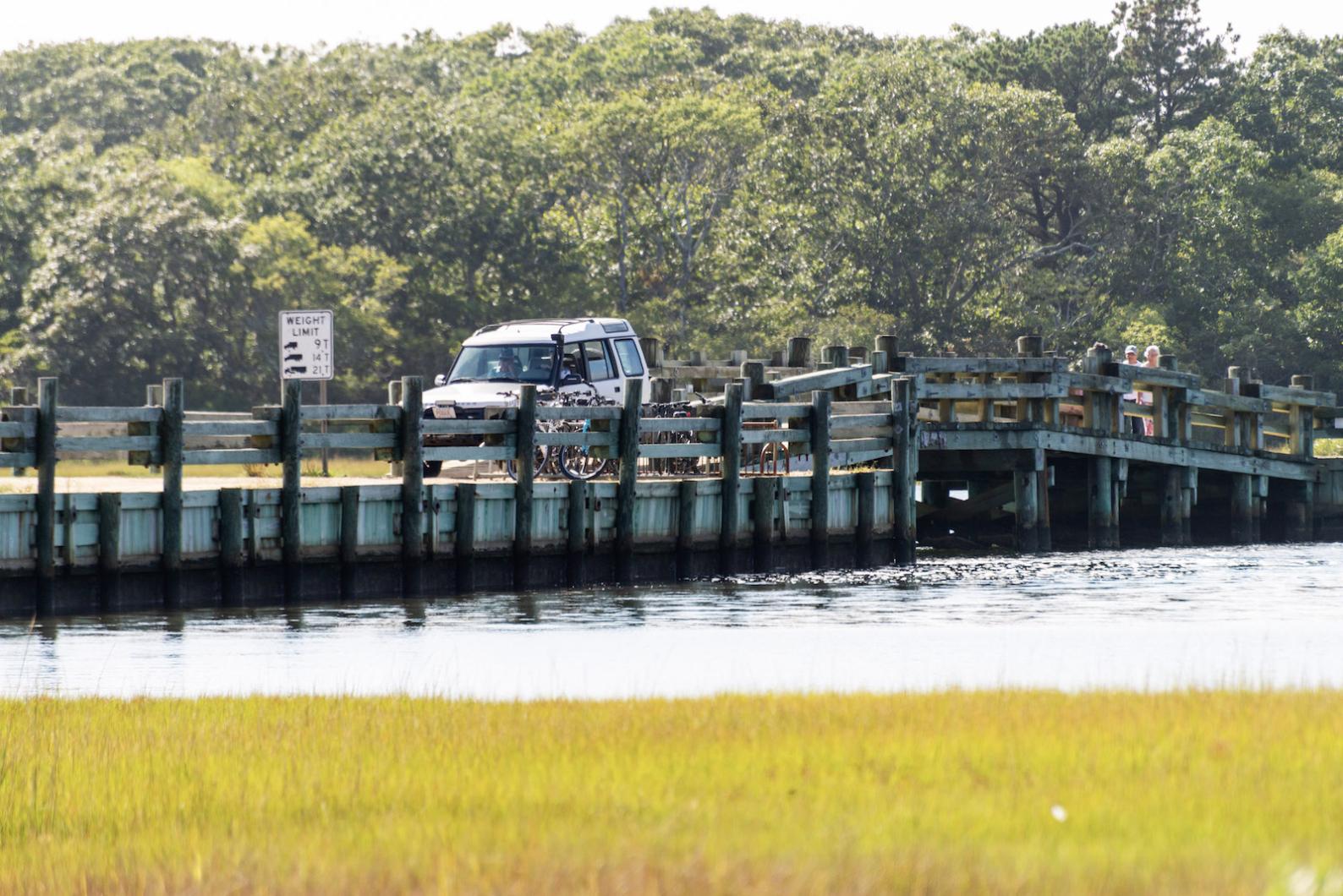
The select board Monday sent a letter to the conservation commission, urging members to require the Trustees put a portion of oversand vehicle sticker sales toward the bridge’s estimated $4.3 million repairs.
With the Dike Bridge on Chappaquiddick needing costly repairs, Edgartown officials are calling on the Trustees of Reservations to dedicate money toward the failing infrastructure.
The select board Monday sent a letter to the conservation commission, urging members to require the Trustees put a portion of oversand vehicle sticker sales toward the bridge’s estimated $4.3 million repairs. The board said the creation of an escrow account specifically for the project should be required for continued oversand access. The Trustees went before the conservation commission earlier this month to get approval for oversand vehicle access on its Chappaquiddick properties.
In a continued hearing on Wednesday, commission members and Trustees representatives discussed the letter and the financial feasibility of the request.
The bridge is jointly owned by the town of Edgartown and the Trustees, but the majority of the needed repairs fall on the Trustees’ side, according to the town. In the past, the statewide land trust contested its responsibility over the structure, claiming that the Dike Bridge and adjoining bulkhead come under shared ownership between a wide range of parties.
Trustees attorney Dylan Sanders Wednesday reiterated that portions of the Dike Bridge are owned by the remnants of the now-defunct Poucha Pond Meadow and Fishing Company, a state-chartered group from the mid-1800s.
“This is not our bulkhead, this is not our land,” Mr. Sanders said. “That said . . . we are committed to finding a solution with this commission and with the town.”
The condition of the Dike Bridge first raised alarms this past winter, prompting the town to conduct emergency repairs in the spring and hire engineering firm Tighe & Bond to assess the need for further repairs. In June, the firm estimated costs to repair the bridge’s aging bulkhead alone — the least-sound section of the bridge — to be more than $4 million.
The Dike bridge is currently the only access point to the Trustees’ Cape Pogue properties. For that reason, commission member Geoffrey Kontje said the organization should take responsibility to see that access point maintained.
“The town can’t continue to repair your property,” he said. “There needs to be a plan.”
Both Mr. Sanders and Trustees Islands director Darci Schofield claimed that revenue from its Chappaquiddick properties historically has not fully covered maintenance costs, leaving little self-generating funding for capital projects. Ms. Schofield reported that the Trustees sold 1,531 permits to Chappy in 2023, with only 18 per cent of those as sales from year-round Martha’s Vineyard residents. Oversand passes go for either $200 or $350 for expanded access, with the commission estimating yearly revenue between $300,000 and $500,000.
Sticker sales at other Trustees’ properties, including Sandy Neck Beach on Cape Cod, usually outsell Chappaquiddick, according to a presentation from Ms. Schofield.
“It would seem to me there’s nowhere near enough revenue to subsidize a $4.3 million dollar repair . . . so there has to be some kind of agreement there,” commission chair Peter Vincent said.
Some members of the public disagreed, noting that the organization has earned more than $38 million in profits in previous years, with its top three officials each earning more than $300,000.
“Ownership is not the issue,” resident Joe Russo said. “The issue is who caused the damage. If you break it, you buy it . . . . It is patently clear in this case that over 30 years of use is the precise cause of the damage.”
“The Trustees need to shift this money around to work for the people of Martha’s Vineyard,” he added.
The discussion also turned back to the question of capacity limits on the Trustees’ Vineyard properties. The organization has proposed a limit of 300 cars total on its Leland, Wasque and Cape Pogue properties, but some commission members and members of the public questioned if the limit goes far enough.
According to data provided by the Trustees, more than 300 cars can travel to the organization’s Chappaquiddick properties during peak season, averaging between 150 and 200 cars per day in the warmer months.
Self-described conservation enthusiast Seena Pidani was concerned that not enough research has gone into oversand vehicles impacts on the dynamic barrier beach.
“We don’t have any studies as far as what the impact of one vehicle driving over the beach is,” Mr. Pidani said. “The fact that I have to look to all these different sources to try and assess the impact of this and it’s not just attached to the NOI application is probably the most concerning part of this.”
The hearing has been continued to Nov. 8.
Editor's note: this report has been updated with details from Wednesday's conservation commission meeting.
Comments
I agree use some of all that
Frank OBI agree use some of all that money made on stickers! Stop buying new trucks and equipment (toys). Also maybe a fee to go over the bridge??
The Trustees were given much
Bo Reily ChappyThe Trustees were given much of Pogue and East beach by landowners who loved the natural habitat. Those gifts were expressly made on the condition of maintaining the pristine beauty from the encroaching destruction by our "Civilization". If you allow OSVs, in limited numbers, every penny of the TTOR vineyard revenue should stay on island to maintain more than the Dyke Bridge, but the fragile and diminishing beach environment that they are mandated to protect.
Why are vehicles allowed on
Albert GosnoldWhy are vehicles allowed on the beach?
What are the The Island's TTOR expenses? Revenue?
Vehicles are allowed on that
JaredN Boston/ChappyVehicles are allowed on that beach because it is the only practical way to access most of it. It is over four miles from Dyke Bridge up to North Beach. The vast majority of the beaches on Martha’s Vineyard are privately owned and inaccessible. Cape Poge contains about 1/2 of the public beaches on Martha’s Vineyard and the only practical way to access most of it is by vehicle. While some young and fit people can make the walk up to North Beach, families with children, elderly, and the infirm simply cannot. The best fishing I’ve ever had was on North Beach, but at age 63 with a bad knee, I simply can’t walk that far and back carrying fishing gear.
The Trustees were given much
RB EastvilleThe Trustees were given much of Pogue and East beach by landowners who loved the natural habitat. Those gifts were expressly made on the condition of maintaining the pristine beauty from the encroaching destruction by our "Civilization". These were not the "conditions". Some current Chappy landowners have twisted this to restrict access according to their wishes.
This looks like a perfect
Mr. B ChilmarkThis looks like a perfect case for a user fee. If you drive a vehicle over this thing, you pay X dollars.
There already is a user fee.
JaredN Boston/ChappyThere already is a user fee. Over-sand vehicles require a permit from the Trustees. The cost of that permit is over $200 per vehicle this year.
Yes it is important to make
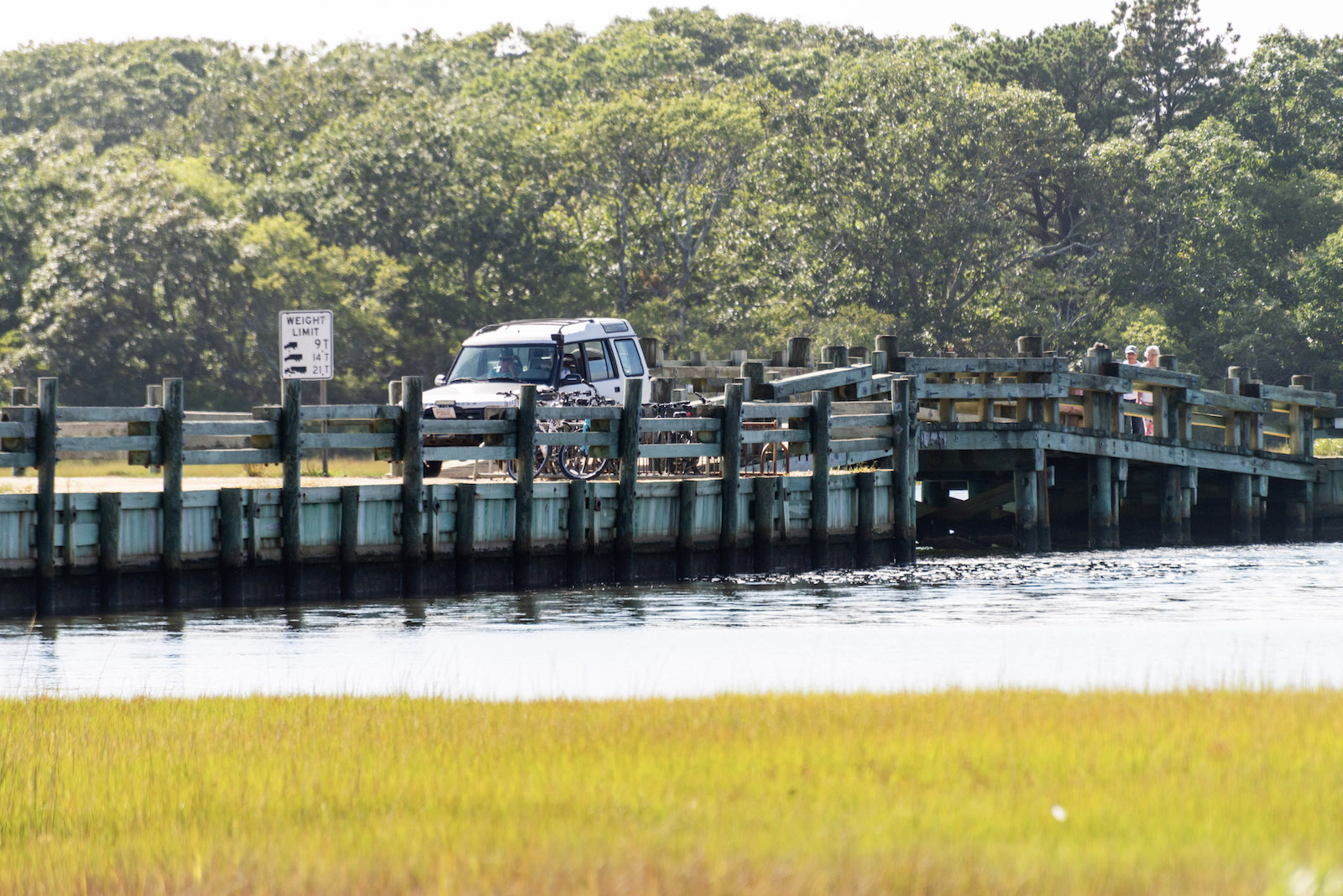
Patrick Barrett west TisburyYes it is important to make this bridge safe. However as someone who has been in the construction industry my entire life can we just look at this form a practical point of view. Take a look at this picture of this bridge. This is not the George Washington Bridge or some major project. 4.3 million dollars to repair this? Come on everyone. Lets get some completive pricing from other qualified contractors.
Spend $4m to watch this thing
Why Bother? ChappySpend $4m to watch this thing get blown out by rising seas and higher tides? No thanks. Tell the residents on Cape Pogue they’re going to need a bigger boat instead… Time to get sensible about how money is being spent in this new era of climate change.
I aggree. Why Bother?
J Klingensmith Naples, FloridaI aggree. Why Bother?
4 million, 20 years, $550
Albert Gosnold4 million, 20 years, $550 dollars a day. An average of five cars a day? $110 each, is it worth it?
It only seems fair that the
ABC ChappaquiddickIt only seems fair that the Cape Pogue property owners also contribute to the bridge repair since they have an easement over the bridge. After all, the Cape Pogue property owners are seeking to prohibit OSV travel over the bridge so they will be the only users if they win. Also, the wear to the bridge and bulkhead is caused by weather and water not use, so any argument that OSVs are damaging the bridge more than residents is misplaced.
This is a wonderful
Rich EdgartownThis is a wonderful opportunity for the Trustees to settle the OSV topic. TTOR kicks in for repair, and in turn is granted 20 year OSV access with certain restrictions. TTOR needs to know they will get a return on the bridge investment and not have the funding source of OSV permits pulled from them after making the investment. The small number of property owners seeking a ban on OSV cannot also ask for TTOR to pay for the bridge.
Agree! Bridge fees! Climate
Margot Lane MenemshaAgree! Bridge fees! Climate change is gonna eat that bridge for supper, anyway.
The solution to bridge
Albert GosnoldThe solution to bridge problem is for the TTOR to donate the bridge to the town. The town would pay the four million to repair it and then set the toll for a four year ROI. ~$275 a day. On an annualized basis 10 Vehicles a day, a $30 toll (you have to pay the toll taker).
Add new comment