


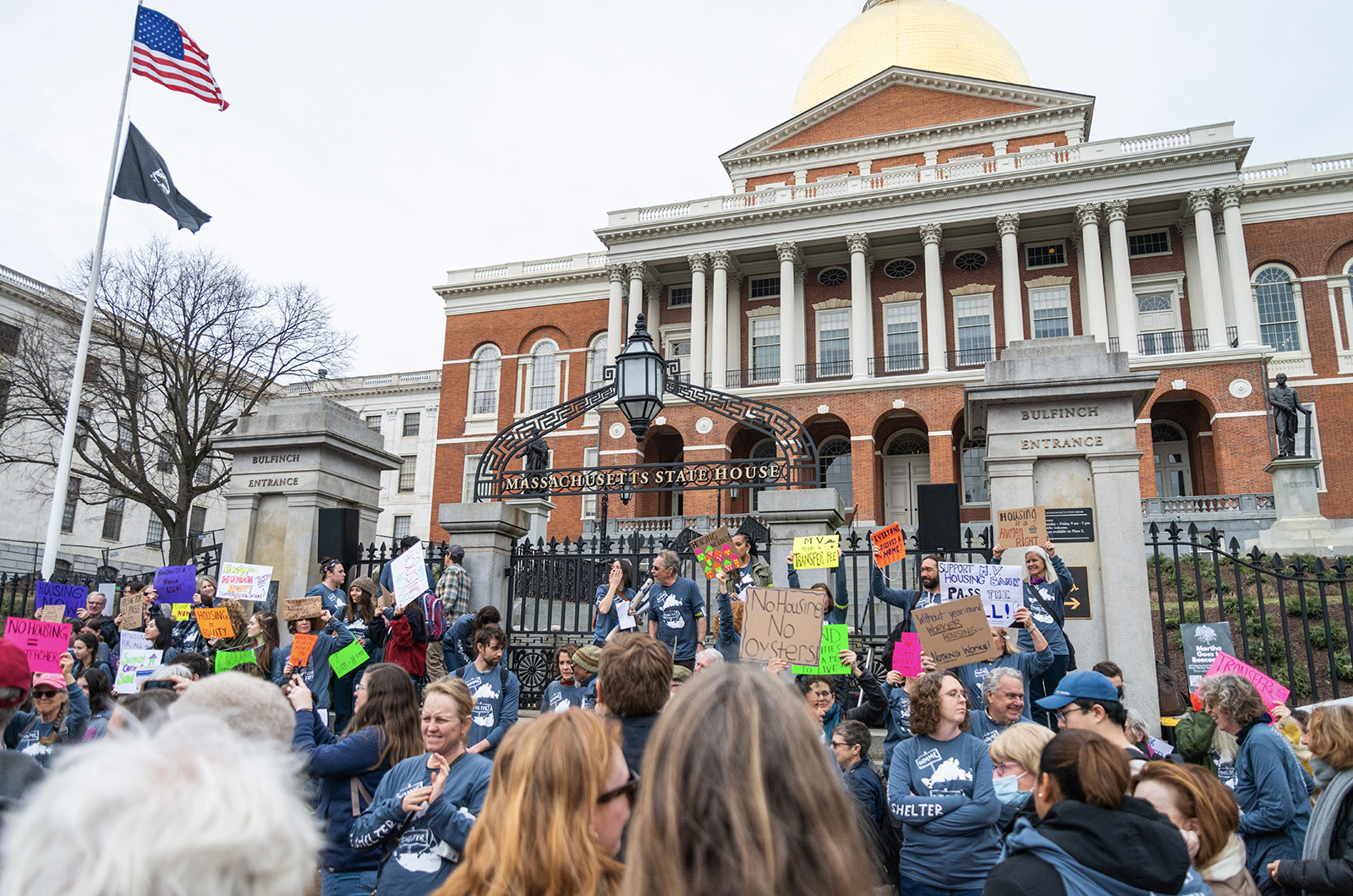
Gov. Maura Healey unveiled a $4 billion housing plan Wednesday that includes a local option transfer fee, a provision that Islanders have sought for years to help fight the Vineyard’s housing crisis.
Gov. Maura Healey unveiled a $4 billion statewide housing plan this week that includes a local option transfer fee, a provision that Islanders have sought for years to help fight the Vineyard’s housing crisis.
The governor’s bill, titled the “Affordable Homes Act” and filed Wednesday with the state legislature, would allow communities the option of adopting a real estate transaction fee of .5 per cent to two per cent on property sales over $1 million, or the county median home sale price, whichever is greater.
For the Vineyard, the county median home sale price in the second quarter of 2023 was $1.39 million.
The state expects the fee would apply to fewer than 14 per cent of all residential sales across the state. Under the bill, the fee would be paid for by the seller of the property, with money going to affordable housing developments within the community.
Island Housing advocates were pleased with the transfer fee and other provisions in Ms. Healey’s massive housing push, which she said was the largest ever in the state.
“As you can imagine, we’re just completely thrilled,” said Julie Fay, the co-chair of the Coalition to Create a Martha’s Vineyard Housing Bank, a group that for the past three years has pushed legislators to allow a local option transfer fee on the Island. “The governor heard our urgency to create a path to building housing on the Island, and that is huge.”
All six Island towns voted last year to petition the state to allow a 2 per cent transfer fee on most real estate transactions higher than $1 million. The resulting revenue would then be put in a bank for the purpose of building more housing on-Island, much in the way that the Island’s land bank operates.
The transfer fee language in governor’s bill differs in one significant way from what the town meetings petitioned for in the creation of the housing bank. The Vineyard proposal was proposed to be paid for by the buyer, not the seller.
Advocates noted that Gov. Healey’s bill includes specific language allowing not only individual cities and towns, but “regional affordable housing commissions” to administer the transfer fee, paving the way for a possible Islandwide approach to affordable housing.
Hundreds of Islanders went to Beacon Hill earlier this year to make the case for a housing transfer fee and champion a Vineyard housing bank.
In-person hearings for the state housing bill took place last week and included testimony from state Sen. Julian Cyr, who represents the Vineyard. While no one from the Vineyard spoke, Ms. Fay said that Islanders submitted over 350 pieces of written testimony in support of the housing bank and transfer fee.
Other communities across the state have also advocated for transfer fees, but the efforts did not have the backing of former Gov. Charlie Baker. To now have the governor’s backing is a “game changer,” said state Sen. Julian Cyr.
“What this does is it resets the table on the conversation,” Mr. Cyr said Wednesday. “It’s a bold proposal by the governor and it shows she’s really listened to Cape and Islanders.”
State Rep. Dylan Fernandes said the bill delivered on a promise to Cape and Islanders struggling to keep a foothold in the region’s runaway housing market.
“I thank Governor Healey for her leadership in putting forward legislation that meets the moment,” Rep. Fernandes said in a statement. “This bill empowers our towns and cities with the flexible and powerful tools they need to provide fair, dignified housing to our communities.”
Other housing advocates, though, believe that the legislation could have gone further.
“I’m disappointed it didn’t come out as an executive order because that would mean we’d have a transfer fee today,” said Lucy Morrison, the chair of the Edgartown planning board and a member of the Martha’s Vineyard Commission’s housing action task force. “It’s a win, but just not as big of a win as it could have been.”
Gov. Healey’s proposal also includes the creation of a seasonal communities designation and a council that would provide recommendations to the state’s Executive Office of Housing and Livable Communities regarding potential regulations for towns that see large fluctuation in employment and housing needs throughout the year. The bill also offers a potential local option property tax exemption for the development of year-round rental units.
Martha’s Vineyard Commission housing planner Laura Silber said the seasonal communities designation would open up the Vineyard to an entirely new set of tools, programs, and permissions to address the local housing crisis. Those allowances, she said, would in turn help her goals to create a municipal workforce housing program, a year-round deed restriction program, or any other programs the state does not currently allow.
“Rather than having to chip away at each individual ask, this designation would allow us to compile and receive them as one whole toolkit,” Ms. Silber said.
The bill also would allow accessory dwelling units less than 900 square feet by right throughout the state, though communities would be able to set some restrictions.
Advocates said that while it may be too early to tell the bill’s impacts for the Island, language like the accessory dwelling unit expansion and seasonal communities designation could go far in addressing the Island’s housing crisis.
Mr. Cyr said that many of the details in the bill could change as the bill works its way through Beacon Hill.
In the meantime, housing advocates are continuing to explore a litany of methods to address the Island’s housing crisis. Most recently, Ms. Morrison said the MVC housing task force met with planners from Provincetown to discuss ways the other Cape resort community has attempted to ease its housing burden.
“There’s no one silver bullet solution,” she said.
Comments
Classic bait and switch. This
Mark EdgartownClassic bait and switch. This concept was sold to voters as no incremental tax / financial burden to islanders that had bought, invested in and cared for their properties as a retirement nest egg. Seller now bears full economic cost.
You've done fine. 2% off of
Nancy OBYou've done fine. 2% off of your millions on your Edgartown house won't hurt your retirement. Best governor in my lifetime. Maura is for the people.
More like she is for spending
Mark EdgartownMore like she is for spending other people’s hard earned money and redistributing it elsewhere. In all honesty, with limited supply and inelastic demand, this tax will push the marginal cost of housing even higher as pricing adjusts upward account for the financial friction.
Mark - the objective of the
Mark VHMark - the objective of the Housing Bank is specifically to increase supply of affordable housing. There is no issue for anyone who has the means of spending $1 million-plus on a home on the Vineyard. For the +/- 20% of year-round island residents who are experiencing some form of chronic housing and/or food insecurity, the Governor's decision is big step in the direction of bringing much needed relief to this problem.
Your complaint is silly IMO,
Edgartown EdgartownYour complaint is silly IMO, it's all coming out of the same pot of money. Do you really think the seller won't just add $ to the asking price to cover the fee? Give me a break, there is no actual difference here.
Wow that’s a very large
Gina Menemsha/NYCWow that’s a very large assumption that all senior sellers will cash out with millions in appreciation
Not sure what calculation you are using but RE goes up & down in value
As a wealth redistribution program I think the it will go thru many edits pre a vote
At least raise this to a $2
Mark Acker VHAt least raise this to a $2 million threshold. At $1 million almost every Islander with now pay $40,000 more and higher to buy a house, between this and the Land Bank fee. That's obscene.
This was sold to us as a fee
Sally Anderson OBThis was sold to us as a fee paid by the buyers, that’s is what we voted for. So that new people gobbling up the homes here would have to contribute to a solution for the problem they are creating. I feel so deceived by the housing bank and their team and never would have put so much effort trying to help it pass if I knew this would be the outcome. Why are we punishing long time islanders who might someday need to sell? The buyer needs to pay this fee.
It's the same pot of money,
R Scott Patterson EdgartownIt's the same pot of money, seller will increase selling price to cover the cost. Can you see that the fee will still be paid by the buyers and there is no actual difference? Perhaps you know this already and you're simply gaslighting, IDK.
Sally,
Mike SomewhereSally,
I agree that the buyer needs to bare the cost of this fee. All this will do is raise the price of the house/property. Making it further out of reach for the folks making 150% of the AMI, which if I read correctly is around $150k.
Additionally- MV prices are all over $1m, making every sale subject to the fee. This is going to turn out very badly for an island with finite land. What happens when ALL available land is built out? What program will it be applied to?
Short sighted thinking to say the least.
My advice to those who want to live here- work hard- save your money and buy the same way the rest of us regular folks did. I don’t and never have made what is the AMI here now. This is really preposterous. Besides the fact that it will also create a very distinct class division. But this what ‘So called Islanders want’. Wreck the island so you can live and work here making more than many you are working for. Did I say preposterous- let me say it again- PREPOSTEROUS.
Sally, the CCMVHB completely
Kimberly Angell, CCMVHB Exec Comm member West TisburySally, the CCMVHB completely understands your concern. However, this is not the Housing Bank bill that all the towns overwhelmingly passed in the Spring of 2022. This is the Govenor's housing bill that includes a statewide transfer fee. While we are immensely grateful that the Govenor has heard our voice and need for housing solutions statewide,this is certainly not the bill's final version. Like any bill, it will go through its normal process at the Statehouse (amendments and so on). CCMVHB will continue to advocate for the fee to be on the buyer and to create a regional agengcy to administer the funds.
This is nothing but wealth re
Mike EdgartownThis is nothing but wealth re-allocation. The tax is .5 to 2 percent. Our local “stewards” have never seen a dollar of someone else’s that they do not want to grab or spend. Just because it has been enacted does not mean it has to be collected. Please show some fiscal restraint as we enter into a global recession. Also, quick question why in most of this affordable housing do we give it away? Makes zero sense to build housing and give it away with zero strings attached. This tired story that always resounds in the commentary of affordable housing for the mythical, pure as the driven snow “Islander” that needs a free house is misguided. Many of us grew up in places we needed to leave until we could earn enough to move back into the wealthier areas. That is how America has been for a couple of hundred years now. It works pretty well.
The common thread of nearly
Chappy Guy ChappyThe common thread of nearly all comments on this matter is that it's a great idea... as long as someone else is paying for it. Everyone wants people they don't know (new buyers) or people with more valuable homes (after all, by definition, anyone with more than you must not be paying their "fair share") to pay. If there is agreement that a new revenue source is needed to enable more affordable housing, then why isn't this everyone's problem/obligation and why should it not therefore be built into property taxes, thus making every home owner contribute proportionately? Those "long time islanders who might someday need to sell" will be receiving valuations enhanced by the very dynamics that are driving the need for affordable housing, so why should they not pay? At the same, why should current owners not pay? Why should anyone be exempt from proportionately supporting this effort? But if we are going to collect this tax, please let the money actually be spent for the designated purpose. I've yet to see confirmation that the short-term rental tax revenues have been used as promised. Oh, and Mark from Edgartown is spot on about the marginal pricing dynamics, but who cares if you're not the one paying....
I think you are exactly on
Annie logan OBI think you are exactly on point: who gets this magic money and how will it be spent? Please point out all the multi unit developments approved and queued up to build on island. And who manages the building project to build units that the builder can afford to build and the down trodden prospective owners can afford to buy? Maybe the builders will be required to make their own special contribution - building at “cost” and no + on their time and materials. That will work. The whole concept is specious - taxing that other guy has been popular since FDR. Whole books have been written on it.
Wonderful to see common sense
Aquinah AquinnahWonderful to see common sense here - something that is surprisingly not so common…
I worked my entire life to
Sara EdgartownI worked my entire life to buy a home. When I bought I had to pay a land bank fee, know I will have to pay a affordable housing fee?? What??? This is over the top!!We always tax the home owners. This affordable housing thing is gone over the top.
Maybe thinking about dropping
mike kelfer chilmarkMaybe thinking about dropping the land-bank tax incurred at purchase is a discussion worth having...taxing the purchase, state taxing the gains at sale, and now additionally taxing your sale for an affordable housing bank feels money-grabby. Maybe somehow calculating a "credit" of your already-paid land-bank tax paid at purchase towards this new levy should be considered.
At the very least, this additional tax should go towards RENT-controlled RENTAL units.
Home-ownership needn't be the only directive here, particularly on an island so dependent on foreign workers during the"season", many of whom ensure your favorite restaurant can serve you a $50 entree while having to sleep in their cars at night and use public showers.
A lot of handwringing over a
Islander EdgartownA lot of handwringing over a grand total of, at the highest percentage of 2%, of 26K at the median price of 1.3 mil of a Vineyard house. So sellers are saying that they can’t pay that fee - or raise the price of their sale to 1,326,000 for the sale? Gee, huge difference. It’s hard not to criticize the greed of people, especially the older generations who are leaving the younger generation of teachers, nurses, police officers, doctors, teachers, administrators, and others an island in which is completely unaffordable to them. Boo hoo. It really is so sad to see these conservative crocodile tears, to help fix the crisis. I own a home and if I’m selling for 1.3 million gee I can afford $26K of that for the betterment of this hard working community that has been completely priced out by market forces due to so many moving and/or buying here during COVID.
I will say that, that the best way to do this is through legislation. Executive orders can be rescinded first of all in future administrations and brought to court, but they are most importantly not the American system of governing, they represent a failure of government in that we are supposed to legislate together to pass laws, not declare them from on high!
Under the proposal from the
William Joseph James-RobertsUnder the proposal from the governor's office, there wouldn't be any fee at all on a sale at the median price because that's the exemption amount. Under the housing bank's original proposal the exemption amount is 1 mil, so in your example the fee would be $6000. So it really is true that everyone is making too big of a fuss out of the added cost to the sort of house regular folks are shopping for. The exemption amount is a big part of what makes this funding method a good one. That said, I think there are serious issues with HOW the money would be spent. It is hard to find a way that's both equitable and even slightly effective at addressing the problem that doesn't have serious environmental downsides.
Hello,
Maya TexasHello,
I am a young widow and empty nester that has visited the island many times and I am interested in living and teaching in the Oakbluffs area in the somewhat near future (1-2 years). I am nowhere near poor (upper middle class for Texas) but I AM concerned about the affordability of housing. Any advice on where to start or how to get the most accurate information regarding housing options? Would I even be welcome by the community? Any and all comments are appreciated :)
They arent trying to make
Ken Edg.They arent trying to make houses affordable. They are trying to provide housing for people that cant afford one. They have given up on the affordable part.
I hope someone from the
Chip Coblyn OBI hope someone from the housing bank group will weigh in on the finer points of how the fees are calculated—before the rumor mill cranks up to 11.
Where exactly does this road
Marty Milner TALLAHASSEEWhere exactly does this road go for the total Island community and is it sustainable? When 'affordable and equity' were removed from neighbor equation, feudal labor came in the back door, claiming replacement hegemony. Will taxed work permits be the next issue? Hedge fund Air BNB rentals(The numbers work.)? Martha's Vineyard, first and foremost, has always been a diverse community. This unsolved problem haunts the outcome, which NO ONE wants to discuss. The actual, irreversible death of that community. In our bell jar of an economy the oxygen is limited, and the island is ALWAYS the front leading microcosm.
I read endless articles about
tom BostonI read endless articles about the affordable housing crisis on the Island and that apparently increased taxes and fees will help solve it. But nowhere do I read about town budgets. Property taxes have soared in recent years on the Island. Rental taxes have been added as well. Land Bank tax and now seller tax. Maybe the towns should take a hard look at their budgets and cut spending. Then use the excess funds for affordable housing initiatives. The Vineyard has more than enough tax revenue. I question the allocation of those revenues.
"The bill also would allow
Ben I. EDG"The bill also would allow accessory dwelling units less than 900 square feet by right throughout the state, though communities would be able to set some restrictions." - Can anyone speak more to this and/or point in the direction of reviewing the bill itself? This is an incredibly open-ended provision to the bill, and would likely conflict with existing zoning bylaws (septic, lot size, # bedrooms). Certainly could help alleviate existing housing pressure and put some control in the hands of island homeowners to take ownership of creating housing.
Let’s take a different tack.
Bruce RealityLet’s take a different tack. What if we unresort our island. Not kidding. As a resort we have created a housing crisis, food cost crisis, staffing crisis and more.
About seven ferry boats carrying cars go to Nantucket on any given day. Let’s reduce the 16 or so a day to our island to 7 as well. We will be unresorted. The need for resort workers will drop. The island will become more sustainable from a food supply perspective. Our schools will have less children requiring less teachers and other public workers. Casual home owners will sell their homes due to an inability to rent them. In turn prices will fall on property making it more affordable. Our friendly, small town life will return to our beautiful island. Join me and change the dialog. Thank you for listening
While what you propose simply
tom BostonWhile what you propose simply won't happen (imagine the cost of all the bankruptcies), you touch on a point I have made before. I'm not convinced we have a supply problem. But I am convinced we have a demand issue. There are more ways to address that than just the same old raise taxes (basically forcing someone else to pay) mantra. I'd like to see the Island think more creatively. Even if we did tax and solve the housing crisis, it would only be short term. We'd be right back to square one 5 years later. What problem are we actually solving?
Absolutely makes sense. Let
Rational Person OAK BLUFFSAbsolutely makes sense. Let's destroy the business model that sustains all of us and throw us all into financial ruin. Good idea dude!
Thank you Bruce for offering
Ross Benthien ChappyThank you Bruce for offering such an intriguing perspective. The island community should model this out and see where it takes us. It is very uncomfortable to talk of downsizing, retreating, or shrinking demand. Growth is always the default. So much energy around managing the growth, all the while knowing that even small perpetual growth, especially on island, is absolutely unsustainable. It is easy to get caught up in all the community boosterism, but I surmise that few would find their lives meaningfully different, and possibly a whole lot better, if we had a whole lot less of what we have today.
I agree with Bruce. It’s time
Dan East ChopI agree with Bruce. It’s time to un-resort. Close the tourist traps.
Plenty of affordable houses over on the mainland and job demand that lasts more than sixty days.
Add new comment