


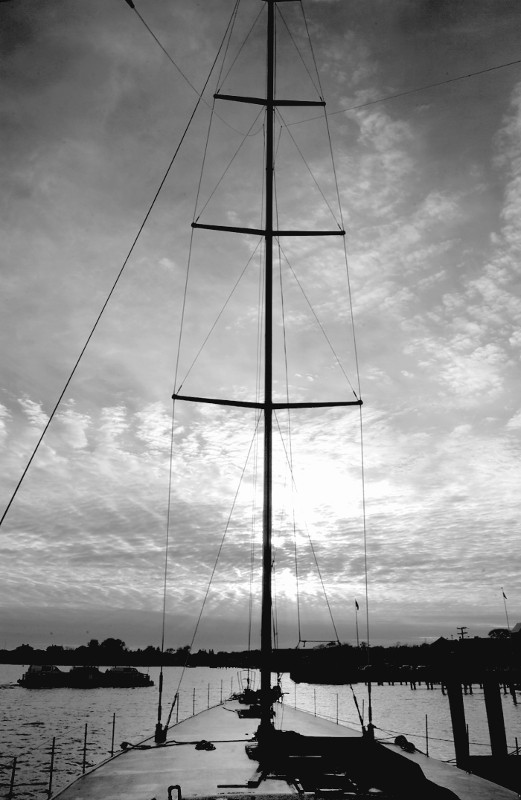
The long, slender vessel with the mast towering high above Edgartown is one part sailboat and one part floating workshop.

Dusty is able deck hand.
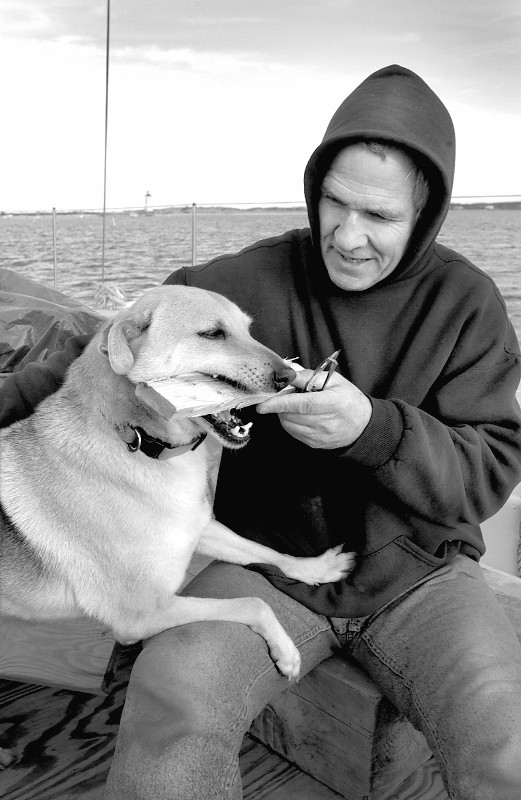
Dusty is able deck hand.
On the deck, old saw horses and scraps of faded wood are scattered around the stern, and multicolored patches of epoxy and resin stain the fiberglass. The coaming around the cockpit is under construction, and the scarred and sun-bleached wood around it suggests it has been that way for years. Rough plywood cutouts act as temporary hatches; they are shaded by the looming mast, fastened by thousands of gleaming rivets.
Below deck is more of the same: a workbench covered with tools, crates and coils of rope. On the makeshift cabin floor are more crates, more coils of rope, jugs of orange juice and a dog, Dusty, that is gnawing on a discarded piece of wood.
This is the Mass Transit, a 105-foot racing sloop that has become one of the Vineyard's most curious - and some might say notorious - boats. The work in progress is the creation of West Tisbury's Nicholas van Nes, a sailing enthusiast who has spent more than a third of his life pursuing his dream to build a boat - all by himself. With more than two decades of work behind him, Mr. van Nes is finally nearing the end of what has been a long and strange odyssey.
On a recent afternoon, he and his son, Joe, were busy down below, drilling holes through the fiberglass deck. A bitter January chill had taken hold, though the cabin still provided a respite from the wind that whistled through the standing rigging above.
"I'm a nut, I freely admit that," Mr. van Nes said with a laugh. "You have to be crazy to do this alone like I have. But I love it, I'm obsessed with it, and I know that I will sail this boat and the 20-something years I spent working on it will all be worth the ride."
Indeed, building the Mass Transit has been a patchwork process.
Short on cash, without additional labor save for a few friends and some strangers along the way, and with little to no knowledge of boat building, Mr. van Nes has struggled to complete the boat in the two decades since he started.
"I look at it as my life's biggest challenge," he said.
However, there is another story to Mr. van Nes and his do-it-yourself sailboat, one of a ship without a home port and of an owner mired in one controversy after another. Since moving to the Vineyard 10 years ago, Mr. van Nes has never had a permanent mooring, instead moving from harbor to harbor - an issue that has led to numerous conflicts with Island harbor masters.
Like the time during his first winter when his dinghy drifted off, leaving he and his son stranded aboard the Mass Transit, then moored in Katama Bay. When Edgartown harbor master Charlie Blair found the rowboat on shore with only life jackets in it, he feared the worst and called in the Coast Guard for a search and rescue. The van Neses were later found safely huddled aboard the sloop.

Joe Van Nes inspects day's work.
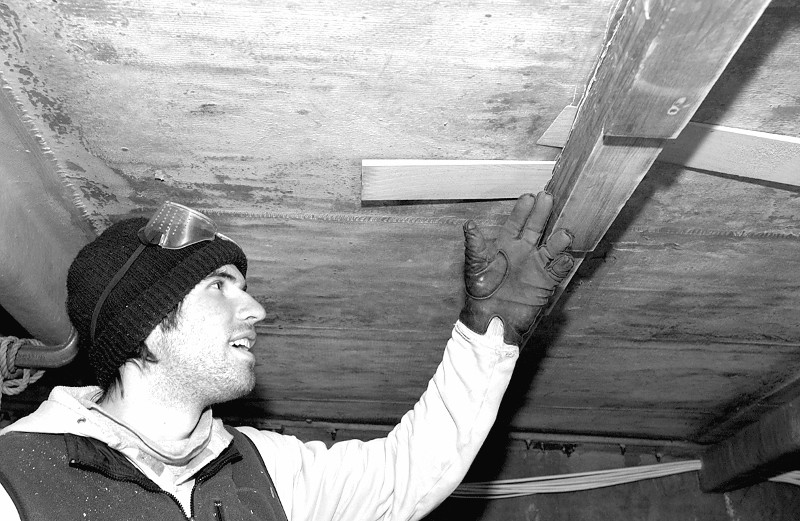
Joe Van Nes inspects day's work.
Another time he lost his tender while moored in Vineyard Haven. According to Mr. van Nes, he slipped getting out of the dinghy, and it drifted off as he was gathering himself - moving right into the path of the ferry Islander. Despite Mr. van Nes's attempts to contact Tisbury harbor master Jay Wilbur to assure him he was safe, another search and rescue team was deployed. Authorities again found Mr. van Nes safely aboard his boat.
Just last winter the boat was caught in Katama Bay during a blizzard; it dragged anchor and eventually ran aground. Although boats of that size are not permitted to moor in the bay during the winter, Mr. Blair granted Mr. van Nes permission to ride out the storm there. But when ice set in, the engine flooded and the boat partially sank. It remained stuck for two-and-a-half months.
Much to Mr. van Nes's embarrassment, there are more of these stories, more incidents that have painted him - rightly or wrongly - as irresponsible. As a result, he and his boat have angered officials across the Island to the point where they want no part in providing the Mass Transit with a place to moor.
"There are things I wish I could have done a little differently, but I am proud of this boat and am just looking for a place to finish it," he said, wrapping his hand on the fiberglass hull. "I feel like I have been pressured, even harassed, to finish the boat. Who cares how long it takes me? Considering I don't have a mooring, I think we're doing a pretty good job."

Sleeping quarters are still under construction.
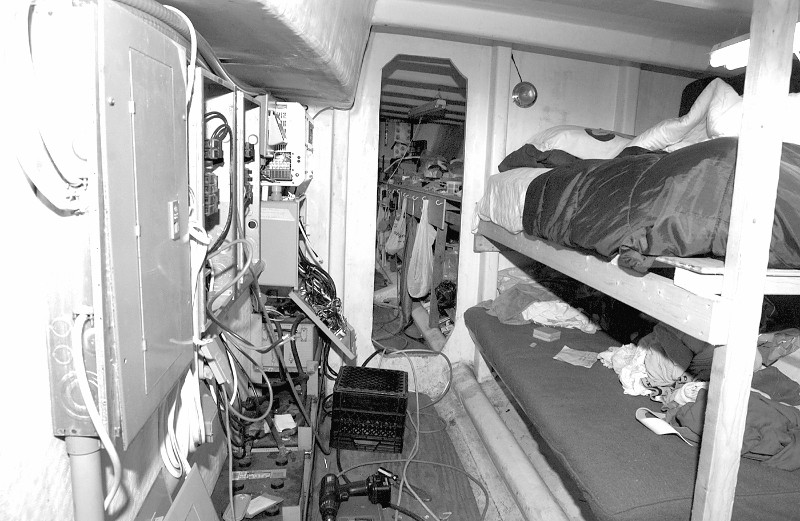
Sleeping quarters are still under construction.
Tensions over the Mass Transit came to a head last month when the Tisbury selectmen ordered the boat off a mooring in Vineyard Haven harbor. Mr. Wilbur had received complaints that the boat, which was moored next to the schooner Shenandoah, was blocking access for a fuel barge. Selectmen tasked Mr. Wilbur with removing Mr. van Nes's boat.
Mr. van Nes moved the boat, but a subsequent argument between he and Mr. Wilbur that ended in a screaming match is currently the subject of a criminal complaint filed by Mr. Wilbur, who said Mr. van Nes threatened him.
Currently, Mass Transit is tied up at north wharf in Edgartown, where Mr. Blair has allowed it to dock for the winter.
Mr. van Nes began building the Mass Transit in New York city in the early 1980s. At the time he was running a charter sailing business in the city, and doing so well that he decided to build another boat. With permission from the parks department, he began framing the hull inside an old landfill near Battery Park, in the shadow of the World Trade Center and not far from where he docked his first boat, the 73-foot yawl Petral.
But when he lost his charter contract in 1996, he left for the Vineyard, bringing a half-built Mass Transit with him. He bounced around from harbor to harbor, splitting time between Vineyard Haven, Edgartown and Menemsha. A shortage of funds, manpower and knowledge of shipbuilding slowed Mr. van Nes's progress to a crawl. He recently installed the mast, a 135-foot structure that took years to complete.

Despite all of his hardships, Mr. van Nes, 61, exudes a youthful excitement and intensity that belies his age. When he talks about Mass Transit and imagines her cutting through Vineyard Sound, he sounds more like a teenager anxious to take his parents' car out for a spin than a father of two college students. And while he beams at the thought of her heeling in the wind, he has learned not to guess when that time will come. He still needs to find the sails, attach the boom and build the heads, galley and rest of the interior.
"I learned not to make predictions because I don't know what is going to happen next," he said. "Everything has been a chapter, an ongoing saga."
But as quickly as he acknowledges that he is terrible with predictions, he says he is cautiously optimistic that he will be sailing this summer. If everything goes according to plan.
"Which probably won't happen," he said with a laugh.
But on this day summer was a distant dream as the sun ducked behind the clouds and Mr. van Nes contemplated the work that remains. Next on the list: the 30-foot boom, sitting in his yard and finally ready to be attached to the mast. But like so much of his history with the Mass Transit, he does not know exactly when or how he will complete the task.
But for starters, he relies on an old standby: "Do you know anyone with a 30-foot trailer?"
Comments
I just found this article on
Mark Hazelwood EdinburghNick and I went through UDT/R
Larry Nelson Arlington, VaNick and I went through UDT/R Training as Navy Ensigns in 1967. That is what is now called BUD/S, the initial qualifying training for Navy SEALs. I'm trying to find Nick to invite him to our 50th reunion at Little Creek Amphibious Base, Va Beach, Va the weekend of July 20.
Nick, if you see this, please contact me through Jim.
Lawrence W. Nelson
CDR, USN ( Ret)
I was hired by Nick in 1987
Sergio Magalhaes Jr New YorkI was hired by Nick in 1987 and we worked on the restoration of his sailboat called PETREL in City Island, NY.
At the same year Nick started building his new boat, at that time called 105, at Pier 59.
I met Nick working on 105 (as
Attila Wenger NYCI met Nick working on 105 (as it was called then) in Liberty Harbor Marina in Jersey City in the early 1990’s. He was still chartering Petral from the tip of Manhattan on the daily basis. Sadly reading he hasn’t finish the project yet… Good luck Nick
In 1979 on a visit to New
Robert Wynne Horsham Victoria AustraliaIn 1979 on a visit to New York, I happened upon Nick's yacht Petrel at the tip of Manhattan being soon to leave and bought a ticket for a sail around the harbour from the young lady in the ticket office. In conversation with her on board I mentioned a book I had about a sailing family in New York, "Into the Wind" by Mary van Nes. Would you believe, she says, that the skipper at the wheel is Nicky, one of Mary's sons. I made myself known to him and on discovering that I was a sailor, he put me on the wheel for the duration of the cruise, while he chatted with the other passengers.
In 1986, again in New York, I telephoned Nick's home in case I could do another cruise and explained to the lady who answered how I had sailed with Nick before. Yes she said, I sold you the ticket, I am now married to Nick and we have a son, perhaps it was Joe. Would you like to talk to Nick she said, which I did. The result was that he arranged to pick me up downtown the next morning at my hotel and show me the new yacht he was then building on the Hudson shore. I have recently been reading on this Gazette site what Nick has been up to in the intervening 37 years. It seems he is still building the boat, and that Petrel is no more.
I met Nick in 1976 and
Jeffrey Rowland NYCI met Nick in 1976 and started volunteering on the Petrel. We started talking about his plan to build a 105' sailboat designed by Alan Gurney and that he had mad a deal to use the landfill on the south side of the South Cove of what was to be Battery Park City. In hours of phone calls I helped him plan how to build the stage on which the hull stations would be set up and later the deck. I stayed with the project all the way thru to the completion of the hull and the upside down deck form, which I ran the crew of volunteers to build. On the masonite waxed form went the gel coat and layers of glass, the Airex foam, and the glassing of the underside of the deck and cockpit. We used one of the deck beams as a mold to match the arc of the deck for the many that would be needed along the entire deck. Once the deck was ready it needed to be flipped over, so using the two boom cranes (as we had done with the hull) we then lifted and rolled the deck and placed it onto the flange of the completed hull. enclosing the boat. I was working in construction in those years and I would look down from my woodworking job on the 107th floor of the trade center while I was at work and then down to the boat to look up at it after work. once the two parts were joined, the boat was moved to the end of one of the Chelsea piers for interior work. There's now a garden and the Holocaust Museum where the hull and deck built. Nick was the most inspiring man I ever worked for and I thank him for the memories.
Add new comment