


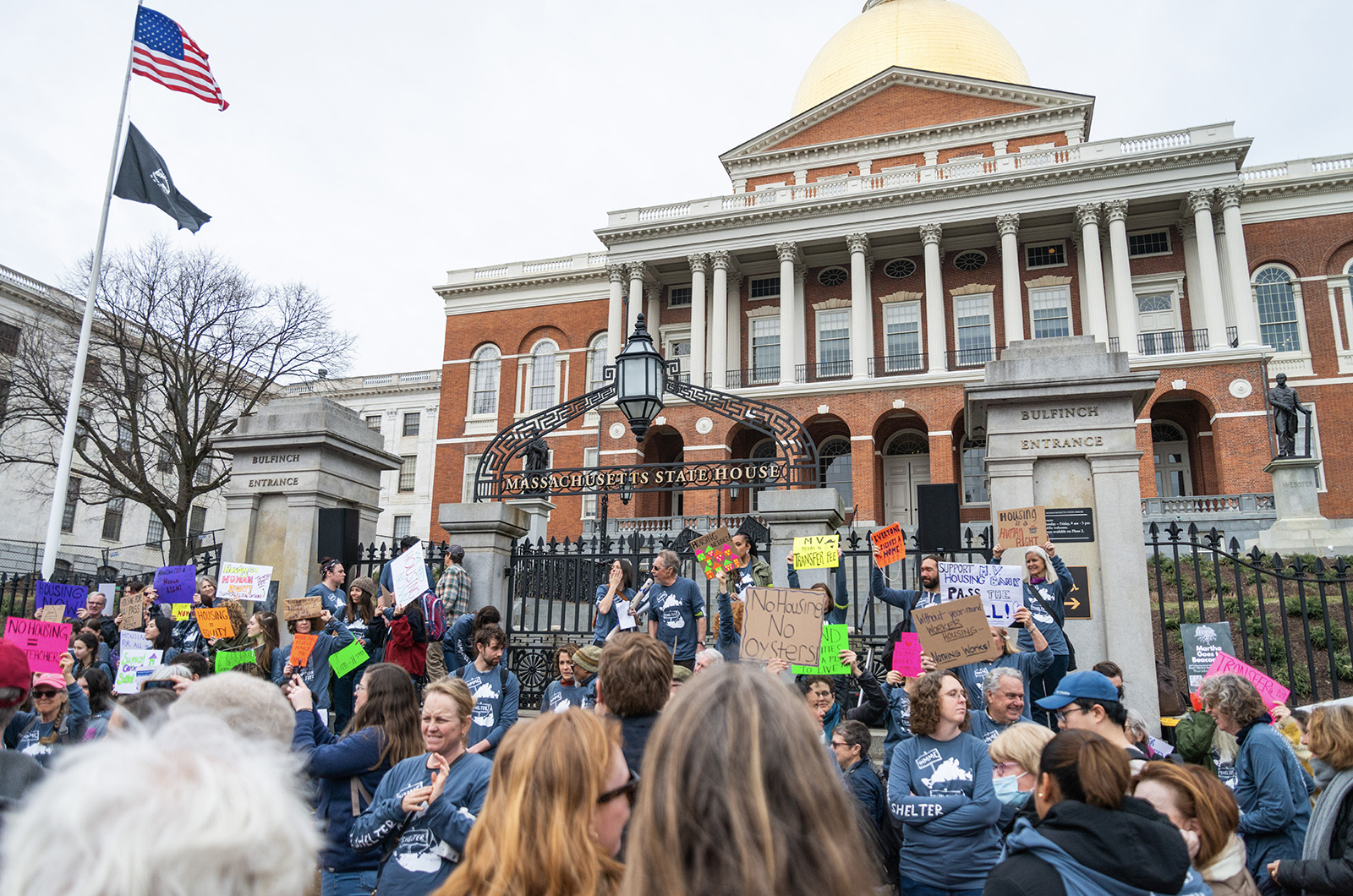
Island housing advocates will return to Boston Tuesday to lobby their support for the local option transfer fee and housing bank bills being reviewed at the State House.
Island housing advocates will return to Boston Tuesday to lobby their support for the local option transfer fee and housing bank bills being reviewed at the State House.
Islanders and other officials from across the state will attend an event organized by the Local Option for Housing Affordability (LOHA) coalition in order to try and keep legislative mometum on efforts to ease the state’s worsening housing crisis. One main objective will be to rally for the local option transfer fee, which would allow municipalities to tax real estate transactions over $1 million, creating a reliable revenue source for affordable housing.
On the Island, the proposed housing bank would operate like the land bank, creating a regional housing development entity funded by the transfer fee.
Representing the Island, speakers Dan O’Connell and NaDaizja Bolling will join advocates in briefing key legislators on housing issues.
Mr. O’Connell served as the state secretary of housing and economic development under Gov. Deval Patrick, splitting time between Boston and the Vineyard. In his decades-long experience in state politics, he said he had never seen a day of action more successful than the rally to support the Island housing bank that took place earlier this year.
“Everything we’re doing is trying to sustain that energy created March 23,” he said.
Ms. Bolling is the director of the Aquinnah Cultural Center and a member of the Wampanoag Tribe of Gay Head (Aquinnah). She had previously spoken to legislators at the Beacon Hill rally about how rising housing costs have further displaced the Island’s indigenous community.
“What makes a community indigenous is their ties to their homeland,” she said. “That’s significant.”
To Ms. Bolling, the current housing crisis is just the latest iteration of settler colonialism that has displaced indigenous communities for generations.
“We’ve been squeezed over to one side of the Island…now we share a struggle with the rest of the Island, or at least they’re now feeling what we’ve experienced for a long time,” she said.
The event’s organizer, LOHA, is composed of more than 100 regional and local organizations, including the Martha’s Vineyard Commission (MVC) and the nonprofit Island Housing Trust. The commission’s housing planner Laura Silber, who serves on the board of LOHA, said the coalition marks a turning point for many of the groups lending their support.
For example, she said this is the first time Mass General Brigham, which runs the Martha’s Vineyard Hospital, has expressed support for an issue not directly related to healthcare. The wide breadth of voices speaks to advocates’ view that housing is a “root cause issue,” affecting public health, economic well-being, and more, she said.
“That has defined the trajectory of the statewide conversation,” she said.
Other speakers include Brian Sullivan, the vice president of the Nantucket Association of Real Estate Brokers, a subsect of the Massachusetts Association of Realtors that has historically opposed the transfer fee. Mr. O’Connell said Mr. Sullivan’s support goes a long way in quelling concerns that a transfer fee would hamper the local real estate market.
“We have 30 years’ experience of the land bank fee that has not in any way constrained the housing market,” Mr. O’Connell said.
He added that the move to take the issue statewide came after a similar housing bank bill previously died in the legislature. To get lawmakers on board, he said, the transfer fee legislation needed to be applicable to any community, even if that application looks different from town to town.
Legislators have also questioned whether communities have explored every revenue source available to them, to which Mr. O’Connell admitted that not every Island community has. On top of utilizing existing revenue sources like Community Preservation Act funds and short-term rental taxes, he said the transfer fee would provide the windfall needed for major projects.
“Other available funds pale in comparison to the impact that a transfer fee would have,” he said, estimating that a transfer fee would bring in $12-$15 million annually.
Still, he acknowledged that the legislation was only a piece – albeit a big piece – of the puzzle. At town meeting this year, Nantucket approved a permanent $6.5 million tax override for affordable housing initiatives, dwarfing investment seen anywhere on the Vineyard.
To keep the ball rolling, Mr. O’Connell said the Coalition to Create the Martha’s Vineyard Housing Bank has started drawing from its list of more than 450 volunteers to encourage “as many Vineyarders as possible” to testify in front of the legislature.
Ms. Bolling has shared stories of friends and coworkers who have lived in trailers on others’ property or even taken up residence at their place of work.
“I think it does make an impact to hear these stories personally,” she said.
The newly created Island-wide Housing Task Force also held its first meeting last month to give housing advocates, planning board members, and residents a centralized place to stay informed about housing developments and look towards solutions.
“We will have to afford ourselves of every opportunity to solve this issue,” Mr. O’Connell said.
Comments
A big difference between
Inde West tisburyA big difference between Nantucket and the vineyard is that Nantucket has a huge swath of land that is understood to be the “lower income” neighborhood. It’s a different beast from the rest of the island. Tourists would never consider renting or owning there. It’s easier to build apartments and other forms of rent controlled living space. And so Nantucket is succeeding where the Vineyard is not. So far as I can tell, the Vineyard hasn’t been willing to go that route and instead keeps entertaining these tiny projects hidden in a few acres of woods. But it’s hard for me to see how such tiny projects can ever add up.
Also, on a separate note, we are also having an equally big challenge finding affordable commercial space for small businesses. I don’t hear to same interest in solving this problem but they should go together. Until laws are in place to prevent commercial space from converting to residential space we risk losing the infrastructure that would support the small businesses that ultimately hire the people who currently have no places to live.
Money from the Short term
Sara OBMoney from the Short term rental should be used to help with affordable housing? Where does all that money go??
In Edgartown, the general
Mark EdgartownIn Edgartown, the general fund where it can be used to keep tax rates low.
Add new comment