

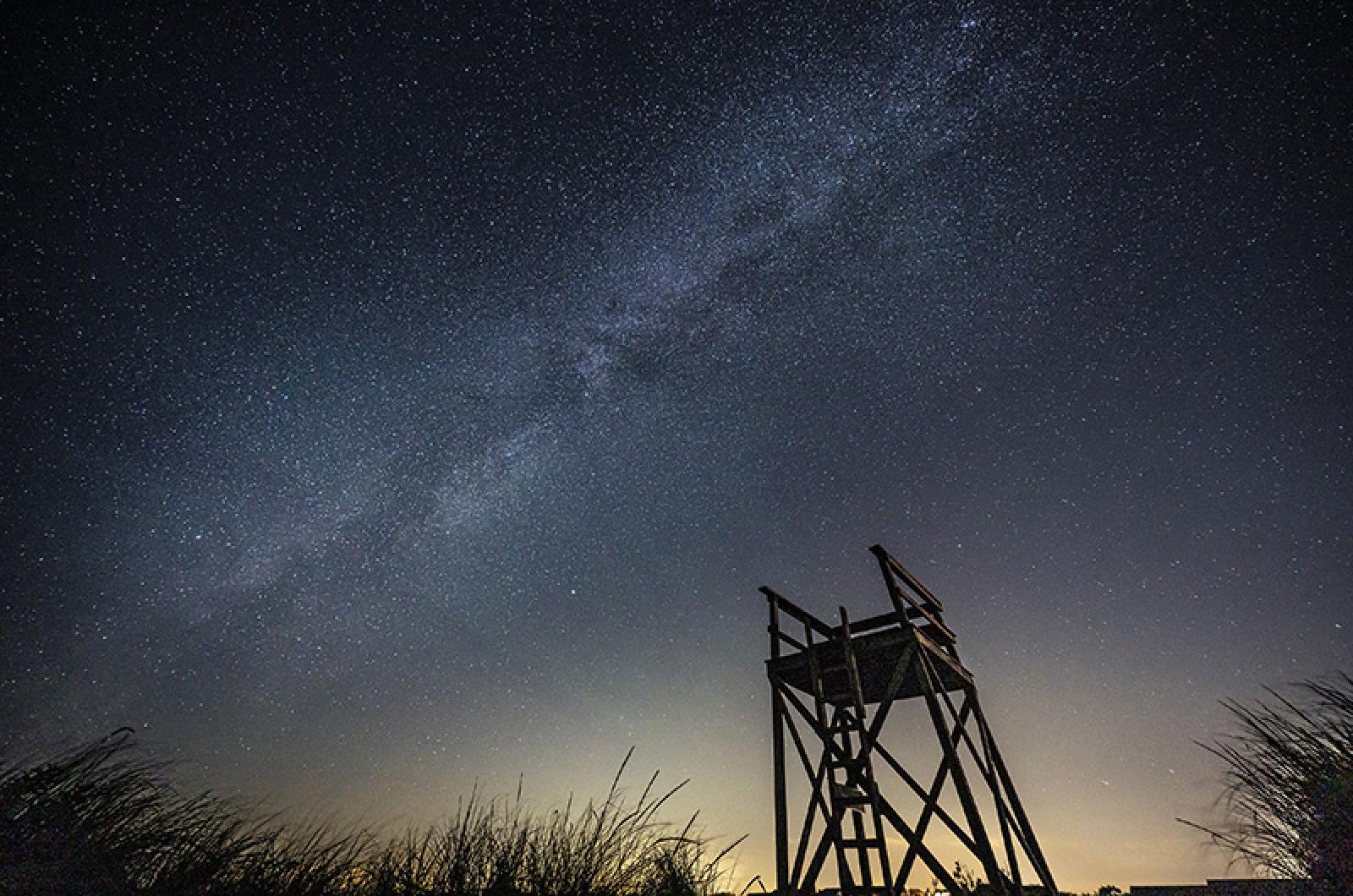
One of the many nice things about living on the Island is that we have a much better view of the stars at night than most of the eastern mainland.
One of the many nice things about living on the Island is that we have a much better view of the stars at night than most of the eastern mainland because of our dark skies, especially out over the ocean.
That is set to be severely damaged later this year as the first 62 of what may be hundreds of offshore wind turbines are built in a huge area of ocean to our south. To put in perspective the area of the seabed that will be affected, the first phase Vineyard Wind turbine field is roughly the size of Martha’s Vineyard. But their full lease block is 167,000 acres or three times the size of the Island, according to federal lease data. That’s less than a quarter of the total area south of the Island that has been leased, however, which spans more than 100 miles from end to end.
The wind turbine generator enclosures will be atop towers about 450 feet above the water — the height of a 35-story office building. All 62 of them are planned to have extremely bright red aeronautical beacons flashing on and off. As acknowledged in the visual impact assessment included in the federal permit documentation: “These lights will be visible from all coastal locations where daytime views of WTG [wind turbine generator] nacelles occur.” That’s the entire southern shore of the Island. What the assessment doesn’t say is that the scattered light will be visible inland from any place on the Island that has a clear view of the night sky to the south. There will additional lighting closer to the sea surface from the service platforms and marine navigation lights that will also contribute to lighting up the night sky.
The Vineyard Wind turbine field will be light pollution on steroids. The aerobeacons will be far above the visual horizon, which from the beach is about 30 miles for a tower of that height. They will be visible at even greater distances inland from higher ground. The bright lights will reflect off clouds, mist and fog and scatter widely. I suspect it will be a great shock to many people when they realize just how starkly visible the purportedly “out of sight out of mind” wind farms prove to be. Even the five much smaller wind turbines off Block Island can easily be seen scattering light in the sky from Newport, Point Judith and Montauk, which are about the same distance away as the Vineyard Wind project is from here. Vineyard Wind will have a vastly greater impact on the night sky with more than 12 times as many turbines that are nearly twice as high — and it is only the beginning, as the other large wind projects in the queue get under way over the next several years.
The European owners of Vineyard Wind want everyone to think they are sensitive stewards of the environment and bring many benefits to the community. It would be a relatively simple matter for them to greatly reduce the light pollution from their facility. But they don’t seem to care in the least. Their excuse is no doubt that “we’re just following the Federal Aviation Administration rules.” However, those FAA rules were developed years ago for tall structures in urban areas or isolated structures, not vast fields of offshore wind turbines.
There are two mitigation measures that could be implemented at relatively little cost. One would be to greatly reduce the number of aerobeacons so that only the towers marking the boundaries of the turbine field are lit. The second mitigation measure would be to illuminate the aerobeacons only if there are any aircraft in the vicinity to which they might pose a safety risk. This is a very easy thing to do with current technology. Airplanes and helicopters have transponders that constantly transmit their position, altitude, course and speed. The wind farm could be equipped with a receiver that would automatically switch on the aerobeacons if an aircraft was approaching a safety zone, which might be below 2,000 feet and within five or 10 miles. That would be very, very seldom given that the turbines are in an area where planes normally are at greater altitude. The flashing aeronautical beacons could remain dark most of the time. These mitigation strategies would need to be worked out with the FAA, but that should not be a major obstacle since safe operation of aircraft can still be ensured. Indeed, the federal government should be very supportive since it will reduce one impact of the wind farms and avoid creating public concern. There are already examples in other parts of the country of regulations designed to reduce the light pollution from wind farms along these lines.
We have made the choice as a nation to provide billions of dollars in government subsidies and create a highly favorable regulatory process for these enormous industrial developments in our pristine near-coastal waters. There was never a real debate as to whether it was worth the environmental and economic costs because the financial and industrial backers of the wind farms and their supporters positioned these developments as critical to slowing climate change. The federal regulatory agencies and the government of the commonwealth make no pretence of objectivity. They are openly boosters who view their primary duty as paving the way for the offshore wind industry, even going so far as to grant Vineyard Wind permission to harass or kill nearly two dozen endangered right whales. However, unlike other aspects of these projects such as their location in critical marine habitat areas, the light pollution from the wind turbines is something that can be mitigated with no consequences for electricity production and an insignificant financial impact. Indeed, the developers might save money by producing less light pollution since they will need fewer aerobeacons and use much less electricity to illuminate them.
Vineyard Wind should take the initiative to voluntarily pursue mitigation measures for the massive light pollution its turbine field will produce. It can demonstrate that its European owners really do care about what happens here and not just about the billions in profits they will harvest. They can show leadership in the industry and serve as a model that the Federal government can adopt for other projects. Now is the time for them to step up.
Fred Khedouri lives in Chilmark.
Comments
Talk about throwing some
Harriet WTTalk about throwing some light on the subject. What about our migrating birds? How can we help??
Both measures appear worthy
Rex Jarrell West TisburyBoth measures appear worthy of pursuit.
Well thought out and all
Bob EdgartownWell thought out and all great points. Let’s see if they do the right thing with out being told. I am sure they knew about this issue but many of us it will be the first time to read it myself included. We need dark skies here on the island and out at sea.
It’s so very refreshing to
Sharon Purdy EsgartownIt’s so very refreshing to have someone present an objection to a developmental project while, at the same time, also presenting a solution. This is well presented and worth serious consideration. I hope Mr. Khedouri will take a step to put his thoughts into action and that The Gazette will keep us all informed on how we might support them.
I find it ironic that the
SGR ChilmarkI find it ironic that the sole reason for this oversized wind turbine project is allegedly to protect the environment while in fact it will permanently alter it for the whales, the birds and for those of us that chose to be here because of it’s environmental beauty.
Too little, too late.
David EdgartownToo little, too late. Excellent points but the hearings are over and the approvals have been issued. Can't recall if Vineyard Power, when they promoted the turbines, shared this with us while proclaiming that there would be no visuals. Besides, light pollution on MV seems to be here to stay. We have a house across the street with lights on all night. Their garage looks like a 7-11. Two houses down, exterior lighting casts a glow in all directions all year from the exterior lights; a seasonal house. Down the street a new, unoccupied spec house has 39 lights scattered throughout the property; most pointing up. The view out to sea will soon be like it is looking back to the mainland.
If humans continues to burn
Peter Pfluger Oak BluffsIf humans continues to burn fossil fuels and discourage the change to relatively harmless alternative energies, all of Mother Nature's living things will certainly suffocate and die in the near future. Let us look at the big picture and the long run and choose wisely and with the entire planet in mind. I'm very happy to see that Fred, the author of this article, has mentioned two, very doable remedies to this light issue and has shown a willingness to find and explore solutions.
"Technology development has made demand-based obstruction lights possible, allowing lights to be turned on only when aircrafts are approaching. Obstruction light control (OLC) systems are installed and tested at an increasing number of locations."
https://www.sciencedirect.com/science/article/pii/S096014812200595X
So change the turbine
Tracy ConnecticutSo change the turbine lighting requirements or notify the pilots a different way than lights. Time to stop doing the easy thing we have always done and time to be more sophisticated. Or just do not allow to pilots to fly there and turn the lights off. I would prefer clean air and free energy fuel even if I got a little light. A bit of wind and with the waves you will not see the light.
The gazette should at least
Roger FrankThe gazette should at least fact check opinion pieces before publishing. Vineyard Wind will be using the lighting mitigation that is suggested here and they don’t have permission to kill right whales. Hopefully someone will write a response to this to get the facts straight.
a tragic demise
virginia yorke Aquinnaha tragic demise
for this once beautiful island.
Nice well written article.
don keller Vineyard HavenNice well written article.
I have asked the good people at Vineyard power to provide me with information about the lighting. They have an office at 151 Beach road and have an "open house" to answer any questions from 3 until 6 every Wednesday. I encourage anyone who is concerned to visit them.
But first, the Idea that any regulatory agency has allowed nearly 2 dozen right whales to be killed is totally false.
It is disinformation that comes from a tiny grain of truth. Noaa does not allow nor have they permitted the killing of any marine mammal. There are 2 levels of marine "harassment" Level "A" is;
"(18) (A) The term “harassment” means any act of pursuit, torment, or annoyance which— (i) has the potential to injure a marine mammal or marine mammal stock in the wild..."
V.W is not permitted to have any "takes" of ANY marine mammal at this level.
Level "B" harassment;
"means any act of pursuit, torment, or annoyance which has the potential to disturb a marine mammal or marine mammal stock in the wild by causing disruption of behavioral patterns, including, but not limited to, migration, breathing, nursing, breeding, feeding, or sheltering but which does not have the potential to injure a marine mammal or marine mammal stock in the wild."
V,W is permitted to have up to 20 of these "takes"
So to sum it up--- NO DEATHS, NO INJURIES of ANY marine mammal. From anything associated with any offshore wind power.
But to the lighting--
The people at V.W do most certainly care about it.Your comment that they don't is disingenuous and uninformed.
Also-- Vineyard wind is 50% owned by Avangrid renewables, which is based in Portland Oregon, and 50% by Copenhagen Infrastructure Partners, based in Copenhagen. They are the world's leader in this technology. The U.S is far behind and does not have any companies capable of such a project.
FAA rules for these structures require 2 flashing bulbs at the top of the nacelle, and 3 half way down the tower.
They are L 810 bulbs. They are red and they flash. They produce about 200 lumens of light-- the equivalent of a 20 watt incandescent bulb. To put it in perspective, most security lights that many people leave on all night produce about 2,000 lumens of glaring white light. A neighbor 3 doors away from me has 4 of them. Given the low intensity and red color of the required obstruction lights, I doubt they have the potential to create "light pollution on steroids" or produce enough light to block out the milky way.
They will indeed be visible.
The complete set of rules governing this can be read here:
https://www.faa.gov/documentlibrary/media/advisory_circular/ac_70_7460-…
Chapter 13 addresses lighting for wind farms.Section 13- 7 addresses towers at the height of V.W Including your good idea to have only the perimeter illuminated. It seems they are too far apart to do that.
There is no mention of the excellent technology you mention about having sensors to detect planes and flocks of birds.
There are some of those systems in operation off the coast of northern Europe, with a high degree of success. The next time I talk to the people at Vineyard Wind I will ask them to lobby for that rule change.
Much gratitude for your
Ida G Millman Hebron CTMuch gratitude for your carefully written response to warnings of light pollution attendant on the beginnings of renewable power for the V. L&B&L
I appreciate your thoughtful
Fred Khedouri ChilmarkI appreciate your thoughtful comments. However, while we are in fact-checking mode, I must note that there are some elements of your comment that are inaccurate. You say that Vineyard Wind does not have an "incidental take" permit that would allow it to unintentionally harm or kill a North Atlantic Right Whale because its permit only allows Level B harassment. That is wrong unless NOAA needs to correct the description on their website of the permit they granted. It says "NOAA Fisheries has issued an incidental harassment authorization (IHA) to Vineyard Wind 1, LLC to take, by Level A harassment and Level B harassment, marine mammals during construction of a commercial wind energy project offshore Massachusetts." I checked this carefully before writing my essay and read the actual permit as well as the NOAA website description. As you note, Level A harassment can include unintended injury or death. I fervently wish that no harm will come to marine mammals from this enormous intrusion on their habitat. But NOAA has become an advocacy organization and uses the absence of data to justify its regulatory actions in support of the wind industry. There is no direct scientific evidence to support the claim that construction and operation of these turbine fields is not harmful or disruptive. I agree that there isn't much data to support the contention that it is harmful, though common sense would suggest anything on that scale that produces stupendous amounts of noise and electromagnetic fields is likely to have an impact. The North Sea turbine fields are in a very different habitat area that is frankly largely devoid of life and much shallower. As for the aerobeacons not being visible because of their low intensity, I suggest you go take a look at the five Block Island turbines at night some time. I have been out fishing in that direction many times since they were built and they are very clearly visible and the scattered light makes the sky glow if there is mist or fog.
Forgot to mention that you
Fred Khedouri ChilmarkForgot to mention that you also said "Vineyard Wind is 50% owned by Avangrid Renewables, which is based in Portland..." and maybe you should have added that Avangrid Renewables is a wholly owned unit of IBERDROLA, which has its corporate headquarters in Spain. So Vineyard WInd is indeed 100% European in terms of its economic ownership.
This is wholly incorrect.
Sarah JasperThis is wholly incorrect. Avangrid is listed on the New York Stock Exchange (AGR) and anyone can buy their stock. It is selling at $38 a share as of this morning. It’s a shame you are allowed this platform to spread misinformation in both your “opinion” article and in your comments. How does this happen?
People, this is an opinion
Carla A Cooper EdgartownPeople, this is an opinion piece. Not a piece of journalism. I guarantee the lights from Martha’s Vineyard Airport are brighter than what you’ll see miles off the coast.
Let’s encourage Islanders &
Caroline Reily MetairieLet’s encourage Islanders & developers do their part to limit light pollution. Would love for the Vineyard Gazette to include encouraging campaign. Federal Campaigns such as “Give a hoot, don't polutte” were so successful. Maybe we can start a movement encouraging everyone to turn off the lights and have a milky way...
I'm going to visit Block
Sam Fall RiverI'm going to visit Block Island arriving tomorrow. Aside from the beauty of the Island and town I was going for the dark skies : something very rare in NE USA, specifically to photograph the milkyway. Only now do I find out about this wind farm that no tourist information mentions! Already feel taken in by tourist trap. The thousands of $ I've already spent might have been better spent on a trip west to the deserts that have not yet been polluted. Too late to back out now. I'm more than disappointed feeling ripped off. Tourists should be informed better as in the typical tourist info I found nothing about wind farm. Only from an article about Martha's Vineyard is there a mention of it that led me here. Still hoping they are not so bright as to ruin half my trip.
Add new comment