


Edgartown Conservation Commission members have raised concerns regarding the number of vehicles the Trustees’ allow on their trails and whether the organization would be able to secure sufficient staffing for the summer volume.
New wrinkles have developed in a contentious series of Edgartown Conservation Commission hearings to determine whether The Trustees of Reservations can continue the sale of oversand vehicle permits on its Cape Pogue and Leland Beach properties.
For months, Chappaquiddick residents have urged the commission to deny the Trustees’ permit application, arguing that the organization’s handling of oversand vehicle access has come to the detriment of the areas’ delicate barrier dunes and protected wetlands. The Cape Pogue area in particular has become a flashpoint with some residents taking legal action against the organization, claiming a pattern of land misuse, noncomplicance and neglect.
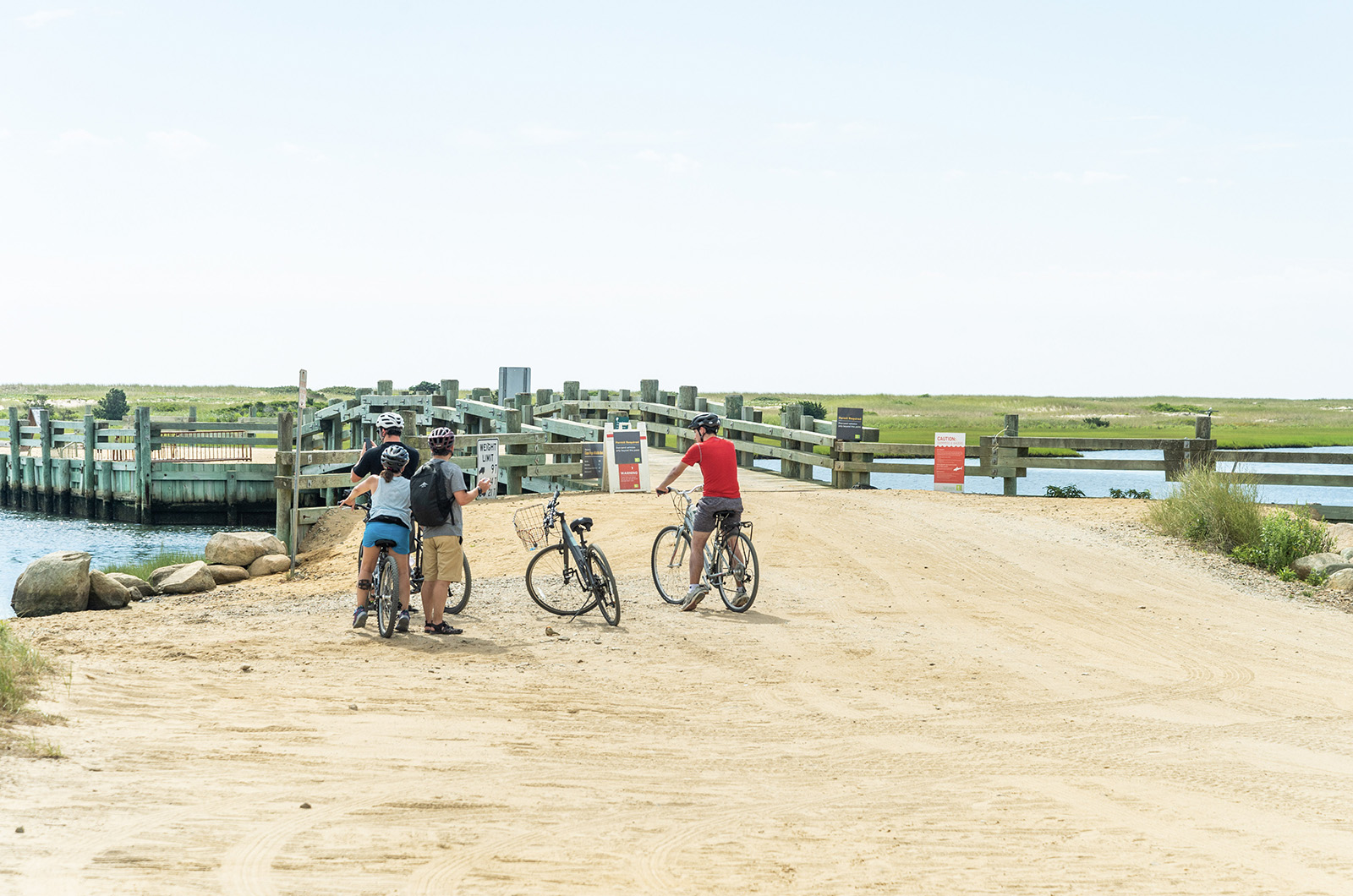
“Forty thousand vehicles go over the Dike Bridge on an annual basis, according to the traffic counter,” resident Joe Russo said, referring to the town-owned bridge connecting Cape Pogue to the rest of Chappaquiddick. “I don’t want to sit around while they run this property into the ground and then wash their hands of it.”
In the hearing on Feb. 15, commission members raised concerns regarding the number of vehicles the Trustees’ allow on their trails and whether the organization would be able to secure sufficient staffing for the summer volume. The Trustees do not currently limit the number of oversand vehicles that can go through their properties, Trustees islands portfolio director Darci Schofield said, but follow a guideline of one vehicle per 20 feet by 30 feet square area.
Ms. Schofield told members of the commission that they could provide conditions to implement limits.
The Trustees have not released numbers of how many permitted vehicles pass through its properties each year, but reported 4,500 total permits sold last year.
Due to the unique environmental needs of each property, the commission recommended that the Trustees submit separate notices of intent so oversand access may continue unfettered on Leland Beach while residents debate the effects of vehicle access on Cape Pogue. Ms. Schofield said that the Trustees still consider the properties similar enough to fall under one notice, but it has assembled a working group of various stakeholders to further discuss Cape Pogue management.
“It would be much easier and cleaner if they were separate notices,” conservation agent Jane Varkonda said.
The Trustees of Reservations is the largest land trust in the state and has sold oversand vehicle permits on its Edgartown beach properties since 1990. Over the past several hearings, abutters have reported an erosion of trust in the nonprofit conservancy organization, claiming it has deprioritized its conservational responsibilities.
“It seems that making money by selling OSV permits and T-shirts has taken over their mission,” said Leslie Self, whose family first donated a swath of land to the organization in the 1950s.
The oversand vehicle debate is just the latest challenge the organization has faced in the past year, beginning with widespread public backlash against its proposed beach management plan in July. Ms. Schofield has since said that the Trustees plan to release an updated draft this October.
Earlier this winter, the Trustees relinquished control of Norton Point Beach, which is owned by Dukes County, to allow the town of Edgartown to pursue their application for management. Norton Point Beach had originally been included in the Trustees’ notice of intent.
Chappaquiddick resident Tom Ross said that the last oversand vehicle license issued to the Trustees in 2016 had been contingent on the procurement of a beach management plan, and in the absence of an approved plan, the application left too much up in the air.
“We trust they’re being truthful that the next plan will be released in the fall, but we have no idea when or if it will be approved,” Mr. Ross said. “[The Trust] has continuously shown that the commission’s conditions as well as their own has been meaningless to them.”
Cape Pogue resident Victor Colantonio, who co-filed a lawsuit against the Trustees, echoed Mr. Ross’s point, expressing concern at the lack of land studies and data in the Trustees’ application.
“It’s almost daring people to come out of the woodwork and say, ‘This is preposterous,’” Mr. Colantonio said. “We don’t have enough information to make a decision.”
The sale of permits typically begins in January, with trails opening up to oversand vehicle access in late May. The public hearing will continue on Feb. 22.
Comments
“Forty thousand vehicles go
Ron Domurat Edgartown“Forty thousand vehicles go over Dike Bridge on an annual basis” (More than one hundred per day for 365 days, or 200 per day during the period from May 1 thru the end of October ????)…….Hmmmm!
I have been an observer of the Edgartown ConCom meetings since The Trustees of Reservations filed their recent NOI. I am also a surf angler, shell fisherman and frequent OSV user of the Trustee’s trails on Chappy, and have been for almost forty years. I am appalled by the shameful and selfish behavior of the few Cape Poge property owners (all but two of whom are seasonal) behind a movement to prohibit OSV travel north of Dike Bridge to Island neighbors, friends and visitors. I note their grievances but beyond nature taking its due course, in four decades of use, have personally found very little in the way of trail or dune damage. I can also count on two hands the numbers of intentional acts of vandalism that I have heard about or witnessed. The area from Dike Bridge north looks much the same as it did when I first started to visit in 1982 and believe the Trustee’s have been good stewards of the properties they own or manage. I am not alone. A recent social media post from a seasonal visitor stated, “I freely admit that I live in CT and only come in June to fish but everything to me looks just as beautiful and pristine as when I first came 20 years ago. So I must be missing something. After around June 6th through August, Cape Poge is closed to OSV use - so when does Cape Poge becomes what I have seen referred to as "Disneyland" or a "Carnival"? When is the most over-crowding?”
Yes, the Trustee’s appear to have lost their way a bit and yes, to keep up with the times, changes need to be made, but this issue can be settled without taking a radical step like closing the area to OSV usage. I have little sympathy for inconveniences created by OSV use to the residents of Cape Poge. I believe they are a very small price to pay for those who have the means and are privileged to reside, even seasonally, in that pristine and wonderfully remote area of Martha’s Vineyard.
Ron kinda hit it on the head.
Ron McKee Buxton Maine an Oak BluffsRon kinda hit it on the head. From using the beach since the early 80s I've seen little if any abuse. From picking up trash and helping stuck OSV users from time to time I see little if any overcrowding unless it's a bluefish blitz during the Derby or a small family event by the locals. The Trustees used to manage things well till the bird issue got rediculous. We the sportsmen used to always be part of dune grass planting,snow fences and used Christmas trees planting to protect the dunes from erosion. Then the birds came. Anti erosion an dune protection practices were stopped as it was claimed it hurt bird territory as they wanted it flat. This lead to a huge amount of erosion due the dunes washing away creating a flat beach. Yet it's the OSV users being blamed for the erosion that we helped battle for decades with dune protection practices. The figures listed are a joke. This along with the constant efforts to shut the beaches show the destruction of the great relationship we've all had for years. Please someone step forward to stop this. We all enjoy the beaches. It's a shame that a small handful are working so hard to destroy the friendship and relation ship of the beach users for so many decades. Thank Ron for what you posted.
I hope the editorial team at
Jack McCauley ChappyI hope the editorial team at the Gazette can keep the focus on this issue a high priority as it will ensure a constructive tension on making all parties accountable and forthcoming. This said a couple of question arise from Ms Schofield’s comments. Why are the trustees continuing to withhold data on traffic and usage from the town and community? What expertise/logic is behind the Trustees guideline/policy of “one vehicle per 20 feet by 30 feet square area”. That sounds like the logic for the development of a parking lot! Every move exhibited since the outcry over the poorly designed, poorly-thought out plan brought forward last year by the Trustee’s and Ms Scofield, has resulted in the Trustee’s withholding information, not communicating or engaging with the Community, and the discovery of more and more information that is impossible to reconcile with the fragility and irretrievable beauty of this beloved reservation.
4500 permits? 40,000 vehicles per year? Its sheer madness ……Mr Russo is right to assert that in the few facts obtained since the outcry from the Trustee’s plan, suggest that the Trusteees behaviors to date, is literally “running this property into the ground”. Please Gazette editors keep this dialogue and the community’s voice alive so that we all may come together in some way around true facts — and get to discussions around solutions presently unforeseen, to ensure the enjoyment and viability of this wonderful property.
It's not 40,000 vehicles per
Drew EdgartownIt's not 40,000 vehicles per year, it's vehicle trips on the Dyke Bridge and each vehicle trip needs to be one time on and one time off, so that is at most 20,000 vehicles per year. If you divide that by 365, that is a total of less than 55 vehicles per day on average. Then you need to subtract out Trustees vehicles for rangers which cross that bridge many times per day, making the true total far less than that. The real number should be no surprise to people who actually use the area for OSV and know that even in the busy season the beaches and trails are generally sparsely populated with vehicles.
Thank you Drew!!! Our family
Math is awesome EdgartownThank you Drew!!! Our family is out on Cape Poge often and it is - NOT - a parking lot like Norton Point. No where even close, so let's all take some deep breaths and keep this slice of heaven on earth accessible by those who have come to cherish it for decades, if not generations.
Don’t disagree with this.
Jack ChappyDon’t disagree with this. Your math, if correct would minimize the overall impact that was implied in the article — however it strikes me that the Trustees have had years where they have been asked to clarify and sharing their analyses and traffic data regarding their “stewardship” — they have time and time again chosen not to and apparently are holding firm to that course of action. So the issue remains — they won’t enlighten the community on their rulemaking — and it results in division, outcry and polarization. They alone are the architects of the frustration and discord that has been created — not the property owners or the OSV permit holders. Be nice if reason prevails upon them so we can get beyond data opinions and get to better definitions based on data facts. It will help everybody including the Trustees.
The Trustees draft plan was
JaredN Boston/ChappyThe Trustees draft plan was very poorly received. The Trustees recently brought a “revised” plan to the working group. Unfortunately, their “revised” plan was mostly unchanged. It still closes the bay side trails and closes access to the Elbow and the Gut.
The Trustees are negotiating in bad faith. They clearly never intended to listen to the community.
This is a wildlife refuge.
Life long Chappy Live long chappy ecosystem healthThis is a wildlife refuge.
OSV should take a far back seat to interests related to coastal ecosystem health.
Choose to do coastal things with no vehicle.
Walk to Fish? Kayak and enjoy views from Dike bridge… why should there be a right to drive on all areas of barrier beaches?
History and precedent of past use is gone. Minimize speaking for yourself and a summer dream.
The current needs of the coast may not include your summer Jeep fun.
“Choose to do coastal things
Ron Domurat Edgartown“Choose to do coastal things with no vehicle. Walk to Fish?” There are many in their sunset years who have been using that area to fish and/or shellfish for many years. Some have mobility issues. Inherited property, or the means to purchase such properties, does not come with exclusive rights to OSV trails or land set aside for public use and enjoyment. This issue is not about the “current needs of the coast”
Add new comment