


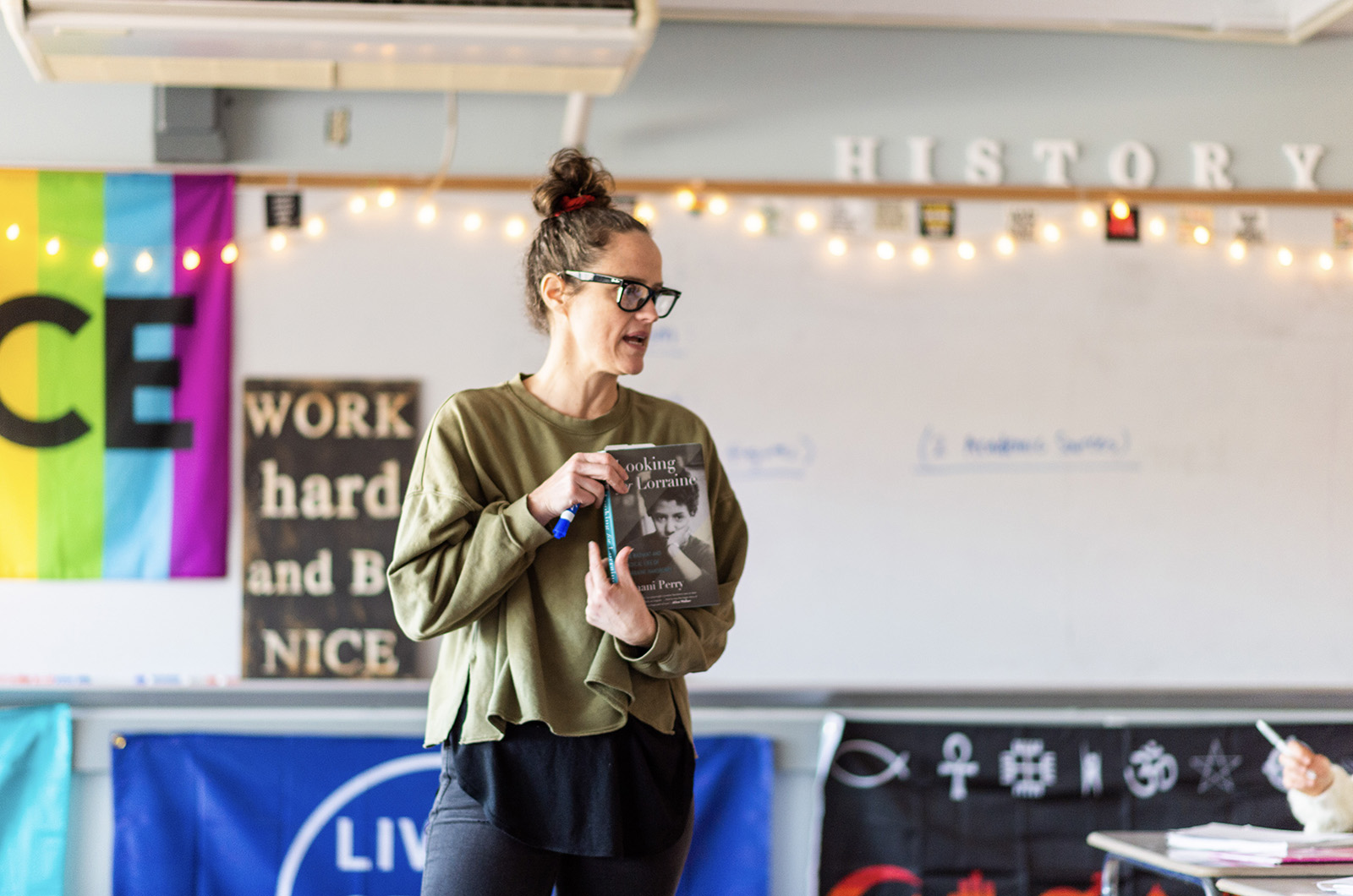
This fall, the Martha’s Vineyard Regional High School became one of only 60 high schools across the country selected for the College Board’s AP African American Studies pilot program.
This fall, the Martha’s Vineyard Regional High School became one of only 60 high schools across the country selected for the College Board’s AP African American Studies pilot program. Halfway into the school year, course instructor Ena Thulin hopes to make the most of the opportunity.
“Martha’s Vineyard was chosen because of the rich background and history with the African American experience,” Ms. Thulin said. “It’s such a privilege to be a part of this community of educators, some of the brightest minds of Black education.”
The program, designed to create a rigorous, comprehensive overview of African American history and culture from the 17th century to today, released its official curriculum to the public earlier this month.
Principal Sara Dingledy said she had been in talks with the College Board for months about the course, with the educational organization initially reaching out to connect with the Vineyard’s own prominent African American historians and scholars to help develop its pilot curriculum.

Nikeya Tankard feels the class does a good job creating a safe environment for discussion.

Nikeya Tankard feels the class does a good job creating a safe environment for discussion.
“They were looking to connect with expertise in the area, and they said Martha’s Vineyard was the place they could do this,” she said. When the time came to test the course in a classroom setting, Ms. Dingledy expressed interest in having MVRHS participate in the pilot program. The reception, she said, has been wholly positive.
“Students really love the course,” she said. “It’s been getting great feedback, and I know we’ll run the course again next year.”
The course, although centered around African American history, is interdisciplinary, combining art, literature and music in its curriculum, Ms. Dingledy said. That emphasis on art and literature is one of Ms. Thulin’s favorite aspects of the course.
“When you bring in art, music, short stories . . . that’s when you get history told through the everyday person,” Ms. Thulin said. “So many of the people in this course are just everyday people, including people we don’t even have names for.”
Even with its interdisciplinary approach, the course is structured similarly to other AP history courses. Every item presented in class is a primary document, meaning a direct account from the time. When students have debates or discussions, both Ms. Thulin and her students said those debates remain inside the texts.
“That was something I was worried about, as a person of color taking the course, that I would have my identity or my experience debated,” said junior Nikeya Tankard, who identifies as biracial. “But it was not like how I thought it would be. The claims are based on texts and evidence, and everyone is really great at making claims carefully.”

Jack DeBettencourt said the course has allowed for a deeper dive into the subject.
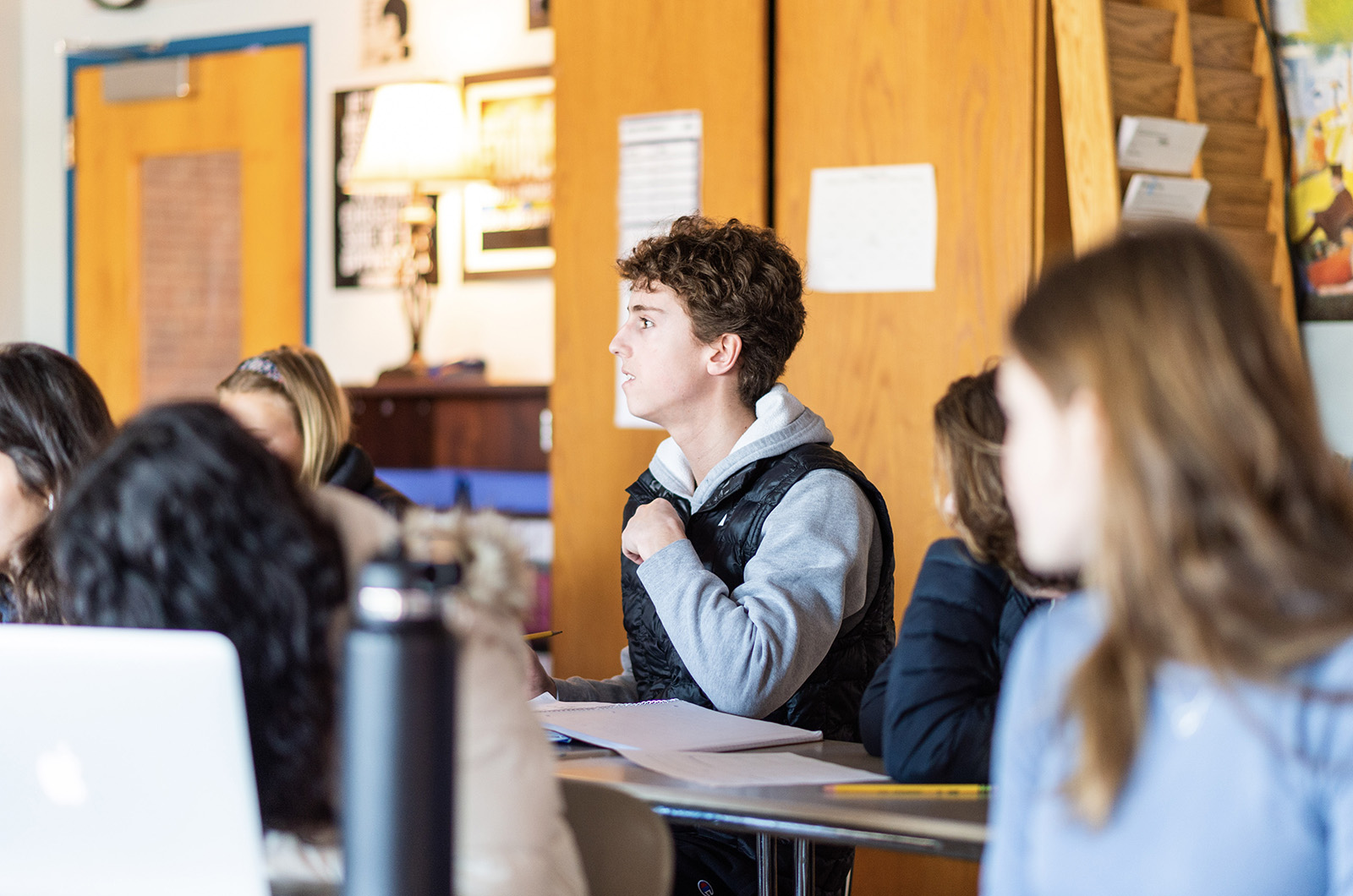
Jack DeBettencourt said the course has allowed for a deeper dive into the subject.
Ms. Tankard said the course is particularly mindful of language, using terms like “enslaved people” instead of “slaves” to center individuals’ humanity.
“Doing that has created a really safe environment,” she said.
When the College Board made the program’s curriculum public on Feb. 1, the course description included several differences from the coursework first presented to teachers, Ms. Thulin said, as a result of ongoing feedback. The College Board’s changes include downplaying works on contemporary topics such as reparations and intersectionality, and introducing a new unit on Black conservatism. The updates, although in the works for upwards of a year, were announced after Florida governor Ron DeSantis banned the course in his state and denounced its curriculum as “woke” indoctrination.
MVRHS students taking the course disagree.
“We’ve been talking a lot about how controversial the class is and how people say it’s indoctrination, but it’s been the opposite,” said Juliet Morse, a senior in Ms. Thulin’s class. “This course is teaching me to think for myself.”
Ms. Morse decided to take the AP course after noticing how little African American history she knew from her regular U.S. history classes.
“It’s been eye-opening,” she said. “Everything in U.S. history is connected to the Black experience. America is built off of Black people, even if DeSantis doesn’t want me to say that.”
Junior Jack DeBettencourt said the course has given him the opportunity to learn African American history more deeply than he has in previous classes.
“When we learned about slave auctions, we learned how families would be separated and some people would never see their families again,” he said. “I had learned that in the past, but not its impact on the community...it was maybe just a section in a textbook.”
Ms. Thulin noted that Governor DeSantis’s rhetoric mirrored criticism aimed at proposed African American Studies curricula in the 1960s and 1970s, a saga the class had just finished studying.
“It’s a complete parallel,” she said, adding that the Martha’s Vineyard community has been very supportive of the course overall.
Despite certain high-profile objections, Ms. Thulin said she will continue to present a wide variety of perspectives to her students.
“The theme of the class is it’s our responsibility to learn,” she said. “It’s not the teacher’s job to say, ‘This happened.’ It’s to show the sources and let students come to their own conclusions.”
“I don’t feel that the class has failed to present both sides at all,” senior Jake Glasgow added. “It’s about presenting students with facts and letting them come to their own conclusions themselves . . . If we’re not letting students do that, what are we even doing?”
Ms. Thulin said that the course has inspired many of her students to continue African American studies in college. For others, they see the lessons learned in the course as the foundation to a broader understanding of American culture.
“It’s prompted me to be more curious,” junior Julia Sayre said.
Ms. Sayre and Ms. Tankard are both editors at the student newspaper. Ms. Tankard said the class has even informed her approach to writing and journalism. Recently, the class watched a presentation on Ida B. Wells, the African American journalist who exposed lynchings to the American public.
“Hearing the stories that have never been told . . . that’s something I’ve always wanted to do,” Ms. Tankard said. “To tell the stories that have been hidden.”
Comments
I’m so proud to read we’re in
Michael MVRHS AlumI’m so proud to read we’re in the pilot program!
As an educator with a
Christine SengeAs an educator with a graduate degree in American Racial & Ethnic Studies, I know first-hand that Black History is essential to American History, & needs to be taught to all students, not only as an elective course.
So very proud and thrilled
Carol Dixon-Woolfolk TisburySo very proud and thrilled that this is here. And especially proud that the educators here are so strong in their values and support of true learning. Thank you!!
We're all Americans.
LJ EdgartownWe're all Americans.
Morgan Freeman said it best:
"I'm not African. I'm an American."
How do we deal with racism?
"Stop talking about it".
https://worldtribune.com/life/black-history-month-what-morgan-freeman-e…
Exactly, we are all Americans
Danny VHExactly, we are all Americans! Growing up off island with friends of all colors we never questioned or noticed race. Only in the past 20 years has race been pushed by those who have good intentions, no doubt, but very misguided good intentions. Our children hear how race was never an issue for us growing up now ask why is it now being brought up all the time. It is clearly an industry that has drawn in weak good intentioned misguided people who have been raised on a false premise that racism is rampant in our country. Sadly there are true racists out there and I have been witness to that,it is scarce, there are far more good people in than the few that practice racism.
“Our children hear how race
Dana Nunes MV“Our children hear how race was never an issue for us growing up?” How old are you, white or black, and when/where did I you grow up? I grew up in a small South Shore, Ma town in the ‘60’s. From 2nd to 6th grade I got punched and called the N-word at least once a day. I lived in constant fear. The teachers would see, and turn a blind eye. I was afraid that if I told my mother, she would march in to school and her absolute fierceness would rain embarrassment upon me. As a kid, that seemed even worse than the beatings. I loved learning but it was hard in that environment, and now I wonder where I would be if I’d been allowed to flourish.
Yes, there are more good people but don’t kid yourself, the racists aren’t as scarce as you’d like to believe, and they make themselves known-even on MV.
LJ of Edgarton - you've taken
A PennsylvaniaLJ of Edgarton - you've taken this quote totally out of context and perhaps inadvertently twisted Freeman's meaning! Here's the script that precedes your chosen quote: "Wallace: “Black History Month, you find …” Freeman: “Ridiculous.” Wallace: “Why?” Freeman: “You’re going to relegate my history to a month?” Wallace: “Come on.” Freeman: “What do you do with yours? Which month is White History Month? Come on; tell me.” Wallace: “I’m Jewish.” Freeman: “OK. Which month is Jewish History Month?” Wallace: “There isn’t one.”
Freeman: “Why not? Do you want one?” Wallace: “No, no.” Freeman: “I don’t either. I don’t want a Black History Month. Black history is American history.” Wallace: “How are we going to get rid of racism until … ?”
Freeman: “Stop talking about it. I’m going to stop calling you a white man. And I’m going to ask you to stop calling me a black man. I know you as Mike Wallace. You know me as Morgan Freeman. You’re not going to say, ‘I know this white guy named Mike Wallace.’ Hear what I’m saying?”
Despite years of Black History Februarys, many know little to nothing about the vast role played by Arab and Muslim slavers in the African slave trade. The practice began centuries before Europeans slavers bought and transported slaves out of Africa and continued well after European slavery ended.
Then Freeman shares more about the worldwide practices and outcomes of enslaving others, but you have to read the whole article and understand that he's not saying racism never existed, which it seems some who responded to your comment see as the takeaway.
The recently revised version
Ron EdgartownThe recently revised version of this AP course removed a number of irrelevant topics so that it now focuses on the history, literature, art and other aspects of African American life. In this format it is now a course well-worth taking.
Wonderful to read the High
Bill McGrath Elkridge,MDWonderful to read the High School is piloting this course. Sounds like the perfect source for a continuing education program for the broader community as well. Well done Ena, Sara, and the students enjoying the course.
Bravo MVRHS. This is
Beka ElDeiry MVBravo MVRHS. This is something to be proud of . When possible , please offer this class to all learning levels . Thank you !
I haven’t read the curriculum
Chip Coblyn OBI haven’t read the curriculum, so I can’t responsibly opine on the minutiae of the AP course. But, I hope our Massachusetts high school will demand that the course be presented in full, without censorship mandated by the Florida Governor 1400 miles to our southwest. I trust our kids to navigate an AP course as it was originally intended to be taught.
The history of African
Leroy OBThe history of African Americans should highlight how Africans sold off their own people into slavery around the world. It should include how Europeans helped civilize the African people and bring them into the modern world. The history should include how black on black crime has had an affect on the black community. Lastly, what about the white people, why can't the white people have a White history month?
Yes, teach all of it. As for
Dana Nunes MVYes, teach all of it. As for Europeans helping to “civilize” the African people, what is your definition of civilized? They had their own culture and traditions going back hundreds of years; did they get to choose? Who’s to say one’s civilization is better than another? Who’s the arbiter?
As for White History Month, man, that’s all I had in four years of high school, day after day, the glories of the White race. Black history was covered in one 45 minute period-of the entire school year! If it’s at all possible for you, try imagining yourself as a 14, 15 or 16 year-old black kid in those classes. Where do you fit in? You’re barely even an afterthought.
White History, my ass!
Talk about white fragility!
Mark VHTalk about white fragility! Leroy - you unfortunately embody it perfectly. So sad. There is so much for you to learn.
"helped civilize the African
Jane Norton Chilmark"helped civilize the African people and bring them into the modern world"??? By forcing them into ships where they were packed liked sardines and bound for weeks as they awaited their arrival to the Americas and were auctioned off like merchandise - if they survived the Middle Passage? Where mothers, fathers, and children were ripped from each other's arms on the auction block? What is wrong with you?
For all the accolades I hope
George Stein OBFor all the accolades I hope this inspires those dunging praises to engage in supporting fundraising for the Island academic facilities . Island schools need quite a bit of work long overdue. Haggling 5 years over practice fields is quite a cry for help
So proud and excited our high
Thomas Dresser Oak BluffsSo proud and excited our high school is offering the AP Course in African American Studies. Much needed and sure to be appreciated by students and teacher alike. Well done, MVRHS!
Add new comment