

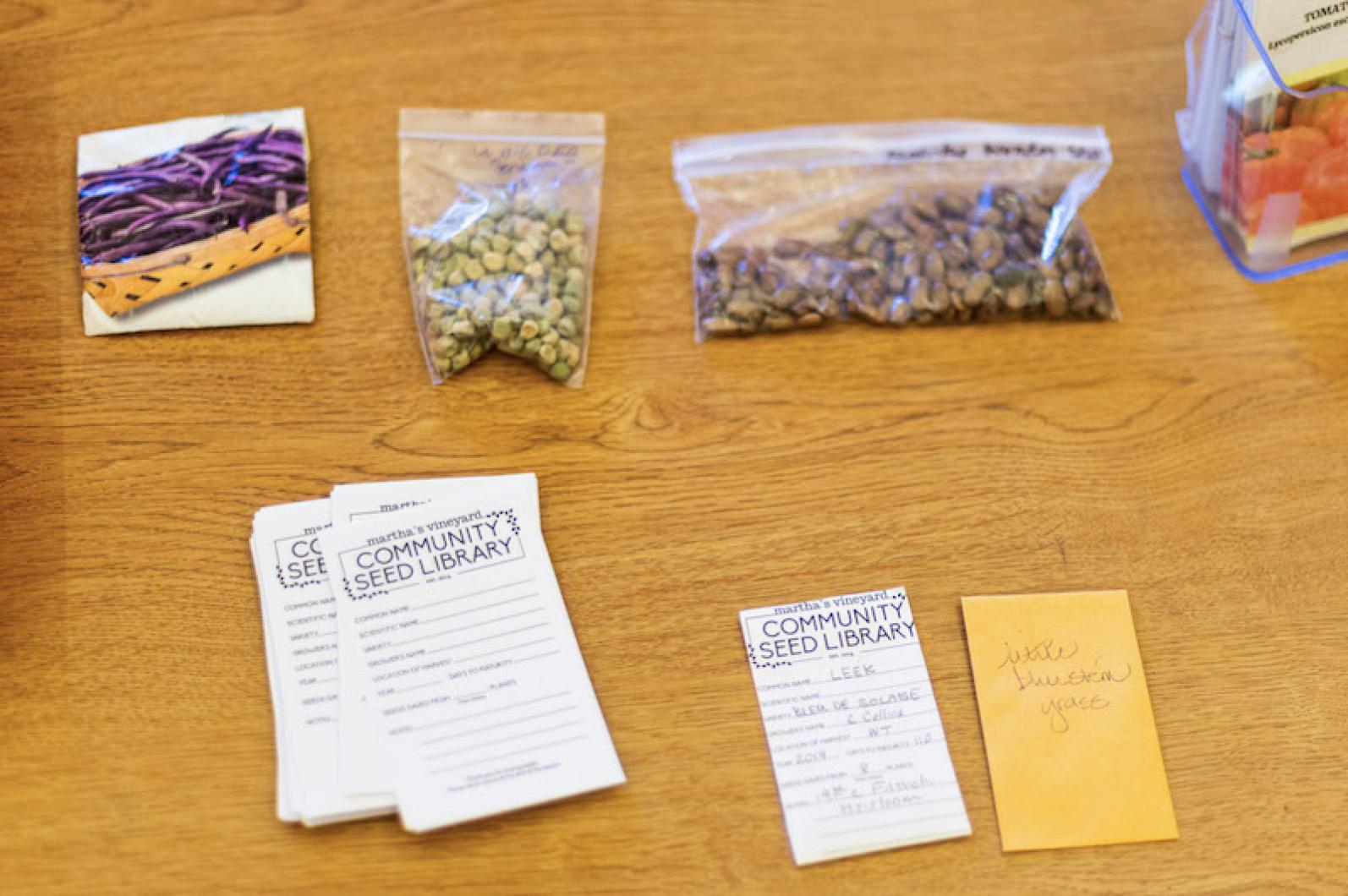
Clinks and clatters permeated the West Tisbury library Saturday as spherical beads of coriander and oblong dried beans of the pinto and pole variety were transferred from glass jars to paper envelopes.
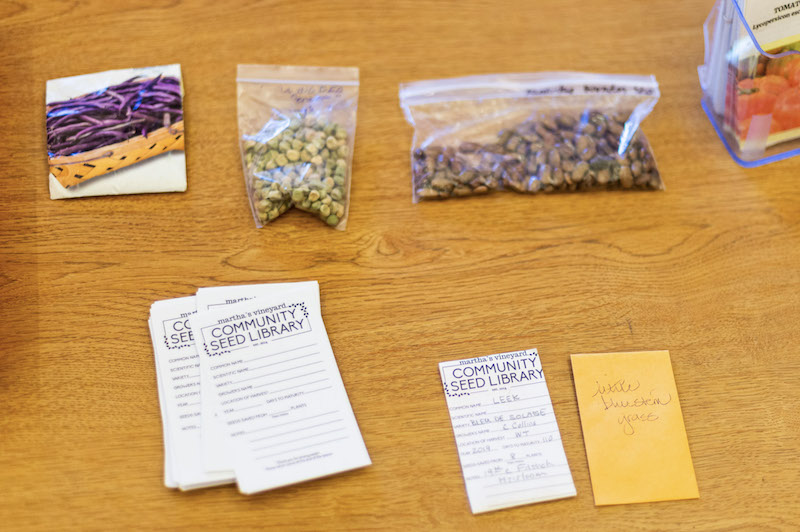
Clinks and clatters permeated the West Tisbury library Saturday as spherical beads of coriander and oblong dried beans of the pinto and pole variety were transferred from glass jars to paper envelopes.
The sorting was part of Martha’s Vineyard Seed Library’s annual seed swap and volunteers were on hand to then take the envelopes filled with seeds and restock an old four-by-six card cabinet.
“We are here to celebrate seed diversity,” said Rebecca Sanders, one of the founding members of the seed library.
Rebecca Sanders at the West Tisbury Library talks about the mission of seed saving.
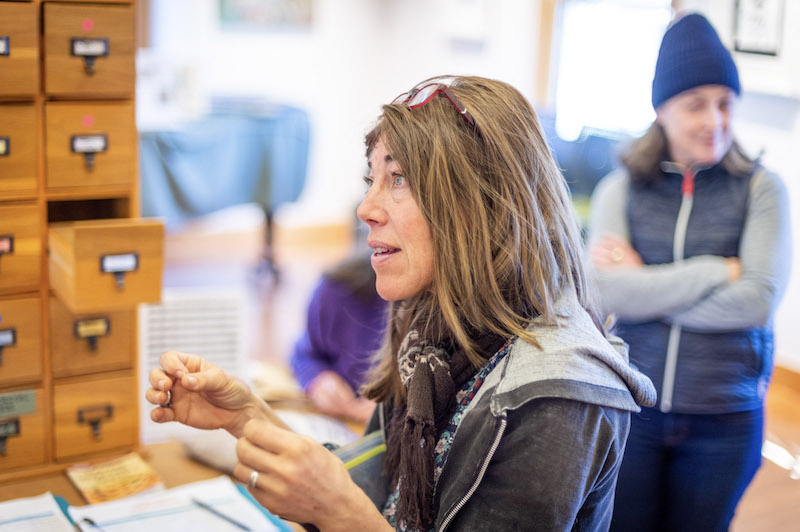
Rebecca Sanders at the West Tisbury Library talks about the mission of seed saving.
As part of its mission, Ms. Sanders said, the group helps supply local seeds to gardeners and hopes to encourage those same gardeners to save and contribute seeds back to the library. By building (or rather, rebuilding) the practice of seed saving on-Island, the group looks to create a more solid foundation for the Island food supply.
As organizer Carol Collins explained, the fundamentals of their approach are far from new.
“My parents used to save seeds. It was just what you did, so I’ve always done it,” she said.
In addition to saving money on buying seeds, seed saving has the added advantage of creating plant varieties more resilient to local conditions. By saving seeds from peak harvests each year over a long period, the genetic makeup best adapted to the Vineyard’s particular climate is isolated.
Card catalogue of seeds is for everyone.
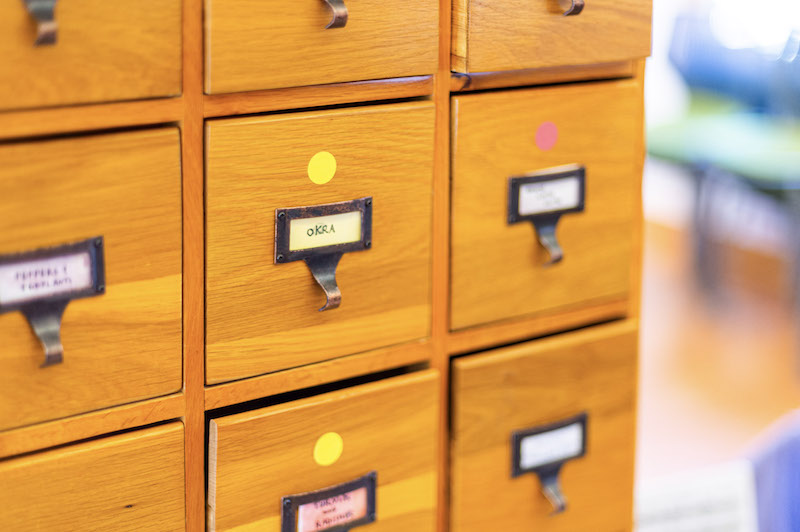
Card catalogue of seeds is for everyone.
Proof of concept can be found, Ms. Collins said, with her Vineyard-adapted Roma tomato variety.
“Romas are supposed to get almost six hours of sun...but these are so prolific, and they only get four or five hours a day,” she said, adding that the home-grown variety is much less susceptible to blossom rot.
Seeds from her variety are available any time at the West Tisbury library, and seed deposits are always accepted.
Tomatoes are a good place for novice seed savers to start, said Janet Woodcock, as are beans and peppers. For these crops, a gardener simply picks the fruit of a particularly good specimen, dries the seeds and germinates them next year. For tomatoes and peppers, a gardener can even eat their harvest after the seeds are removed.
Keeping the seeds categorized.
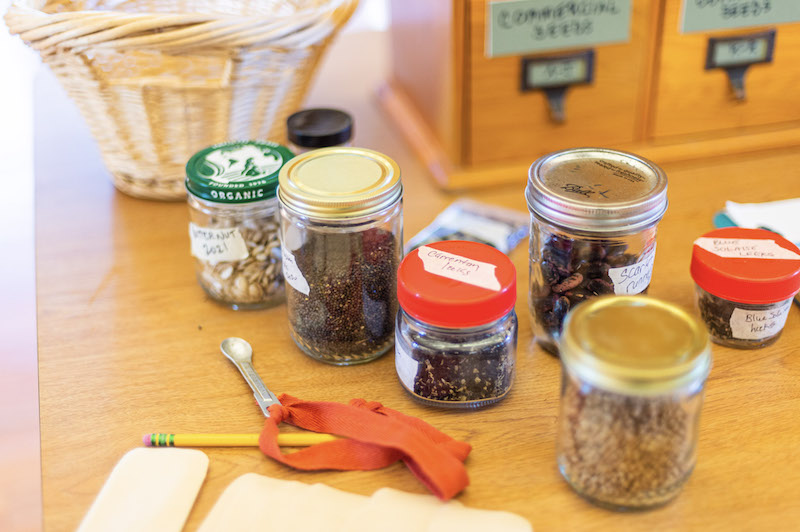
Keeping the seeds categorized.
Some crops take a bit more effort.
“It’s taken me three years to do eggplant,” she said. “You let it grow and stay on the plant until it starts to look really gross.”
Each added day on the plant, she said, is another day for something to go wrong.
Other crops are a challenge to save seeds from due to their growth cycle, forcing gardeners to reckon with unfamiliar stages of the plant life cycle. Ms. Sanders used kale as an example. Since kale is a biennial, it needs to be grown for a second year before it produces seeds.
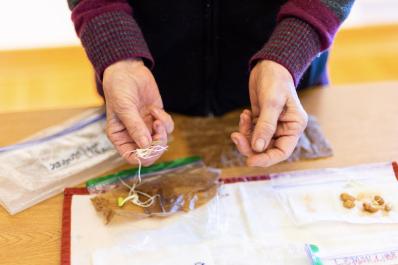
Giving the gift of gardening.
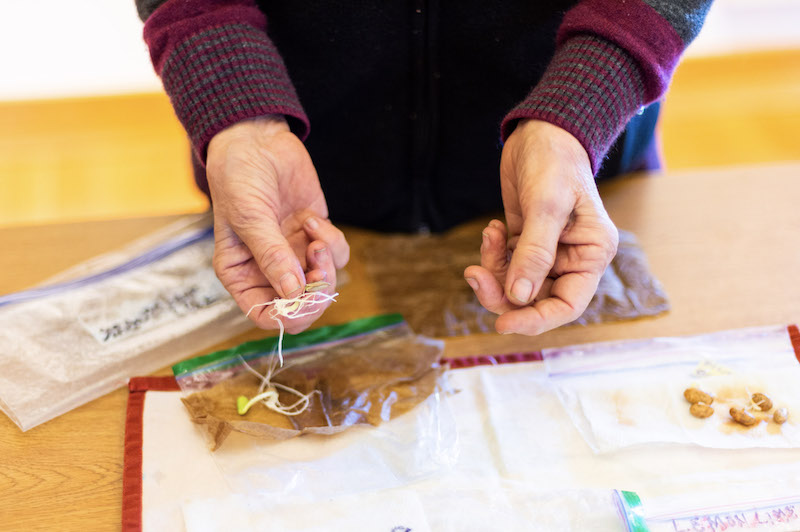
Giving the gift of gardening.
Ms. Sanders recommends that seed savers cordon off a specific part of their garden for their plants to grow out to their more mature stage, a process called roguing. She also cautioned growers to make sure their seeds are non-hybridized, open pollinated seeds, since hybrid variety seeds often do not reproduce true to form.
Though not all seed library users contribute their own stock, the group that gathered this Saturday is a group of true believers.
“You have the chance to be a part of something big,” Emily Meegan said to prospective savers, as she sorted out little half-moon seeds of calendula flowers from a pile of seed and chaff.
It is like a library where, upon returning a book, you have written another chapter for the next patron to read.
Comments
Thank you Thomas for the
Rebecca Sanders West Tisbury, Mass.Thank you Thomas for the wonderful article. What a talented writer you are!
My favorite part is the analogy in the end - returning seeds really is akin to returning books, with new chapters written each season, by people in your community - how interesting is this!
Just wanted to clarify a few things if i could. Yes kale is a biennial. It poses a challenge to seed savers not only because it flowers in the second season, but also because the plants cannot self- pollinate, they must cross with other kale of the same species in order to be fertilized. Kale is in the Brassica, or brocoli family, and is most often pollinated by flies and bees. Kale varieties must be isolated if you are planning to save for seed, because they will not only cross with other kale, but also with brocoli, cauliflower, cabbage, brussel- sprouts, kohlrabi and collards! Red russian and siberian kale will even cross pollinate with rutabagas! More than you ever wanted to know about the pollination of kale :). "Rogueing" is actually the process of pulling out any "off -type" plants - or those whose traits we do not wish to perpetuate. Rogueing is akin to selective breeding, in the sense that we are removing the plants we do not wish to reproduce, and leaving those that display characteristics that are "true to type". Curly kale that is actually curly for instance.
Seed saving is fun and challenging, and the Seed Library folks can teach you all about it. Thank you again for spreading the word Thomas! Glad to see you at the Swap!
Add new comment