


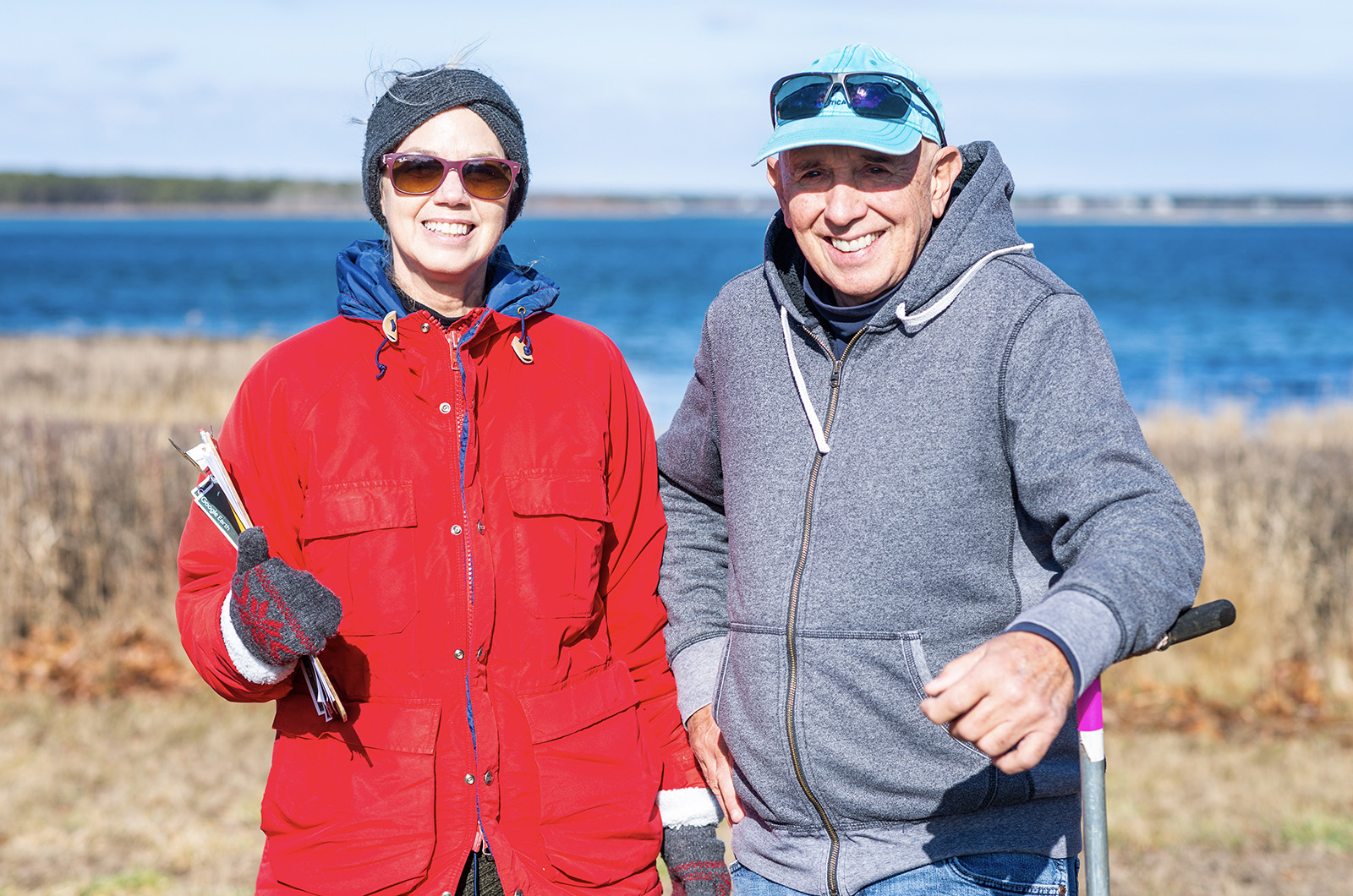
On a boulder-peppered hill in Chilmark, a septic system is near completion. Tons of dense clay have been excavated and in its place a mess of tubes and concrete boxes now sit. Only one step is left: the septic must contend with Coop.
On a boulder-peppered hill in Chilmark, a septic system is near completion. Tons of dense clay have been excavated and in its place a mess of tubes and concrete boxes now sit.
Only one step is left: the septic must contend with Coop.
As melted snow turned the clay to slick mud, septic inspector Doug (Coop) Cooper shuffled up to the pit, sipping a less than fresh cup of coffee.
“When I went to Woodstock we used to slip and slide on this stuff,” he said, getting near the edge to look into the liquid distribution mechanism. With more than 4,000 Island inspections under his belt, Mr. Cooper didn’t have to look for long. With a quick nod and thumbs up, his job was done. The signature would come later.

Coop moved to the Island in 1995 and settled into the septic inspection business right away.

Coop moved to the Island in 1995 and settled into the septic inspection business right away.
If you want to understand the fabric of the Vineyard, septic is a good place to start. It intersects with nearly every major issue on-Island, from zoning and development to water quality and environmental protection. After nearly 30 years in Island septic, and a lifetime in the field, Doug Cooper understands it better than most.
“If you remember in the NBA, before the shot clock and the three-point line, that’s when I started,” Mr. Cooper said of his origins.
After graduating from college in 1973 with a degree in geology and engineering, he got a job operating a municipal sewage
treatment plant. It was a good time to get into wastewater, he said, with the recent founding of the EPA because of “Nixon trying to escape Watergate”. Mr. Cooper then entered the public sector, working as a health agent, zoning inspector and planner in Connecticut, before heading up the state’s Department of Environmental Protection wetlands program.
It was there he met his wife Carla, the other half of Cooper Environmental Services. While Mr. Cooper deals with wastewater and geology, Mrs. Cooper brings her biological background to their business in wetland surveying.
“We are a real team,” he said.
In 1995, after the couple had their first child, they decided to move to the Vineyard.
“I had no job prospects or anything really,” Mr. Cooper said. “But that’s when the Title 5 regulations were passed.”
Title 5 was the biggest thing to happen in Massachusetts septic regulation, and thus Mr. Cooper’s employment problem was solved. The regulations specified how septic systems had to be installed and maintained, and required inspections when homes changed hands. On the Island, in particular, there was much work to be done. For one, the Island was, and still is, scattered with a multitude of cesspits.

Who ya gonna call?

Who ya gonna call?
“They were the most rudimentary wastewater treatment you could have, other than just piping it out to a brook,” Mr Cooper said.
Massachusetts was the last state in the union to ban them in 1979, meaning that hundreds of systems had to be inspected and potentially replaced. Non-cesspit systems, too, would have to be inspected — a massive undertaking on the Vineyard.
Because of the Island’s development history, Mr. Cooper said, septic had become the predominant wastewater solution.
“It was basically a backdoor approach to zoning,” he said, explaining that town planners would use septic regulations to regulate growth. That strategy also made towns reticent to construct large, centralized treatment plants.
“Towns are always dancing on that razor’s edge . . . between community character and environmental protection,” Mr. Cooper said.
And so an Island septic industry proliferated and with it a great demand for septic engineers and inspectors. And Mr. Cooper went along for the ride.
“It’s mind-blowing how busy that business is around here,” he said.
The fundamentals of septic treatment, he said, haven’t changed much since 1930: waste enters the system, solids are separated out to decompose and liquids make their way through a leaching field out into the soil. Most developments, Mr. Cooper said, have been improvements made to existing technology.
“If we think about how computers evolved since the ‘60s, where you had the Honeywell 320 that took up an entire room, well now we have tablets and phones that do the same computing. The same thing with wastewater technology, it’s just like going to transistors from tubes,” he said.
But just as important as the technology is the environment in which septics are installed. It all boils down to geology. As Mr. Cooper drove up to his inspection job, he reveled in its geologic history, the massive boulders and rolling hills pushed into a great mass on the edge of the Island by ancient glaciers.
“These are all made of marine clays,” he said. “The weight of the ice pressed down on those clays and flexed them up, and they bent like plastic.”
That substrate, he said, poses certain challenges. Continuing uphill to the inspection, he pointed out the little surface streams and rivulets forming on the surface of the soil. Just as the topsoil struggles to absorb rainwater, neither can it easily dispel septic fluids.
In other parts of the Island, composed of sandy soils brought down by glacial streams, drainage is much easier, leading to a different problem. Just as septic runoff can be easily drained, so too can septic pollutants, Mr. Cooper explained.
Even septic technology and regulations continue to change. With emphasis on package plant systems and nitrogen pollution growing, Mr. Cooper still finds his work as exhilarating as ever.
“I don’t want to get too Zen about it, but it’s just what I do,” he said.
Mr. Cooper spends most of his days driving around the Island, looking at septics and wetlands and thinking about the land. He said he sometimes feels a bit like Johnny Cash in his song I’ve Been Everywhere.
“I’ve driven down nearly every road on this Island,” he said. “Sometimes people are confused and if they ever ask me who I am, I just tell ‘em, ‘It’s Coop!’”
Comments
Tremendous story, great
George Stein OBTremendous story, great people. Much appreciated to give worthy civil servant a moment in the spotlight
I totally agree!
Jenise BarnhouseI totally agree!
Great article about two great
Karen LiffmannGreat article about two great people !!
Invaluable members of our
Caroline FlandersInvaluable members of our Island community!
Terrific article. Recall.how
B A Hiller S. CA. Bethany Bch DETerrific article. Recall.how relieved I was after Doug Cooper & Carla figured out what was truly going on with our family's 37 year old septic system. He is absolutely a class act, knows his business, delivers above what he suggests as a solution/promises. is also humble about it. Their daughter is a sweetheart.
Wishing them all the best. With gratitude, Beth Ann Hiller
They say the road to hell is
Vincent Dziezyk CapeThey say the road to hell is paved with good intentions, right now I feel as if the DEP is wanting to pave a Super Highway. In good conscience the best available technology should be used to address an issue. That is why I believe a “Toilet to Tap” system should be applied.
The best science of the time, with some compromise, led to the development of the current Title V regulations. After enormous expense collectively we still have the same problem only worse due to continued land development.
Orange County California implemented a “Toilet to Tap” water treatment facility to address a water shortage crisis. The facility has been running for a number of years with exceptional success. Yes, I know, water shortage is not the primary dilemma here, but if they are drinking their waste water they are also not dumping it into the environment. Which is exactly the problem we are faced with.
Currently water treatment plants throughout the country discharge an estimated
34 Billion gallons a day, per epa.gov website, into the environment. The majority of this treated warm freshwater ends up in the Ocean. I know that's a hard number to visualize, so let me help you. That is the approximate equivalent of melting 650,000 average size Icebergs daily. The temperature of the discharged water is warmer than the body of water receiving it, it is also affecting the salinity of the water. Both of these factors are contributing to a rise in temperature and the beginning of current shifts with-in the Ocean.
Regardless of which way we proceed with addressing this issue millions, if not, billions of dollars will be spent. The question is should we spend the money on what we think will help the project or on a project that will once and for all solve the issue of nitrogen as well as numerous other chemicals from entering our critical habitats and ensuring that we will never face another water ban.
To recap, a “Toilet to Tap” system would addresses;
Nitrogen and other chemicals from entering Critical Habitat Shortage of drinking water
Sinkholes and sinking land
Salinity changes
Rising Ocean levels
Rising Ocean temperatures The current proposal addresses;
A REDUCTION of nitrogen levels
Either way this is going to hurt the pocket book, the question is how to best use the money and resources. “Insanity is doing the same thing over and over and expecting different results” Albert Einstein.
Sincerely:
Vincent Dziezyk
Good information, Vincent. I
Lorraine EdgartownGood information, Vincent. I have wastewater experts in my extended family. Toilet to tap can be disconcerting for the layperson, however, we must husband our resources and put money into R and D and then follow the science. I have lived on sailboats for extended periods of time, having to limit fresh water usage, we are a wasteful people; just brushing teeth and letting potable water run down the drain, throwing out perfectly good potable water indiscriminately, without a care in the world, we have been living in a fool's paradise; just turn on the tap for unending fresh, potable water, those days are ending. We must each, I mean EACH, person in EACH household, be cognizant of the privilege of fresh, potable water, just by turning a tap.
Terrific article! Doug and
Liz Peirce VHTerrific article! Doug and Carla do so much each and every day to help strengthen the Vineyard community spirit. They're a class act!
Wonderful and timely article
MDW EdgartownWonderful and timely article about a great team!
Coop is a wonderful man. I
Helen EdgartownCoop is a wonderful man. I think he needs help. There are many infractions on septic systems on this island. Get a team and start a door to door examination, not a drive by. Total exams while people are occupying the properties, rentals etc. A serious house to house exam. Every caring Islander should welcome you…….It’s sadly need.
What is an infraction that
question mvyWhat is an infraction that you are referring to? The towns keep a log of pumpout permits so they know who has a failed system. How do you 'examine' a working septic on private property? Send a backhoe to dig up a lawn of a taxpayer? Inspections are required at the time of sale, forcing homeowners to upgrade since a failed system is a matter of opinion. Fail because of a layer of solids measuring a certain number of inches? Failure because a junction box lid may show seepeage? If the towns made a special price for maintenance pumpouts, it would do a lot to help alleviate problems for systems, and make them last longer and be more efficient. Sewer plant sizes are used to limit development, so pick your poison.
That’s what we are talking
Diane EdgartownThat’s what we are talking about. Houses when occupied, number of people, testing soil, maintenance pump outs….I am not an engineer but the town must have one. Figure it out and check each and every one, Drive by, really…..Up island is different than down, as their lots are much larger. Edgartown should now have 2 acre zoning. I know good luck with that…..It’s all about the money……
There is know doubt that Doug
Tom Engley West tisburyThere is know doubt that Doug Cooper is a great and his partners as well. Toilet to tap sounds promising. Vincent Dziezyk makes a great case as well. We now treat municipal sewerage to a point where it can be release into the ground. Oak bluffs pumps to plant treats it then pumps it under ocean park. Edgartown treats the pumps it into the ground near the great pond. We are upside down we produce more and more waste I recycle with no promise of my recycling being recycled but when I dump my recycling I feel better I do hear that about 15% of what I dump is really recycled. We still live in the Stone Age. A developer who wants to open a new restaurant in VH said all waste will be recycled. HOG WASH.
Add new comment