

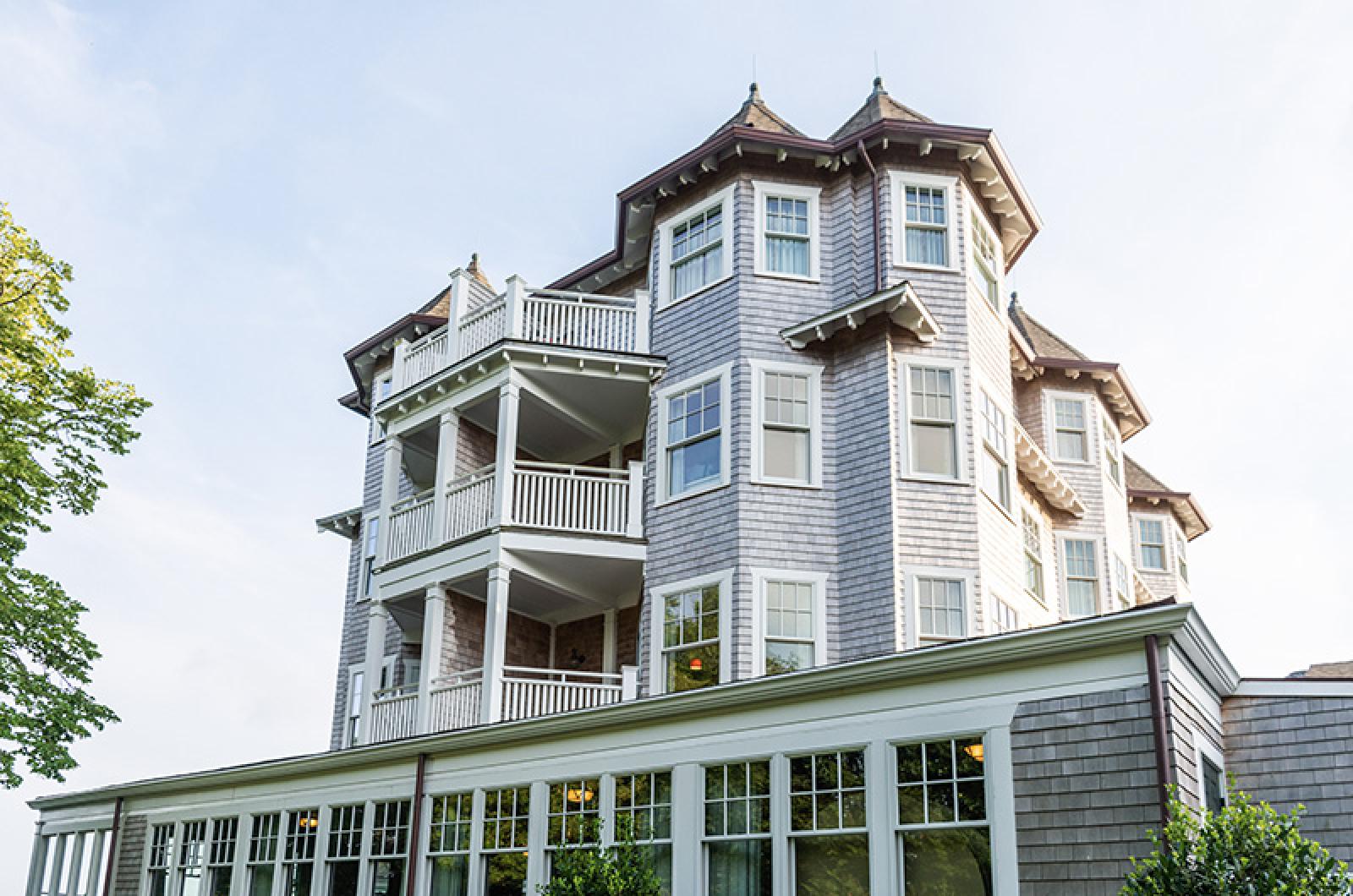

Marking a first in its long history, the Martha’s Vineyard Commission has reached an out-of-court settlement with the Harbor View Hotel by significantly revising a written decision in the case involving a spa expansion project at the hotel.
Marking a first in its long history, the Martha’s Vineyard Commission has reached an out-of-court settlement with the Harbor View Hotel by significantly revising a written decision in the case involving a spa expansion project at the hotel.
Announced at the outset of the MVC meeting last Thursday by commission chairman Joan Malkin, the settlement agreement was recorded in the Dukes County superior court earlier that afternoon. The agreement, which is still subject to approval by a judge, was approved in an executive session by commissioners held on July 7, according to court documents.
The details of the discussion that took place behind closed doors are not known, and Ms. Malkin offered no explanation beyond saying that the matter is now resolved.
“This settlement agreement completely resolves the litigation,” she said. “It allows the hotel to move forward with its approved project while maintaining what the commission believes is the appropriate balance between the benefits and detriments.
“It is all now a matter of public record,” she added.
The Harbor View Hotel expansion plans have a complicated history and originally date to 2008, when a major hotel expansion was approved by the MVC.
Soon after, the hotel changed ownership during an economic downturn, and plans were shelved. In 2018 the plans were revised under new hotel ownership, and were approved by the MVC after extensive review.
In 2021, a third modification involving the addition of a spa to the hotel was approved by the commission after another extensive review.
That modification included 13 lengthy conditions, partly in response to vocal objections from hotel neighbors, who had become outspoken about what they claimed was creeping commercial expansion in a residential area.
Among other things, the conditions placed strict limits on the spa, allowing use by hotel guests only and barring cash transactions for payment, instead requiring that any charges be posted to the guest rooms.
The hotel appealed in superior court, claiming that the commission had overstepped its bounds and exceeded its statutory authority.
The settlement agreement includes 16 conditions, some new and some revised versions of previous conditions. The section of the decision where the commission weighs the benefits and detriments of the project, as required by its statute, has also been changed in numerous places. The changes correspond roughly to the revised conditions, although direct comparison is difficult, with numerous language changes occurring throughout the document.
Adding further complication, the 2021 written decision was not included along with the revised agreement when the settlement was filed with the court, nor was it immediately available on the MVC website, though it has since been posted there.
Among other things the revised decision:
• Eases rules for use of the spa, with use now allowed by hotel guests and two of their guests, with no restrictions on the methods of payment.
• Slashes the hotel’s affordable housing contribution from roughly $500,000 to $107,000, but increases the work force housing contribution from 22 units and three apartments to 25 units and five apartments.
• Revises and restates an acknowledgment that a house at 199 North Water street owned by the hotel cannot be used as “a commercial overflow facility for the hotel.”
• Eliminates a requirement that the hotel broadly convene a community relations group that includes all neighbors living within a certain radius of the hotel, instead requiring the hotel to hold a meeting with abutters prior to filing any request for further modification or change of use.
It is the first known case of the commission modifying a written decision in response to litigation.
The settlement agreement is signed by the Boston attorneys representing both sides in the case: Kevin O’Flaherty at Goulston & Storrs, and Johanna Schneider at Hemenway & Barnes.
Ms. Schneider was also the lead attorney for the commission in the recent civil trial in an unrelated court challenge by developers seeking to overturn the commission’s denial of the Meeting House Way subdivision in Edgartown. That case remains pending before the superior court.
Speaking to the Gazette by phone Monday about the Harbor View settlement, Ms. Schneider agreed the settlement is unusual.
“I think what was unique about this case was this was not an instance where the commission had denied a project and the developer was trying to get the commission to reconsider its decision,” Ms. Schneider said.
She also downplayed the changes.
“The majority of the decision involves clarifying the conditions ... if you look at this side by side [with the earlier decision], a lot of the changes were clarifications that would make them more workable,” she said.
She also said the executive session discussion was both proper and legal under the Massachusetts Open Meeting Law.
“Settlement of litigation may be done [in executive session] as long as the results of the vote are reported . . . that is permissible,” Ms. Schneider said.
On Thursday, the settlement agreement was not listed as an agenda item for the meeting, but instead was raised by Ms. Malkin as “one other comment before I get to the meat of the meeting tonight,” a recording of the Zoom meeting shows.
“This settlement was the result of good faith negotiations. I am very appreciative of the hotel for working diligently with us to resolve all of the outstanding issues that were raised,” Ms. Malkin said.
“The resolution allows the hotel, which frankly is a longstanding Island business, to continue to operate in one of our most significant industries, which is the tourism industry, while, very importantly, still addressing the core concerns of the commission.”
Harbor View general manager Scott Little attended the meeting but made no comment.
Written decisions of the MVC are recorded in the Dukes County Registry of Deeds as the final step in the MVC’s development of regional impact process after a project is reviewed and approved, with or without conditions.
Zach Harris contributed reporting.
Comments
That's great. Now, what was
Mitch ChilmarkThat's great. Now, what was the compromise? It would be nice to know what was decided and what is going to happen at the Harbor View.
The MVC has lost its way and
Bob EdgartownThe MVC has lost its way and again acting in secret. They did not want to be on the losing end in court which looks like could of happen. The radical agenda of the current make up of the MVC is coming back to haunt them. We need term limits on all boards.
To me, Malkin's comments
Jane Chittick EdgartownTo me, Malkin's comments sound pro-Harbor View expansion of their operations. I hope behind all this secrecy I am wrong. Whatever happened to transparency in public matters?
The MVC has been twisting
David EdgartownThe MVC has been twisting applicants into pretzels for a number of years. I think the court system will see more suits filed against the MVC, and the courts will "help" the MVC more clearly understand what it can and can't do.
I agree with David. The money
Mark EdgartownI agree with David. The money wasted on legal fees is significant. This could have been put to better use. The MVC must be more thoughtful in its current aggressive approach. The lawsuits the MVC is generating are the direct result of the MVC overstepping its authority and due to lack of clear objective rules. This has become the recurring pattern of this commission with no end in sight. The MVC will be facing more and more lawsuits for its overzealous and overprotective non supportable actions and vague decisions. It is not productive, not serving the residents and is waisting significant amounts of tax payers money. It must be hundreds of thousand’s of dollars needlessly spent by the MVC. It is finally time to revamp the MVC.
Freedom of information act.
Tom Engley West TisburyFreedom of information act.
Who ensures that the
Amy EdgartownWho ensures that the workforce housing agreement is implemented? ...."increases the work force housing contribution from 22 units and three apartments to 25 units and five apartments"
It’s always puzzling when
Oh EdgartownIt’s always puzzling when people purchase property next to a commercial venue, then act to restrict its activity and ultimately, it’s viability. If I read this right, the community will now have a spa which is not available to community residents. How does that serve anyone well, MVC? I thought the community was your priority?
Purchasing the property next
MariePurchasing the property next to aN existing business was their choice. It does not mean that the business can expand as they want every time they want to make more money.
Something is fishy here. The
Mark Acker VhSomething is fishy here. The MVC is a public organization that must follow due process laws. How can a modification of a finding happen without further public hearings? The public and particularly the abutters must participate in any modification of a finding.
The complaining neighbors
Carol Vineyard HavenThe complaining neighbors could have run the ball all the way in court on this expansion. But, instead the MVC steps in and does it for them. Why? Only real winners here are the lawyers.
So much for transparency.
Dugie DukesSo much for transparency. This is so "Do as I say,not as I do.mentality. Quality of life issues for residents has been trampled on, for Special Interest groups with only 1 true intention. Profits for shareholders. Beyond shameful.They got everything they wanted. Life long residents have no one looking out for their posterity.
One reason for our Island's
Peter Palches Oak BluffsOne reason for our Island's continuing attractiveness to tourists and their money is the Commission's constant pushback against development. No other agency is tasked to protect our environment as a whole. How much easier it would be for deep-pocketed developers to line our beaches with condos if they could pick on planning boards one at a time, town by town, looking for a weak spot. Of course there are protracted conversations and sometimes confusing conditions. When values compete, that's the nature of the game. And legal bills, too. But consider the freebie we get when people like Christina Brown, Linda Sibley, Fred Hancock, Trip Barnes, Richard Toole (and many others) spend countless hours working in behalf of the whole Island Community. Thank you, Commission.
The MVC and the TTOR are out
Lorraine EdgartownThe MVC and the TTOR are out of control and have flagrantly violated their intended mission. Enough. I am a wise old coot who has lived a long time and seen a lot and I can see the handwriting on the wall. Rein them in folks, the wild horses are out of control.
Add new comment