


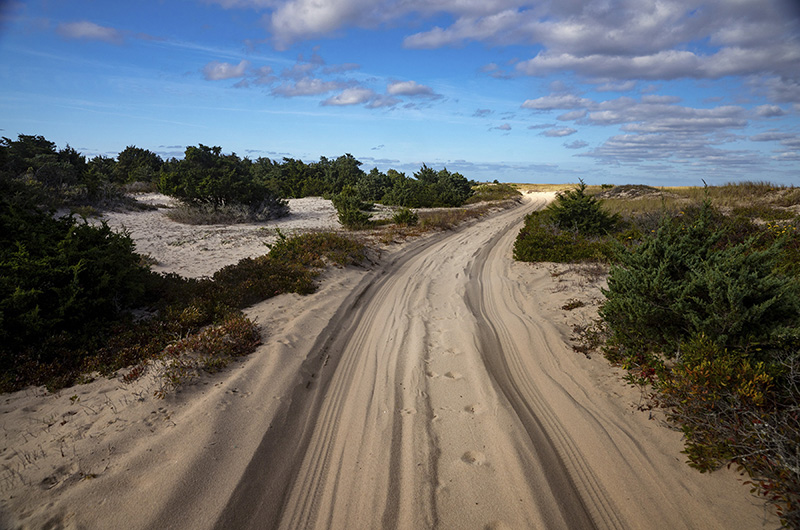
A legal effort by two Chappaquiddick landowners to block oversand vehicle (OSV) access to the tip of Cape Pogue for the 2022 season has been denied by a Massachusetts Land Court justice.
A legal effort by two Chappaquiddick landowners to block oversand vehicle (OSV) access to the tip of Cape Pogue for the 2022 season has been denied by a Massachusetts Land Court justice.
In a nine-page order issued Friday, the Hon. Howard P. Speicher said there was no evidence to show that the Trustees of Reservations had exceeded its long-held right of access to an unpaved track in the Cape Pogue Wildlife Refuge that cuts across two parcels owned by Victor and Dawn Roberto Bruno Colantonio.
Moreover, the judge said, the Colantonios had not made a sufficient case that continuing to allow OSV traffic across their land would cause them or their property immediate and irreparable harm.
The decision came in a motion for a preliminary injunction filed by the Colantonios, who own two four-acre parcels at the far northern tip of Chappaquiddick in the sparsely inhabited, 400-acre Cape Pogue Wildlife Refuge, most of which is owned by the Trustees.
Despite the early setback, Denise Chicoine, a partner at Englander and Chicoine in Boston who is representing the Colantonios, said the plaintiffs will continue to press ahead with the case in land court.
“Absolutely, yes. This was just the first step in the larger effort to address the mismanagement of Cape Pogue by the Trustees,” Ms. Chicoine told the Gazette by phone Monday.
“It has nothing to do at all with cutting off [OSV use] . . . it’s about the overarching issue of seeking balance in reasonable use,” she continued, describing what said was a “sincere effort to work with all the stakeholders for the best outcome. But one of the pieces of information we don’t have is the number of vehicles [that travel on the oversand trails at Cape Pogue]. We think the number is in the high thousands.”
In an email to the Gazette Tuesday, Trustees attorney Dylan Sanders, with Sugarman, Rogers, Barshak and Cohen, acknowledged the status of the case.
“As the court the held, the private landowners did not demonstrate that the Trustees have exceeded their rights by allowing the public to use the common right of way to access the Cape Pogue Wildlife Reserve, as the public has been doing since at least 1959,” Mr. Sanders wrote. “The Trustees look forward to working with all stakeholders, including neighbors, the town of Edgartown, and interested members of the public alike, in addressing issues of common concern regarding the management of this unique resource. Plaintiffs’ lawsuit may move forward, but these are issues that would benefit more from broad public discussion rather than litigation.”
The Colantonios originally sought to stop the Trustees from selling all OSV permits on Cape Pogue, claiming the traffic constituted a nuisance and overburdened the right of way that they share with the Trustees. They later clarified their motion, asking that OSV traffic be barred for a five-mile stretch crossing their property near the Cape Pogue Lighthouse.
Rachel Self and William Gazaille, who identified themselves as the only full-time residents of Cape Pogue, provided affidavits in support of the Colantonios’ motion, contending that the Trustees have done a poor job of monitoring OSV traffic and have not been responsive to residents’ concerns over the course of years.
Judge Speicher noted that the “real thrust” of the landowners’ complaint “appears to be their concern that the Trustees are mismanaging the wildlife refuge in general and have ‘destroyed the natural beauty, tranquility, wildlife habitat, vegetation, and dunes of Cape Pogue.’
“This is a legitimate concern if true,” Judge Speicher continued, “but is not one that is addressed to the alleged overburdening of the right of way.”
In his ruling, Judge Speicher noted that the right of way at issue was originally established in 1891 and passed to the Trustees in 1959 when the organization acquired 132 acres and created the Cape Pogue Wildlife Refuge. A separate easement created in 1987 on one of the lots now owned by the Colantonios also allowed the Trustees access over that property.
Under state law, easements that don’t limit how they can be used are interpreted broadly — even if, for example, modes of transportation have changed, the judge wrote.
“Accordingly, use of the right of way by motor vehicles is completely consistent with the general right of way granted in 1891,” the judge wrote.
He concluded: “The plaintiffs’ concerns about the management [of Cape Pogue] and the right of way used for access to it should be addressed by discussions between the parties, but neither the public’s interest nor that of the parties would be adequately and legitimately served by the prohibition of public access to much of the Cape Pogue Wildlife Refuge while such talks proceed.”
Comments
This is nimbyism in its worst
Thomas EdgartownThis is nimbyism in its worst sense. Don’t let these people deny the public access to a wonderful property
Maybe if the public and
Slater MVMaybe if the public and trustees actually respected the properties this wouldn’t be a problem…this used to be one of my favorite places, now it’s just a carnival like everywhere else on the island.
I completely agree with you
Martha EdgartownI completely agree with you Mr. Slater, it has been very sad to watch the carnivalization of Cape Pogue and so many other places on MV Island. There should be controls put in place similar to the limitations on boat traffic in Cape Pogue Pond established by the Town of Edgartown. Hopefully the Trustees will do the same. It's not 1891 or 1959 anymore. For the sake of the environmental balance of our Island and Cape Pogue please establish feasible limitations on permits.
Slater, my sentiments,
Lorraine EdgartownSlater, my sentiments, exactly. My heart just aches for the quiet enjoyment of that beautiful area, one can go almost nowhere presently, without hordes of people and the sounds of engines. In covered wagon days, I could spend quiet hours there with my book and my engineless sailboat. It was sometimes a bit of a challenge getting my small craft back into Edgartown but I always made it. I suppose life goes on, in all of its noisy forms, but that does not mean I hav to like it.
To Victor and Dawn - The
Right Down The Road MVTo Victor and Dawn - The happiest people I know are people who don't even think about being happy. They just think about being good neighbors, good people. And then happiness sort of sneaks in the back window while they are busy doing good.
Sadly this is about
Ed BostonSadly this is about capitalism at the expense of a precious natural resource. The trustees’ goal is to sell as many passes to vehicles as possible. Beaches are not meant to be highways and those vehicles destroy the gentle balance people are ironically are paying to see. The trustees must fulfill their duty to protect the land by greatly limiting access and not being driven by dollar signs. After all, it’s a place that has chosen to have no stores, traffic lights or commerce for a reason and the trustees decide it’s Disneyland. Shameful.
Firstly, Thank you to the
David Collins RIFirstly, Thank you to the Trustees for protecting this important public access. I am an avid surfcaster who has used this ROW for many years on my visits to Chappy. What the lawsuit and article fail to mention is that access to this ROW is already severely limited each year by piping plover nesting and other factors. Also the plaintiffs are making a claim that TTOR is selling permits for profit, which is not the case with the non-profit organization. It is my opinion that TTOR is doing an excellent job of protecting the beautiful natural resources of the island and Cape Poge. This lawsuit is akin to folks who by a house next to an operating airport and then decide to complain about the airplanes. They knew what they were getting into when they purchased the properties and now want to change the rules to meet their personal needs.
couldn't agree more. the TTOR
Peacegirl MVcouldn't agree more. the TTOR does a great job managing the property -- their presence is apparent throughout the island.
I don’t agree. In at least
Kristin Cape CodI don’t agree. In at least one case, the homeowners have owned property there since the 1940s- so your analogy doesn’t apply.
This point is interesting:
“It has nothing to do at all with cutting off [OSV use] . . . it’s about the overarching issue of seeking balance in reasonable use,” she continued, describing what said was a “sincere effort to work with all the stakeholders for the best outcome. But one of the pieces of information we don’t have is the number of vehicles [that travel on the oversand trails at Cape Pogue]. We think the number is in the high thousands.”
Why the secrecy on the #s?
The right of way has existed
Laurence EdgartownThe right of way has existed since 1891.
The Colantonios bought the
Mark edgartownThe Colantonios bought the plots in 1999 and 2006.
The trustees have counters
Colin Floyd Dyke rdThe trustees have counters attached to the dyke bridge. I’m pretty sure the town owns it though I could be wrong. I’m wondering if there is a way to gain that info through the town?
I do not know the home owners
Bob EdgartowmI do not know the home owners but I do know the Trustees and use the property all the time. Even the long drive to the gut. The trustees do a great job protecting what they can control to the point of not allowing the public to much of the property in prime time. Why do we always come to lawyers and courts to try and change rules in mid stream. It is money that has changed the island and it is to bad the Trustees are having to spend the limited money they have to fight this frivolous lawsuit.
Maybe instead of silence the
Jack ChappyMaybe instead of silence the Trustees can answer: How many OSV permits are sold? How many permits year over year last 4 years? How many much revenue does this produce? How is that revenue allocated? How many permits in the Trustees estimation would be too many? Why can’t the Trustees provide this information? Is this silence what you call “management”?
TTOR needs to provide the
Rich EdgartownTTOR needs to provide the data. I suspect a reduction in the number of permits will be part of a reasonable solution. Residents should have “first dibs” on the limited permits, similar to existing SSA reservation policy.
I agree, Rich. The Trustees
Kathleen BostonI agree, Rich. The Trustees need to be more transparent about their sales and visit logs. This isn’t about denying access, it is about responsible and safe access, and not overburdening this precious and delicate barrier beach. We can all agree that want it to be around for our kid and grandkids, can’t we?
And there it is, the classic
JaredN Boston/ChappyAnd there it is, the classic NIMBYism: “I’ve got mine, now keep out all the riff-raff”.
If gas reaches 6 bucks a
Ken Edg.If gas reaches 6 bucks a gallon, that might slow them down. Those vehicles use plenty of gas.
The right of way was granted
Steve OBThe right of way was granted in 1891, when 'reasonable use' meant it was OK for some number of people to use it to get out on Cape Pogue. The judge asserts that the idea of 'reasonable use' does not rule out the type of technology that would became available on Chappy after 1935 with the advent of a car ferry. So 'reasonable use' must limit something else that existed when the easement was granted. All I can come up with is the number of people. The Vineyard population of 1890 was 4369 (http://history.vineyard.net/dukes/bnk1_28.htm), I wonder how many per year made it out to Cape Pogue?
Your analysis does not
Ron EdgartownYour analysis does not accurately state the applicable law. There are two easements involved. The Trustees sold one of the two lots in question in 1987 and specifically reserved the right for the Trustees and its licensees (permit holders)to pass over that lot with motor vehicles. There is no limitation in that easement on the number of licensees that can be allowed. The second easement was created in the 1891 partition and is a general easement, meaning it is intended to allow for all reasonable uses as those uses may change over time (note especially the last phrase). Even ancient easements that are expressly limited only to use by ox carts and horses have been interpreted to allow for use by motor vehicles. The reasoning is that land owners cannot be condemned to live forever in the conditions and circumstances of the time when the easement was granted. So the standard to be applied to the 1891 easement is determined by reference to what constitutes "reasonable uses" today --not in 1891. There is case law to the effect that the use of an easement by a large number of people is not, by that reason alone, an unreasonable use. So any proper analysis of this case must apply these legal standards.
TTOR has exploited the land
Tim BostonTTOR has exploited the land for decades with little oversight. They rule this natural treasure like a fiefdom, and they have refused to acknowledge concerns from stakeholders over the years. The vehicles in question have grown bigger, heavier, and more aggressive than they were in the past, not to mention more numerous, causing exponentially more erosion and abuse to the fragile ecology each year. With simultaneous acute threats to the land from climate change and rising sea levels, the time to act is now. Nobody is trying to block respectful and responsible public access to the land; this is about safeguarding the land so that it continues to EXIST and can be shared and enjoyed by all for decades to come.
I am not commenting one way
mm edgI am not commenting one way or the other about the issue. That being said, a nonprofit legally has to be transparent. Holding back information is what makes folks suspicious. Sunshine is the best disinfectant. If there is nothing to hide...why take this course?
As a summer visitor to Chappy
Paul Callan New YorkAs a summer visitor to Chappy, it is readily apparent that the Trustees are neglecting their obligation to preserve and protect one of the most beautiful stretches of beach & bay front on America’s East Coast. I hope that the lawsuit is a wake-up call for them. It looks to me like the Cape Pogue resident’s are not seeking to deny access but rather to compel the Trustees to regulate access in a manner sensitive to preservation this beautiful natural resource for all to enjoy now and in the future.
The trustees have sold out
Marie EdgartownThe trustees have sold out our beaches in the name of protection. The major tragedy was when they started to issue weekly passes. They should be fired. Edgartown should take back their beaches and stop the nonsense. Our residents will be mindful or the endangered species and watch and protect. I know this is a pie in the sky wish, then again, we did take back the farm. Why are we the only town that doesn’t have beach stickers for residents? Why do we have to take care of the rest of the island when it comes to public beaches? We need a take back our beaches campaign or the rest of the island has to open up theirs, and OB thinks they are the only town that shares. PS also think Edgartown residence should have discounted ferry tickets to Chappy, same town, same taxes…..
Add new comment