



As he takes the reins of the Island tick-borne illness prevention program, Patrick Roden-Reynolds aims to build on the work of his predecessor Dick Johnson.
As he takes the reins of the Island tick-borne illness prevention program, Patrick Roden-Reynolds aims to build on the work of his predecessor Dick Johnson, continuing yard sweeps and surveys, setting up standardized monitoring sites and keeping tick density maps up to date.
He also plans to be a listener.
“My priority for at least the first three, six months is just kind of listening to what the boards of health have to say, to what community members have to say,” he told the Gazette in an interview.
Mr. Roden-Reynolds is the new public health biologist at Island Health Care, the Vineyard’s federally qualified community health center. His position was created when IHC and the six Island boards of health joined a state-funded, regional public health collaborative last summer. Nantucket and Gosnold are also part of the collaborative.

Biologist Dick Johnson sweeping an Island yard for ticks in July 2021. Mr. Roden-Reynolds plans to continue the yard surveys.
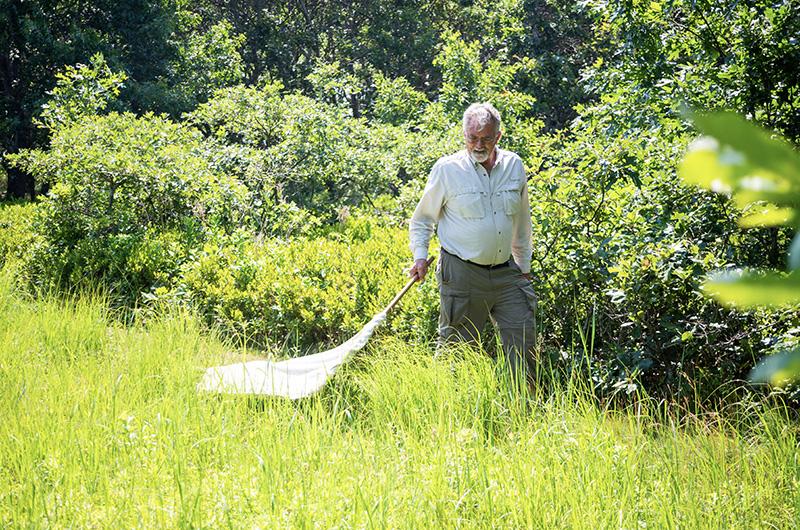
Biologist Dick Johnson sweeping an Island yard for ticks in July 2021. Mr. Roden-Reynolds plans to continue the yard surveys.
In addition to tracking to the incidence of ticks and the diseases they carry through a variety of measures, Mr. Roden-Reynolds will be responsible for mosquito study and control (a job Mr. Johnson also performed), and tracking blue-green algae and cyanobacteria.
But ticks are the priority, he said.
Mr. Roden-Reynolds studied tick control as a graduate student at the University of Maryland. Most recently he spent a year in Las Vegas doing research on bighorn sheep.
A relative newcomer to the Island, he had been coming for summer vacations for a few years. He found out about the job serendipitously from two friends who heard about it.
“It seemed like a perfect fit for me,” he said.
Tick-borne illnesses, especially Lyme disease, are considered at epidemic levels on the Island.
Citing statistics and the history of tick-borne illnesses, Mr. Roden-Reynolds said up to 60 per cent of ticks are infected with some sort of disease in areas with habitat and climate similar to the Island. He also said scientists studying tick-borne illness in the Northeast are playing catch-up.
“It was [around] 1970 when Lyme disease was named and discovered, and it probably wasn’t until the ’80s or ’90s that research and control efforts started, so I think the disease is just kind of entrenched,” he said.
Deer and mice are the main vectors which spread disease to ticks, Mr. Roden-Reynolds said. He said after moving to Vineyard Haven last month, he began to notice the Island’s large turkey population and became interested in studying turkeys as tick hosts.
“It’s time to start thinking about everyone else, too: skunks, raccoons . . . squirrels, everyone can carry ticks,” he said.
And he emphasized the importance of prevention through education.
“[By] maintaining your yard and then just doing a tick check, you can live in tick habitat all your life and be fine,” he said.
Mr. Roden-Reynolds said he plans to continue the educational talks begun by Mr. Johnson, whose work studying ticks and tick diseases has spanned the last 10 years years. He wants to be be sure to include the youngest Islanders.
“Kids are always outdoors and they’re not really paying attention [to ticks],” he said. “But if you start them out young and then they are aware of the issue, it can go a long way to reducing risk.”
Comments
Best of luck Patrick! this
Jimmy EdgartownBest of luck Patrick! this is very important and a real issue on the Island... I wish more folks were as concerned about ticks and LYME disease than what kind of field is going to be put down at the High School.
I couldn't agree more Jimmy.
Bruce EdgartownI couldn't agree more Jimmy.
I remember reading once about
Bob EdgartownI remember reading once about cotton balls dipped in some kind of treatment that the mice would collect and bring to their nest that kill ticks. Let’s get some town funding to cover the island if this is true.
We have been using this
Diana barrett ChilmarkWe have been using this method, known as tick tubes for five years and have seen a significant decrease in the tick population. They are easily available, are put out in April and July in the the high grass and shrubs.
They contain permethrin,
B WtThey contain permethrin, which is extremely toxic to many beneficial insects (bees, wasps, beetles, etc) , as well as very harmful to freshwater aquatic vertebrates (fish, frogs, etc) and smaller organisms as well- all of which are part of a healthy thriving ecosystem. Freshwater and estuaric ecosystems are extremely fragile and are huge biomarkers of overall environmental health, and there are many all over the island. Throwing everything out of whack to kill ticks will cause a bigger problem than the ticks do. Like the sound of peepers in spring? Island wide tick tubes would put those lil guys in grave danger.
The Vineyard has a good one!!
Darby Clay GeorgiaThe Vineyard has a good one!!
The Vineyard has a good one!!
Darby Clay GeorgiaThe Vineyard has a good one!!
I support this effort and
Celia Imrey EdgartownI support this effort and hope that Patrick’s expertise will bring us Island tick management that does not also disturb other insect populations. Spraying yards with ‘natural’ insecticide to kill ticks affects lots of other small critters, too. And then we wonder why we don’t hear as many birds in the woods...
Mr. Roden-Reynolds
Brenda+Leonard Oak BluffsMr. Roden-Reynolds
Welcome to our community. We have been in need of someone who can help with this situation.
Enjoy the beauty of our Island and I am glad that you are here.
EcoHealth Inc., a Boston
Fiona Vineyard HavenEcoHealth Inc., a Boston company, manufactures Damminix Tick Tubes (ticktube.com); another brand is Thermacell. A team at the Harvard School of Public Health created the tube system of tick control in 1987. The pesticide used, permethrin, is harmless to the mice, “although it kills ticks attached to mice, as well as ticks that drop off into the nest,” according to an article in the Washington Post.
Add new comment