

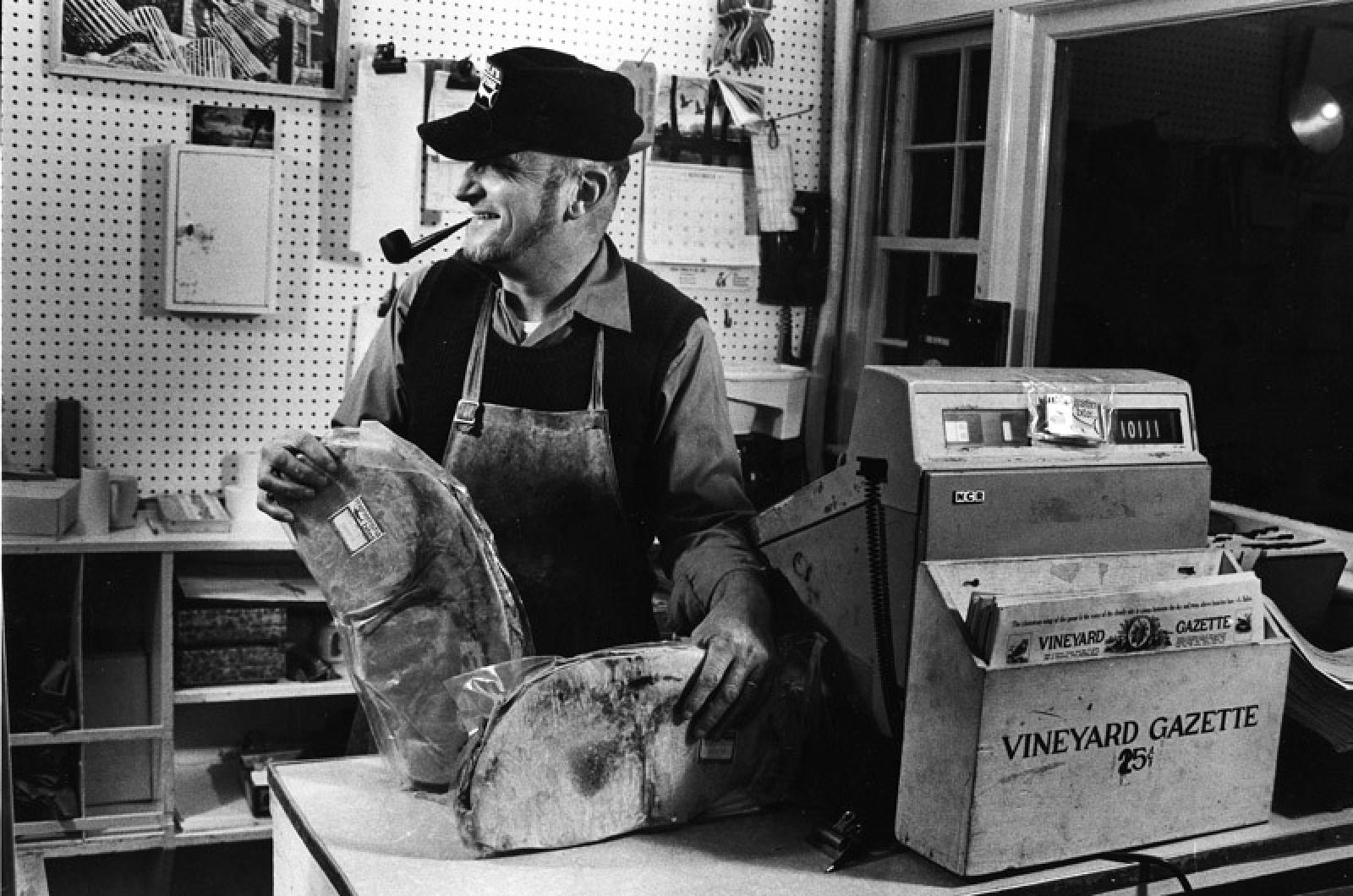
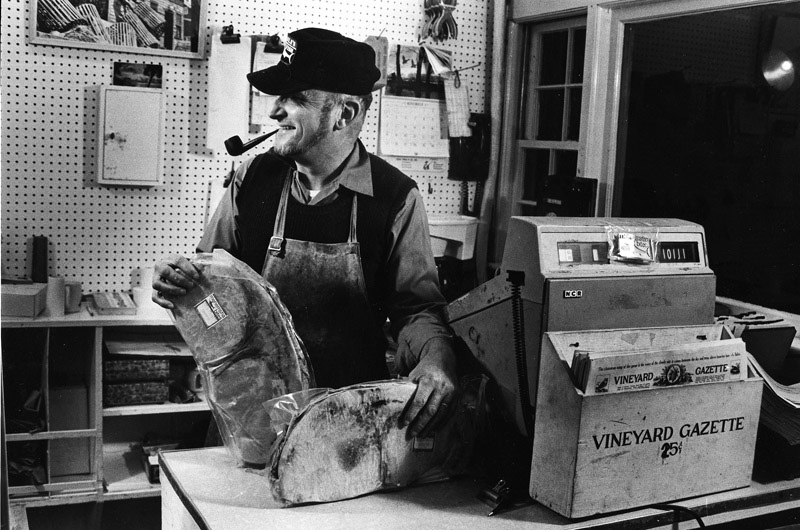
In the early 1970s, I spent summers working at Poole’s Fish Market in Menemsha.
In the early 1970s, I spent summers working at Poole’s Fish Market in Menemsha. Everett Poole, the son of a fisherman, began buying and selling fish from a handcart when he was 13 years old, not long after the hurricane of 1938 wiped out the docks. By the time I worked for him, Everett had built a wholesale and retail business that employed 15 or more people during the summer season and supported many more.
From June through August, the market was a beehive of activity — open from 7 a.m. to 7 p.m. six days a week, and noon until 5 p.m. on Sunday. Everett ran every facet of the operation, sometimes from the small office in the attic of the market — a place most of us rarely glimpsed — but more often from the floor of the market. A manager oversaw the retail sales, and the more experienced of those below the manager cut fish and staffed the counter. I and the other less experienced employees handled the menial tasks. We moved fish. We removed dead lobsters from the vast tanks. We smelled them to see if the meat was still good (a task not recommended for those who had a few too many the previous evening). We picked meat from cooked lobsters — bushels and bushels of cooked lobster. We hauled fish carcasses to barrels on the dock for use as lobster bait. And we cleaned, and we cleaned, and we cleaned.
Those of us in our teens had a certain apprehension of Everett. Our wariness stemmed from his uncompromising standards. He left no doubt of what was expected. And his expectations, derived from many years of experience, did not always meet those of the retail customer. On more than one occasion, faced with a customer who asked for more than Everett thought was reasonable (“I wanted one of those lobsters to be 1 7/8 pounds, not 1 ¾!”), Everett sent them to find another market to cater to their needs.
Every day had a rhythm. The first order of business — wholesale orders. Twenty pounds of heavy sole and 15 pounds of striped bass to the Outrigger. Thirty pounds of little necks and 40 lobsters to the Harborview. Fifty pounds of swordfish to the Home Port. On most days, the delivery van was full by 10 a.m., ready to head down-Island or, occasionally, off-Island. Once the van was on its way, we got a 15-minute coffee break — always spent at The Bite. After the break, we processed whatever came into the market. Bob Flanders delivered clams which had to be separated into sizes (Quahaugs, Cherry Stones and Little Necks). Donald Poole, Everett’s father (whom we called “Cap’n Poole”), delivered lobsters that also had to be sorted (Chickens, Quarters, Halves, Jumbos). Whenever a commercial boat pulled up at the dock outside the market, we unloaded, weighed and iced the fish, all under Everett’s watchful eye.
On occasion, the sea gave us something to marvel at. The 28-pound lobster was so large it required its own tank. The 50-pound striped bass brought pangs of jealousy from those of us who labored to catch just such a beast. But the greatest source of awe was the swordfish.
Back in the late 60s and early 70s, schools of swordfish still roamed Georges Bank. Following their fathers, and their fathers’ fathers, Menemsha fishermen threw their harpoons to harvest the fish. And what fish they were. Everett usually had half a day’s notice that a boat was approaching. He ensured that several of his strong young men were available, checked the proper functioning of the hoist, and prepared for the delivery.
The first fish off the boat was always a wonder — a huge thing, even without head, tail or innards. We hoisted the fish from deck to scale. Everett weighed the fish and carved its weight in the small fin next to the cleaved tail. We moved the fish to the walk-in cooler, packed it in ice, and brought in the next.
As we unloaded the boat, sightseers gathered to watch on the dock. And inevitably, they were treated to at least one behemoth. Perhaps it was 500 pounds. Perhaps 600. Hoisted over the dock, it brought gasps. Those of us handling the fish treated it casually — all in a day’s work. But secretly, our awe was as great as their’s. Perhaps greater, because we all knew that the days of unloading such fish in Menemsha were numbered.
Today, the market still exists, but Everett is no longer a part of it. The business looks the same, but the operation is different. Locally-caught swordfish is a rarity. The lobster catch has dwindled. The trays in the display case contain salmon and halibut — caught far away — and farmed oysters. There’s still locally caught sole, although with catch limits fewer and fewer fisherman can afford to harvest them. There are still clams and bluefish and, for a brief period each summer, striped bass. But much of the operation is now prepared food — seafood lunch or dinner for the tourists. The meal is delicious, but the wonder at the bounty of the sea is gone.
What did I learn from my years at Poole’s? My wife will tell you that I learned how to pick meat from a lobster faster than anyone she’s ever known. She may be right (although those who worked with me surely get similar accolades), but I learned much more than that. I learned the usual sorts of things one learns from a first job: the importance of showing up on time; the importance of taking direction; the importance of looking for ways to do something just a bit better than correctly. But I also learned about the wonder of the natural world and the rhythms of the sea. I learned about the value (and stress) of entrepreneurship. I learned that earning trust and responsibility takes time and can easily be lost. And I learned the comfort that comes from a job that requires hard work but can be left at the end of a shift.
Some of us who worked for him kept in touch. One is a neurosurgeon. Others work in finance, law, education — all manner of different occupations and professions. One or two fell to the curses of modern life — isolation, depression, drugs. But we all feel a kinship, having worked for Everett, a kinship borne of respect for the man and what he created.
Everett’s passing represents the passing of a way of life on the Island. Gone are the days when men made their living entirely off the sea. Gone are the days when the bounty of the sea was all a man needed to survive. Everett was a man rarely seen today — a man whose ambition neither undershot or overshot its mark. He worked hard for himself and his family. But having achieved success in his business, he set it aside not for some greater ambition but to be a valued part of his community.
Although much of Everett’s working life was spent on land, he reaped his bounty from the sea. And so I am sure he would, if asked, echo the sentiments of his father.
“Sometimes I almost wonder why God Almighty made the land, and the best reason I can think of is to separate the oceans,” he said. “Can you think of any better way to make a living than at sea?”
James Harrison lives in Colorado.
Comments
Jamie, lovely!
Dorothy Straight Newbury / Chilmark, Mass.Jamie, lovely!
Bravo! Captures perfectly a
Andrew Fischer California / ChilmarkBravo! Captures perfectly a moment in time on the island and one of its most beloved characters
This brought back great
Josh Dubow CaliforniaThis brought back great memories for someone like me who spent 6 summers working at Poole’s and learned so much from Everett during that time. Thanks for writing it
Beautifully written.
Paul SullivanBeautifully written.
Mr.Harrison in his wonderful
Breck Montague GLOUCESTER, VAMr.Harrison in his wonderful rememberence of Everett Poole, brings memories of life-forming summer jobs for lucky kids in the '60s and early '70s. For me it was working for Walter Sylvia at Seven Gates Farm. Mr. Harrison, I am so glad you had the experience.
My son also worked for
Bonnie Eldridge South DartmouthMy son also worked for Everett and had the same kind of experience. It was a great first job for him because you had to work hard for Everett to earn his respect. Was always interested to see his name in the papers especially around town meeting time. Was sad to hear of his passing. Sort of the end of an era.
Just perfect!
Cristina Kirkland PanamaJust perfect!
Lovely written.
What a lovely written piece.
Abbe Burt Vineyard HavenWhat a lovely written piece. My heart is aching with the loss of my friend Everett. And my sadness expands to other losses in our beloved island’s character - oversized houses used but a few weeks each summer, traffic over running our byways, shuttered main streets in the “off season”, and centuries old traditions like watching a Menemsha sunset from the beach cut off by lack of accessibility. Everett was appalled at these developments. RIP dear island man.
Jamie, a terrific and
Bill Wolf Aquinnah Farm, Rectortown, VirginiaJamie, a terrific and affectionate memorial. Well done!
A wonderful memory of Everett
Sarah Mayhew Davis, CAA wonderful memory of Everett. Thank you. My father John Mayhew was an avid fisherman and friend of Everett’s. I have many memories of going to Poole’s Fish Market when I was a kid. Another Vineyard icon gone. I was very sad to hear this news. RIP Everett.
It's wonderful to read a
Rob Styler ArizonaIt's wonderful to read a piece like this in a crazy world. Great story and a reminder that the simpler things are often the best.
I had that exact same
Scott Darling Downingtown, PAI had that exact same experience starting when I was 13 and worked for Everett for 6 summers. I started bagging clams for the down island delivery to the restaurants and moved up the ladder to cutting fish. My brother Peter and sister Sue also worked for Everett. At one point I recall Everett asking my dad if he wanted to buy the fish market since his three kids spent so much time there. Everett taught each one of his “kids” a valuable lesson or two during their tenure whether they knew it I’d not. 50 years later and I’m still in touch with a numbers of my fish market buddies. What a great way to grow up. Thank you Everett. You meant a lot to me and so many others!
Thank you for sharing your
Andrew T. BostonThank you for sharing your life's learning experience. I had the thought that it might inspire others to seek a summer position there, or something similar on the Island. The tricky bit though, in terms of changing times, is where could they find a decent place to live?
We came to the island in 1976
Hal EdgartownWe came to the island in 1976 as guests - We were across the pond in East Pasture. One of the first places our host took us to was Poole's - It was a sight to behold for our sons. Having spent many a trip to or from Menemsha talking about the wonderment of buying your fish right off the boat. This article reminded me of those days - R.I.P Mister Poole
A beautifully written,
Karl Uhlendorf Washington, DCA beautifully written, resonating piece. I had the privilege of working for Everett in his OB and Edgartown offshoots. A different experience from Menemsha, but with many of the same life-long lessons under his guidance. Very sad to hear of his passing, but nice to take a minute to recall with appreciation the difference he made for so many young people on the island.
wow great story! and now my
rob the roofer new jerseywow great story! and now my wait for september begins. thanks for the temporary fix.
I think James your story of
Dave Conway Whippany NJI think James your story of working @ Pooles was well said bravo & working along side of you. But you left out the initiations being thrown in the harbor like me or in a lobster tank. The first time met Everett was when my family was invited to a clambake on Squibnocket beach not knowing years later I'd be working for him. Years later I'd enjoy visiting him at his chanlery off season when visiting my parents. One winter he and his chef Joe Hyde had a promotion their seafood culinary foods and shellfish in Princeton NJ.I was invited to open oysters and clams for the occasion and he stayed for the weekend at our house in Basking Ridge . He'll be missed .
Add new comment