

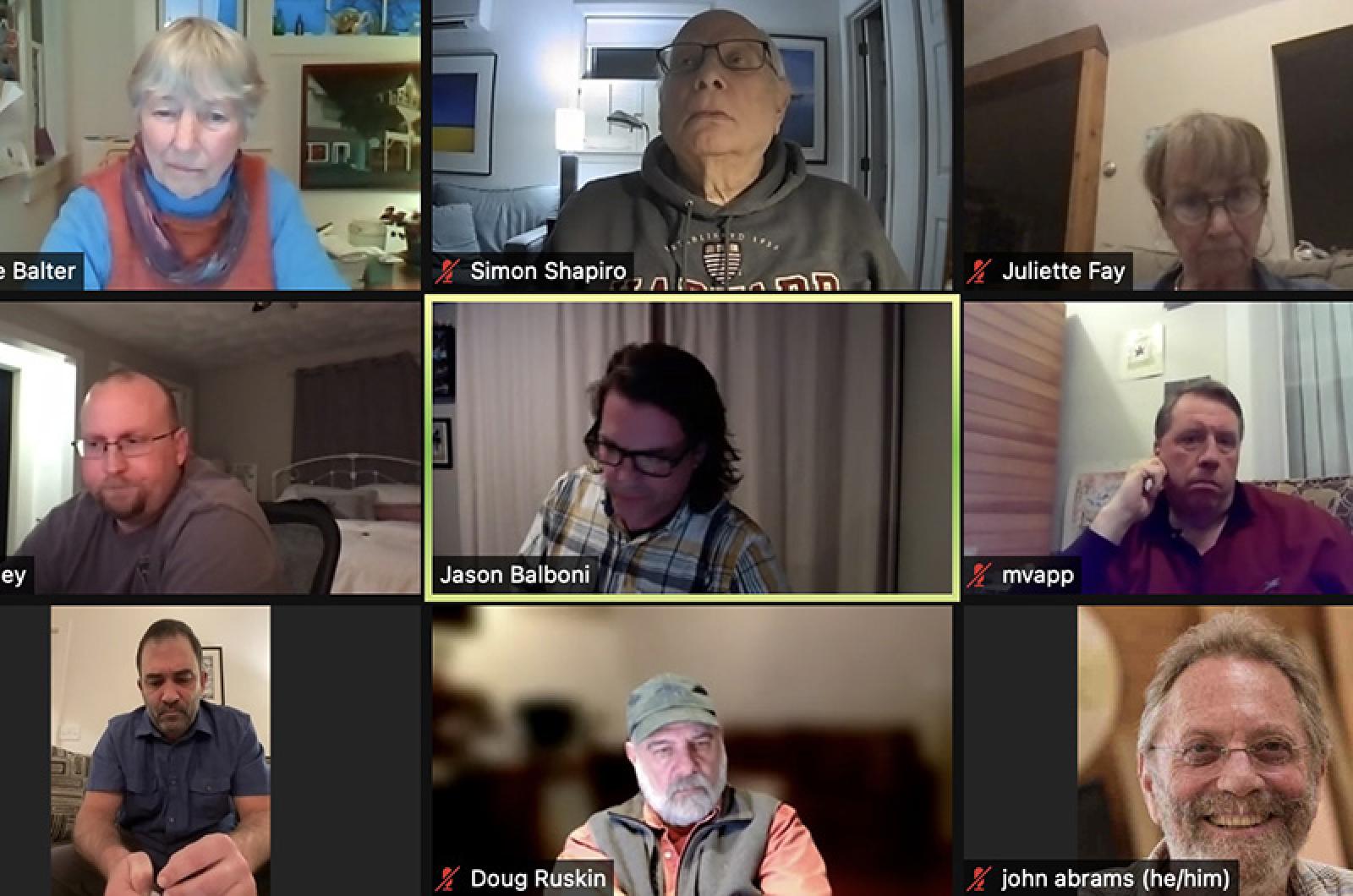
As the coalition to create a Martha’s Vineyard housing bank whittles away at a draft town meeting warrant article, questions and criticism from public officials keep flowing.
As the coalition to create a Martha’s Vineyard housing bank whittles away at a draft town meeting warrant article that would set the bank into motion, questions and criticism from public officials keep flowing.
On Tuesday, that criticism came from the Oak Bluffs select board, when the coalition gave an amended presentation explaining the terms of the housing bank, modeled after the Martha’s Vineyard Land Bank. The coalition is working to adapt the proposed article, which it intends to have present at the town meetings of all six Island towns, based on feedback from the towns’ select boards.
So far, Chilmark, Aquinnah and Tisbury have each approved the article for town meeting, but Oak Bluffs, Edgartown and West Tisbury have all called for further changes to the article, often citing a lack of detail in some areas.
Oak Bluffs again deferred a decision on the article Tuesday, as the deadline for submission to town meeting grows closer.
A main sticking point of discussion was the ability for a participating town to withdraw from the housing bank, and the consequences of such an action.
As proposed, the housing bank would allow any participating town to withdraw from the housing bank at any time. But members of the housing bank coalition clarified that the proposed two per cent tax on home sales in participating towns would still apply until that town’s share of any housing bank debt existing at the time of withdrawal is satisfied.
“It’s almost as if the statement that you can drop out at any time is illusory,” select board member Gail Barmakian said.
Board member Brian Packish agreed.
“You’re still opted in, you’re just not on the hook for any new debt,” he said.
But housing bank coalition member John Abrams said debt accrued by the housing bank to create affordable housing “shouldn’t be the straw that breaks the camel’s back.” He added that revenue from the tax should cover a significant chunk of the cost of creating housing.
“The revenue will be so strong,” Mr. Abrams said.
He noted that each town would also have an advisory board that would have to approve any new debt for housing projects, acting as a slow-down mechanism if the towns feel too much money has been bonded for projects.
Select board members cited a number of other issues with the housing bank. Member Ryan Ruley worried that the housing bank may collect more yearly revenue than it will be able to spend. With current sales numbers, he said the bank would collect over $10 million a year, and speculated that by the time the bank reaches its built-in 30-year dissolution, it could have taken in well over $300 million.
But Mr. Abrams said a focus on projects such as renovations to existing buildings to create new housing would help spend the revenue.
Select board members also asked the housing bank coalition to come up with a solid dollar amount land bank commissioners would receive as a stipend. And they expressed concern that the housing bank would create a secondary, artificial market: One for those making up to 240 per cent of the area median income who would qualify for housing bank projects, and a more laissez-faire market for those making more.
Board member Gail Barmakian took issue with the idea that housing bank properties would be taken off the free market in perpetuity.
Coalition members argued that two housing markets already exist on the island, and the housing bank would simply expand the ability for those making more than 140 per cent of the area median income to afford a home.
“What that does is it broadens hugely the people that will qualify,” Mr. Abrams said.
Despite the questions and concerns, the select board moved in a separate discussion Tuesday to draft a letter to the state offering support for two pieces of legislation that create a legal pathway for transfer fees such as the one proposed by the housing bank and other entities like it.
“We would be giving general support for the theory,” Ms. Barmakian said.
Mr. Packish expressed some concern over the letter, saying he didn’t have enough feedback from constituents to support it. But after the rest of the board voted to draft the letter, Mr. Packish followed suit.
“Based on the will of the board, Packish aye,” he said when the measure came to a vote.
The draft housing bank article is set for more discussion at the select board’s Jan. 11 meeting, days before the town deadline for filing the article.
Comments
Let's remember this is a new
Bob EdgartownLet's remember this is a new tax on anyone who sells a home. If passed it never goes away as we get addicted to the money. Be very careful with all the wording as these are clever people working on this and words on paper seem to come back to haunt us later. The discussion of affordable housing goes back 50 years and will be around 50 years from now with or without this scheme. Nice to see a few towns looking closer at this instead of going with the heart strings that this works on.
May I ask the Gazette to
Zeb AquinnahMay I ask the Gazette to create a link to the proposed provision? It's hard to consider it carefully without seeing the text.
The revised draft is now
EditorThe revised draft is now attached to the story.
Thanks. It seems that the tax
Zeb AquinnahThanks. It seems that the tax would not affect the first $1 million of any sale. So the purchaser of a $1 million home would have NO housing transfer tax to pay. That seems like a meaningful exemption, which might make the tax more appealing to some. It also might create an exploitable loophole for properties that can be sold in parts or to multiple buyers, so that should be considered during the final drafting.
This is a bad idea. You
OB NativeThis is a bad idea. You would be taking away from people that work hard to try and purchase a home here. Or the people that worked hard and want to sell their home and retire somewhere else. All this does is support the next big contractor, so he can create 40 units to collect rent on every month.
Taxing retirement nest eggs
Mark EdgartownTaxing retirement nest eggs of seniors is wrong. Many have put blood, sweat and tears into maintaining their homes and may depend on sale proceeds to fund retirement. Taxing and big government can’t be the solution to every island issue.
Wouldn’t the simplest
Ryan TisburyWouldn’t the simplest workaround, for all the extra taxation naysayers, be that real estate agents stipulate the the home buyer be responsible for the 2% tax?
No, additional costs will
Mark EdgartownNo, additional costs will reduce the overall sale proceeds regardless of who pays for it, let’s not unfairly tax islanders
Gee, sellers are already
DownislanderGee, sellers are already responsible for paying the agent's commission, plus the state's transfer tax.
Can we add anything else to eat away at their load?
Has anyone considered levying this new tax only on those who sell a house after less than two years of ownership?
That would be in line with the IRS.
I like your idea BUT.
mike Marthas vineyardI like your idea BUT. discussing who pays, is accepting the tax or fee, or whatever you want to call it. taxing people over and over for anything I am against.
I bought a home here. I worked and had a second job. my wife worked and had a second job also. I did not go asking for help, or asking the property owners to pitch in and pay my way here..
Check the Draft Paragraph
Kathy Laskowski Oak BluffsCheck the Draft Paragraph titled Transfer Fee. The buyer pays the fee. It may add to the price, not reduce it. This is not a zero sum game. It’s a plan to help people live full time on the island.
This was the point I was
Ryan TisburyThis was the point I was trying to ease into. An extra tax immediately puts up people’s hackles. Let’s remember that a tax is the burden of the buyer, not the seller!
I noticed the term “tax” used
Fred Roven EdgartownI noticed the term “tax” used in many discussions of the Housing Bank. Will the 2% in fact be a tax and therefore a tax deductible expense or a fee similar to the Land Bank?
And, regardless of which side of a real estate transaction is assessed the cost, the seller will simply add the fee to their price. Any and all costs are the buyers. Without their dollars, there is no sale, no fees, no taxes.
Last time, change the Land
Ken Rusczyk Oak BluffsLast time, change the Land Bank's legislation giving both banks, Land and Housing, 1% each. It's called compromise.
Affordable housing is the
Mike SomewhereAffordable housing is the responsibility of the state, not the local inhabitants.
This tax should not go through.
Additionally, once there is no longer any land available- and the time will come - does the tax go away? My guess is no, and that it would be used to subsidize low income families that drill can't afford housing on their own. Sounds like this tax would fund something like Section 8 - welfare. Again, the states responsibility.
This is not the Land Bank- preserving land.
The problem with the Land Bank though is that it is taking formerly taxed land and making it tax exempt. This raises tax payers real estate tax individually. What happens when there is no more Land to preserve. Does the tax persist? The Land Bank must already own an amount of land rivaling a small town and does not pay taxes. This is penalizing the remaining residents.
Happy New Year to all. This
Lorraine EdgartownHappy New Year to all. This proposed tax (fee) money grab means a net loss to all except the land bank. IMHO..having been around the track a few times here and there and yonder, I have seen this played out in a number of areas. Stop the taxing of the home owner.
Add new comment