


In the aftermath of George Floyd’s murder last summer, the Martha's Vineyard Camp Meeting Association decided to look into its history, forming a social justice, diversity and inclusion task force.
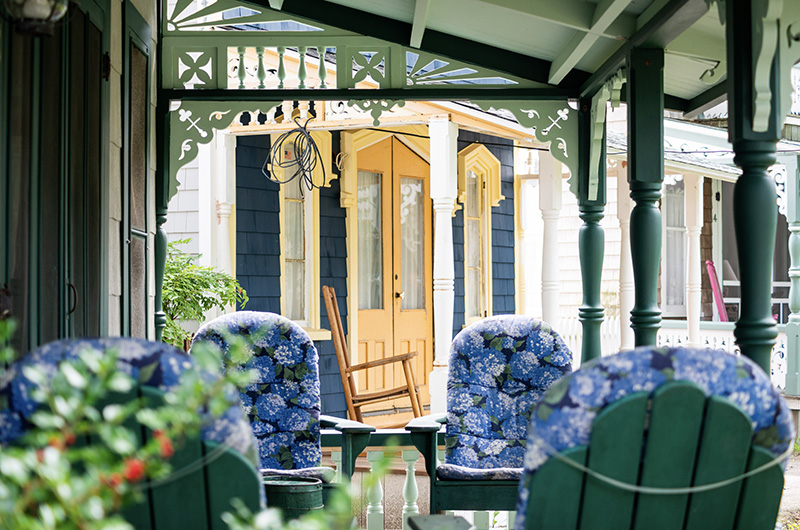
The Martha’s Vineyard Camp Meeting Association dates to 1835 when Jeremiah Pease and six other men from the Edgartown Methodist Church secured a half acre of land in Oak Bluffs. This was a period when Methodist camp meetings and religious revivals proliferated in the summertime. The Oak Bluffs camp meeting community grew over the years from a few tents to cottages, to the majestic Tabernacle and iconic gingerbread houses that are a major tourist attraction today. In 2005, the Camp Ground was placed on the National Register of Historic Places.
Recently, however, another story about the origins of the community was uncovered, one that points to a community of abolitionists and whose early founders and residents included a vibrant African American community, only to have that community segregated and moved off during the Jim Crow years.
In the aftermath of George Floyd’s murder last summer, the camp meeting association decided to look into this history, forming a social justice, diversity and inclusion task force.
“In the larger town of Oak Bluffs, there is an incredible diversity and one where my family feels completely welcome and included in all aspects of the town and the activities and such,” said Molly Shabica, co-chairman of the task force. “It had become increasingly evident to me and probably to many that there was perhaps a disconnect between the smaller Martha’s Vineyard Camp Meeting Association and the larger community of Oak Bluffs, particularly when it comes to the racial diversity.”
The task force enlisted Camp Ground resident and historian Andrew Patch to help with the project. A cottage owner for 10 years, Mr. Patch said he began investigating the broader history of the association six or seven years ago.
On Saturday, Mr. Patch gave a presentation on his research at the monthly meeting of the Martha's Vineyard chapter of the NAACP, introduced by NAACP chapter president Arthur Hardy-Doubleday. Some of Mr. Patch's research counters the notion that the first black community on the Island began with the foundation of the black-owned hotel Shearer Cottage in East Chop. Mr. Patch said his findings indicated that Dr. Samuel Birmingham, a wealthy black and native American physician from New Bedford had leased a tent lot in the Camp Ground as early as 1862.
Dr. Birmingham owned 3 Forest Circle from 1865 to 1870, and was possibly the first seasonal resident of color on the Island — “a full 50 years before the advent of the Shearer Cottage,” Mr. Patch said in his presentation held over Zoom Saturday.
Another early black resident was the Rev. William Jackson, a fellow New Bedford resident and minister who served as a conductor on the Underground Railroad and was the first black officer in the U.S. Army, Mr. Patch said. Reverend Jackson purchased 12 Central avenue in 1871.
Mr. Patch noted that in the antebellum period, many early white leaders of the Methodist Camp Ground were staunch abolitionists. But after the abolishment of slavery led to the proliferation of Jim Crow policies in the ensuing decades, the Camp Ground saw more segregationist and discriminatory practices.
“You can also be an abolitionist and a segregationist,” the historian said.
The lease records and board minutes Mr. Patch analyzed indicate that residents of color were limited to small areas of the Camp Ground, namely the farthest northern and western sections. Mr. Patch said his research also demonstrated how cottages owned by people of color were removed from the Camp Ground and relocated. The location of one former neighborhood of color in the Camp Ground on what was once Wamsutta avenue is now a parking lot. Next year, a marker will be placed there, adding the site to the Island’s African American Heritage Trail.
By the 20th century, the association stopped issuing leases to people of color, Mr. Patch said. “I can’t find evidence of any new leaseholders of color from the 1910s through, let’s say, the 1970s,” he said.
He said the camp meeting association refused to lease to Catholics and Jews as well.
“All the way into the 1960s, if you wanted to rent a cottage in the Camp Ground, you had to fill out a form, and the form included spaces to identify your religion and your race, and I think the right answers were white and Protestant,” Mr. Patch said.
He said his research remains ongoing. His findings to date will be published in an upcoming issue of the Martha’s Vineyard Museum Quarterly. According to museum research librarian Bow Van Riper, Mr. Patch’s work illuminates a vital yet forgotten chapter of the Island’s history. Mr. Van Riper said despite the rich heritage of black vacationers in Oak Bluffs, Mr. Patch’s research shows how racism and discrimination were tangible parts of the town’s origins.
Ms. Shabica said Mr. Patch’s research has helped the camp meeting association take an honest look at its foundations, but that is only the beginning.
“The minimum that we should expect of ourselves is honesty,” she said, “And I think that only when we are honest with things that have happened in the past and honest with even where we are right now, that’s the only way we can actually have honest discussions moving forward.”
Comments
Campground beauty is only
T Bone Oak BluffsCampground beauty is only paint deep.
The Campground's beauty is as
Bt. The CampgroundThe Campground's beauty is as deep as is the fragile nature of our human condition. In the case of this historical review, we have succeeded and failed in equal parts. Fortunately, we all have ability to create and promote 'beauty' that can stand the test of time and historic review. That must be the goal for all of us. It is a journey of unknowable miles. And we have many steps yet to travel.
The beauty of the Campground
Glen Field MVCMAThe beauty of the Campground is only paint deep? That comment might have been more accurate 50 years ago. However, the number of coats of paint that have been scrapped off and reapplied since then represent the true beauty of the Campground. I am not so naive as to say that there isn’t still work to be done. However, I assure you that the Campground as a whole is eons ahead of our country, our state, and, yes, even the rest of our beloved island community, when it comes to the issue of racism. Does that mean that racism is nonexistent in the hallowed grounds of the MVCMA? Of course it doesn’t. However, to my knowledge, no one has ever tried to deny the unfortunate past policies of the organization and this recent “research” comes as no surprise to anyone with a long history in the Campground. It is well known and deplored by the vast majority of current residents. Anti-racism is prevalent in the MVCMA and I am proud to be a resident.
Of the 300+ cottages in the
T Bone Oak BluffsOf the 300+ cottages in the Campground how many are owned by families of color? I would wager the number is zero. Words are nice 'paint", but ownership speaks volumes.
6 African American families
S Smith O.B6 African American families own houses in here.
We're not so much talking
Peter Palches Oak BluffsWe're not so much talking paint as we're talking whitewash. Here is a story about an iconic institution -- the Campground -- confronting its own history of racism. What could be deeper or more beautiful?
Given the make up of my
Ebie Wood 16 Wesleyan GroveGiven the make up of my family and our circle friends,I do believe that a look at Campground history is more than appropriate. But, I do take issue with Mr. Patchs ownership statement. He's inaccurate.
Good for you Molly....it's
Karen Sankey EdgartownGood for you Molly....it's about time!
How can everyone having this
You are on Indian Land AquinnahHow can everyone having this conversation conveniently leave out that Oak Bluffs is Wampanoag Land???
To truly discuss the history this point must be acknowledged
There was one African
L Wilson Oak BlufffsThere was one African American lease granted in the 70’s
Bravo for this honest,
Beka ElDeiry MVBravo for this honest, historic and important conversation. As we push foward and peel away racism from our public and private entities , let our leaders embrace these questions of justice, diversity and inclusion .
Thanks for sharing an
Thomas Dresser Oak BluffsThanks for sharing an informative program in a well-written article.
Do we know if this Zoom meeting was recorded, and, if so, how can I get to see it?
It was very informative to
Lee Jackson Van Allen Oak BluffsIt was very informative to read Kate Dario’s article on the Methodist Camp Ground and learn about the research conducted by Martha’s Vineyard Camp Meeting Association president and historian, Andrew Patch. As a member of the Shearer family, it is important to respectfully clarify that the Shearer family has never claimed that the founding of Shearer Cottage, our family’s inn located in East Chip, marked the beginning of the first black community on the Island. We are well aware that African Americans and families of African descent lived and owned property on Martha’s Vineyard long before the Shearers arrived.
The MVM Campground was
Boston Jay Boston MassachusettsThe MVM Campground was founded on religious principles; there is no place for political partisanship or political agendas. Over 20 years of summers in MV I’ve never witnessed racism, sexism or other bias at The Campground.
The review of the Campground
MM O.BThe review of the Campground history is old history. Presently it does not reflect the MVCMA, as is event in the programs and religious services we had this summer at the tabernacle. All religions and races move here because they feel comfortible and accepted.. The newly formed task force is not needed in our community.
Fantastic article, and on an
Danielle Herget Oak BluffsFantastic article, and on an incredibly important topic. Go Molly!
Add new comment