


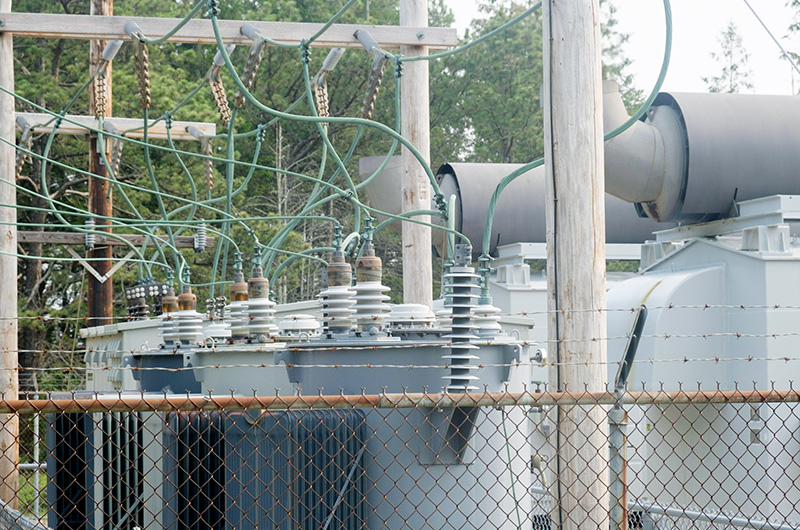
Eversource has canceled a long-awaited battery energy storage project planned for Martha’s Vineyard, complicating a plan to achieve ambitious green energy goals on the Vineyard.
Eversource has canceled a long-awaited battery energy storage project planned for Martha’s Vineyard, complicating a plan to achieve ambitious green energy goals on the Vineyard and highlighting the Island’s infrastructure challenges after an undersea cable failure last Friday.
In a letter sent to the state Department of Public Utilities, Eversource said it had decided to withdraw the $15 million, 15-megawatt battery storage project planned for the company’s service center off the Edgartown-Vineyard Haven Road in Oak Bluffs. According to the letter, dated May 26, a feasibility analysis conducted earlier this year showed “an increased future load forecast” for Martha’s Vineyard, as well as increased project costs.
Instead, the company hopes to build a fifth submarine cable to the Island, which it says will render the planned battery storage facility redundant.
“The [cable] construction will eliminate the usefulness of the Martha’s Vineyard BESS,” the letter said. “In addition, the new cable will allow for the retirement of the existing diesel generators without the need for the BESS. These reasons have caused the company to make the difficult decision to discontinue the Martha’s Vineyard BESS project.”
Serviced by an aging energy infrastructure that includes three undersea cables running from a switching station in Falmouth to West Chop, and a fourth cable that runs to East Chop, Martha’s Vineyard has electric needs that are becoming increasingly taxed as population has ballooned in the past half-century, according to Eversource and Island energy experts. Late last week, a fault in one of the undersea cables caused rolling blackouts across the Island. Soon after, Eversource announced it would bring 15 backup generators to the Island as it completes repairs to the cable, which could take up to 10 weeks.
The primary purpose of the battery storage project, originally filed in 2018, was to significantly reduce the company’s reliance on five 12.5-megawatt diesel-fired generators that are used to supply backup power to the Island during high load conditions in the peak summer months.
The diesel generators date to the 1950s.
“The year-round population on the Island is around 15,000 but increases to approximately 125,000 residents in the summer,” Eversource wrote in the letter to the DPU. “Electric consumption surges on the Island in the summer and the undersea cables become strained.”
According to initial plans, the battery storage facility would have helped phase out the fossil fuel-powered diesel generators, deferred the need for a new, expensive undersea cable and reduced strain on the grid, resulting in additional capacity and shaving yearly and monthly peaks.

Electricity is delivered to the Vineyard via four undersea cables running from the Cape.
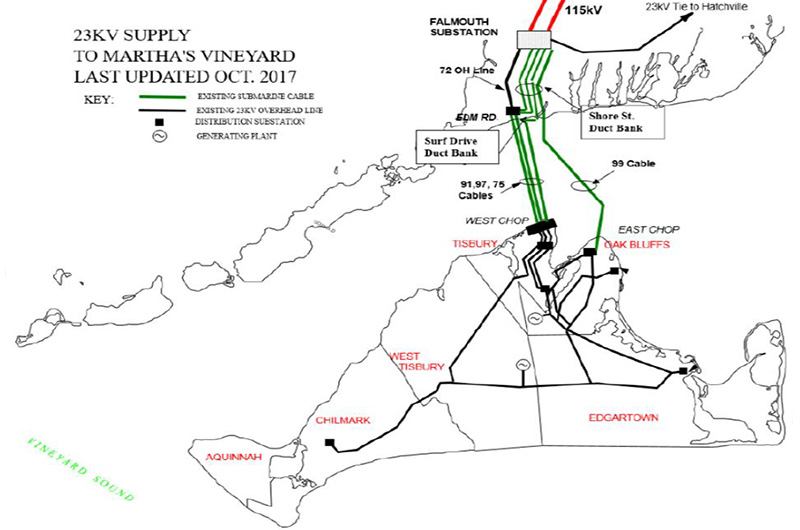
Electricity is delivered to the Vineyard via four undersea cables running from the Cape.
The project was filed with the Martha’s Vineyard Commission as a development of regional impact (DRI), and public hearings were held with the town of Oak Bluffs.
Commission DRI coordinator Alex Elvin confirmed by phone Thursday that the project was withdrawn in May.
Meanwhile, a nonbinding green energy initiative spearheaded by the commission and a climate action task force to reduce fossil fuel consumption by 50 per cent by 2030, and 100 per cent by 2040, has since been adopted by five of the six Island towns. The battery storage facility was an important facet of that goal — crucial for storing electricity generated by renewable solar and wind power on or near the Island.
In its letter, Eversource said that conversations with the climate action task force showed that the utility had significantly underestimated initial projections for Island electrification, even relative to recent energy growth models. The task force has emphasized the adoption of electric vehicles and electric heat pumps, among other things.
Instead of spending heavily on a battery storage facility, Eversource, which is New England’s largest public utility, decided a fifth cable would adequately cover the Island’s expected electric needs for the next decade. In the May 26 letter, Eversource said it would work with the task force to develop a tool to forecast future electrification goals.
But in an interview with the Gazette, Rob Hannemann, an engineer and former Tufts professor who lives in Chilmark and has been a leader on the climate action committee, said Eversource’s decision to cancel the batter storage project has created new challenges for achieving the Island’s green energy commitments.
Mr. Hannemann said the Island will have to burn between 300,000 and 500,000 gallons of diesel per year for the next five years, because the four current cables are at capacity, and building a fifth cable will take at least half a decade. And he said long-term planning remains challenging because Eversource reacts to need, rather than engaging in big-picture planning discussions that span more than a decade.
“The battery storage facility was going to stabilize the local grid, and therefore allow more distributed energy resources, like solar,” Mr. Hannemann said. “Canceling the battery causes us to burn diesel, but it also gets in the way of adopting more local renewable energy.”
In Mr. Hannemann’s view, the Island will likely need both a new cable and a storage facility.
“It’s somewhat of a red herring, because, in fact, they are going to need a fifth cable anyway,” he said. “It’s one of those things, where it’s not A versus B. We need A and B. The real reason, I suspect, is, oh gee, it costs more than we thought it was going to.”
According to the Eversource letter, other challenges did arise as the project snaked its way through the permitting process, including increased cost estimates. A contractor for the project left the energy storage business, threatening the project’s strict five-year timeline. Civil construction bids were received at three times the expected amount, and aesthetic concerns from Oak Bluffs required the company to construct a building to house the system, the letter said. “Due to these factors, the estimated project cost increased substantially,” Eversource wrote.
Estimates rose from $15 million to more than $23 million, according to the letter.
Eversource said conversations remain ongoing with Island officials and that the fifth cable project is in development. After the failure this weekend, Mr. Hannemann said it was needed as soon as possible.
“The real deal is, those cables are old. And what just happened, we discovered how old those cables really are,” he said. “This has now become a security of supply issue.”
In a presentation before the Edgartown select board early this week, Alan Strahler, who heads the town energy committee, outlined the serious challenges facing the Island’s energy infrastructure, saying the current grid is insufficient, and Island supply capacity would need to be doubled for the Island to reach its all-electric goal. He also pushed for a new cable and battery storage facility.
Although electrification is expected to lead to significant cost reductions for rate-payers and match nationwide consumer economic shifts, Mr. Strahler said the Island’s ambitious goals also outpace state energy initiatives, which list a 70 per cent fossil fuel reduction goal by 2040.
“We have a definite issue here with where Eversource is going, as far as where it thinks the Island’s needs are,” Mr. Strahler said. “Reaching our goal of all-electric, all-renewable power on the Island is going to require accelerating that electrification process, even beyond what Eversource is planning.”
Selectman Michael Donaroma called issue “startling.”
“I think Eversource has some work to do, by the looks of it,” he said.
Comments
Why can't we get a cable
AnonymousWhy can't we get a cable directly from Vineyahd Wind to power the Island!!
Cuz they are going to cost $3
MichelleCuz they are going to cost $3 bil and cause more harm than they will ever produce in electrical output to offset their worth?
That’s not the reason at all.
Tisbury guyThat’s not the reason at all. Ask an electrical engineer why we can’t bring a cable with that much electricity into MV. We don’t have the infrastructure.
You could call Vineyard Wind,
Thomas Hodgson wtYou could call Vineyard Wind, and they could explain this to you. My guess is that there is no gain, and no point in taking that power directly to the island. That wind electricity needs to be fed into the grid, and the place that happens is going to be over on the Cape, where the large transmission lines are. From the arrival point on the Cape to the Vineyard is only forty or fifty miles, so Vineyard Wind power would have no trouble getting over here. Since electrical energy travels more or less at the speed of light, it would take Vineyard Wind power about 0.0003 seconds to get from source to user.
We couldn't afford the cost
Paul Oak BluffsWe couldn't afford the cost of wind. People have now idea what their bills will look like to pay for it. Get ready to live cold in the winter and warm in the summer.
The method of trasnporting
Tim Johnson Vineyard HavenThe method of trasnporting the power from the offshore turbines to the mainland will be High Voltage DC power.
End users in the US use AC electricity.
Bringing a cable (or even a branch ) means a DC to AC facility would need to be built on the island.
The same power transmission method is to be used for both Mayflower Wind and Vineyard Wind projects.
I don't think the people
Michael WTI don't think the people pushing electric cars understand the power demand to recharge such vehicles. The windmills don't produce enough power to warrant the huge expense and upkeep (especially at Sea). Any number of things could happen and render everyones EV'S useless...ie hurricane, or undersea cable failure.
I agree that people pushing
John Cape CodI agree that people pushing for the Green agenda don't have a clue as to what the power demand that will be required to meet that idea. Also as to where that electrical power will come from. No wind turbine farm or solar panel array will ever be able to supply the grid with enough consistent electricity to even deliver a fraction of the power that will be needed in the future.
Well, solar & wind deliver 21
Carol formerly ChilmarkWell, solar & wind deliver 21% of the electricity used every day by 40 million Californians - that's a pretty big "fraction." See link to 2019 production (it's higher now, but I didn't see the 2020 stats yet on the CA CEC site): https://www.energy.ca.gov/data-reports/energy-almanac/california-electr…
And your logic doesn’t apply
Tisbury guyAnd your logic doesn’t apply to gas powered vehicles? What if any of the island gas stations underground fuels tanks failed and we have gasoline leaking into the ground or the ferry with all of the gas trucks sinks?
Michael, et al - I HAVE an
Carol formerly ChilmarkMichael, et al - I HAVE an electric car, have had it for four years now (a Leaf), and to my astonishment - despite a 50 mile round trip daily commute, recharging it at night in my garage - it barely budged my electric bill. About a 15% increase.
I’m not sure I understand the
John Aldeborgh Edgartown, MA & Christiansted, VII’m not sure I understand the comment “ Mr. Hannemann said. “Canceling the battery causes us to burn diesel, but it also gets in the way of adopting more local renewable energy.”, I’m focused specifically on adopting more local renewable energy. From personal experience the cost of solar on the island is very non-competitive. I completed a 36 panel installation with battery at our winter home in the USVI in May 2020, where electricity is $0.42 per kWh (much higher then here) and the turn key system price was $36K. Wanting to do the same thing here, I got a quote for an identical system from a regional supplier, late last year, and the quote was $52K, almost 50% higher. Bottom line, the math doesn’t work, so the grid isn’t the issue, in fact it’s a completely independent issue. Honestly, at $36k the math still doesn’t work because of the lower cost per kWh here vs the USVI. This also ignores the fact that solar is less efficient in New England than the USVI because of the greatly reduced number of hours of daylight in the winter and the comparative number of sunny days annually. Local renewable energy on the island has some serious practical issues to overcome before it makes economic sense, unless the end goal is force the shift to renewables by simply increasing the price of electricity to consumers, which I sincerely hope isn’t the case as that only injures those who can least afford it.
Interesting but very true
Taxi Man EdgartownInteresting but very true
Mr. Aldeborgh:
Michael OBMr. Aldeborgh:
My sincerest thanks for publicizing the real costs of a solar system on the island.
Getting a price from anyone out there for a system is worse than a dentist appointment.
J. A., you are correct. The
Lorraine EdgartownJ. A., you are correct. The amount of power needed to simply charge electric vehicles is astonishing. If everyone on this island had an electric vehicle and plugged it in, goodbye power grid. Many people simply do not understand the amount of electric power needed to run a modern life, even on an individual basis. The cost of electricity is going to be very very dear; the people who can least afford it will suffer. Most people cannot afford a big increase in electric power billing. The average household is being beset on all sides. Everyone talks about affordable housing, but those houses have to be billed for utilities and many people simply do not have disposal income to deal with rising prices through inflation, rising fees for everything, taxing authorities, providing basis needs for public school systems for the students, which many systems around the country are needing. One cannot live in a modern country, live a life with mod cons, inexpensively. Many people are being overwhelmed with rising prices and inflationary spending. Retired people living on a fixed income have had to make a choice, run an air conditioner on a hot, steamy day or eat. That is not an exaggeration. And, not just one area of the country.
This highlights the growing
JayEff EdgartownThis highlights the growing demand for island resources. We're victims of too much growth -- without full consideration of the affect on scarce resources. We see the worsening traffic situation, but we can't see the increasing demand for power, water, and more. One can wish that the island officials would put a hold on all new construction. Maybe for a few years.
This isn't just an island problem. We're pushing the envelope everywhere but it is worse on an island where we depend on a link to the mainland. Imagine how easily some of that link could be sabotaged, or crippled by climate-change driven weather. Time to put a lid on the island growth!
All the folks with mega
Jim EdgartownAll the folks with mega mansions and gas guzzling SUV's need to rethink there Carbon foot prints.... Solar Solar Solar
I bought a bicycle and walk to most places when allowable. I am healthier and feel better....
Jim, well said!!! I love the
Dean OBJim, well said!!! I love the folks who push green energy and then drive around in a 100k SUV’s private jets and live in a 5,000 sq ft homes….
Just saying
And boats! Unless it’s a sail
OBNY OBAnd boats! Unless it’s a sail boat - it burns a lot of fuel.
This unfortunate development
Allen Schaeffer MarylandThis unfortunate development highlights in stark and practical blackout-reality the weaknesses in the energy generation, storage and distribution business models and existing system of which many policies today are increasingly placing more burden on in pursuit of the "all electric" future. Things don't always work out as planned.
The fact that the island has a 1950's generation Diesel generators speaks volumes about two things; government management to upgrade systems before there is a problem, and the incredible durability of diesel generators- something that is 60 to 70 years old. The newest generation (tier 4) achieve near zero emissions for particulates and smog forming compounds. While not the most efficient means of generating electricity long term, it is good to know these units are mobile and can be rapidly deployed to bridge the gap until the cable is repaired to keep the summer manageable on the vineyard.
Add new comment