



Vineyard doctors, allergists and biologists have identified at least a dozen Islanders who have been formally diagnosed with alpha gal syndrome, a largely unstudied new syndrome.
Rick Karney, a shellfish biologist and former director of the Martha’s Vineyard Shellfish Group, never used to eat much red meat.
But he got a hankering during the pandemic, and his neighbor picked up a steak for him at Cronig’s.

Chloe Combra is part of a team collecting ticks this summer around the Island for further study.

Chloe Combra is part of a team collecting ticks this summer around the Island for further study.
“I made it on the grill, and ate it,” Mr. Karney said. “A little while after that, I was watching TV, and I got this weird pain in my stomach.”
By the time Mr. Karney stood up to put his plate in the sink, the room was spinning.
“The next thing I remember, I was on the floor,” Mr. Karney said. “I’m disoriented, thinking, where . . . am I? I had fainted.”
Mr. Karney, who has dealt with allergies all his life, drove himself to the Martha’s Vineyard Hospital emergency room in a heavy sweat, welts spreading across his body. Familiar with tick bites and tick-borne illness, Mr. Karney knew this was different. He asked to be tested for a rare allergy to red meat he had heard about that had been shown to develop from Lone Star tick bites.
The test had to be sent to Missouri for analysis. But sure enough, days later he got his results: positive.
“It’s like when Lyme first came about. People are not very aware of it,” Mr. Karney said. “I was surprised . . . my primary [care doctor] said, I’ve heard of this before, but you’re the first patient I’ve seen who has it.”
About a year later, and Mr. Karney is not alone. Vineyard doctors, allergists and biologists have identified at least a dozen Islanders who have also been formally diagnosed with the allergy, adding a frightening, largely unstudied new syndrome to the already dizzying array of tick-borne illnesses facing Vineyard residents.
Known as Alpha Gal syndrome, the allergy was first recognized in the southeastern United States more than a decade ago. But as Lone Star ticks have rapidly proliferated northward, so too has the allergy, following the dangerous arachnids across the country — and the Vineyard Sound.
Transmitted through a carbohydrate molecule called alpha-gal that gets secreted in Lone Star tick bites, the allergy triggers an immune response that can produce mild to severe allergic reactions to red meat, including pork.
Milder symptoms include rashes, hives, itching, stomach aches and sweating. Severe symptoms range from angioedemia, or swelling of the lips and mouth, which is considered a medical emergency, to life-threatening anaphylaxis. Reactions can be triggered by eating, or in certain rare cases, even smelling red meat. There is no known treatment, other than to avoid mammalian meat products. It is unknown how long the allergy lasts.
Dr. Karen Casper, head of the Martha’s Vineyard Hospital emergency room, said in an interview that while the syndrome remains rare, she has seen about two patients in the past three years come into the ER for treatment. Allergist and otolaryngologist Dr. Edward Caldwell, who practices in West Tisbury, said he has treated approximately 10 Vineyard patients in the past year and a half who have received laboratory confirmed positive tests.
“It’s here,” Dr. Caldwell told the Gazette in an interview. “It’s a little hard to tell how prevalent it is, because it is a fairly new tick-borne illness for the Island. But unfortunately, I think it is going to become more prevalent. The Lone Star ticks seem to be thriving here, and they are a fairly new arrival.”
According to Richard Johnson, a biologist and head of the Island’s tick-borne illness prevention initiative who conducts regular yard sweeps across the Island, Lone Star ticks are more than thriving. In five short years, the fast-moving, aggressive species has become the dominant tick on the Vineyard, spreading inward from its initial outposts on Chappaquiddick and in Aquinnah.
Mr. Johnson said he has found Lone Star ticks while doing yard sweeps in down-Island towns this year, including 20 on one sweep in Oak Bluffs — noticing for the first time their ubiquity Island-wide.
“Three years ago I would have told you they weren’t in Oak Bluffs,” Mr. Johnson said. “Now, every place we go, we are finding them.”
To make matters worse, the omnipresence of the Lone Star tick hasn’t done anything to push out deer ticks, or the diseases they carry. Dr. Casper said the incidence of tick-borne illness at the ER has grown, with nearly 600 Island patients testing positive for Lyme disease between June 30, 2020 and June 30, 2021.
Although Lone Star ticks do not transmit Lyme disease like their deer tick relatives, they are responsible for a different cocktail of unsavory, latinate pathogens, including ehrlichiosis, tularemia and Southern-tick associated rash illness, or STARI. The CDC recently included the red meat allergy as an addendum to the Lone Star’s official “Tick ID” primer.
But unlike other tick-borne illnesses, the state Department of Public Health does not track the syndrome because it is technically an allergy, rather than a disease, making its true prevalence nearly impossible to gauge.
Because of the growing ubiquity of Lone Star ticks, Mr. Johnson suspects that the Vineyard is, and will continue to be, a hot spot for the allergy.
“There’s probably no place else in the state that’s dealing with this issue,” Mr. Johnson said. “We’re at the forefront of it.”
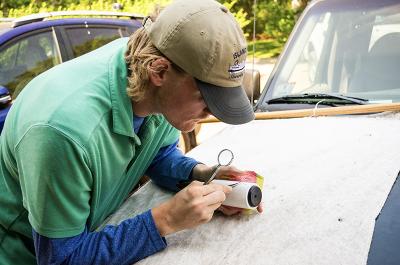
Ben Rush examines tick collected using a lint roller.
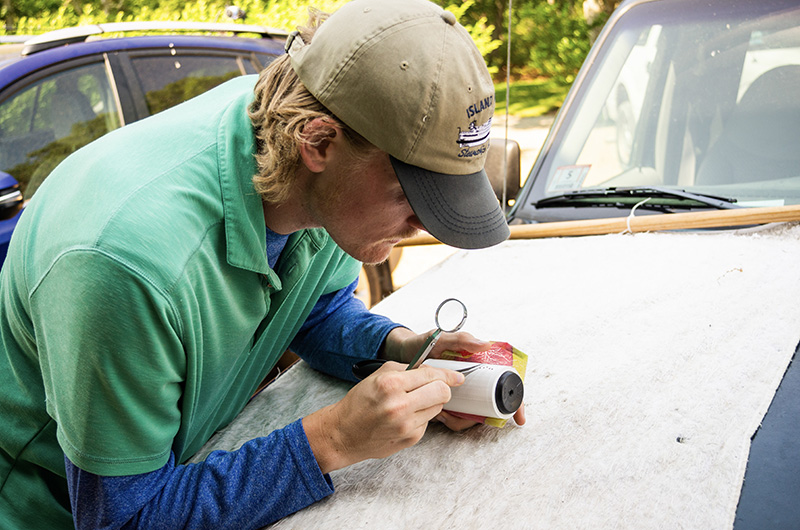
Ben Rush examines tick collected using a lint roller.
Almost all known Vineyard patients have a history of tick bites, and a history of allergy issues, experts said. But harder science on Alpha Gal syndrome remains elusive, leaving even the medical community uncertain about the allergy’s prevalence, biology and impact. And for most patients, the first symptoms come as a surprise, often hours after meat consumption, adding to its dangerousness.
Compared to dairy or gluten sensitivity, red meat allergies are uncommon.
“My gestalt is that it is unusual for somebody to have this type of reaction with zero history of allergy problems,” Dr. Caldwell said. “But most of my patients are coming in, not knowing they had it. They eat steak or pork, get a rash, and then get tested.”
Mammal byproducts also appear in a surprising array of foods, packaging and medical equipment, including gelatin and certain chemotherapy treatments.
Patients span all ages and genders, including children. Becky Cournoyer, who lives in West Tisbury, saw her son Roan, age 12, diagnosed with the allergy in 2018, more than a year after he first started experiencing a variety of symptoms, including stomach aches, vomiting and on one occasion, difficulty breathing.
For a long time, Ms. Cournoyer and her doctors struggled to diagnose the allergy, thinking it might be dairy-related. The Massachusetts General Hospital pediatric allergy panel does not include alpha-gal, and it wasn’t until her Vineyard pediatrician performed the specific alpha-gal blood test that the family got an answer.
“It was really hard to pinpoint,” Ms. Cournoyer said.
Both Roan and Mr. Karney now avoid red meat entirely, and Dr. Caldwell said he prescribes his alpha-gal patients an epipen. With steak off the menu, Ms. Cournoyer said her family has resorted to other dietary options.
“Emu meat is almost identical to beef,” Ms. Cournoyer said. “And so we eat a lot of emu now.”
But as it has become more prevalent across the country, formal and informal support networks for Alpha Gal Syndrome have grown as well. A Facebook group devoted to the allergy has more than 8,000 members, and both Ms. Cournoyer and Mr. Karney said they have benefitted from the help and community, expressing a desire that the allergy becomes more widely known in the medical world.
Mr. Johnson and the tick-borne illness reduction initiative have hired an intern, Grace Newfield, currently in her fifth year of a combined undergraduate and master’s degree program, to conduct public health outreach and research on the allergy. And Dr. Casper said it is on the radar for emergency room specialists and primary care doctors.
“The primary care team is actively thinking about this allergy when people come in with allergic reactions,” Dr. Casper said.
Dr. Caldw
ell expressed concern about the prevalence of the syndrome, and the speed at which it has grown.
“It really kind of popped up,” he said. “It’ll be interesting to see where this is at in three to four years.”
As for Mr. Karney, he is feeling healthy, and never ate much red meat anyway. But he now wears a hazmat suit when he goes out to his garden.
“It changes your life, that’s for sure,” he said.
Aliyah Walker contributed reporting.
Comments
But he will always have
Ginny IslandBut he will always have oysters!
Not necessarily. We have
TimOpiela PittsburghNot necessarily. We have seen an increase of reactions to shell fish including lobster and crab meat. We believe this may be triggered by the increase use of Lobster Bacon bait ( Pigs legs and Cow Hides) use ( 10 million pounds per year) within the US East Coast fisheries.
This makes eating such seafood items a form of Russian Roulette given there is no way to tell the difference between product caught using this bait or secondarily if the bait is disregarded upon completion of the use of the trap pilots back into the fisheries. Historically, import farm or responsibly raise seafood products are feed similar mammalian scrapes and have to by excluded from Alpha gal Syndrome patients diets. This fishery practice needs to be addressed given the already limited protein diet choices of this extremely emerging Tick Borne Disease. For additional information of Alpha gal syndrome, the Facebook support group referred to in the article is called: Alpha gal Support ( Non Public)
I have recently been
Janette hall South Dartmouth, MAI have recently been diagnosed with this allergy. Are you aware of any groups I can connect with to ask questions and receive advise and information?
Thank you
There is a great Facebook
Grace Newfield West Tisbury, MAThere is a great Facebook group called "Alpha Gal Support Non-Public". Very helpful and welcoming community.
My husband is afflicted with
Alissa MVMy husband is afflicted with this allergy and it does him and other sufferers a great disservice to say it is simply a “red meat” allergy. Alpha Gal allergy prevents many sufferers from eating any cheese, butter, and milk products. The biggest problem for my husband is the fact that cane sure, unless it is labeled organic, is processed with bone char to whiten it, including brown sugar! It prevents him from eating most bread products and prepared foods. Also, toothpaste often contains carrageenan( a seaweed that contains alpha gal) and soaps, fabric softeners, shampoo, lotions, and laundry detergent are often made with mammal products. He can’t pet our dog! So readers, take care to avoid lone star ticks. It will be life changing if you develop sudden sensitivity like my healthy husband who never suffered anything beyond mild pollen allergies before developing alpha gal syndrome. One steak diner sent him to the ER with anaphylaxis six hours later. It caused his blood pressure to drop very low. We are just learning as we go along. Please don’t report falsely soothing statements based on doctors’ gut instinct. It is not helpful and may be harmful.
I also have this , no red
J. Sona TexasI also have this , no red meat and nothing that comes from an animal with red meat. I had to become a vegatarian. So i feel for your husband .
Alissa
richard johnson Oak BluffsAlissa
I have been trying to reach your husband (I beleive we all kinow each other from years ago when our daughters were friends). could you contact me at [email protected]? thanks
Dick Johnson
When I was first diagnosed,
Linda Smith AlabamaWhen I was first diagnosed, people would say "oh, so it's JUST a red meat allergy". NO, it's not "JUST" a allergy! AGS is a very serious life threatening disease! And what's even worse is when you go into ER and tell the Dr what you have, they look at you like you're crazy and tell you to take Benadryl... Just last month I almost died. I went to my local ER on a Friday night with swollen eyes, lips and tongue, throwing up, severe pain in my lungs and intestines and had soft ball size hives all over my body. They gave me a IV cocktail of antihistamines & steroids and sent me home. That gave me a little relief, but on Saturday night I was back in ER with even more severe symptoms of Anaphylaxis shock. They gave me the same IV cocktail told me to take Benadryl every 4 hours then sent me home a second time. By Sunday morning I had severe brain fog & dizzyness, throwing up, covered in hives swelling and difficulty breathing. I was able to call an ambulance and was taken to UAB in Birmingham where I was admitted. All of 'this' (I've had MANY) stemmed from me ordering a chicken dinner from a fast food place that put a BEEF based gravy on my mashed potatoes! So NO, it's not "JUST" a red meat allergy !
I have had AGS for one year
Bruce Fowle ChappaquiddickI have had AGS for one year and my wife Marcia for two years. It is hard to imagine that so few cases have been reported from
Vineyard doctors but, as I assume is often the case, since we were able to identify the tick, we’re aware of the allergy, and did not require medical treatment, we did not report it. It would be helpful if there was a local website where all ticks could be identified, cases could be filed, and location patterns could be tracked.
It is of the utmost importance that people with AGS carefully check the ingredients of all food products. A good example is a chicken sausage. They are often encased in a pork skin.
There is a place that tracks
C. Dickerson Seward, NEThere is a place that tracks ticks. The University of Rhode Island has a website called tickencounter.org. You can see what ticks are in your area, when they are most active and at what time of year. There are pictures of all stages of ticks for identification or you can submit a picture with info about where the tick was found and they will identify for you. We also have the Lone Star tick here in Nebraska my husband was bit by one last summer. A few hours after he had some hamburger, his tongue started to swell up. He didn't want to go to the ER so we managed to get a benadryl pill in him before his tongue got too big for him to swallow. Thank God that helped! Now, we're very careful about what he eats. I have been bit multiple times this year and I have been avoiding red meat like the plague.
Good report! Informative! How
Ana de Sousa Oak BluffsGood report! Informative! How about reports on other less widely known tick illnesses like the others noted to be carried by the lone star tick… and tularemia, babesiosis and Powassan? Our community has little info about these… symptoms? Diagnosis, treatment? Leaving us in the dark about whether our medical practitioners are chasing every potential illness from the ubiquitous tick bite… please follow up!
I have had this for 8 years
Beth Kravetz Bethany Beach, DelawareI have had this for 8 years and it took 2 to diagnose; this has been here for a long time and I am still surprised of the lack of awareness from medical professionals of all types, including allergists.
I ate very little mammal meat before I was infected (which is another reason it took 2 years to diagnose, since my severe episodes were infrequent); now I eat none. Nothing, ever.
There is no cure, no treatment. It is up to you to be extremely, overly, and ever vigilant. If I am not 100% sure what is in a food, I do not eat it. I ask about everything that is prepared (what's in the soup? is the stock from chicken or meat?). Vegetarian and vegan restaurants are a good bet.
This tick has been found in every place in the world, except the Arctic Circle! So, be aware, and spread the word to everyone you know.
Thanks, Noah, for this very
Chris Daly AquinnahThanks, Noah, for this very important and informative story. Stick with it.
Thank you for this article
Vasha Brunelle Vineyard HavenThank you for this article and for the follow-up comments. I had no idea that AGS was so severe. My heart goes out to everyone living with it.
Good God.
Martha MageeGood God.
I ask yet again why is there
Gabrielle West TisburyI ask yet again why is there not a tick borne disease research clinic on this island?
I've had AGS for three years.
Tom Artessa Central NYI've had AGS for three years. Could not believe local doctors never heard of it rashes for sure
Two words, Guinea Fowl. On
Steve Ewing EdgartownTwo words, Guinea Fowl. On another note, my brother Colin came down with a high fever in the early sixties. Dr. Nevin thought it might be tick related so they shipped him up to Mass General. Sure enough it was Rocky Mountain Spotted Fever. It was supposedly the first reported case east of the Rockies. I don't know about that but he was really sick. I remember he had spots on the soles of his feet and the palms of his hands. My parents signed a waver to use photos of him in Time Magazine. Turned out the pictures were too gross for the general public so they substituted a photo of a wood tick instead. I haven't heard much about RMSF lately. Guinea Hens do make noise but they do love ticks. There used to be quite a few of them running around, even in the down town area. I don't know how they would fit in these days.
A few years ago I had several
Jeff Plain HuntsvilleA few years ago I had several allergic reactions after eating red meat (sometimes hours later) and they continued to get progressively worse. I had a particularly bad episode while in Atlanta for a meeting and was able to see an allergist. After lots of tests, he finally suspected Alpha Gal.
When the test results finally came back negative, I questioned the result based upon the information I had been able to find online. Turned out they ran the wrong test. After another test and wait, the results came back negative.
This is a very severe allergy and life altering. I feel for those that have or will get the allergy and their families. Be safe everyone.
Fun fact: The alpha-gal
Jeremy TisburyFun fact: The alpha-gal molecule is found in all mammals except Catarrhines, which include old world monkeys, apes, and humans. So cannibals need not fret.
thank you everyone for taking
richard johnson Oak Bluffsthank you everyone for taking time to respond and for the informationyou provided. One thing the Tick Program is trying to do is to identify how many people on Martha's Vineyard have the alpha gal allergy, how you were diagnosed, what doctors you saw and how long it took to get diagnosed. As mentioned in the article, Grace Newfield is a graduate student inpublic health who is interning with the Tick Program and learn more about alpha gal on the island. If you are willing to talk to her, youcan email her at
[email protected]
or call me at 508 693-1893 and I will put her in touch with you.
Thank you in advance
Dick Johnson
I encourage those interested
Beth Carrison Maine (formerly Massachusetts)I encourage those interested in learning more about AGS to read the Alpha-gal Syndrome Subcommittee report, supported by the Dept of HHS Tick-Borne Disease Working Group (TBDWG) which is a federal advisory committee responsible for identifying gaps and overlaps in Tick-Borne research here in the United States.
I was a coauthor of this report and welcome inquires at [email protected].
You may also email the advisory committee directly to provide your written commentary for the next public meeting scheduled for 8/26. For more details and to register visit - https://www.hhs.gov/ash/advisory-committees/tickbornedisease/meetings/2…
AGS TBDWG Report-
https://www.hhs.gov/ash/advisory-committees/tickbornedisease/reports/al…
Be safe out there!
The state of the science on
Rick Karney West TisburyThe state of the science on alpha-gal syndrome
https://www.frontiersin.org/articles/10.3389/fcimb.2021.680264/full
This is a really good article
Carmen davis Massillon,ohioThis is a really good article and thanks everyone for sharing your stories,I have having allergies is very painful. I have an allergy to vanilla,it comes back to the alcohol it's used to dry it out. I ate vanilla pudding and was in the er 4 hours later fighting for my life. A week later the same thing. We still don't know what caused the allergy. But I now feel I can continue trying to figure it out that I'm not crazy. Thanks
Carmen
I had alpha gal. My face and
John oleary Hopkinson maI had alpha gal. My face and lips swelled every time I had eaten red meat. I went to an allergist and was prescribed an epie pen and was told to go to the er anytime I had a reaction. After about a year and a half I tried eating a little red meat with no reaction. The doctors had told me it might go away. I am now enjoying burgers and steaks again.
Add new comment