

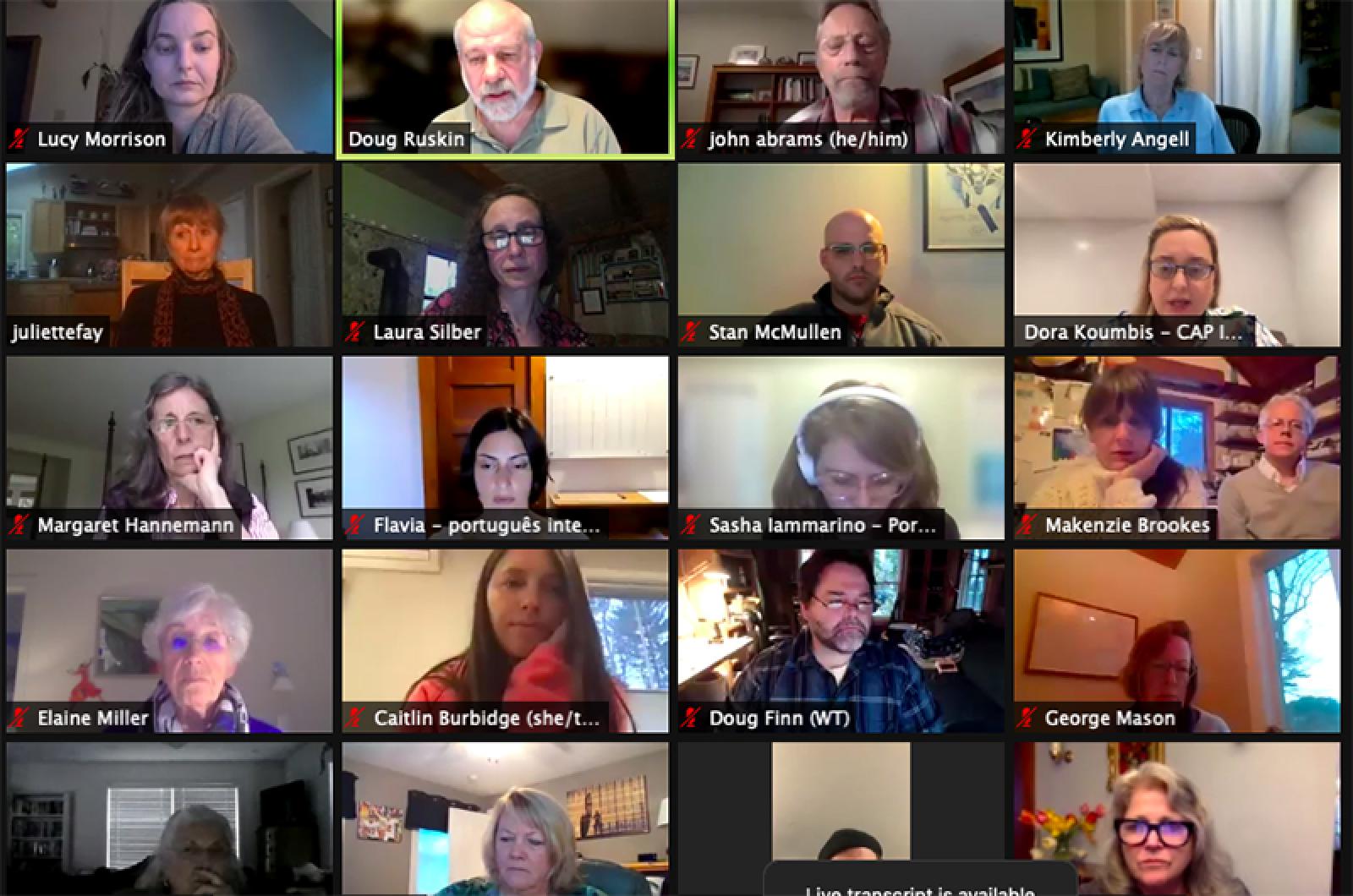
Questions and compliments came from all directions at Monday night’s forum on the renewed effort to create a housing bank on Martha’s Vineyard, as organizers aired the long-term plan.
Questions and compliments came from all directions at Monday night’s forum on the renewed effort to create a housing bank on Martha’s Vineyard, as organizers aired the long-term plan before the public.
The hour-and-a-half listening session was hosted by the Coalition to Create the Martha’s Vineyard Housing Bank, an ad hoc group of about 20 Islanders with the goal of creating a permanent funding source to advance year-round housing on the Island.
A second session is scheduled for Wednesday at 7 p.m.
Julie Fay, the former executive director of Martha’s Vineyard Community Services, and Arielle Faria, an administrator on the Edgartown affordable housing committee, are co-chairing the group. Laura Silber has been hired as a paid staffer to organize the effort.
The housing bank idea stretches back for nearly two decades, when the first attempt to pass legislation to create a transfer tax failed on Beacon Hill amid opposition from the real estate industry. A similar effort that would have used money from a new short-term rental tax was nixed on Vineyard town meeting floors in 2019.
But at the 135-person Zoom forum Monday night, organizers stressed the urgency this time around, against the backdrop of a housing shortage widely seen as unprecedented, even for the Vineyard.
In a poll conducted at the beginning of the forum, 62 per cent of respondents said they or someone they knew was in an unstable housing situation on the Island.
“The crisis has hit a catastrophic level we have never seen before . . . threatening our infrastructure, our public health system, our schools, the economic survival of our businesses, and the social and volunteer support systems so critical to the fabric of small town life,” Ms. Fay said. “We need a comprehensive, regional solution with long-range planning and funding appropriate to the scale with the problem.”
Presenting the plan, Ms. Fay and Ms. Silber said the housing bank would be modeled after the Martha’s Vineyard Land Bank and be funded by a transfer fee, paid by buyers, for transactions above a certain threshold, with the hope of raising $7 to $10 million annually.
The coalition plans to place a home rule petition question before voters at all six annual town meetings in 2022, and if the petition is approved, take it to the state legislature. Six other towns across the commonwealth have crafted similar proposals.
At the forum Monday, there were questions about the timeline, structure, and the decision to tax buyers rather than sellers. Coalition members cited two reasons for that decision.
“Basically, we felt that it was a more salable approach,” Doug Ruskin said. “Buyers are unknown to us, whereas sellers are our neighbors. That’s one consideration. The bigger one, frankly, is that we have to sell it to the legislature once it is approved. Indications are that there might be some preference [for a buyer tax] at the legislative level.”
Organizers acknowledged that the real estate industry, which has a powerful lobby, has long opposed transfer fees. But they said too that many Island real estate brokers are backing the housing bank this time around, and that the Cape Cod & Islands Association of REALTORS has softened its stance in recent years.
“This time, we are not going to let the real estate lobby get in our way,” said John Abrams, who moderated the forum.
Kaylea Moore, a legislative aide for state Rep. Dylan Fernandes, said the Cape and Islands delegation supports the proposal. Ms. Silber also said the Vineyard will be partnering with Nantucket, which has a group specifically designated to fighting the real estate lobby.
“We feel like there is more momentum behind this,” she said.
Panelists included land bank executive director James Lengyel, Dukes County Regional Housing Authority director David Vigneault, and Island Housing Trust executive director Philippe Jordi
All said the housing bank would likely prioritize building on already developed, rather than undeveloped, land. They also said legal issues prevent giving preference to people who grew up or were born on the Island.
And as the housing bank focuses on long-term, year-round housing, Adam Turner, executive director of the Martha’s Vineyard Commission, said a parallel effort is underway to form a task force for short-term summer worker housing.
He spoke to the immediate necessity of the housing bank.
“It’s got to happen. And if it doesn’t happen, it’s really going to hurt this place that we call home,” Mr. Turner said.
As the forum came to a close, participants flooded the Zoom comment section with compliments about the forum and the proposal. Denise Schepici, president and chief executive officer of Martha’s Vineyard Hospital, voiced her praise, saying that doctors and nurses were struggling to find housing, and that the hospital wholeheartedly endorsed the proposal.
“I’ve remained uncharacteristically silent through all of this because I’m just in awe and wonder of the effort here,” Ms. Schepici said.
Comments
Absolutely against short term
ZackAbsolutely against short term summer housing. If each town followed the law when it came to affordable housing, we wouldn't be in the position we are now. Year round affordable housing - yes. Short term worker housing - BIG NO.
The only stumbling block was
MarieThe only stumbling block was figuring out who should pay, the buyers or sellers.
Other people’s money is always the go-to..
The answers to your personal
Bob OBThe answers to your personal problems do not lie in someone else's wallet. It makes no practical difference whether you claim to be taxing the buyer or the seller, you are suggesting a proposed mandatory financial drag upon a transaction that you are not a party to, for purposes of your own, and for no apparent direct benefit to the actual interested parties. You cannot put lipstick on that pig no matter what high minded purpose you would claim. Theft is never a virtue, regardless of the means of your intended victim.
Ms Fay says “The crisis has hit a catastrophic level we have never seen before . . . threatening our infrastructure, or public health system, or schools, the economic survival of our businesses, and the social and volunteer support systems so critical to the fabric of small town life,”. Of course, the only thing standing between us and that certain catastrophe is the establishment of yet another governmental entity, to which we must relinquish our money and the power to redistribute it. Well, maybe. Maybe not. I, for one, am willing to bet that none of those institutions will suffer in the absence of the proposed housing bank.
I wonder why this mindset stops at housing? This is a unique environment. Everything costs more on an island. Shouldn't we also be subsidizing food, clothing, utilities, fuel and transportation? Maybe you think you have the right to a subsidized cheeseburger at a local restaurant.
What is not yours is not yours. It doesn't matter how badly you want it. You do not have the right to live on Martha's Vineyard if you cannot afford to. If that fact creates problems for those of us who can afford to live here, then I guess we'll have to figure those out when the time comes.
Wow, Bob, you sure do remind
Sara Oak BluffsWow, Bob, you sure do remind me of my grandfather who had two houses and a lot of money and used to clink his highball glass with his cronies, proclaiming, "IGM" or "I Got Mine." (He inherited it from his father.) (By the time I came along the money was gone.) I do think our middle class, no longer able to afford housing, should be able to look for some assistance. These are our teachers, our police officers, etc. And apparently since our main income comes from the fact that we are a resort community, we also need folks to prop up the people who lives in those (big) houses all or part of the summer -- housekeeping, shopping, etc. with places for their "help" to live. (I also think that people who move here without resources are more victims of poor planning than overpriced real estate.) We have two problems: not enough places for summer workers to live, and not enough low to middle income housing for year-round people. Possibly these problems should be looked at apart from one another.
Bob, you are consistent with
Paul EdgartownBob, you are consistent with your views... but this collective sharing is called civilization/community... and this the foundation of societies that thrive and those that do not... I do not mind paying more for so the whole succeeds....
I've been hearing the same
here we go again edgI've been hearing the same story about the cost of housing for years. As someone who paid market price at the time of 18% fixed rate mortgages and 13.75% variable rate mortgages (30 year loans), I'm jealous of those folks who buy today and pay less than 3% fixed rate. Sure the land cost less but so were wages. Wages have gone up more percentage wise than the cost of real estate. We used to work hard, save a lot, and we didn't buy $1200 phones and buy $50,000 four wheel pickup trucks and expensive boats. I find it hard to shed a tear for a business that won't pay fair wages to their employees while charging $30 for a burger and $10 for a bowl of soup. Let the market forces work without more government intervention and taxation.
So how much did you pay for
B WTSo how much did you pay for your house, and how much did you make a year? Since supposedly those two things have increased at a proportional rate it seems more relevant to your argument than the interest rates.
The land & house cost me
here we go again edgThe land & house cost me approximately 10 times my annual income. Doing the math with those old interest rates... a borrower ended up owing like 5 times the original amount borrowed which was the interest. So if a police officer today makes 100k, their expenditure of 1 million at todays current rates would be a lot less than when a police officer made 8k per year and paid 80k for a house. 1m borrowed at todays rate of 3% plus interest (517k)= payments of 1.517k. The difference being the one who paid 80k for the house at 18% interest would have to pay back the 80k PLUS 354k in interest for a total of $434k (on an intial 8k salary) while at todays interest rates its a bargain. Todays buyer pays about 50% of total payments over 30 years as interest, whereas the buyer with high interest rates paid back almost 442% .So the interest rate is a LOT more relevant to my argument than you thought. Nice try tho.
There are good intentions
Jonathan K.There are good intentions here but there are also unintended consequences. I simply do not understand how a tax on real estate will help solve problem in lack or high prices in real estate? This board is trying to do good with other people's money and that is simply unjust and wrong. This will increase the prices of housing that IS available and make it even more nu-affordable. Make seasonal business responsible for putting up the help that they hire so that hard working year-round residents are not kicked out in the summer because of temporary summer workers who pay a lot more to rent a room.
There seems to be a pattern
Tom Cole TisburyThere seems to be a pattern of very cool responses to these proposals in these comments sections, housing is a difficult predicament on the island, slapping another tax is not the answer.
Although affordable housing
gina Menemsha/NYCAlthough affordable housing is a noble goal creating another Bureacracy & new tax to support that goal is misguided..
While the summer employment housing is another issue IMO. , there are already several established agencies working to offer options to those that qualify.. & not everyone that wants an affordable house does.. It takes personal planning/responsibility to live on Island..
I also seriously doubt the State Legislature would green light this "new tax" with out pushback on many levels..
A lot of the whiners here
Charlie Callahan So Boston/EdgartownA lot of the whiners here bought houses 30 and 40 years ago when you could buy a nice place here for 50k and may only have been making 30 or 40k a year. Now that same house is probably worth 800k. Chances are your not making 800k.Pay has not kept pace with housing costs. This island has no where close to the amount of affordable housing they are supposed to have for the number of people here
I wish all of the commenters
Christina west tisburyI wish all of the commenters here who have issues with how the housing bank plans to operate would actually attend the meetings and voice their opinions there. VERY easy to speak poorly about a lot of hard work that people are doing when you are behind a screen; it would be actually productive to bring those opposing views to the meetings and perhaps get some answers!
Home ownership builds wealth
BCS Oak BluffsHome ownership builds wealth among all income groups. Affordable housing is usually deed restricted so it will remain affordable in the future thereby preventing the owner the amount of equity a non deed restricted property would accumulate. These "affordable" properties essentially prevent lower income people from building wealth.
Wealth building is not a
Jo-Ann West TisburyWealth building is not a social responsibility. Safe housing is a need. Lack of housing impacts us all, even if we worked and struggled and got ours. We need the working people to service us and our homes, and to keep us living in a place that is not exclusive to wealthy people. What a boring world that would be!
Vancouver, Oakland,
M West TisburyVancouver, Oakland, Washington, D.C. and many other cities have variants of an "empty house tax." This can be a small percentage of the building's assessed value, or a flat fee, if the house is unoccupied a certain amount of the year. In such cities these policies are not just used to help fund affordable housing, but to combat blight, which reminds me of a few businesses that have been empty for a number of years (cough cough, the theaters in OB).
Maybe we could look at that sort of approach here.
Typical big government
AJS Montauk, NYTypical big government solution "add another tax".
AJS, while I tend to agree
Lorraine EdgartownAJS, while I tend to agree with your premise, we, the people, are the government. We vote, we put the government officials in office. If we do not like the actions of the people for whom we voted, we can vote them out. That said, incumbents do have the edge in elections. Other than government officials, we are dealing with a certain percentage of the population who think they can spend our money better than we can. One constantly sees such phrases as: one percenters, the haves and the have nots, that is not conducive to a united citizenry.
Adding an additional tax to
Mark EdgartownAdding an additional tax to real estate transactions unfairly penalizes those who have saved, invested in and maintained their properties. The entire Northeast region has elevated housing costs and cost of living, this is nothing new. The concept that one must live on island to work here is absurd. Many people that work in Boston, NYC, etc and commute over an hour each way.
It is absurd that one MUST
Mike SomewhereIt is absurd that one MUST live where you work. I don't, and live here. As has been noted numerous times - the cost of living in a nice place is always higher.
Weston, Newton, Wellesley, Beacon Hill, Scarsdale, Amagansett, Martha's Vineyard, Nantucket just name a few places that qualify. Because I work there does not mean affordable housing needs to be constructed next to me, or near me. We are creating pockets of low income housing which will lead to devaluation of what we have worked do hard to get.
There are however areas on MV that could be used, but short sighted zoning and unqualified town governance will always be a stumbling block until progressive thinkers are elected. i.e. In town lots with higher densification zoning.
This is what towns and cities around the nation are doing.
Not taking pristine areas and building 4-5 individual structures.
Come on people.
A fast ferry running
The Sherman CompromiseA fast ferry running regularly from Woods Hole, like in 2018, may alleviate many of the challenges the island is experiencing and may possibly cool the cost-push and demand-pull inflation. Does, or would, the Housing Bank and/or its organizers support the implementation of a daily fast ferry from Woods Hole? If not, why?
Good point. I am all for
Anna Cotton Vineyard HavenGood point. I am all for increasing affordable housing but I see no way enough will ever be built to keep up with demand without destroying the nature of the Island. A fast ferry run at 6:30 throughout the day would go a long way. These two are not mutually exclusive.
Put a fork into the island.
Reid Buzz bayPut a fork into the island. After covid the poor place had no chance. It no longer ‘our, your’ island. It’s no longer ‘special’ except you pay a lot to sit in traffic or wait for a bench spot. I suggest Maine.
Many of the comments presage
Chip Coblyn OBMany of the comments presage Martha’s Vineyard as ‘The Villages’ in Florida; older, more conservative, richer, less diverse—did I say older? That’s where we end up after you squeeze out the younger population. Let the Housing Bank have a chance! They are not asking for the moon when they suggest a transfer fee (technically not a tax) on the sale of a house above a certain threshold (i.e., wicked expensive) so that others may also dream about a owning a HOME. The same concept has worked to preserve swathes of our island’s open vistas, through the Land Bank. I no longer hear complaints from that idea. We are better when we are together to solve our problems and housing is right up at the top. I support the idea of a Housing Bank.
It's a compulsory transfer of
Mark EdgartownIt's a compulsory transfer of money on a real estate transaction, it's a tax. How about increasing the sales tax by 2% to finance a housing trust? I support neither, but penalizing me for saving, investing in and maintaining my home is not the answer.
My friends moved to the
moving to the villages mvMy friends moved to the Villages and LOVE it. Everyone there loves it. And somehow younger workers find a place to live and go to work there servicing the Villages. Perhaps we can look to the Villages as guidance. Those of us who live here and made the sacrifices in order to achieve homeownership don't feel inclined to subsidize those looking for the 'easy way out'. Those 'older, more conservative, richer, less diverse...' that's a bit nasty of you to make a remark about people with morals, work ethic, and who fought the wars so you could 'opine'.
Road to nowhere here, folks.
Peter Stone Oak BluffsRoad to nowhere here, folks. Tepid support at best for this plan in the community. We’ve been recycling this issue for decades and the hard truth is that a) there is no ghost town apocalypse of empty classrooms and unanswered 911 calls and b) if you build 100 units of housing, 110 more people will line up for the next round.
For those who did not attend
Kim West TisburyFor those who did not attend the listening sessions, please go to CCMVHB.ORG and watch either or both recorded sessions. Then please give constructive feedback or alternative solutions with funding methods. We want input from our community.
Good point Chip!
Charlie Oak BluffsGood point Chip!
Add new comment