


Leo Kamin is currently a senior at East High School in Denver, Colo.
Leo Kamin is currently a senior at East High School in Denver, Colo. During Covid, he has been devoting much of his time rummaging through the weeds of a research project. This April marks the 100th anniversary of the school newspaper, the Spotlight. As its present editor, Leo is time-traveling, doing virtual interviews with past editors for the purpose of creating a feature story as well as a school archive, an oral history of a print tradition.
Last week he tracked down the editor from 1960. That would be me.
In the age of the internet it wasn’t all that difficult to find me. Leo Googled me and looked for the most recent entry associated with my name. This turned out to be a column published in the Vineyard Gazette in February. He then contacted the Gazette for my contact information.
Imagine a different journey. What if 60 years ago when I was the high school editor, I was told to find some guy who had been the student editor in 1900? This would have called for the kind of legwork I had to do when I began my career as an ink-stained wretch. In the pre-computerization era, information gathering wasn’t a matter of keystrokes. It took the industry and ingenuity of a detective. Everything about getting a story, writing it and publishing it involved in-person meetings, phone calls, phone books, reference librarians, typewriters, carbon paper, linotype machines spewing hot lead and newsprint. The kind you hold in your hands — the kind that comes off on them.
Leo and I talked over Zoom. As I described my time in the Spotlight newsroom, he showed a faint shade of amazement, like a newcomer to a museum.
“I see by the headlines from your era you had about six dances a year,” Leo noted. “We have only one.”
My response: “That’s because we discovered rock’n’roll.”
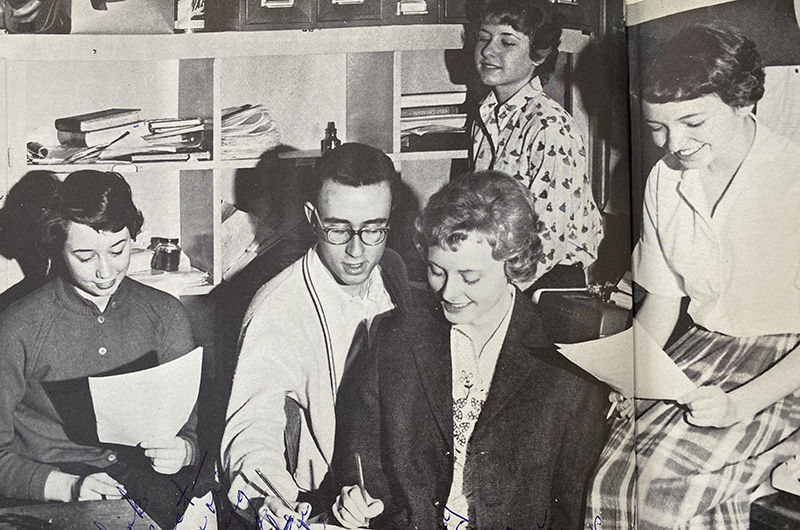
Back in my Mesozoic media era, we put out a biweekly student paper — 13 issues my senior year. It felt like a full-time job. As editor, I was given a full-course credit for my work, the kind of credit you needed to graduate.
No such credit for Leo. His Spotlight, during Covid and pre-Covid, comes out once every six weeks. In a screen-sharing moment he showed me a few of his Spotlight’s pages. It looks more like a magazine and acts like one. It covers big-picture news, what’s going on in real life that has a direct effect on the student body: Black Lives Matter, immigration issues, plus the cultural goings-on in Denver, that city outside the campus.
The stories made me blink in amazement.
“I have to tell you, the difference between then and now is like the difference between awake and woke,” I said. “Civil rights was making headlines in my day, but not in the Spotlight.”
“Why not?” Leo asked appropriately.
“Good question,” I replied. “Somehow we felt honor-bound to life inside the school and, believe it or not, civil rights was yet to be viewed as a school issue, let alone a Denver issue. We were aware of the horrors and indignities inflicted on black people, but at 17 we most likely felt that was ‘news’ for a real newspaper. In retrospect, I think I’m feeling less than adequate.”
The constituency of my newspaper was the school, its students and faculty. We covered our own concerns, mainly sports, dances, oratory contests, mock political conventions and extracurricular clubs and events.
Leo put things in perspective, explaining to me that much of the coverage of events and sports takes place on social media platforms.
“The counselors, the different departments, each club, each sports team and the administration all have their own Instagram accounts that are used to get such information out,” he said.
Leo went on to say that the shift in focus has allowed the student writers to dig into subjects that really interest them. We both agreed that was a good thing. But the past will always have a strong pull.
“Talking to you and other former editors has made a large part of me wish I could go back to the time when the Spotlight was the major source of news for the student body,” Leo said. “Did you feel you had power?”
“Looking back, I’d have to say yes, in an adolescent sort of way.”
Talking with Leo isn’t the only Past-Meets-Present episode I’ve had lately. Last year I was supposed to go back to East High School for my 60th reunion. When the pandemic hit it was of course canceled but ten of my former classmates and I began Zooming together, once a month. Several of them contributed to or were featured in our old Spotlight issues. These virtual sessions, which span nine time zones in a single 90-minute gabfest, have been enlightening and heart-warming as we wistfully recollect our connective tissue.
I look forward to telling everyone about my talk with Leo at our next monthly meeting. Proof, yet again, that you can leave high school but high school never leaves you.
Arnie Reisman and his wife, Paula Lyons, regularly appear on the weekly NPR comedy quiz show, Says You!
Comments
Wow. Are we old ?
Michael OBWow.
Are we old ?
In 5 years - much less 50 -
John FudgeIn 5 years - much less 50 - will it be possible for this kind of backtracking to happen?
Social media are ephemeral - so all those snapshots of student life that Leo could glean from old papers will not be available to those looking back to the present day.
While there are efforts to retain some of the internet's content (e.g. the Internet Archive, archive.org), it is unlikely that an equivalent snapshot of a school experience will be retained.
Even if some of the Instagram or other social media accounts are available, they won't form the coherent or curated picture that a newspaper can.
Consider suggesting to Leo that he raise this concern with the school administration - solving it would be a valuable project. Not just as an altruistic exercise - in another half century, he may well appreciate being able to reinforce memories or reconnect with lost acquaintences.
And for anyone connected with other schools - you should do the same.
Like Arnie Reisman I am a
Philip Hart LA, EdgLike Arnie Reisman I am a graduate of East Denver High School (class of 1962). My older brother Jud was in Arnie’s class of 1960. I still have old issues of Spotlight in storage in Denver. I played sports at East so often appeared in the Spotlight’s sports coverage. As a Black graduate of East I often brag about the notables who attended East over the years like Hattie McDaniel, Philip Bailey, Pam Grier, Don Cheadle, and Robert Smith. East is the oldest public high school in Denver. As to coverage of the civil rights movement I need to see if the Spotlight covered Martin Luther King’s visit to Denver in 1959 a visit my father helped support. Go East Angels!
Thanks, Phil. Get in touch
Arnie Reisman Vineyard HavenThanks, Phil. Get in touch with us when you’re next on the Vineyard. Good to hear your input!
Perhaps a student every month
George Stein Oak BluffsPerhaps a student every month from an Island school should submit an oped from a crop of them. A student from across the continent is getting exposure than our own students? Young people that live here are deserving of their opinions being stated too.
How fun to see another Angel
Heather Carroll Denver, East ChopHow fun to see another Angel/MV connection! I graduated from East in 1990 and was supposed to have my 40th reunion last year when COVID hit. I was an editor for the yearbook in high school but had many friends who were part of the Spotlight staff. We looked forward to the monthly publication, especially the special senior class edition. Social media just isn't the same (that makes me sound old!). I would say the biggest issues we faced in the 80's were whether or not bussing should continue and the gangs. Fall 2019 I had an opportunity to tour East during an event sponsored by the alumnae association and all of those high school memories came flooding back, the good and the bad. How lucky we are to have attended such a beautiful and historic school!
Come on, Arnie. Pictures don
James Malkin ChilmarkCome on, Arnie. Pictures don't lie. You only did the newspaper thing to meet the girls.
Add new comment