


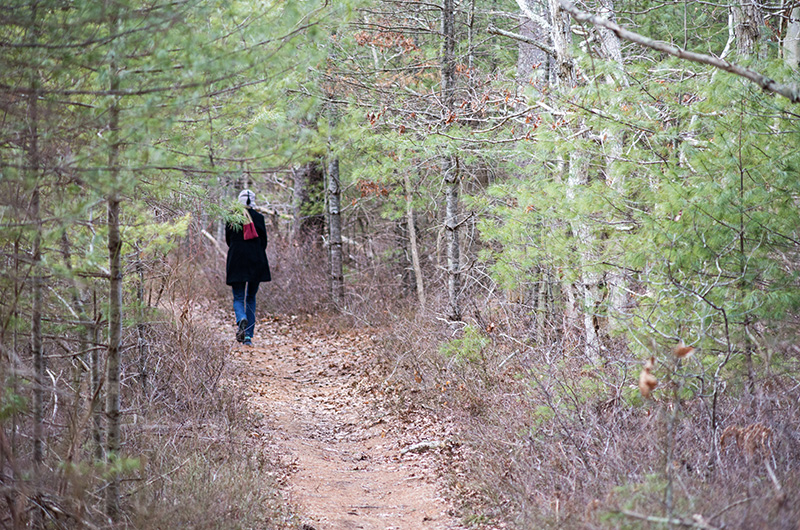
A long trail of good intentions that began with a once-promising partnership between the state and Sheriff’s Meadow ended with an announcement that 25 miles of unpermitted trails would be closed.
In late 2019, the Sheriff’s Meadow Foundation — a venerable nonprofit land trust and leading conservation organization on Martha’s Vineyard — made an exciting announcement in its fall newsletter.
The organization had purchased a new trail cutting machine. Called the Toro Dingo Mini Skid Steer, the purchase was made possible by a generous grant from the Jesse and Betsy Fink Foundation — a philanthropic fund dedicated to promoting biodiversity and environmental stewardship.

Map from project narrative submitted to the state delineates trails.
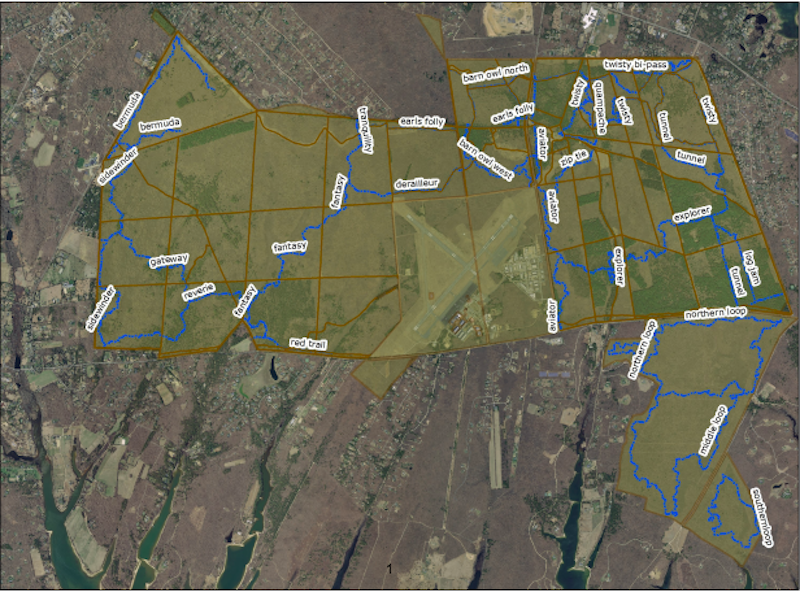
Map from project narrative submitted to the state delineates trails.
In the newsletter announcement, Sheriff’s Meadow celebrated the machine’s arrival.
“This small, nimble, and versatile piece of machinery will make trail creation and maintenance work vastly more efficient,” the article said. “The foundation has already put the machine to good use on Sheriff’s Meadow Foundation trails and on trails in the Manuel F. Correllus State Forest, where we have been helping.”
Nearly 18 months later, the state Department of Conservation and Recreation will close almost 25 miles of new trails in the state forest that were cleared without permits. Although no penalties have been issued, Sheriff’s Meadow will be required to monitor the trail closures and pay for their restoration, which will take place over a period of at least five years.
The trails were carved through 32 acres of habitat for rare and endangered species — including buck moths and eastern whipoorwills — as well as ecologically sensitive frost pockets.
At a two-hour public information session last week, the state provided almost no timeline and took almost no responsibility for the trail clearing, saying DCR became aware of the problem in April 2020.
But interviews with Sheriff’s Meadow staff, board members and others familiar with the clearing, as well as an examination of public records and emails over the past three years, offer a more nuanced picture of the events that led to the announcement.
They reveal a long trail of good intentions that began with a once-promising partnership between the state and Sheriff’s Meadow to maintain a largely neglected, 5,000-acre state forest. Over time the relationship was hampered by miscommunication, lack of oversight by the state and inadequate attention to environmental impacts by Sheriff’s Meadow, highlighting the challenges of third-party land management.
Public records provided to the Gazette also suggest that state officials knew about at least some of the unpermitted trail cutting before April 2020, with a reference to illegally built trails as early as January of 2020, raising questions about DCR’s timeline of events. In a Jan. 7, 2020 email to another staff member, Paul Jahnige, trail section head for DCR, referenced the state forest project. “I understand there may be some trails on the ground that are not on our current map. These might be historic, or might have been built more recently with permission (although I don’t think we’ve got trail proposal forms on any of them) or there might or might not be illegally built trails,” he wrote.
•
According to a 90-page project narrative submitted by Sheriff’s Meadow to the state in July 2020, the trail work began in the southern forest in June 2018 and continued through February 2020, with most work occurring in January and November of 2019.
In an interview Wednesday and follow-up phone call Thursday, Sheriff’s Meadow executive director Adam Moore said the organization and DCR had signed a written stewardship agreement in April 2018 to conduct work in the forest. Mr. Moore read aloud an email from Chris Bruno, who was state forest superintendent at the time, confirming the agreement, which broadly focused on trail maintenance and said any new trail work would receive proper permitting from state agencies.
Mr. Moore said the work, and trails project, were spearheaded by former board member Michael Berwind, who led the foundation’s trails committee, although staff and other volunteers were also involved. Mr. Moore said he was aware of the new trails that were created dating to 2018, and he said he was told by Mr. Bruno that they had received proper approvals. Mr. Moore said when he asked about permits, Mr. Bruno said they would be provided, although ultimately they were not.
Mr. Bruno, who was hired in 2017, abruptly left his position in March 2020, a month before the state said it became aware of the clearing. He has since become the new park manager at Taylorsville Lake State Park in Kentucky. Contacted by phone and text message this week, Mr. Bruno declined to comment.
Mr. Berwind, who designed the trails and did a large portion of the clearing until December 2019, is no longer on the board of Sheriff’s Meadow, and also declined to comment.
But speaking to the Gazette this week, Mr. Moore took full responsibility for the missteps. He said in hindsight he was at fault for not asking to see official permitting documents before volunteers and board members conducted the trail work. He called his reliance on verbal commitments instead of documents a mistake, and he reaffirmed Sheriff Meadow’s steadfast commitment to land conservation and trail management.
“When I look back at this, I should have asked for the permits at the very start when we decided to sign an agreement with the state and started to work together,” Mr. Moore said. “We were working with trusted partners . . . but when I look back on it, that was a mistake that I admit and apologize for.”
Speaking to the Gazette by phone Wednesday, Sheriff’s Meadow board president Peter Getsinger added his own remarks.
“What has happened in the state forest is upsetting,” Mr. Getsinger said. “And I think we are all, as a board and an organization . . . wanting to redress the situation that has occurred, and to continue in our role as Martha’s Vineyard’s land conservation agency.”
Mr. Getsinger also said Mr. Moore had the full trust of his board, and that his primary goal was ensuring the Vineyard community could maintain its trust in Sheriff’s Meadow.
“We have continually tried to work with DCR and Natural Heritage to try to redress the wrongs that have been done, because . . . really without trust, we don’t exist,” he said.
At the meeting last Thursday, DCR officials said the state had never received a written request from Mr. Bruno or anyone else to conduct the trail clearing, and that written approval was never formally granted.
“We have no documentation to that effect,” said Eric Seaborn. “There’s really no way to know factually one way or the other.”
But Mr. Moore said if Sheriff’s Meadow had known the trail work was not permitted, the conservation organization would have never gotten involved. He said it did not become clear to him until the spring of 2020 that the trail clearing had not received approval from DCR and the Natural Heritage and Endangered Species Program. After it did become clear, he said a report was submitted to Natural Heritage that described the scope of the work. Mitigation planning began at the state level, which eventually led to last week’s announcement that the state would close the trails.
But the damage had been done.
“We want to work hard to restore trust in Sheriff’s Meadow Foundation,” Mr. Moore said. “And we’ll do whatever is necessary to do that. We take it very seriously.”
•
According to Mr. Moore, the 2018 stewardship agreement with the state forest came amid a variety of other contemporaneous developments for the foundation, which was begun by former Gazette editor Henry Beetle Hough in the 1950s and has since grown into one of the Island’s leading land trusts, holding nearly 3,000 acres in conservation that span the Vineyard, from Cedar Tree Neck Sanctuary to Quansoo Farm.
In 2017, Sheriff’s Meadow launched a strategic plan that included a goal of improving trail connectivity across the Island, Mr. Moore and Mr. Getsinger said. Part of that plan included the launch of the popular MV Trails App, which includes an interactive map of every walking, hiking or biking trail on the Vineyard.
At the same time, the state forest, a large wilderness located in the middle of the Island and criss-crossed by fire lanes, was facing challenges.
Severely short-staffed and low on funding and equipment, the forest management had seen turnover since the death of longtime superintendent John Varkonda. Mr. Bruno was the only full-time employee, and the state, citing legal reasons, did not allow him to live in a house on the property. Difficulties in finding and hiring seasonal labor were a constant thread in weekly reports from Mr. Bruno to DCR, records show.
“We have a great need for help here at Correllus,” Mr. Bruno wrote to south regional director Karl Pastore in the summer of 2019.
Meanwhile, Sheriff’s Meadow had stepped in to offer a hand, on a strictly volunteer basis.
After a spate of particularly vicious northeast storms in March 2018, Mr. Berwind provided equipment and assisted Mr. Bruno in milling dozens of trees that had fallen on state forest trails between 2018 and 2019, according to Mr. Moore and others familiar with the events. The trees were going to be used for a pavilion, designed by the high school; the Gazette ran a short story about the project.
In April 2018, with the stewardship agreement in place, Sheriff’s Meadow offered Mr. Bruno a tractor and volunteers to help with maintenance. The foundation had also begun a program where it placed wooden benches in the forest, and organized successful volunteer work days with a friends group.
Nearly a year later, in March 2019, Mr. Moore wrote a letter to DCR commissioner Leo Roy requesting a more formal, long-term partnership between Sheriff’s Meadow and DCR in the state forest. In the letter, he said Sheriff’s Meadow was interested in expanding the state’s centrally-located garage for winter equipment storage. As part of the agreement, Mr. Moore offered, Sheriff’s Meadow would maintain and monitor trails, help with forestry and catalog endangered species. The state replied with a thank you letter, Mr. Moore said.
“It’s something that we were excited about, and hoped that this could turn into a good relationship for both organizations, and the community,” he recalled Wednesday.
The formal partnership never materialized.
•
The Sheriff’s Meadow project narrative shows that work began in the southern forest later that spring and continued through 2019, occurring alongside permitted work to restore, trim, mow and maintain existing trails. Mr. Moore said Sheriff’s Meadow was open about the work throughout the process, pointing by example to the September 2019 newsletter announcement, and was operating under the belief it had been approved.
But Mr. Moore confirmed that he never saw official permits, and reiterated that Sheriff’s Meadow was working with trusted partners.
“We had permission from DCR to do work in the forest on trails,” he said. “We had a good relationship with DCR and didn’t have any indication of a problem, up until more recently.”
Tom Robinson, a Sheriff’s Meadow board member and chairman of the Tisbury conservation commission who helped with some of the trail cutting in January 2019, offered a similar account. He said Mr. Bruno had helped Mr. Berwind brush cut roots in the southern forest, and Mr. Robinson was under the belief the superintendent had received encouragement from his superiors at DCR about the trail creation.
“Chris was all gung-ho about this,” Mr. Robinson said. “It was in the back of my mind, that this was too good to be true. But the reality, historically, is that [the state forest] is like the forgotten child of DCR . . . for them to say that Sheriff’s Meadow did this all in a vacuum, is somewhat disingenuous on DCR’s part.”
Tim Simmons, a restoration ecologist who was executive director of Sheriff’s Meadow in the 1980s and later worked for the state Natural Heritage program, told the Gazette in an interview that he came to the Island in late 2019 as part of an unrelated project and was told by Mr. Bruno about the trail clearing.
“It was sort of offhand,” Mr. Simmons said. “Somebody mentioned that Sheriff’s Meadow was cutting trails. And I said, Chris, what are you talking about? Who’s reviewing these trails? He said nobody is reviewing the trails, they are just cutting them. And I go, what is this?”
Several months later Mr. Bruno had left his job and the Island. “I was surprised when he left,” Mr. Robinson said. “But the reality was he wasn’t getting paid much. He was living on Chappy. His wife went back to school . . . it may have been coincidence, or it may have been cause and effect. I don’t know.”
Mr. Simmons expressed frustration that it took the state as long as it did to close the trails. Like Mr. Robinson, he pointed to the state’s lack of interest in the forest as a primary factor that led to the unintended violations.
“Here’s one of the most significant and neglected places in the state. Without presence, these things are going to happen. And clearly this time, even with presence, these things are going to happen,” he said. “Maybe they just failed to give Chris the appropriate training. I don’t know.”
Mr. Moore said he plans to meet with the state next Tuesday to discuss the mitigation plan. He said there no price estimate yet for the restoration, which he said will involve a combination of active monitoring and work to ensure the trails are closed to the public. Mr. Moore said over time, the trails will become overgrown, and will need to be monitored for invasive species.
The state decision to close the trails has carved its own divisions through the Vineyard’s conservation and recreation community, with debate over the severity of the violations and whether there is a need to shut down the trails now that they exist. The trails have become popular among some members of the Island mountain biking community.
Reflecting on the past months, Mr. Moore agreed that ultimately the main problem likely came down to miscommunication, and what he called a “gray area” between lines of authority.
“Those are things that need to be fixed,” Mr. Moore said. “We’re all part of this community here . . . and at the heart of it is a beautiful, 5,000-acre forest. And it’s important to everyone who is here. And it’s very important to Sheriff’s Meadow. And it’s very important to Sheriff’s Meadow to correct the errors we made, and to make sure they don’t happen again.”
Mr. Robinson added that he hoped the forest was important for one other stakeholder as well: the state.
“If anything good comes out of this, maybe they’ll pay a little more attention to their forest down here,” he said.
Comments
Sheriff's Meadow Foundation
Nelson Sigelman Vineyard HavenSheriff's Meadow Foundation staff and volunteers contributed many hours of hard work to construct these trails. Emails show the state forest superintendent was aware of the work. Yes, SMF made a mistake when it relied on the superintendent’s assurances that permitting was in place.
What I don't understand is the animus, or why many of those who comment from atop their high environmental horse cloak their identity. SMF maintains many beautiful properties and works with other organizations to enhance the outdoor experience for us all. If it tried to put one over on the state exactly what was the payoff for SMF, which bore all the associated costs?
The irony is that DCR, which badly needs partnerships to make up for its inability to maintain underfunded state properties, is going to toss out all those hours of volunteer labor and allow miles of trails that are now available to all members of the public to revert to tick-infested Brillo Pad brush.
What e-mails would those be?
Tim SimmonsWhat e-mails would those be? A request under the state's document freedom act yielded no such communications.
Who cares!! Lets enjoy the
Gail EdgartownWho cares!! Lets enjoy the trails please...
Why is everyone anti bike?
Jim O EdgartownrtownWhy is everyone anti bike?
They aren't. They are anti
IslanderThey aren't. They are anti illegal trails. However, many may be turning anti bike due to local riders inability to admit they were wrong, inability to stop riding rhe illegal trails, and general entitlement and ignorance of environmental laws and regulations.
That’s a lot of blame
John Vineyard HavenThat’s a lot of blame assigned and a lot of generalized judgment heaped on an entire group of people most of whom you know nothing about. I bet you also have a lot of the same for the “Lance wanna be’s” as you probably call them when they are “in your way” on the roads. How ‘bout a little constructive debate instead of generalized hate. People on bikes are not villains, just looking for a little recreation and exercise. C’mon man.
I want to pick a bone with
Pro Human West TisburyI want to pick a bone with some of the commenters that are using the word entitlement as a slur.
It is an insult and is not a good way to win your point.
Let me then try to right this ship by discussing that word.
Dictionary.com - Adjective
The pertinent definitions are:
2) having a right or legitimate claim to something:
The inheritance passes to the legally entitled heir.
3) assuming or acting as though one has an innate right or claim to wealth, success, recognition, etc.:
I was so entitled and self-centered that I never noticed the injustices around me.
So.. why would several commenters say that bikers, in particular, have a sense of entitlement that they have a right to ride the trails? Perhaps because we ALL have an entitlement to use the state forest. It literally is stated in the Massachusetts DCR Trail Guidelines Manual. The hunters go everywhere in the forest, not just on trails. So could adventurous hikers, horses, and bikers. It is just a lot better for the forest and the human alike to use the trails. All users realize this and, believe it or not, all users care deeply for the forest.
Now here is the real zinger. Who gave us the right to walk public lands? These rights are not doled out by the state, they are inalienable rights granted to us by our creator. It was our revolution that changed us from only having rights granted by our rulers to having rights granted by god.
"All men are created equal, that they are endowed by their Creator with certain unalienable Rights, that among these are Life, Liberty and the pursuit of Happiness."
Now let's talk about how to solve this mess but let's do it in a civil manner, together as Americans and as Islanders. I am sure we can come to a just and common-sense solution.
John, when I told local
IslanderJohn, when I told local mountain bikers the trails were illegal and they told me to get lost, does that not make them a villain? Also why are a lot of them still riding the trails even though they are illegal? I'm actually a bicyclist myself, I just have very little respect for people knowingly doing illegal things because they don't care to do it the right way.
The trails, as some have
Dean Rosenthal EdgartownThe trails, as some have pointed, do not correspond to the State Forest topography. Hikers know this and it was a big mistake to move forward with this project. Many parties are at fault, the role of Mr. Bruno is particularly strange and central. But also, real concern is Adam Moore. I appreciate his bonafide sincerity and genuine apology, but it is time for the Board to look outward and see their legacy here as well, if they are reading, too. We need a new leader there in order to start anew. Others have mentioned Caroline Tuttle’s issues in a similar issue elsewhere. When this happens in state and National politics, it’s not so much that heads roll, which occurs for good reason, but that accountability occurs - meaning we need new leadership. The board may have confidence, but that is personal, and ultimately we have been failed. Why do they have confidence? The Island needs confidence and mine has flagged, so has thousands of us. It’s not against Adam, but if the board can’t take the right steps out of a self-agreeing sense of standing order, then Adam should consider resigning. This really is a major scandal - scandal may be the wrong word, but this was major. It was Chris Bruno and DCR who in some way first created the problem, but it was Mr. Moore who was not diligent when we needed be careful and thorough. The message sent from the board is that despite this extraordinary mistake, there will not be accountability - it’s a fact, they need to explain otherwise if they disagree. It’s classic Vineyard in some ways, especially when compared to accountability we see on the national level, at least in progressive politics, where accountability does a occur. This isn’t political, it’s local and environmental. It was bizarre and unfortunate this debacle occurred, the idea that there are no consequences for any involved would be even more bizarre. That is so easy to acknowledge. As well, it is hoped this story that is reported excellently and with depth is one of a first to hold accountability on Martha’s Vineyard to a higher standard.
This sums it up perfectly.
Janet H. ChilmarkThis sums it up perfectly.
I have lived adjacent to the
Robert MacGregor West TisburyI have lived adjacent to the state forest for 30 years and watched it’s management steadily decline ever since Jon died . Is there an overall environmental plan for the state forest? We are already interfering with the natural environment by suppressing fire and creating fire lines What is the natural order?Meadows have been created but need to be maintained in order to preserve the original sand plain environment through mowing and managed burns. The state obviously does not consider this a priority and I have noticed invasive species encroaching, the larger question is what is the plan,and are there resources to develop it.
Dean is correct, as are
Elizabeth Marshall Edgartown and Hobe Sound FloridaDean is correct, as are earlier comments calling for leadership change at SMF.
Remember this organization can only exist by accepting tax exempt donor funds, and using the tax code to provide incentives and legal structures for wealthy landowners to donate land and easements. At some point the State Attorney General, who oversees tax exempt activity, is going to look into their practices. I am not suggesting wrong doing with the books - but we must all be able to admit this was another HUGE betrayal of the mission which is what their tax and governance status relies on.
The responsibility for what
jane varkonda EdgartownThe responsibility for what happened, trails without permits and without input from the public relative to how the largest piece of open space on the Vineyard is used or not used lies squarely and firmly on DCR and the Superintendent at the time. Is Sheriff's Meadow and the board member who spearheaded this guilty as well, of course without question. But with all due respect, the Superintendent at the time had sufficient seasonal and year round staff and equipment needed to do the job. All the previous Forest Suporvisors, Manny, John and Ginny had less help, less boots on the ground and inferior equipment that managed to get repaired without additional oversight and assistance. Working in the environmental field takes commitment to a job, your job, your responsibility, something to look forward to and be proud of. The forest likely did not need more trails for one specific user group at this time when other maintenance issues were ignored and continue to decline and fall apart. Why create more work when existing conditions cannot be maintained and improved? That is the question that needs to be answered. DCR will only pay attention when everyone, forest employees, bikers, horse riders, runners, birders and ecologists that study the forest and all the marvels that it quietly holds speak up consistently and united for the common good. So much time, effort, state and federal dollars have been poured into the forest in the past decades, to watch such an important piece of land fall into disrepair and neglect is sickening, to me and my family, on so many levels. To those who say who needs more moths or just fight fires with helicopters, what is the big deal, please read the hundreds and hundreds of pages of environmental assessments, studies, management plans and the plan on these new trails and you will have your answers. The State needs to maintain State property with public funds and public input. Third party management by a private conservation organization, even in this limited capacity has proved a slippery slope which screams loud and clear in this mountain bike trails mess.
I’d like to echo the comments
Alley Moore Oak BluffsI’d like to echo the comments made by Chris Kennedy earlier. I’ve known Adam Moore (no relation) for more than a decade and have always been impressed by his commitment to conservation, core values, and leadership at Sheriff’s Meadow. As Chris said Adam “stood up” and took his share of the blame for mistakes made in the state forest. Not so for DCR and the previous state forest superintendent Chris Bruno who own a “huge piece” of this. Knowing Adam as a person of his word, I have full faith that Sheriff’s Meadow will do whatever it takes to restore any land harmed by the new trails, and put measures in place to ensure that this will not happen again.
These trails are one of my
Ben EdgartownThese trails are one of my favorite things about living on MV.
Would be nice to have an
Peter EdgartownWould be nice to have an article that detailed the history of the State Forest in the context of the history of the landscape of the Vineyard. My understanding is the island used to be mostly open space, because of farming and livestock, and that in the 1940s and fifties the farming declined and the scrub oak forests that cover most of the island moved in. In my 50 years on the island I've seen many open vistas become hemmed in scrub oak and brush.
Also what is the actual history of the forest? I had heard that it was planted by the Civilian Conservation Corps during the 1930s Depression, the CCC being an employment program. Also that the CCC chose to plant red pine, which we are too far south for, and that is the reason we have a forest full of dead and dying pine trees. So Vineyard Gazette, why not give us the backstory?
Subject: Buffalo moths won’t
Craig Thompson New Canaan, ConnSubject: Buffalo moths won’t you come out tonight?
Eric,
Over the last 15 years, I’ve enjoyed the Vineyard’s beaches and bike paths. After a friend of mine was injured on the bike paths, I discovered a new island treasure. It was the interior of the island accessible to hybrid and mountain bikes on a vast network of trails. It has been a large reason for my annual pilgrimage to the Vineyard.
Over the last few weeks. I’ve been following the discussion on the unpermitted trail cutting in the State Forest. It is clear from what I’ve read that there was a breakdown in the supervisory role of the DCR and it’s forest manager. To make up for their error, they have decided that the unpermitted trails should be restored without getting any input from the Vineyard community. Why is there a rush to remediate, when the island community should have some input?
In this time of the pandemic, the use of these trails in the State Forest has been a great healer for many to find the space to pull their lives together. Why is there this rush to judgment? Is it because the DCR wants to sweep it under the rug? Sheriff’s Meadow should not pay for DCR’s lack of supervision. They have better uses for their money than covering up DCR’s mistakes.
DCR should not spend money to remediate these trails without the community input. It seems that the DCR is looking for the Buffalo Moths in the dark.
Regards
Craig Thompson
994 Oenoke Ridge
New Canaan, Conn.
The "animus" is easy to
Jose Oak BluffsThe "animus" is easy to understand. Laws exist for a reason, no matter how "noble" the intentions. If you don't like the law, do the hard work to have it changed. SMF believed that their opinions and "needs" about the right thing were all that mattered, even if formal approvals and protocols were trampled in the process.
I am a contributor to the SMF and I am upset. I didn't send my funds to be misused in this manner nor do I want my funds used to remediate the mistakes of SMF. In the real world, those who performed this clearing, and those who knowingly approved it, would pay for the damages out of their own pockets, and not donor funds.
I will not contribute one cent more to SMF until there is a change in leadership and oversight. I have lost confidence in their stewardship of our precious resources.
Add new comment