


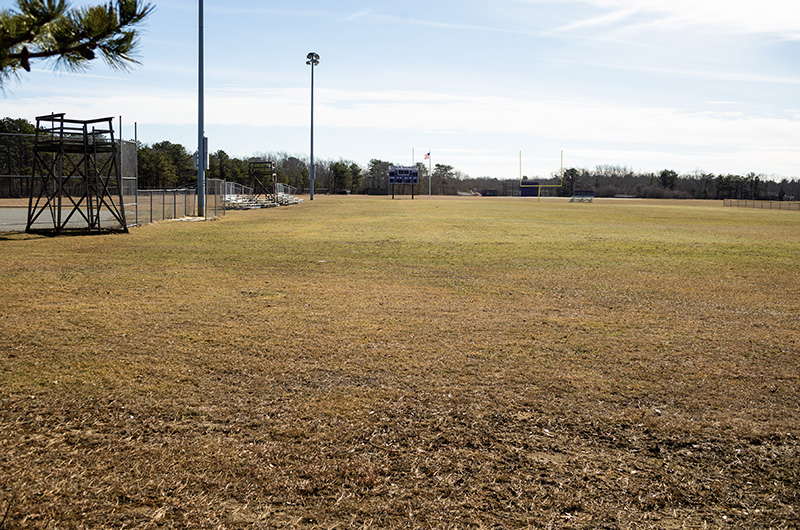
A long-awaited toxicology report became a new point of tension at a Martha’s Vineyard Commission hearing Thursday on the long-debated $7 million athletic field renovation at the regional high school.
A long-awaited toxicology report became a new point of tension at a Martha’s Vineyard Commission hearing Thursday, as scientists assessed the regional high school’s proposed athletic field renovation for health risks and environmental impact.
The hearing, which drew over 100 participants, marked the third in an ongoing series of public hearings devoted to the $7 million field renovation, which is under review by the commission as a development of regional impact (DRI). The project, which has sown divisions in the community, calls for five natural grass fields and one synthetic turf field, among other facility improvements.
Previous hearings aired testimony from proponents and opponents, passionate on all sides.
On Thursday, commissioners turned their attention to a question at the core of the project’s review — the toxicity of synthetic fields. In a highly technical three-hour discussion, commissioners heard testimony from at least three toxicology experts brought on by the MVC, the high school and the Field Fund, a primary opponent of the project.
Ron Myrick from the independent consulting firm Tetra Tech kicked off the conversation with the results of a toxicology report analyzing the chemicals used to make the synthetic turf and their potential risks to human health and the environment.
The tests were ordered by the commission and conducted independently by Tetra Tech, with a peer review and recommendation completed by the firm Horsely Witten. The high school paid for the $51,000 report.
Mr. Myrick said test results showed small amounts of per and polyfluoroalkyl substances (PFAS), which can be harmful to humans but are present in most soils.
“In summary, this is what we found, low level concentrations . . . of . . . semi volatiles, metals and PFAS in the various synthetic turf components,” he said. “However, these materials are present in concentrations that are consistent with background concentrations in natural soil or concentrations well below the risk based standards.”
Brian Massa, a scientist with Horsely Witten, added that chemicals from the field could leach into the Island groundwater, but concluded that drinking water would remain within Massachusetts DEP standards.
Both scientists strongly emphasized the limits of the testing science currently available for PFAS, urging the school to adopt a long-term monitoring plan.
Two more experts — one speaking for the high school, the other for project opponents — then gave their own, conflicting testimony regarding the report, engaging in occasionally tense exchanges.
Kristen Mello, the expert speaking for the Field Fund, said the turf chemicals posed serious health risks.
“PFAS exposure has been linked to reductions in antibody response and disease resistance, increases in airway hypersensitivity, asthma and risk of autoimmune disease,” she said in part.
Dr. Laura Green, the toxicologist speaking for the high school, pushed back vehemently, arguing that PFAS is already present in the environment. She said concerning levels of lead found in Vineyard soil presented a larger problem than PFAS.
“For the life of me I cannot understand why anyone would be concerned about perfluorinated-alkyl substances here. There is a lot more in dirt than there is in BrockFill, but these are tiny numbers,” Dr. Green said. “We toxicologists are concerned much more about heavy metals than we are about [PFAS].”
During a question and answer period that followed, a few commissioners pushed back against testimony from the high school toxicologist. In a sharp exchange, commissioner Ben Robinson asked about how to reconcile increasing levels of chemicals in the environment as industry regulation standards continue to decrease, leading to more disagreement between the high school and Field Fund experts, and testy remarks from Mr. Robinson.
“What we’re talking about is a single product here, but we’re talking about a significant amount of that single product. And if we want to lower the levels of PFAS in the background we should stop adding PFAS into the background,” he said.
Other commissioners, including Doug Sederholm and Jeff Agnoli, expressed caution about the many unknowns regarding chemicals referenced in the reports.
“I think it would be safe to say based on all the science we’ve heard that there’s a lot more to learn . . . and that would be in the years ahead long after the field would be installed,” Mr. Agnoli said.
In broader public testimony during the hearing’s final half-hour, some expressed confusion at the conflicting scientific reports.
“We’ve all heard experts on both sides, I would say you know they make very strong arguments, but they both can’t be right . . . it can’t both be true that the field is toxic or not toxic” said Sam Hall.
Greg Coutinho spoke forcefully, calling plastic a toxic pollutant and urging the high school to invest in its grass fields, while Cynthia Doyle criticized the school for ignoring the environmental consequences of turf.
“The school leadership says the school is in great academic shape. But that is not true, our high school is in trouble. It is avidly pursuing a project that exacerbates climate change plastic pollution and ignores local zoning,” Ms. Doyle said.
On the other side, Louis Paciello spoke emotionally about the project and its lengthy review process in one of the final comments of the evening.
“We’re working with these kids on these fields, we’ve played on them, we coach on them,” he said. “It’s a little frustrating when we have to sit and listen to all this science and it seems at times that people that are in the trenches are kind of getting overlooked.”
The hearing was continued to March 18.
Comments
I'm sure there are MVRHS
Marty Milner TALLAHASSEEI'm sure there are MVRHS runners who didn't expect to have their shot at championships and records sidetracked by COVID 19. In the future the "action" on the track being discussed will also impact the hopes and dreams of future students. Get it done right, get it done once. This is about the students, not the politics. Figure out what the right thing to do over time is, and do that. Do the right thing for the students who are going to use the track. Posturing innovation for its own sake isn't helpful. The wheel already exists, its round, it rolls.
Please just vote on this
Jim S TisburyPlease just vote on this either way and end everyone’s misery.
As a college athlete I played
T Bone Oak BluffsAs a college athlete I played on many types of fields, most artificial. Just make a decision. The “losing” side won’t be happy. That’s a given, but at last the kids can look forward to playing on better, safer fields soon. This dragging on for years and years is ridiculous.
You would think this is the
Brad EdgartownYou would think this is the first turf field ever installed in the United States. Fact of the matter is, MV is likely the LAST. Get with the times and set aside the small town politics. The studies have all be performed THOUSANDS of times throughout the country.
Seems to me there is a
MW EdgartownSeems to me there is a material difference between taking a casual walk along a dirt road, kicking up a little dust along the way, and being pounded into it. I would not want my kids--or anyone else's--to be rolling around on this synthetic.
At this point I have to
TisKid VHAt this point I have to wonder how much (or less) more energy it might take to keep grass fields taken care of. Will it have to be watered a lot? Will it have to be fertilized a lot? Will they actually do it? Is that good for the environment? Everything has a cost.
There is no argument for
Shane Martha’s VineyardThere is no argument for synthetic fields. You can’t buy a plastic bottle in West Tisbury now, we made Vineyard Golf go strictly organic fertilizer but we are considering a plastic, expensive field for our kids to play on. Makes no sense. If synthetic was the best option every NFL team would have one but instead the head of the NFL players association is calling for all NFL fields to real grass. Anyone that’s says, “well everyone else has a field turf field” has no argument. You cannot compare us to other communities that do not drink their ground water, have not prioritized their water quality, and have not been trying to lead on these environmental issues. Spend the money of real grass and get the horticulture program to learn turf management while maintaining the field.
This turf field has always
Mary Oak BluffsThis turf field has always bothered me. I attended an event at the Gillette field house (turf) in 2019 and came home covered in tiny plastic bits. At the time, I thought little soccer players will breathe that in. But Shane, holy toledo!! I looked it up. The NFL players association (ESPN Sept 2020) is asking for all grass fields across the NFL to 'reduce lower extremity injury' to their players. Not a high school athlete so I have assumed that the turf fields are better for the student athletes because the people 'who know' want them. Apparently, not better for injuries per the NFL Players Association and they certainly would know. Why would we eliminate single use plastic beverage bottles 5 miles away and then put down a ton (or more) of expiring plastic? Come on MV, let's not do this plastic field thing. I think it is okay to change our minds and do the right thing for our environment and our athletes. Grass seems to be the right thing on both counts.
The grass fields promoted by
Daniel WeissThe grass fields promoted by the NFLPA are manicured and professionally maintained at a far greater expense and intensity than any public high school could justify. The other difference is that most NFL grass fields are used less than once a week. Team practice occurs on separate fields. NFL field protocols simply don’t apply here.
Well said I agree
Cement Truck Driver Edgartown but used to be Vineyard HavenWell said I agree
++ totally agree! Such a good
Standby line++ totally agree! Such a good idea about incorporating turf management into educational programming!
Parents and community members
Herb Vineyard HavenParents and community members who are against the artifical turf due to the chemicals and difficulty in recycling should probably also commit to no longer purchasing, wearing, and dressing their children in any clothing made of the same plastic chemicals that comprise the proposed artifical turf, to be consistent. This could include giving up polyethylene, polyester, polypropylene, nylon. so no more fleece (non-wool) jackets and bedding/blankets, etc, nylon windbreakers, quick dry clothing, athletic team jersey's, most modern women's undergarments, and most popular athletic clothing brands (under armour, lulu, I should bother to list because VG will editsbrands out). Opponets should probably add any acrylic clothing to the list to boycott just to be safe.
We're having the same
Deborah Princeton, NJWe're having the same conversation here. Such intense feelings on both sides of the argument. I've gotten completely swept away by the intensity of my own feelings. I just wanted to respond to Herb's comment. I NEVER WEAR ANY of the clothing items you mentioned. I do not buy anything with fleece in it. No bedding like that, no quick-dry clothing. No acrylic. I do not want any of these chemicals next to my body. And I certainly do not want my grandchildren playing on plastic turf.
Add new comment