

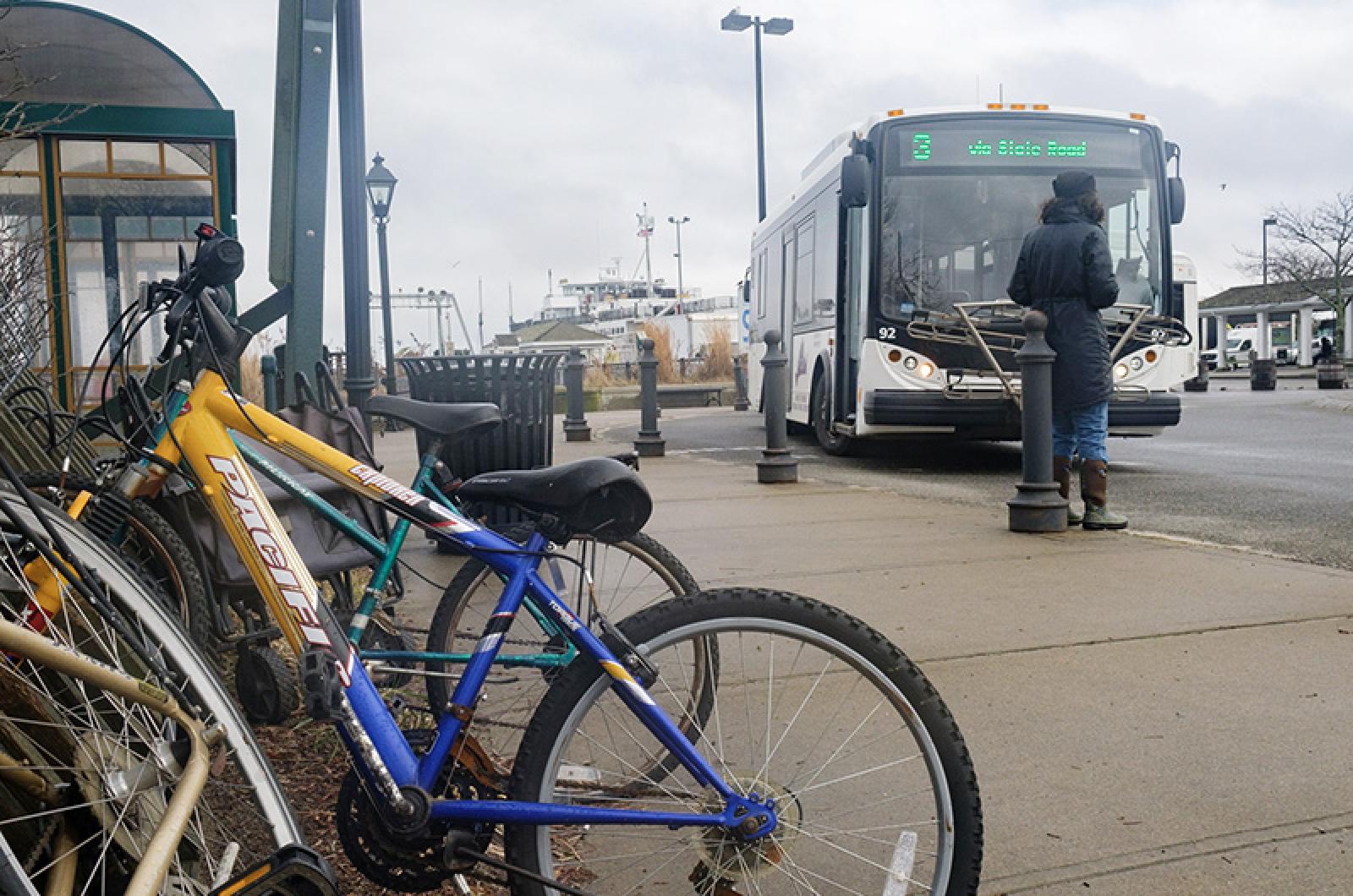
Ridership has declined sharply on Vineyard Transit Authority (VTA) buses this year, as the pandemic’s impact on public transit authorities nationwide trickles down to the Island.
Ridership has declined sharply on Vineyard Transit Authority (VTA) buses this year, as the pandemic’s impact on public transit authorities nationwide trickles down to the Island, forcing sharp cutbacks on routes amid falling revenues.
The VTA annual report shows that 894,055 people rode Island buses in fiscal year 2020, compared with more than 1.3 million the previous year, a nearly 32 per cent decrease. Declines in the VTA’s on-demand service for people with disabilities also saw a 35 per cent decrease.
The declines in revenue and ridership are unprecedented for the state-funded bus transit agency, which normally sees dramatic seasonal fluctuations, according to VTA administrator Angie Gompert. In an interview with the Gazette last week, Ms. Gompert said the pandemic, as well as subtler factors, caused the staggering drop and increased costs, leaving unanswered questions about the future of the transit agency and its funding.
“Ridership has seen a deep, deep decrease from our normal operations,” Ms. Gompert said. “These are numbers we haven’t seen in 15 or 16 years.”
Broken down by month, the decline is striking, Ms. Gompert said.
In March, when the first pandemic lockdown restrictions began, the VTA carried 16,042 riders — a 48 per cent decrease from the same period past year. By April, ridership had dropped by 84 per cent, hitting a record low of 6,971 passengers in a single month. The numbers remained similarly low throughout the summer.
“This was not even close to our standard summer,” Ms. Gompert said, pointing to the effects of a shrunken seasonal workforce and fewer day trippers on Island bus routes.
Revenues followed suit, she said.
In FY20, VTA buses saw a revenue drop of roughly 26 per cent — or $426,460 — from 2019, according to the report. The VTA on-demand shuttle also saw a $12,000 decrease, with farebox revenues 37 per cent lower than the year before. Most of the loss occurred over the summer, when the agency typically brings in two-thirds of its annual revenue from ridership, Ms. Gompert said.
Partially at the behest of the towns, the VTA also reduced its in-season service last spring and summer, curtailing routes and further affecting the bottom line, Ms. Gompert said. According to the report, the agency saw a 26 per cent decrease in the number of vehicle miles covered by buses this year and a 22 per cent decrease in the number of vehicle hours.
“Because we did service modifications that also impacted the ridership and a revenue stream . . . Those numbers are going to be hard to achieve for us for years to come,” she said, noting that transit systems across the commonwealth suffered similar 2020 deficits.
And while fares have remained steady, operating costs have also climbed over the past year, as a confluence of fewer riders and incremental wage increases for bus drivers have driven up the cost to operate each passenger trip by almost 50 per cent, Ms. Gompert said. In 2019, 35.5 per cent of operating costs were covered by fare revenues, while in 2020 the number fell to 25.7 per cent, the annual report shows.
And while Ms. Gompert cited the pandemic as a central factor, the decreases are also part of a broader, three-year trend of reduced ridership at the VTA, which had begun to feel the effects of transportation network companies like Uber and Lyft on the Island transportation market.
“You can really look at our ridership losses prior to the pandemic and look at the TNC data, and you add those two numbers together and that’s what we used to have for ridership,” said Ms. Gompert. “We have a very good transit system here, but with the impacts of the TNCs . . . we have been reducing and trimming.”
Ms. Gompert pointed to a drop in annual ridership of about 200,000 between 2017 and 2019. More changes could follow as the TNC market continues to grow, she said.
Falling ridership could also affect state funding down the line, Ms. Gompert said. Each year the agency receives about $1.6 million in funding from the state, calculated based on the Island’s population size, service area and ridership. Though the impact of the pandemic on the funding is unclear at the moment, keeping ridership up will be important, Ms. Gompert said.
Since the start of the pandemic the VTA has received one installment of $1.4 million in federal CARES Act monies to fill the budgetary gaps, most of which will be exhausted by the end of the fiscal year, Ms. Gompert said. Another installment is set to arrive this spring, but the effects of the deficits will likely long outlast the next budget cycle.
“After the pandemic, I think it’s going to take us a while to rebound,” she said. “We used the CARES funding to balance the budget and we’ll be doing that I would say, easily for the next two to three years.”
But as spring approaches, Ms. Gompert said the conversation has quickly turned to solutions, beginning with the launch of the agency’s Love VTA campaign to boost ridership.
In February, the VTA is offering free rides for school kids and families during vacation week. In April free rides will be offered to the Islandwide beach cleanup program in honor of Earth Day. The VTA will also be offering free rides to the hospital for any resident getting vaccinated from now until May 14.
“There’s a lot of things we’re doing to try to stir up ridership and just try to get people back on,” Ms. Gompert said. “Transit is still essential for the economic livelihood of a community . . . We’re trying to remind everybody that we’re here and working hard to do our part.”
Meanwhile, Ms. Gompert said she is expecting a busy summer, and said plans are in place to ramp up bus and van service beginning in April. “I expect us to be significantly busier than we were last year for a longer period of time,” she said of summer rider projections. “We’ll be ready for that.”
But the optimism is measured as concerns abound over the future of a transit system that has been fundamentally altered this year.
“I don’t know what the appetite for transit is, not just in our region but in other regions too,” Ms. Gompert said. “I’m hopeful that we can within five years get back to where we were . . . [but] will we get back to carrying 1.4 million people a year, I’m not sure.”
Comments
The VTA pay-per-ride business
Islander EdgartownThe VTA pay-per-ride business model simply doesn’t work — and can’t.
VTA needs to study going to a free ride business model — all rides are completely free all of the time — with the cost financed through a tourist fee assessment (perhaps part of a hotel tax or SSA surcharge). Many “tourist” towns do this — like Aspen/Vail Colorado — all public transportation is completely free.
Why does that make sense? It encourages the use of public transportation and discourages tourist automobiles clogging the ferry and Island roads. And part of that should be LOWERING parking ferry terminal parking rates so weekend visitors are financially incentivized to leave their cars on the mainland.
This is called a “nudge” — creating economic incentives for socially beneficial conduct (think of 401k accounts where contributions are tax deductible).
The solution to the VTA revenue shortfall isn’t RAISING fares — that will only reduce ridership. The solution is LOWERING (or altogether eliminating) fares and obtaining gap funding from some other related source.
I really like these ideas.
Molly West TisburyI really like these ideas. Anything that leads to fewer cars here is going to improve our quality of life.
Excellent suggestions. The
Duncan, Vineyard HavenExcellent suggestions. The summer traffic is awful, and this would help preserve the island.
Are you talking about rfta in
James OBAre you talking about rfta in apsen? It’s definitely not free
This is such an excellent
Mm VHThis is such an excellent idea. In addition to the benefits listed, improving the nightmare that is parking in season, as well as cutting down on overall pollution would be such a benefit.
Great ideas !! I nominate
Right Whale HooterGreat ideas !! I nominate “islander” to be on the VTA board of directors !
Let’s be clear the Public
Peter Bradford Oak BluffsLet’s be clear the Public transportation is supposed to make up where private businesses cannot. If the VTA is loosing ridership to TNCs and taxis then that is how the free market is supposed to work. The people who drive for the private transportation companies are real people who live in our community who are trying to make a living so they can pay their bills and put food on their tables. If this is the case then the VTA should be reducing their service and budget to their demand, not launching programs to try to get that ridership back. They should reduce service to reduce the burden on taxpayers local, state or federal. This is just a pattern of predatory behavior by a public organization that should not be happening at all and is at the expense of local people. If lower ridership reduces their ability to get federal funding then they don’t need it. We don’t need to perpetuate an inflated bureaucracy at the expense of our private island owned businesses and citizens. The trend of switching to private transportation is nationwide and will continue as it is going to be a long time before many people are comfortable jamming onto a crowded bus, and people are increasing willing to pay a little more for private direct transportation.
Certain valued “public goods”
Islander EdgartownCertain valued “public goods” cannot operate fully in a free market environment — for instance, public school education, and police and fire services. Should we reduce or eliminate public funding for those services as well? We make the judgment that certain benefits to society are large enough that they should be supported through some sort of societal funding. No one can reasonably dispute that having a reliable and efficient transportation system throughout the Island — one that would help reduce congestion and pollution, and promote sustainable transportation infrastructure — is a worthwhile public good.
The economic reality is that if fares go up ridership will go down. It’s an inevitable death spiral. Look at ridership statistics — the proof is there. We shouldn’t be pricing public goods out of the market.
If there is a nationwide trend to private transportation it’s because public transportation is headed in the wrong direction — higher fares and less reliable service. Multiple car trips — 25 or 50 cars replicating the route of a single bus — doesn’t make good sense from any perspective, economic or environmental. The benefit of having fewer cars coming to the Island for short (mostly overnight weekend) visits — where visitors would be financially incentivized to instead use a reliable, low-priced or even free, bus system — is obvious.
The fare to take the bus from
Peter Bradford Oak BluffsThe fare to take the bus from one town to another is $2.50. That is not pricing anyone out of using it. It is literally less than 10% of the taxi or TNC fare. Less than buying a soda. People aren’t deciding not to take the bus because of the fare. People are choosing to bring their cars or using other services because of convenience and time. If you come for the day and use the bus you will spend 1/2 of your time waiting for or riding the bus. It doesn’t really make sense if you are trying to make the most out of your vacation time. People aren’t spending over $100 to bring their cars because the bus fare prices them out, it is less than a gallon of gas. The idea that eliminating the fare will change anyone actions is actually laughable, you can buy a month pass for less than one ride from VH to Edgartown in a taxi or TNC. The price structure has absolutely nothing to do with ridership and they could raise their prices 5x and still be the cheapest transportation option, so no there is not any indication that greater fares equals lower ridership. There are 14 taxi companies, 10 livery companies, at least 50 year round and over 150 seasonal TNC drivers on the island. These are real people, your friends and neighbors. They are trying to make a living. They don’t deserve be to be put out of business or out of a job because you think there are too many cars on the road. The congestion is mostly cause by islanders not tourists as every household has two or three cars. I’m not saying that we should get rid of the VTA, it serves its purpose. But it doesn’t need to and should not be trying to take business from private businesses that are owned and employed by islanders who rely on that income to live. You have a huge bureaucracy subsidized by the state and fed, to keep fares low, and yet people are still choosing to use the free market private businesses, that is how this is supposed to work, it’s called consumer choice. The VTA should make their model fit their demand. If the demand goes up they can add more buses, it’s that simple.
Smaller buses would help to
Bob EdgartownSmaller buses would help to reduce costs. We seem to worry about the environment but having empty large buses run all day does more harm than anything else we are doing here. The VTA chases federal and state handouts which is there real job. They are good at it and costs the taxpayer both coming and going. That is why they want electric buses it is always follow the money. In this case taxpayer money which people think is always full.
Even when times were good,
Up island girl ChilmarkEven when times were good, seeing huge empty buses (sometimes 2 following each other) with few riders made no sense. Polluters, noisy, not in keeping with our beautiful island. Smaller quite buses might make sense. Miss the days of hitchhiking!
The VTA is used for the
Isabella EdgartownThe VTA is used for the seasonal tourist trade. Period. And WE the island residents and homeowners who pay taxes are the ones subsidizing this tourist industry. The few residents who ride these empty buses can be accommodated by VTA-vouchers. It's simple.
Let the tourists use Tour buses run by private companies here on the island.
And the VTA can solicit advertising support for these vouchers from the shops, restaurants, hotels, etc., and make it practically zero costs.
No, it's not simple.
Kenny Oak BluffsNo, it's not simple.
Raise the “weekend turnaround
Islander EdgartownRaise the “weekend turnaround” ferry fare, lower the price of SSA parking for the same time period, and offer free VTA fares for visitors that choose to leave their cars on the mainland (vouchers). I’d bet that visitors would respond in an economically rational way — fewer cars on the Island for short-term visits.
Public transit can supplement taxis — some people just won’t want to ride a bus. That’s their choice — but don’t price public transit so high that those who want to use it won’t because it’s become financially unattractive. A car with a family of 4 costs $10 per town if those occupants take the bus instead. That’s $30 for a bus to get from the VH SSA dock to Edgartown (probably not that different from the taxi fare for the same trip). And back is another $30. That’s $60 out the price of a car on the ferry. That’s without going anywhere else on the Island (again, $10 per town) other than back and forth to Edgartown. By my math putting the car on the ferry is a clearly preferable (economic) choice. After a few outings (e.g., to South Beach, Up Island) over several days putting the car on the ferry is the less expensive option.
Sounds to me that some object to low or no fare buses because it WILL likely produce the intended result — more VTA ridership and fewer cars on Island roads.
Observing a majority of buses
Frank Brunelle Vineyard HavenObserving a majority of buses running empty or near empty for many years now, and I mean a vast majority, it does seem like it is time to find another solution. Can we get a figure on how many miles per gallon each passenger averages by week? It would be very helpful. Is it less than a pickup truck with driver only for example?
Do you have any sense of the
c VHDo you have any sense of the difference in price between a bus fare and a ride service like Uber? Perhaps we do indeed need smaller buses, but low (or free)fares and increase in availability and routes would very much help islanders. Taking that away would ADD a financial burden to many who do use the system. Also, Isabella... the tourists are our lifeblood. Why the hostility? Of course, we do things to encourage their coming here... so we can enjoy the money they bring to our stores, restaurants, charities, etc.
And the new huge electric
Lorraine EdgartownAnd the new huge electric buses that were just obtained? And, the charging station in the middle of the village? Does any of this make any sense at all? What about jitneys. I know many older people who do like to ride the buses as one cannot park in the villages in the summer anyway, and the routes have always been good to service the entire island. Perhaps Islander has a good idea? I just do not like to see those huge, empty buses wheeling around, something elusive is at hand.
I agree, the VTA should be
Jim EdgartownI agree, the VTA should be free...maybe a small tax on hotels and restaurants??
How many commenters have ever
ZephyrHow many commenters have ever used the buses? Before I lived here I visited many times and almost always used the buses to get around the island. In the summer they can be very crowded to the point I've had to stand a few times. The electric buses are the future and make huge sense for the environment and long-term costs. One suggestion would be to have various bus sizes for the off-season. However, there are many working people on the island and students who use the existing fleet year-round to get to work, school, the Y, and shopping. I don't think I ever go by the bus stop near Stop & Shop and there aren't people there with full grocery bags. The point is the VTA is a vital island service. I've never taken an Uber or a taxi on the island, but I could see doing so if I arrived on the ferry with a large load of luggage. There are obviously needs for both types of service.
Started using Uber in 2017 on
Mark EdgartownStarted using Uber in 2017 on MV and will never go back, on-call and reliable service at competitive rates. Can't beat that and you are supporting incomes for drivers.
To Zephyr: I have purchased
Lorraine EdgartownTo Zephyr: I have purchased annual passage books. I support the VTA, it is a good service. Do I use other forms of transportation? Yes, I do. I vividly recall when I had an early flight and the taxi did not show up. Not an unusual occurrence, off season. I trundled my reticule down the street and caught the early bus to the ferry. I heartily approve of public transportation but let us organize it in a sensible manner. I have seen months and months of near empty huge buses. That makes NO sense. Color me skeptical of this push to hugeness.
Add new comment